
The Origin and Evolution of the Earth | CBSE Class 11 Geography Notes
On this page
Watch & explore
Start with a few high-quality watches, then dive into the notes below.

This note covers early theories of the earth’s origin, the expanding universe, the Big Bang, the formation of stars and planets, the evolution of the lithosphere, atmosphere and hydrosphere, and the origin of life.
How did early theories explain the origin of the earth?
What did the nebular hypothesis propose?
Different philosophers and scientists offered many hypotheses about the earth’s origin. One earlier and popular argument came from the German philosopher Immanuel Kant. The mathematician Laplace revised this argument in 1796. It became known as the Nebular Hypothesis.
This hypothesis considered that planets formed from a cloud of material associated with a youthful sun. The sun was slowly rotating. The explanation therefore connected the origin of planets with material around the sun, rather than treating the earth’s formation as an isolated event.
How was the explanation revised?
In 1950, Otto Schmidt in Russia and Carl Weizascar in Germany somewhat revised the nebular hypothesis, though differing in details. They considered the sun to be surrounded by a solar nebula containing mostly hydrogen and helium, together with what may be termed dust.
Friction and collisions between particles led to a disc-shaped cloud. Planets then formed through accretion. The important sequence in this explanation runs from surrounding material to a disc-shaped cloud and then to planets formed by the gathering together of material.
| Development | Date | Central explanation |
|---|---|---|
| Laplace’s revision of Kant’s argument | 1796 | Planets formed from a cloud associated with a youthful, slowly rotating sun. |
| Schmidt and Weizascar’s revision | 1950 | A solar nebula, mostly hydrogen and helium with dust, formed a disc-shaped cloud; planets developed through accretion. |
Later, scientists took up the problem of the origin of the universe, rather than that of just the earth or the planets. This widened the question: explanations now had to address the universe within which galaxies, stars and planets developed.
What does an expanding universe mean?
What happens to the space between galaxies?
The Big Bang Theory is the most popular argument concerning the universe’s origin. It is also called the expanding universe hypothesis. Edwin Hubble, in 1920, provided evidence that the universe is expanding. As time passes, galaxies move further and further apart.
Expansion means an increase in the space between galaxies. Scientists believe that although this space is increasing, observations do not support the expansion of galaxies themselves. The separation of galaxies and the size of individual galaxies must therefore be kept distinct.
What does the balloon example show?
Mark points on a balloon to represent galaxies, then inflate it. As the balloon expands, the marked points appear to move away from one another. This provides a way to visualise increasing distances between galaxies, which is the central idea of an expanding universe.
The example has a limitation. The points drawn on the balloon also expand as the balloon grows. This part does not agree with the observations of galaxies. The balloon example is therefore only partially correct; it illustrates increasing separation but also produces an unsupported change in the points.
Note: An expanding universe means increasing space between galaxies. Observations do not support the expansion of galaxies themselves, even though the points on an inflated balloon become larger.
How did the steady-state concept differ?
Hoyle’s steady-state concept offered an alternative. It considered the universe roughly the same at any point of time. With greater evidence becoming available about expansion, the scientific community at present favours the expanding universe argument. The difference concerns whether the universe changes through expansion or remains roughly the same over time.
What stages does the Big Bang Theory describe?
How did the initial expansion occur?
The Big Bang Theory begins with all matter forming the universe concentrated in one place. This was a “tiny ball”, or singular atom, with an unimaginably small volume, infinite temperature and infinite density. The theory then describes expansion and the development of matter.
- Initially, all matter existed together in the tiny ball. Its extremely small volume was associated with infinite temperature and density.
- The tiny ball exploded violently, producing a huge expansion. It is now generally accepted that the Big Bang took place 13.7 billion years before the present.
- Expansion was particularly rapid within fractions of a second after the event. As the universe grew, some energy was converted into matter; thereafter, expansion slowed down.
- Within the first three minutes from the Big Bang event, the first atom began to form.
- Within 300,000 years from the Big Bang, the temperature dropped to 4,500 K (Kelvin), giving rise to atomic matter. The universe became transparent.
How does the figure represent expansion?
What the figure shows
The Big Bang
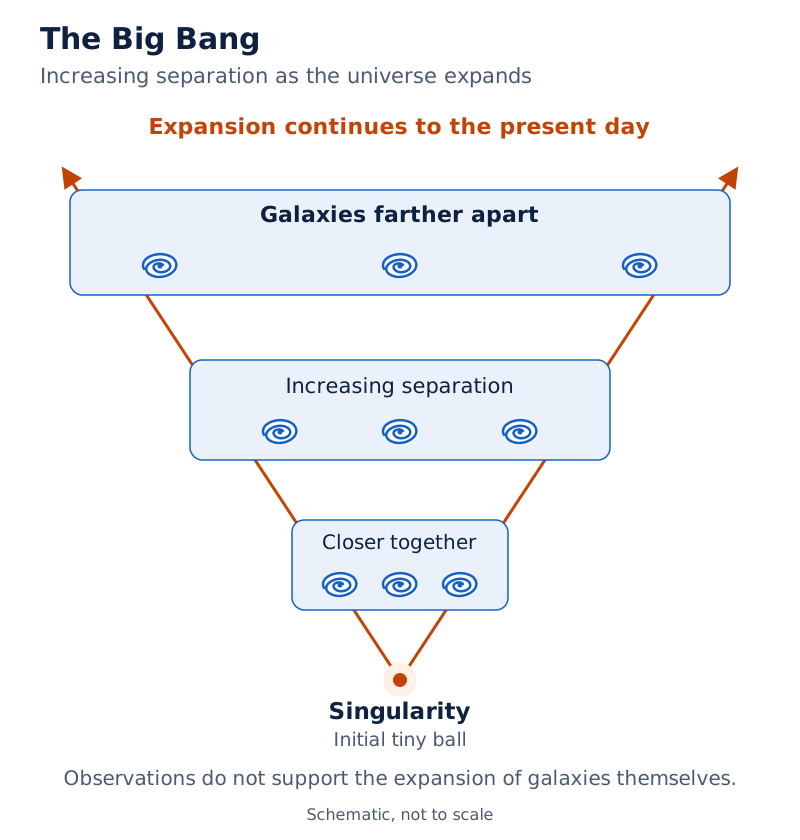
A narrow lower point labelled “Singularity” opens upward between sloping lines. Successively wider panels contain spiral shapes representing galaxies. The widening arrangement depicts expansion from the narrow beginning.
Drawn by One Young India. See Fig. 2.1 in your NCERT textbook
The expansion continues even to the present day. The particularly rapid initial expansion, the subsequent slowing, the formation of the first atom and the appearance of atomic matter belong to the sequence described by this theory.
The time markers refer to different stages. The age of the Big Bang is expressed as time before the present; the first three minutes and the interval of 300,000 years are measured from the Big Bang event. They should not be confused with the age of the earth.
How did galaxies and stars form?
Why did matter begin to gather?
Matter and energy were not distributed evenly in the early universe. These initial density differences produced differences in gravitational forces. Matter was drawn together, providing the basis for the development of galaxies. Uneven distribution and gravitational attraction are therefore linked in this account.
A galaxy contains a large number of stars and extends across vast distances. The diameters of individual galaxies range from 80,000 to 150,000 light years. Such distances are measured in thousands of light years, rather than by treating a light year as a unit of time.
How does a nebula give rise to stars?
- Hydrogen gas accumulates in a very large cloud called a nebula, beginning the formation of a galaxy.
- The growing nebula eventually develops localised clumps of gas within it.
- These clumps continue to grow and become even denser gaseous bodies.
- The denser gaseous bodies give rise to stars. The formation of stars is believed to have taken place some 5 to 6 billion years ago.
This sequence links a large gas cloud to smaller, denser concentrations within it. The nebula is the cloud, whereas the growing localised clumps develop into stars. A galaxy contains many stars, so the terms galaxy, nebula and star do not name the same thing.
Definition: A light year is the distance travelled by light in one year. Light travels at 300,000 km/second, and one light year equals 9.461 × 10¹² km.
The word “year” identifies the travel interval used to define the distance. It does not make a light year a measure of time. The mean distance between the sun and the earth is 149,598,000 km.
How did planetesimals develop into planets?
What formed around the gas core?
The formation of planets is described through successive stages involving gas, dust and smaller bodies. Stars are localised lumps of gas within a nebula. Gravitational force within these lumps leads to the formation of a core in the gas cloud.
A huge rotating disc of gas and dust develops around the gas core. The core and the surrounding disc are different parts of this stage: the core forms within the cloud, while the disc contains material around it from which smaller objects develop.
How did smaller objects combine?
- Gravitational force within localised gas lumps forms a core, with a huge rotating disc of gas and dust around it.
- The gas cloud begins to condense. Matter around the core develops into small, rounded objects.
- Through cohesion, these objects develop into planetesimals. Larger bodies start forming through collisions, while gravitational attraction causes material to stick together.
- In the final stage, the large number of small planetesimals accrete to form fewer large bodies, the planets.
Definition: Planetesimals are the large number of smaller bodies that accrete in the final stage of planet formation to produce fewer large bodies called planets.
The key change is from many smaller bodies to fewer larger bodies. Condensation produces small rounded objects; cohesion, collisions and gravitational attraction allow material to gather. Accretion then connects the planetesimal stage with the formation of planets.
The sequence should therefore retain both the initial gas-and-dust stage and the later planetesimal stage. Stating that planets came from a nebula leaves out the intervening development of a core, a rotating disc, condensed objects and the smaller bodies that combined.
How did the early earth acquire a layered structure?
What was the earth initially like?
The earth initially was a barren, rocky and hot object, with a thin atmosphere of hydrogen and helium. Its present water and atmosphere developed through later changes. The period between 4,600 million years ago and the present includes the evolution of conditions favouring life.
The earth has a layered structure. Material is not uniform from the outermost atmosphere to the centre. Atmospheric matter has the least density, while the interior contains different zones with materials of different characteristics. These differences developed as the early earth changed.
How did differentiation form the layers?
- During its primordial stage, the earth was mostly in a volatile state. A gradual increase in density raised the temperature inside it.
- Material began separating according to density. Heavier materials, like iron, sank towards the centre, while lighter materials moved towards the surface.
- With time, the earth cooled further, solidified and condensed into a smaller size. This later produced an outer surface in the form of a crust.
- During the moon’s formation, the giant impact heated the earth further. Differentiation separated the earth-forming material into different layers.
Definition: Differentiation is the process through which earth-forming material separated into different layers, with heavier material moving towards the centre and lighter material towards the surface.
From the surface towards the centre, the layers are the crust, mantle, outer core and inner core. The density of material increases from the crust to the core. Both the order of these layers and the direction of increasing density are essential to understanding the resulting structure.
Cooling helped the outer surface develop as a crust, while density-related separation explains the arrangement of material within the earth. These processes describe how an initially hot body acquired distinct internal zones rather than a uniform composition throughout.
How did the atmosphere evolve?
What were the three main stages?
The present atmosphere is chiefly composed of nitrogen and oxygen. Its evolution involved the loss of the primordial atmosphere, contributions from the hot interior of the earth, and modification by the living world through photosynthesis. These stages describe changes in both the source and composition of atmospheric gases.
The early atmosphere of hydrogen and helium is supposed to have been stripped off by solar winds. This was not limited to the earth: all terrestrial planets were supposed to have lost their primordial atmosphere through the impact of solar winds.
How did degassing contribute?
As the earth cooled, gases and water vapour escaped from the interior solid earth. This release began the evolution of the present atmosphere. The process by which gases were outpoured from the interior is called degassing.
The early atmosphere formed during this development largely contained water vapour, nitrogen, carbon dioxide, methane and ammonia, with very little free oxygen. Continuous volcanic eruptions contributed water vapour and gases. This composition differed from both the primordial hydrogen-helium atmosphere and the present nitrogen-oxygen atmosphere.
| Atmospheric stage | Main process | Composition or contribution |
|---|---|---|
| Loss of primordial atmosphere | Supposed stripping by solar winds | The early hydrogen and helium atmosphere was lost. |
| Contribution from the hot interior | Degassing and continuous volcanic eruptions | Water vapour, nitrogen, carbon dioxide, methane and ammonia, with very little free oxygen. |
| Modification by the living world | Photosynthesis | Oxygen first accumulated in oceans and later began to flood the atmosphere. |
The phrase very little free oxygen matters: it does not mean abundant oxygen in the early atmosphere. The later contribution of living organisms through photosynthesis belongs to a separate stage, after the atmosphere had begun developing through gases released from the earth’s interior.
How did cooling lead to the formation of oceans?
How were cooling, condensation and rain connected?
The development of the hydrosphere was closely connected with changes in the atmosphere. Water vapour released from the earth’s interior entered the atmosphere. As the earth cooled, this water vapour began to condense, making rainfall part of the sequence of ocean formation.
- Cooling of the earth caused the released water vapour to begin condensing.
- Carbon dioxide in the atmosphere dissolved in rainwater, and the temperature decreased further.
- The further temperature decrease caused more condensation and more rain.
- Rainwater falling on the earth’s surface collected in depressions and gave rise to oceans.
This sequence joins processes occurring in the atmosphere with the collection of water at the surface. Condensation and rain supplied the water, while depressions provided places where it accumulated. The oceans therefore developed as part of the wider cooling and atmospheric changes of the early earth.
When did oceans develop?
The earth’s oceans formed within 500 million years from the formation of the earth. They are as old as 4,000 million years. The first expression gives the interval after the earth formed; the second expresses the age of the oceans.
The primordial earth had been barren, rocky and hot, with a thin hydrogen-helium atmosphere. Later release of water vapour, cooling, condensation and accumulation of rainwater changed this condition. Water at the surface was therefore connected to a sequence of physical changes in the earth and its atmosphere.
Life remained confined to the oceans for a long time. Oceans subsequently received oxygen produced through photosynthesis. Their role thus extended from the collection of rainwater during cooling to the environment in which life and the later accumulation of oxygen developed.
How did life modify the atmosphere through photosynthesis?
When did life and photosynthesis develop?
Sometime around 3,800 million years ago, life began to evolve. However, the development of photosynthesis is placed around 2,500 to 3,000 million years before the present. The beginning of life and the evolution of photosynthesis are therefore distinct events in this account.
Life was confined to oceans for a long time. Photosynthesis began contributing oxygen to ocean water. Eventually, the oceans became saturated with oxygen, and 2,000 million years ago oxygen began to flood the atmosphere. The contribution to oceans preceded this atmospheric change.
How do the main time markers fit together?
| Event | Time marker | Meaning |
|---|---|---|
| Earth’s evolution | 4,600 million years to the present | The interval over which the early earth changed and life evolved. |
| Ocean formation | Within 500 million years from the earth’s formation | Rainwater collected in surface depressions to form oceans. |
| Age of oceans | As old as 4,000 million years | The oceans preceded the later development of photosynthesis. |
| Life began to evolve | Sometime around 3,800 million years ago | The early development of life, long confined to oceans. |
| Photosynthesis evolved | Around 2,500 to 3,000 million years before the present | Oceans began receiving oxygen through photosynthesis. |
| Oxygen began to flood the atmosphere | 2,000 million years ago | This followed the eventual saturation of oceans with oxygen. |
The living world modified an atmosphere that had already undergone earlier changes. Solar winds were associated with the supposed loss of the primordial atmosphere, and gases from the interior helped develop a later atmosphere. Photosynthesis then changed its composition through the contribution of oxygen.
Keeping the sequence intact avoids placing an oxygen-rich atmosphere at the earth’s beginning. The early atmosphere largely contained other gases and very little free oxygen; the later rise of atmospheric oxygen followed biological activity in the oceans.
How is the origin of life explained?
What role did chemical reactions play?
The origin and evolution of life form the last phase in the evolution of the earth. Initially, neither the earth nor its atmosphere was conducive to the development of life. Conditions changed from those of the early hot and barren earth.
Modern scientists describe the origin of life as a kind of chemical reaction. These reactions first generated complex organic molecules and assembled them. The assemblage could duplicate itself, converting inanimate matter into living substance. The ability to duplicate is central to this explanation.
The sequence connects the formation of complex organic molecules, their assembly and the capacity of that assemblage to reproduce itself. It describes the appearance of living substance from inanimate matter rather than assuming that the earth’s earliest conditions already supported life.
What evidence is preserved in rocks?
The record of life in different periods is preserved in rocks as fossils. Microscopic structures closely related to the present form of blue algae have been found in geological formations much older than some 3,000 million years. These structures provide evidence concerning early life.
It can be assumed that life began to evolve sometime 3,800 million years ago. The microscopic structures provide fossil evidence of early life and are closely related to the present form of blue algae.
Note: Fossils preserve a record of life from different periods. The early microscopic structures are closely related to the present form of blue algae; it can be assumed that life began to evolve sometime 3,800 million years ago.
The earth’s evolution thus includes changes in its layered structure, atmosphere, oceans and living world. The origin of life belongs within this longer history of change from an initially hot, rocky and barren planet.
Glossary
- Nebular Hypothesis — An explanation in which planets formed from a cloud of material associated with a youthful, slowly rotating sun.
- Accretion — The gathering together of smaller bodies, as when planetesimals combine to form fewer large bodies called planets.
- Big Bang Theory — The expanding universe explanation beginning with matter concentrated in a tiny ball that exploded and expanded.
- Expanding universe — A universe in which the space between galaxies increases as they move further apart.
- Steady-state concept — Hoyle’s alternative concept that considered the universe roughly the same at any point of time.
- Galaxy — A system containing a large number of stars and extending across vast distances measured in thousands of light years.
- Nebula — A very large cloud of hydrogen gas whose accumulation begins the formation of a galaxy.
- Light year — The distance light travels in one year, equal to 9.461 × 10¹² km.
- Planetesimals — Smaller bodies formed through cohesion that accrete to produce fewer, larger bodies in the form of planets.
- Differentiation — The separation of earth-forming material into layers, with heavier materials sinking and lighter materials moving towards the surface.
- Degassing — The process through which gases were outpoured from the earth’s interior during the evolution of its atmosphere.
- Fossils — The record of life that existed during different periods, preserved in rocks on the earth.
Common errors and misconceptions
- Misconception: A light year measures time. Correct: It measures the distance travelled by light in one year, equal to 9.461 × 10¹² km.
- Misconception: Expansion means that individual galaxies expand. Correct: Space between galaxies increases. Observations do not support the expansion of galaxies themselves.
- Misconception: The balloon example is completely accurate. Correct: It is only partially correct because the marked points expand as well as moving apart.
- Misconception: The earth and the universe have the same age. Correct: The Big Bang is generally accepted to have occurred 13.7 billion years before the present; the earth’s evolution extends from 4,600 million years ago.
- Misconception: Differentiation moved heavier materials towards the surface. Correct: Heavier materials, like iron, sank towards the centre, while lighter materials moved towards the surface.
- Misconception: The early atmosphere already had abundant free oxygen. Correct: The atmosphere developing through release of interior gases had very little free oxygen; photosynthesis later modified its composition.
- Misconception: Oxygen began accumulating in the atmosphere before it entered oceans. Correct: Photosynthesis contributed oxygen to oceans first. After their eventual saturation, oxygen began flooding the atmosphere 2,000 million years ago.
Exam-style questions with model answers
Q1. What is differentiation, and which materials moved towards the earth’s centre? [2 marks]
- Differentiation is the process through which earth-forming material separated into different layers according to density.
- Heavier materials, like iron, sank towards the centre, while lighter materials moved towards the surface.
Q2. Explain why the balloon example is only partially correct as an illustration of the expanding universe. [3 marks]
- Points marked on a balloon represent galaxies. When the balloon is inflated, the points move further apart, illustrating increasing distances between galaxies.
- However, the points themselves also expand as the balloon grows. This does not agree with the observations of galaxies.
- Scientists believe that space between galaxies is increasing, but observations do not support the expansion of galaxies themselves. The example correctly illustrates increasing separation, but the expansion of the marked points does not match observations of galaxies themselves.
Q3. Describe the stages of development considered by the Big Bang Theory. [5 marks]
- All matter forming the universe initially existed together as a tiny ball, or singular atom, with an unimaginably small volume, infinite temperature and infinite density.
- The ball exploded violently, causing huge expansion. It is now generally accepted that the Big Bang took place 13.7 billion years before the present.
- Expansion was particularly rapid within fractions of a second. As the universe grew, some energy became matter. Thereafter, expansion slowed down, although it continues even to the present day.
- Within the first three minutes from the Big Bang event, the first atom began to form.
- Within 300,000 years, the temperature dropped to 4,500 K, giving rise to atomic matter. The universe became transparent.
Q4. Explain how planetesimals developed into planets. [3 marks]
- Gravitational force within localised gas lumps formed a core, surrounded by a huge rotating disc of gas and dust.
- As the cloud condensed, matter around the core developed into small rounded objects. Cohesion formed planetesimals, while collisions and gravitational attraction helped bodies grow and material stick together.
- Finally, the large number of small planetesimals accreted to form fewer large bodies called planets.
Q5. Explain the three stages in the evolution of the atmosphere. [5 marks]
- The first stage was the loss of the primordial atmosphere. The early hydrogen-helium atmosphere is supposed to have been stripped off by solar winds, as in the other terrestrial planets.
- The second stage involved contributions from the hot interior. During cooling, gases and water vapour escaped through degassing, while continuous volcanic eruptions supplied further water vapour and gases.
- This developing atmosphere largely contained water vapour, nitrogen, carbon dioxide, methane and ammonia, with very little free oxygen.
- In the final stage, living organisms modified the atmosphere through photosynthesis.
- Oxygen first accumulated in oceans; after their eventual saturation, it began to flood the atmosphere 2,000 million years ago.
Q6. Describe how the oceans formed during the cooling of the earth. [4 marks]
- Water vapour released from the earth’s interior began condensing as the earth cooled.
- Atmospheric carbon dioxide dissolved in rainwater.
- Temperature decreased further, causing more condensation and more rain.
- Rainwater collected in depressions on the surface, forming oceans. The oceans developed within 500 million years from the formation of the earth and are as old as 4,000 million years.
Q7. Explain the chemical account of life’s origin and the evidence preserved in rocks. [4 marks]
- Modern scientists describe life’s origin as a kind of chemical reaction that generated and assembled complex organic molecules.
- These assemblages could duplicate themselves, converting inanimate matter into living substance.
- Fossils in rocks record life from different periods.
- Microscopic structures closely related to the present form of blue algae occur in formations much older than some 3,000 million years.
- It can be assumed that life began to evolve sometime 3,800 million years ago.
Key takeaways
- The nebular hypothesis connected planet formation with material around a youthful sun; later explanations widened attention to the origin of the universe.
- The expanding universe means increasing space between galaxies, while observations do not support the expansion of individual galaxies themselves.
- The Big Bang is now generally accepted to have taken place 13.7 billion years before the present, and expansion continues.
- Uneven matter distribution produced gravitational differences; growing gas clumps within nebulae became denser bodies that gave rise to stars.
- Planet formation involved a gas core, a rotating disc, smaller rounded objects and planetesimals that accreted into fewer larger bodies.
- Differentiation separated the earth’s material by density, with heavier materials sinking and lighter materials moving towards the surface.
- The atmosphere evolved through primordial loss, contributions from the hot interior and later modification by living organisms through photosynthesis.
- Cooling, condensation and rainfall formed oceans; oxygen from photosynthesis accumulated there before eventually flooding the atmosphere.
- It can be assumed that life began evolving sometime 3,800 million years ago; fossils preserve evidence of life from different periods.
Test yourself
Who revised Kant’s early argument in 1796?
The mathematician Laplace revised Kant’s argument in 1796; it is known as the Nebular Hypothesis.
What did Edwin Hubble provide evidence for in 1920?
Hubble provided evidence that the universe is expanding, with galaxies moving further and further apart.
What occurred within 300,000 years from the Big Bang?
The temperature dropped to 4,500 K, atomic matter developed, and the universe became transparent.
Why is a light year a distance rather than a time?
It measures how far light travels in one year, equal to 9.461 × 10¹² km.
What is the order of the earth’s layers from its surface towards its centre?
The order is crust, mantle, outer core and inner core. Density increases from the crust towards the core.
What gases largely composed the early atmosphere developing from interior releases?
It largely contained water vapour, nitrogen, carbon dioxide, methane and ammonia, with very little free oxygen.
What is degassing?
Degassing is the process through which gases were outpoured from the earth’s interior as its atmosphere evolved.
When did photosynthesis evolve, and when did oxygen begin flooding the atmosphere?
Photosynthesis evolved around 2,500 to 3,000 million years before the present. Oxygen began flooding the atmosphere 2,000 million years ago.
Write about it
Turn a question from this chapter into a paper.
The Writing Studio has a structure guide, a rubric and citation tools for 15 formats, from essays to research papers. Drafting is free with an account. Learnacy Essential adds feedback from an AI writing coach and submission to The OYI Review.
Learnacy Essential is ₹1,499 for the year. Publication depends on review and is not guaranteed.