
Urbanisation | ICSE Class 8 Geography Notes
On this page

This note covers the meaning and causes of urbanisation, rural and urban settlements, migration, urban growth in India, benefits and problems of city life, satellite cities, smart cities, waste management and community action for cleaner settlements.
What is urbanisation, and how is it measured?
Urbanisation is the process through which towns and cities develop and a growing share of people live in urban areas. Urban refers to towns and cities, while rural refers to villages and the countryside.
A human settlement is a group of dwellings where people live. Dwellings are homes. Settlements differ in size, spacing and economic activities, meaning the work people do to earn a living and produce goods or services.
Definition: The level of urbanisation is the percentage of the total population living in urban areas. A percentage expresses a share out of one hundred; the symbol % means per cent.
How does urban population differ from urban share?
Urban population is the number of people living in towns and cities. Urban share compares that number with the total population of the area being studied. These measures answer different questions: how many people live in urban areas, and what share of everyone they represent.
India's urban share in 2011 was 31.16 per cent. This describes the level of urbanisation in that year. It is a historical figure, not a statement about the urban share today.
Enlargement of existing urban centres and the emergence of new towns have played a significant role in India's urbanisation. A settlement's growth also involves changes in its economic activities, technology and social organisation.
Counting houses alone therefore gives an incomplete understanding of urbanisation. We also need to consider the people living there, their work and the services connecting the settlement with other places.
Note: An urban population total and an urban percentage are different measures. Read the heading and the year before interpreting a number.
How do rural and urban settlements differ and depend on each other?
Rural settlements specialise in agriculture and other primary activities, which obtain products directly from nature. Urban settlements specialise in secondary activities, such as manufacturing, and tertiary activities, which provide services such as transport, education and trade.
Manufacturing means processing raw materials into finished goods. A raw material is an input used to make another product. Services meet needs through work such as teaching, transporting goods or providing medical care.
| Feature | Rural settlements | Urban settlements |
|---|---|---|
| Main economic base | Land-based primary activities | Manufacturing and a variety of services |
| Settlement character | Villages may be small and sparsely spaced | Settlements are generally compact and larger |
| Contribution to exchange | Supply food and raw materials | Supply manufactured goods and services |
| Connection with other places | Linked to towns through transport and communication | Linked to villages and other towns through transport and communication |
Why does a city need its surrounding countryside?
A city's hinterland is the surrounding area with which it has economic connections. Cities provide goods and services to rural people in this area and receive food and raw materials in return.
This relationship operates through transport and communication networks. Transport moves people and goods; communication allows information to pass between places. Exchanges sometimes happen directly and sometimes pass through a series of market towns and cities.
The distinction between rural and urban therefore does not mean that they function separately. Their different activities connect them. Food production in villages and services in towns form parts of an interdependent system.
Urban settlements also have varied functions, meaning the activities they perform. A city can combine industry, business, administration and transport. Even a town known for one specialised activity performs several functions, and its functions can change as it grows.
What causes towns and cities to grow?
Migration means movement of people from one place to another. Rural-to-urban migration is movement from villages to towns and cities. It contributes to urban growth, but it is not the sole reason urban populations increase.
How do push and pull factors influence movement?
Push factors make the place people leave seem less attractive. Unemployment and poor living conditions are examples. Low job opportunities in rural areas help explain why people look for work elsewhere.
Pull factors make the destination, or place people move to, seem more attractive. Cities offer employment, educational and medical facilities, transport and communication. These opportunities and the attraction of city life draw migrants.
Industrialisation, the development of industries, creates jobs beyond factories. Industrial areas also attract transport operators, shopkeepers, bank employees, doctors and teachers. This helps explain the connection between manufacturing, services and settlement growth.
- Limited employment or poor living conditions make a rural place less attractive to some residents.
- Urban employment and services make a town or city appear more attractive as a destination.
- People move towards these opportunities, adding to the population at their destination.
- The growing population needs housing and services, which places pressure on urban facilities when provision is inadequate.
What other processes increase urban population?
Natural increase occurs when births exceed deaths. Net in-migration occurs when more people move into a place than move out. Both can increase a city's population.
Reclassification means a change in how a settlement is officially grouped. Sometimes formerly rural settlements become included in urban areas. Their inhabitants then form part of the urban population without each person having to move house.
These processes should be distinguished. Natural increase concerns births and deaths, migration concerns movement, and reclassification concerns the category assigned to a settlement. Urban growth can involve more than one of them.
What do historical figures show about urbanisation in India?
Historical data show how India's urban population and urban share changed over time. The table below selects four years from the urbanisation series for 1901 to 2011. An asterisk (*) identifies provisional figures, meaning figures subject to confirmation. Decennial growth means growth over ten years. In thousands means that each printed population unit represents one thousand people.
| Year | Urban population in thousands | Urban population as % of total population | Decennial growth (%) |
|---|---|---|---|
| 1981 | 1,59,463 | 23.34 | 46.14 |
| 1991 | 2,17,611 | 25.71 | 36.47 |
| 2001 | 2,85,355 | 27.78 | 31.13 |
| 2011* | 3,77,000 | 31.16 | 31.08 |
Here decennial growth refers to growth of the urban population over the preceding decade. Provisional, attached to the 2011 figures, means subject to confirmation. The table separates population totals, urban shares and rates of increase.
How can population rise while its growth rate falls?
The urban population total rises across these selected years. Its share of the total population also rises, from 23.34 per cent in 1981 to 31.16 per cent in 2011. This shows an increasing urban share during this historical interval.
However, the printed decennial growth percentages fall across the rows. A declining growth rate, or rate of increase, does not necessarily mean a declining population. Population can continue to grow while its percentage increase becomes smaller.
Enlargement of existing urban centres and the appearance of new towns help explain this longer process. New administrative centres and industrial centres have also formed part of India's settlement development.
Note: Keep the columns separate. For 2011, 31.16 is the urban share of total population, while 31.08 is the printed decennial growth percentage. They describe different relationships.
The dates matter as much as the values. These figures describe past urbanisation and should not be presented as a current count or a forecast of future city growth.
What benefits can urbanisation bring to people and surrounding areas?
Cities act as centres of economic growth, where production and services develop. Their benefits include employment, access to education and medical facilities, and better transport and communication. These attractions help explain why people move towards urban centres.
How does urban work extend beyond factories?
Industrial development supports factory employment and work in related services. Transport operators move goods and people, shopkeepers sell products, and banks provide financial services. Doctors and teachers meet the health and educational needs of the population.
This variety matters because urban economic activity is not confined to making goods. Manufacturing and services operate together. Some towns become especially associated with administration, education, trade or industry, although each town performs several functions.
| Urban function | Meaning | Example |
|---|---|---|
| Administrative | Supports government headquarters and administration | Chandigarh |
| Industrial | Industries provide a principal basis of activity | Jamshedpur |
| Commercial | Specialises in trade and commerce | Kolkata |
| Educational | Develops as a centre of education | Roorki |
Draw and label
Urban functions in India
On an outline map of India, mark Chandigarh, Jamshedpur, Kolkata and Roorki. Use a key to identify their respective functions: administration, industry, trade and commerce, and education.
These are examples of specialised functions. Each town performs several functions, and these can change as it grows.
How can benefits reach beyond city boundaries?
Urban services and manufactured goods also reach rural settlements. In return, villages supply food and raw materials. Urban growth therefore has connections beyond the people who live within the city itself.
Migrants may support relatives through remittances, meaning money sent home from earnings elsewhere. Such money can help meet household expenses, healthcare and schooling. The case of Ramesh illustrates these uses and the difficulties that can accompany earning away from home.
Opportunities should not be confused with a guarantee that everyone benefits equally. Urban areas contain striking differences in housing and facilities. The presence of jobs and services can attract people even when obtaining secure employment and adequate housing remains difficult.
What does the case study of Ramesh show about migration and city life?
Ramesh's experience connects rural hardship, the attraction of employment and the difficulties of living away from family. His family was heavily in debt, and three brothers and their families had to survive on three acres of land.
He stopped studying after the ninth standard. Poverty and the apparent promise of jobs encouraged him to leave. Other migrants from his village were working in Ludhiana and sending money and goods to their families, which also influenced him.
How did his employment change?
Ramesh first worked in a woollen factory in Ludhiana. He faced a very small income and difficulty adjusting to a new culture and surroundings. With guidance from a friend, he later moved to Surat and learnt welding, the joining of metal pieces.
He then moved with the same contractor, a person who arranges work under a contract, to different places. His work as a welder included a construction site in Talcher, in Odisha's coal region.
What improved, and what remained difficult?
Ramesh sent money to his father in the village. It helped pay for everyday consumption, healthcare and children's schooling. Some money also went towards agriculture, land purchases and house building. His family's standard of living improved significantly.
However, his job was temporary and transferable: it was not permanent and required movement between workplaces. He could not bring his family with him and experienced the pain of separation from those close to him.
The case shows benefits and costs together. New skills and earnings helped his household, while unstable work and repeated movement restricted family life. It does not show that every migrant finds secure work or can move the whole family to a city.
Note: A case study is a close examination of a particular example. Ramesh's experience explains a process; it is not a promise that all migrants will have the same experience.
What problems can accompany rapid urban growth?
Urban areas are generally marked by overcrowding, congestion and inadequate facilities for a rapidly growing population. Congestion means excessive crowding that makes movement difficult. Sanitation means arrangements for hygienic disposal of human waste and wastewater. Inadequate facilities are linked with poor sanitation and polluted air.
Why can housing become a serious difficulty?
High rents and expensive land prevent some migrants from obtaining proper housing. Slums are residential areas with deteriorated housing, poor hygienic conditions and a lack of basic facilities. These facilities include drinking water, lighting and toilets.
Ventilation, the movement of fresh air through a building, is also poor in such housing. Overcrowded narrow streets, inadequate drainage and the absence of safe toilet facilities create health and environmental hazards.
Urban conditions are unequal. Some high-income neighbourhoods have wide roads, streetlights, water supplies, sanitation, parks and playgrounds. Other residents live with serious shortages of these facilities. A city's overall size does not tell us how well everyone lives.
How do different forms of pollution affect urban environments?
Pollution involves harmful changes to the environment through substances or energy released by human activities. A pollutant is a substance or form of energy that causes pollution. Urban environmental problems include pollution of air, water and land, as well as noise.
| Problem | Important sources | Effect or concern |
|---|---|---|
| Air pollution | Burning fuels and industrial activity | Harm to health, including diseases affecting breathing |
| Water pollution | Domestic wastewater, meaning used household water, and industrial waste entering water bodies | Unsafe water and water-borne diseases |
| Land pollution | Improper disposal of untreated waste | Contamination of the land |
| Noise pollution | Traffic, factories and mechanised construction | Unbearable or uncomfortable noise |
Water-borne diseases spread through contaminated water. Diarrhoea is one example. Sewage is wastewater containing household wastes, including human waste. Untreated sewage and industrial waste from cities can create serious health problems farther downstream along rivers.
These problems show why urban planning must consider living conditions and environmental quality alongside the creation of employment. More buildings and economic activity do not, by themselves, ensure adequate facilities for every resident.
How can waste management and local action keep urban areas cleaner?
Solid waste includes discarded materials such as broken glass, plastic containers, polythene bags and pieces of metal. It comes from households as well as industrial and commercial establishments. Waste disposal means the handling and removal of these unwanted materials.
When waste accumulates in streets and open spaces, it creates unpleasant smells and serious health hazards. Flies and rodents act as carriers of disease. Carelessly handled waste can also be scattered by wind and rainwater.
What do the waste figures actually measure?
A metropolitan city is a large city with important economic and service functions. The following estimates illustrate differences in waste collection. They are not dated measurements of present-day performance. The words about and most limit the strength of the claims.
| Places described | Share of solid waste | What the figure measures |
|---|---|---|
| Metropolitan cities such as Mumbai, Kolkata, Chennai and Bengaluru | About 90 per cent | Waste collected and disposed of |
| Most other cities and towns in India | About 30 to 50 per cent | Waste left uncollected |
The rows describe different measures. The first concerns collected waste; the second concerns uncollected waste. They should not be described as two collection percentages, nor should they be used as a current ranking of individual cities.
What the figure shows
Urban waste in Mahim, Mumbai
Photograph: A view of urban waste in Mahim, Mumbai. It shows a narrow space between buildings with scattered waste on the ground and a person among it. It illustrates waste accumulation in a built-up area.
What practical responses address these problems?
Municipal facilities are facilities provided through urban local government. They are involved in waste collection and disposal. Improving waste handling, treating sewage and monitoring industrial wastewater address different sources of urban pollution.
Waste can also be treated as a resource for producing energy and compost, decomposed organic material used to enrich soil. This approach gives useful value to suitable waste materials instead of allowing them to accumulate untreated.
Public awareness is another part of cleaner settlements. People need to avoid adding pollutants to rivers, while industries and public authorities need to address wastewater and waste disposal. Community participation connects local knowledge with the organisations responsible for services.
What are satellite cities, and how do they relate to larger cities?
A satellite city is an urban settlement around a larger city and linked to it. The relationship with a metropolitan city helps describe its place within a wider urban area.
Some old towns have developed as satellite towns around metropolitan cities. Ghaziabad, Rohtak and Gurugram are examples around Delhi. Their development forms part of the changing pattern of urban settlements.
Diagram
Delhi and its satellite towns
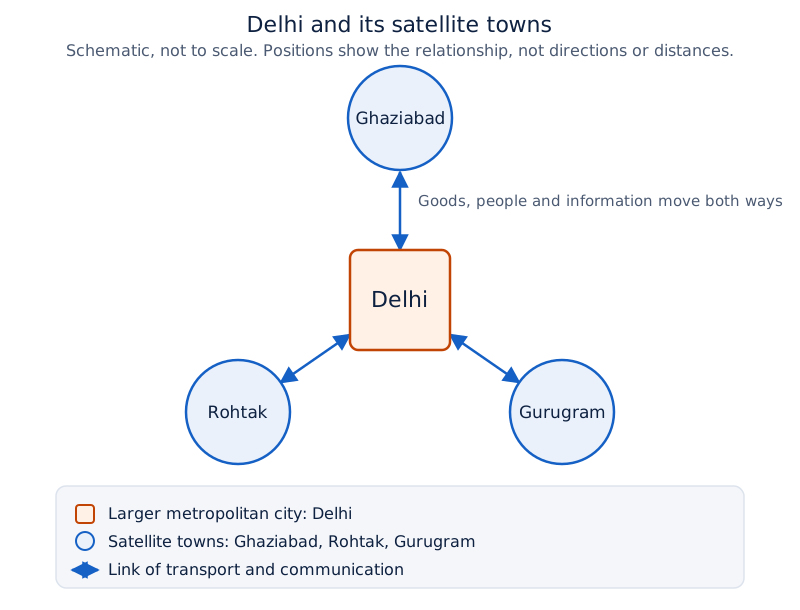
On a map of Delhi and the surrounding area, mark and label Delhi, Ghaziabad, Rohtak and Gurugram. Use one symbol for Delhi and another for the three satellite towns, and explain both symbols in a key.
Ghaziabad, Rohtak and Gurugram illustrate how some old towns developed as satellite towns around a metropolitan city.
Drawn by One Young India.
How is this different from an isolated town?
The word satellite draws attention to the town's relationship with a larger urban centre. Cities are connected with one another, as well as with surrounding rural areas, through the movement of goods, people and information.
A satellite settlement should therefore be studied together with its larger city. Its significance lies in this relationship, not simply in the number of buildings within it. Transport and communication help connect settlements across the wider area.
How do town functions change over time?
Urban functions can develop and become more varied. A place associated with a specialised activity can grow into a centre where industry, trade, administration and transport all matter. These functions can become closely intertwined.
India's urban development has included new administrative headquarters, industrial centres and satellite towns. Increasing investment in rural areas has also supported the growth of medium and small towns. Urbanisation therefore involves a changing network of settlements, as well as the enlargement of individual cities.
Identifying a town as a satellite does not tell us whether every household has adequate water, housing or sanitation. These are separate questions about the quality and distribution of urban facilities.
What makes a city smart, and how can smart planning improve urban life?
A smart city applies smart solutions to improve infrastructure and services. Infrastructure means basic systems and facilities, such as transport, water supply and sanitation, that support everyday life and economic activity. Smart solutions are methods intended to make these systems work better.
The Smart Cities Mission sets out an aim of core infrastructure, a clean and sustainable environment and a decent quality of life. Sustainable development meets present needs while protecting the resources and environmental conditions needed in the future.
What should better solutions achieve?
Smart solutions can make areas less vulnerable to disasters, use fewer resources and provide cheaper services. Vulnerability means susceptibility to harm. Reducing it means making people and places less exposed to damaging consequences.
The aim also includes inclusive development, meaning development that includes different groups of residents in its benefits. The focus is on improving people's lives through better facilities and environmental conditions.
| Planning concern | Smart-city objective |
|---|---|
| Basic needs | Provide core infrastructure and improve services |
| Environmental quality | Support a clean and sustainable environment |
| Resource use | Use fewer resources through better solutions |
| Risk and affordability | Reduce disaster vulnerability and provide cheaper services |
| People's well-being | Promote a decent quality of life through inclusive development |
How does the approach differ from urban growth alone?
A growing urban population describes a change in numbers. Smart-city planning describes an approach to improving how the city functions. Population growth alone does not demonstrate that services have become cleaner, cheaper or more accessible.
The approach looks at compact areas and develops a replicable model, meaning an approach that can be adapted and used elsewhere. Successful improvements are intended to guide other cities seeking to improve their services.
For this reason, a useful comparison between urban centres examines infrastructure, environmental quality, resource use and quality of life. The presence of large buildings alone cannot establish whether these aims have been achieved.
What does the case study of Daurala show about reducing environmental harm?
Daurala, near Meerut, provides an example of community participation in dealing with industrial pollution. The village was affected by industrial wastewater that contaminated its groundwater.
What was the problem, and who became involved?
In 2003, attention focused on serious health and environmental conditions in the village. Untreated industrial wastewater had seeped into the ground and contaminated groundwater, the water stored below the land surface, with harmful metals.
A non-governmental organisation, an organisation outside government, carried out a door-to-door health survey. The community, people's representatives and the organisation discussed solutions. Industrial officials and government officials were also involved in the effort.
The work drew on the principle polluter pays, meaning that those responsible for pollution should bear the costs of addressing it. The example links public participation with industrial responsibility and action by public authorities.
What measures helped the community?
- The capacity of the overhead water tank was increased, and an extra pipeline was laid to provide drinking water.
- The village pond was cleaned by removing accumulated silt, or fine deposited sediment, so that it could hold more water.
- Rainwater-harvesting structures, which collect rainwater for useful storage or replenishment, were built at different places.
- Trees were planted as part of the work to improve the environment.
Cleaning the pond helped water replenish aquifers, underground layers that store and transmit groundwater. Rainwater harvesting helped dilute groundwater contaminants after the monsoons, the seasonal rains. Dilution reduces the concentration of a substance; it does not mean that every contaminant has disappeared.
The example illustrates why public action needs several connected measures. Safe drinking water addresses an immediate need, while pond restoration, rainwater collection and planting address environmental conditions. A health survey also helps identify the problem affecting residents.
The broader lesson for urban and industrial areas is the importance of cooperation. Residents, industries, public authorities and community organisations can contribute different information and resources. Environmental improvement requires practical action alongside awareness of the problem.
Glossary
- Urbanisation — The development of towns and cities and an increasing share of people living in urban areas.
- Human settlement — A group of dwellings of any size where people live and organise their activities.
- Hinterland — The surrounding area connected economically with a town or city through exchanges of goods and services.
- Migration — Movement of people from one place to another, which may be permanent, temporary or seasonal.
- Push factor — A condition that makes a person's place of origin seem less attractive as a place to live.
- Pull factor — A condition that makes a destination seem more attractive than the place a person leaves.
- Natural increase — Population increase that occurs when births exceed deaths in the area under consideration.
- Net in-migration — A situation in which more people move into a place than move out of it.
- Remittances — Money sent home by people earning their income away from their families or home settlements.
- Slum — A residential area characterised by deteriorated housing, poor hygienic conditions and a shortage of basic facilities.
- Solid waste — Discarded solid materials from households, industries and commercial establishments that require collection and appropriate handling.
- Satellite city — An urban settlement around a larger city with which it maintains connections.
- Infrastructure — Basic systems and facilities, including transport, water supply and sanitation, that support a settlement's functioning.
- Smart city — A city applying smart solutions to improve infrastructure, services, environmental conditions and quality of life.
- Aquifer — An underground layer that stores groundwater and allows that water to move through it.
Common errors and misconceptions
- Misconception: Urbanisation means that every village resident moves to a city. Correct: It concerns the development of urban settlements and their population share. Rural and urban settlements continue to exchange goods and services.
- Misconception: Migration is the only way an urban population increases. Correct: Natural increase and sometimes the reclassification of formerly rural settlements also contribute to urban population growth.
- Misconception: A falling population growth rate must mean fewer people. Correct: Population can continue increasing while its percentage growth becomes smaller, as the historical urban data illustrate.
- Misconception: Every city resident has the same access to facilities. Correct: Well-served neighbourhoods and areas lacking adequate housing, water and sanitation can exist within the same urban centre.
- Misconception: Collected waste and uncollected waste are the same measurement. Correct: These describe different parts of waste handling. Read whether a percentage refers to collection or to waste left behind.
- Misconception: A town known for industry performs no other functions. Correct: Each town performs several functions, and these can become more varied and closely connected as it grows.
- Misconception: Large buildings alone make a city smart. Correct: Smart-city aims concern improved infrastructure, services, resource use, environmental quality and people's well-being.
- Misconception: Diluting groundwater pollution removes every contaminant. Correct: Dilution reduces concentration. The Daurala example reports improvement after rainwater harvesting, not the disappearance of every contaminant.
Exam-style questions with model answers
Q1. Urban population is the number living in towns and cities. The level of urbanisation is the percentage of total population living there. India's urban share in 2011 was 31.16 per cent. Using this information, distinguish the two measures and interpret the 2011 figure. [2 marks]
- Urban population is a count of people, whereas the level of urbanisation compares urban residents with the total population as a percentage.
- The figure means that 31.16 per cent of India's total population lived in urban areas in 2011; it is not a current figure.
Q2. Rural settlements provide food and raw materials through land-based primary activities. Urban settlements manufacture goods and provide services. Both exchange products through transport and communication networks. Towns can perform several functions. Using these facts, explain rural-urban interdependence in four points. [4 marks]
- Rural areas supply food to urban residents, connecting village production with the needs of people living in towns and cities.
- They also supply raw materials, which urban manufacturing activities can process into finished goods.
- Urban settlements provide manufactured products and services in return, so their contribution extends beyond the residents within their own boundaries.
- Transport and communication networks support these exchanges, linking rural primary activities with the multiple functions performed in towns.
Q3. Urban population can increase when births exceed deaths, when more people arrive than leave, and when formerly rural settlements are classified as urban. Name and explain these three processes using the information provided. [3 marks]
- Natural increase occurs when births exceed deaths, adding people to the urban population through the balance between these two events.
- Net in-migration occurs when more people move into the urban area than move out, increasing its population through movement.
- Reclassification includes formerly rural settlements within the urban category, so their residents count as urban without necessarily moving home.
Q4. Historical figures give urban population in thousands, urban share and decennial urban population growth respectively: 1981, 1,59,463, 23.34%, 46.14%; 1991, 2,17,611, 25.71%, 36.47%; 2001, 2,85,355, 27.78%, 31.13%; 2011, 3,77,000, 31.16%, 31.08%. Per cent means out of one hundred; decennial means over ten years. The 2011 figures are provisional. State five observations without treating the data as current figures. [5 marks]
- The urban population total increased across all four selected years, from 1,59,463 thousand in 1981 to 3,77,000 thousand in 2011.
- The urban share also increased, from 23.34 per cent of total population in 1981 to 31.16 per cent in 2011.
- The printed decennial urban population growth percentages declined across the selected rows, from 46.14 per cent to 31.08 per cent.
- Increasing totals alongside falling growth percentages show that a population can continue growing while its rate of increase becomes smaller.
- These are historical figures ending in 2011, and the 2011 figures are provisional. They do not establish the present urban population or share.
Q5. Ramesh left a heavily indebted rural family after being attracted by employment in Ludhiana and examples of successful migrants. He later learnt welding in Surat and moved between jobs with a contractor. Money sent home supported daily needs, healthcare, schooling, agriculture and housing. His family's living standard improved, but temporary, transferable work prevented him from bringing them with him. Using only this account, explain two causes, two benefits and one difficulty of his migration. [5 marks]
- Heavy family debt was a push factor because it made conditions at home difficult and encouraged Ramesh to seek earnings elsewhere.
- Employment prospects in Ludhiana and the example of successful migrants acted as pull factors, making urban work appear attractive to him.
- He gained the skill of welding in Surat, which became part of his later employment with a contractor at different places.
- Money sent home supported daily needs, healthcare, schooling, agriculture and housing. These uses contributed to the improved living standard of his family.
- His work remained temporary and transferable, so he could not bring his family with him and had to live apart from them.
Q6. In Daurala, untreated industrial wastewater contaminated groundwater. A health survey and discussions brought residents, an organisation outside government, industries and public officials together. Responses included increasing water-tank capacity and laying a pipeline, cleaning a silted pond, collecting rainwater to replenish groundwater, and planting trees. Describe four responses, using one distinct point for each. [4 marks]
- Increasing water-tank capacity and laying a pipeline improved the arrangements for supplying drinking water to the community affected by contaminated groundwater.
- Cleaning the silted pond removed accumulated sediment, increasing the space available for water and helping groundwater replenishment.
- Collecting rainwater supported the replenishment of groundwater, addressing local water conditions as part of the wider environmental response.
- Planting trees contributed to environmental improvement alongside the measures directed more specifically towards water supply and groundwater.
Q7. Smart-city objectives include core infrastructure, a clean and sustainable environment, decent quality of life and inclusive development. Smart solutions aim to use fewer resources, make services cheaper and reduce vulnerability to disasters. A replicable model can be adapted elsewhere. Explain three aims of this approach using the information given. [3 marks]
- It aims to improve everyday living through core infrastructure and better services, while including different groups of residents in the benefits.
- It aims to protect environmental quality and use fewer resources, linking cleaner surroundings with a sustainable approach to development.
- It aims to make services cheaper and areas less vulnerable to disasters, with successful models available for adaptation in other places.
Key takeaways
- Urbanisation concerns developing towns and cities and their population share; a population count and a percentage measure different things.
- Rural and urban settlements depend on one another through exchanges of food, raw materials, manufactured goods and services.
- Urban population growth can involve natural increase, net in-migration and sometimes the reclassification of formerly rural settlements.
- City jobs and services attract migrants, but Ramesh's experience shows that improved earnings can accompany insecure work and family separation.
- Historical urban figures must retain their years, units and qualifications; a falling growth rate does not necessarily mean population decline.
- Urban growth can accompany housing shortages, inadequate sanitation, accumulated waste and pollution, with unequal access to facilities within cities.
- Satellite towns develop around larger cities, while smart-city planning focuses on improving infrastructure, services, environmental conditions and quality of life.
- Cleaner settlements require practical waste and water management, public awareness and cooperation among residents, industries, community organisations and authorities.
Test yourself
What does the level of urbanisation measure?
It measures the percentage of an area's total population living in urban settlements.
How does a push factor differ from a pull factor?
A push factor makes the place of origin seem less attractive; a pull factor makes the destination seem more attractive.
Why is migration not the complete explanation of urban population growth?
Natural increase also adds people, and reclassification sometimes includes formerly rural settlements within the urban population.
How can a city's population rise while its growth rate falls?
The population can continue increasing, but by a smaller percentage than during an earlier period.
What are remittances, and how did they help Ramesh's family?
Remittances are earnings sent home. Ramesh's money supported daily needs, healthcare, schooling, agriculture, land purchases and house building.
Which satellite towns developed around Delhi?
Ghaziabad, Rohtak and Gurugram are examples of satellite towns that developed around Delhi.
What is the central purpose of smart-city solutions?
They improve infrastructure and services to support a cleaner environment, better resource use and a decent quality of life.
What did the Daurala response combine?
It combined community participation and cooperation with water-supply improvements, pond cleaning, rainwater harvesting and tree planting.
Write about it
Turn a question from this chapter into a paper.
The Writing Studio has a structure guide, a rubric and citation tools for 15 formats, from essays to research papers. Drafting is free with an account. Learnacy Essential adds feedback from an AI writing coach and submission to The OYI Review.
Learnacy Essential is ₹1,499 for the year. Publication depends on review and is not guaranteed.