
Business Communication and Correspondence | ISC Class 12 Business Studies Notes
On this page
Watch & explore
Start with a few high-quality watches, then dive into the notes below.
This note covers the meaning and importance of business communication, its process, methods, types, barriers and remedies, business correspondence, employment and trade letters, report classifications and format, e-mail and video conferencing.
What is business communication and why does it matter?
Definition: Communication is the exchange of ideas, views, facts and feelings between people to create common understanding. Business communication applies this process to the activities and relationships of a business.
Common understanding means that the people involved understand the intended meaning of the message. Merely sending words does not establish that the recipient has understood them. Telling, listening and understanding belong to the same continuing process.
How does communication support management?
- Coordination: Communication connects departments, activities and individuals. Explaining organisational goals, the means of achieving them and relationships between jobs helps people direct their efforts towards common objectives.
- Smooth working: Managers bring human and physical resources together through communication. Organised activity depends on people exchanging the information needed to perform their work.
- Decision making: Relevant information provides the basis for choosing a course of action. Without communication of that information, managers may be unable to make meaningful decisions.
- Managerial efficiency: Managers communicate targets, allocate duties, issue instructions and review performance. Communication therefore supports the performance of managerial functions.
- Cooperation: Two-way communication promotes mutual understanding between management and workers. This supports cooperation and industrial peace, meaning harmonious relations at work.
- Leadership: Leadership means influencing people towards shared objectives. Effective communication helps a leader explain objectives and influence the people working towards them.
- Morale and motivation: Morale is the confidence and spirit of people at work; motivation stimulates people to act towards goals. Communication helps management influence, satisfy and motivate employees.
These contributions are connected but distinct. Explaining how departments depend on each other supports coordination; supplying information for a choice supports decision making. A useful explanation identifies both the managerial need and the way communication meets it.
How does the communication process work?
The sender is the person who initiates communication. The receiver is the person to whom it is directed. The message is the content being conveyed, such as an idea, feeling, suggestion or instruction.
- Encoding: The sender converts the intended message into words, pictures, gestures or other symbols that can convey meaning.
- Channel or medium: The message travels through a path, such as face-to-face conversation, a telephone call or written communication.
- Decoding: The receiver interprets the symbols and gives meaning to the message. Encoding and decoding are related activities performed at different ends of the exchange.
- Feedback: The receiver responds through actions that indicate receipt and understanding. Feedback allows the sender to check how the message has been understood.
Noise means an obstruction to communication. It includes more than sound: ambiguous symbols, a poor telephone connection, inattention, faulty interpretation and prejudices can interfere with understanding. Noise may affect the sender, message or receiver.
What the figure shows
Communication process
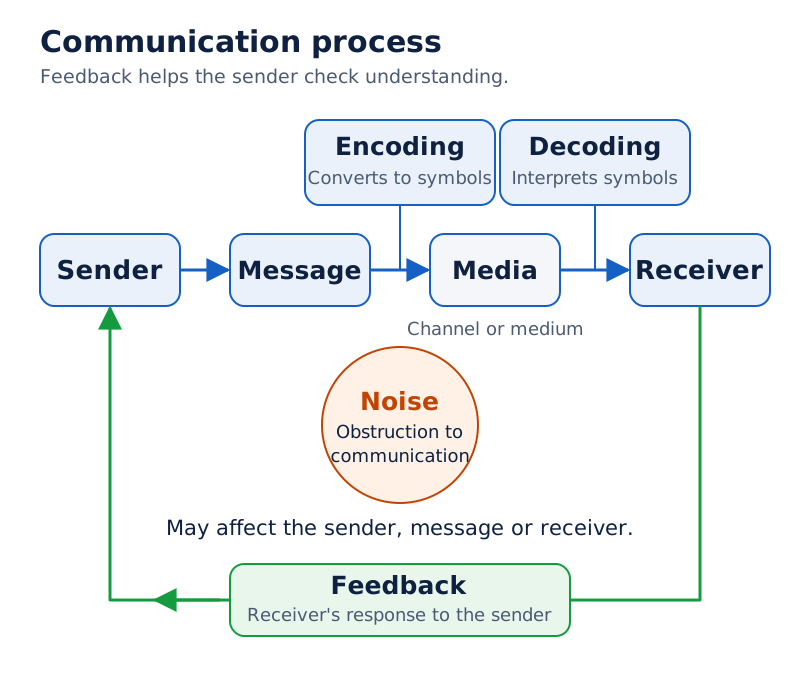
The drawing places Sender, Message, Media and Receiver across the middle. Encoding and Decoding appear above the path. A Feedback route returns from Receiver to Sender below, while Noise appears in a central circle.
Drawn by One Young India.
Why is feedback different from transmission?
Transmission is the sending of the message through its channel. Feedback concerns the receiver's response. The fact that a message has been sent does not by itself show that its intended meaning has been understood.
Asking questions about the message and encouraging a response may help the sender check understanding. Where the response reveals confusion, the communication process may be improved by clarifying the message and responding to the difficulty.
How do oral and written communication differ?
Oral communication conveys meaning through spoken words. Written communication conveys meaning through written words. An official channel is a route established by the organisation; communication following it is formal communication. Neither method, by itself, determines whether the message follows this route.
What are their advantages and disadvantages?
| Basis | Oral communication | Written communication |
|---|---|---|
| Feedback | A conversation permits immediate questions and clarification. | A reply may take time, depending on the means of delivery and response. |
| Record | Spoken words do not by themselves provide a written record. | The message can be retained and consulted later. |
| Preparation | Direct discussion can be arranged quickly, but careless speech can create confusion. | Drafting and checking take time, but allow deliberate organisation of the message. |
| Detail | Lengthy details may be difficult to remember accurately. | Detailed instructions can be read again, provided the writing is clear. |
| Expression | Tone of voice can help convey meaning. | Meaning depends heavily on the choice and arrangement of words. |
Oral communication is useful when discussion and clarification are important. Written communication is useful where precise details and a continuing record are needed. A written message still requires interpretation, and an oral exchange can still be formal.
Information may be lost or become inaccurate when it passes through successive levels. This problem is greater in oral communication. Usually, people cannot retain information for long if they are inattentive or uninterested.
Note: Formal communication may be oral or written, but is generally recorded and filed. Do not confuse the method used with the relationship through which the message travels.
How do gestural and visual communication convey meaning?
Gestural communication conveys meaning through bodily movements, posture and facial expression. Visual communication conveys meaning through visible representations, including pictures, charts and diagrams. The distinction concerns what carries the message: bodily expression or a visual representation.
What are the advantages and limitations?
| Method | Advantages | Limitations |
|---|---|---|
| Gestural | Can communicate without spoken words and reinforce a spoken message. | Gestures can be interpreted differently and may not communicate detailed instructions clearly. |
| Visual | Can present relationships or information in a form that is easy to inspect. | A visual may need explanation; an unclear representation can mislead its audience. |
Body language is communication through bodily expression. Its meaning should agree with the spoken message. Where words and bodily movements do not match, the communication may be wrongly perceived by the receiver.
A visual should have a clear purpose and readable labels. A diagram can organise a process, but the reader still needs to understand what its labels and connections mean. Visible presentation does not remove the need for shared understanding.
Gestural and visual communication can support spoken or written communication. Choosing a method involves considering the message and the receiver's ability to interpret it, rather than assuming that an image or movement explains itself.
How do internal and external communication differ?
Internal communication takes place within an organisation. External communication takes place between the organisation and people or bodies outside it. This classification uses the area of operation of the exchange.
| Basis | Internal | External |
|---|---|---|
| Participants | People or departments within the business. | The business and outside parties. |
| Main purposes | Coordinate work, explain instructions and communicate employee concerns. | Exchange information and maintain relationships with outside parties. |
| Relationships involved | Superiors (people with authority over others), subordinates (people working under that authority) and colleagues. | Customers, suppliers, bankers and government agencies. |
| Boundary | The message remains within the organisation. | The exchange crosses the organisation's boundary. |
What are their advantages and disadvantages?
Internal communication helps people coordinate activities and understand responsibilities. It also provides a route for employee suggestions and concerns. Its effectiveness may suffer when messages pass through too many levels or employees hesitate to speak openly.
External communication helps a business obtain information and maintain relationships beyond its own staff. Clear correspondence supports dealings with suppliers and customers. Misunderstanding or careless wording can damage those relationships and the business's reputation.
The classification does not identify the method. An internal exchange may be spoken or written, and so may an external exchange. First identify who is communicating and whether both participants belong to the same organisation; then consider the method and purpose separately.
How do formal and informal communication differ?
Formal communication follows the official channels established by an organisation. Informal communication takes place without following those formal lines. The informal system is also called the grapevine, because it spreads in different directions without regard to levels of authority.
| Basis | Formal communication | Informal communication |
|---|---|---|
| Route | Official channels designed in the organisation chart. | Personal and social contacts outside prescribed channels. |
| Origin | Organisational work and official relationships. | Employees' need to exchange views beyond formal channels. |
| Record | May be spoken or written, but is generally recorded and filed. | Usually unrecorded and spontaneous. |
| Speed | Prescribed channels may cause delays. | Spreads rapidly. |
| Reliability | Has an identifiable official route, although barriers can affect meaning. | Sometimes becomes distorted; tracing its source is very difficult. |
What benefits and difficulties arise?
Formal communication connects official responsibilities with the flow of instructions and reports. Its identifiable route supports orderly communication. Rigid rules and cumbersome procedures may, however, create hurdles, and a complex structure can delay or distort messages.
Informal communication allows employees to exchange views they cannot express through formal channels. Sometimes grapevine channels may help managers because they carry information rapidly. Managers also use informal channels to learn how subordinates react to information.
Informal communication also generates unauthentic rumours, and informal discussions sometimes may hamper the work environment. Recognising this risk does not justify treating every informal message as false. The practical aim is to use positive aspects and minimise negative ones.
The production manager and marketing manager discussing delivery schedules illustrate communication between departments. Workers discussing a superior's behaviour in a canteen illustrate an informal exchange. The distinction rests on the channel and relationship, not merely the fact that people are talking.
How does communication move upwards, downwards, horizontally and diagonally?
Vertical communication moves between organisational levels. Upward communication flows from subordinate to superior; downward communication flows from superior to subordinate.
Horizontal communication, also called lateral communication, takes place between people or departments at the same organisational level. Diagonal communication crosses both departmental boundaries and organisational levels.
| Direction | Advantages | Disadvantages or limitations |
|---|---|---|
| Upward | Brings progress information, suggestions and employee concerns to management. | Fear or unwillingness to communicate may prevent employees from expressing concerns. |
| Downward | Explains objectives, instructions and responsibilities to employees. | Messages may be delayed or distorted when passing through several levels. |
| Horizontal | Supports coordination between departments and colleagues. | Unwillingness to cooperate can obstruct the exchange of information. |
| Diagonal | Can provide direct contact across departments and levels. | Bypassing usual reporting relationships may create confusion over responsibility. |
How can the directions be distinguished?
An application for leave or a progress report sent to a superior illustrates upward communication. Instructions to complete assigned work and notices directing employees to attend a meeting illustrate downward communication.
A production manager contacting a marketing manager about delivery schedules illustrates horizontal communication. Horizontal communication connects the same level, whereas vertical communication connects different levels. Diagonal communication adds the crossing of departmental boundaries to a difference in level.
Do not classify a message by its subject alone. A report is a document; its direction depends on who sends it and who receives it. Likewise, oral and written describe methods, while horizontal and vertical describe direction.
What barriers obstruct communication and how can they be overcome?
A communication barrier is an obstacle that prevents a message from reaching its destination or being understood as intended. A barrier may filter part of the information or change its perceived meaning.
| Barrier | Meaning |
|---|---|
| Semantic | Difficulty arising from the meaning or interpretation of words, symbols or expressions. |
| Physical and mechanical | Obstruction arising from physical conditions or faults in communication equipment. |
| Organisational | Difficulty associated with organisational structure, authority relationships, rules or procedures. |
| Socio-psychological | Difficulty arising from social relationships, attitudes, emotions, prejudices or differences in perceived status. |
What measures improve understanding?
- Clarify ideas first: Understand and analyse the problem before communicating it. A sender who is unclear about the intended message cannot explain it clearly to another person.
- Consider the receiver: Adjust the message to the receiver's education and level of understanding. Familiar language helps the receiver interpret the intended meaning.
- Consult others: Involve relevant people while planning the communication. Participation may help gain ready acceptance and willing cooperation.
- Check language and tone: Use understandable language and a manner that does not offend the listener's sentiments. Content and delivery both matter.
- Provide useful information: Consider the listener's interests and needs. Relating the message to these helps make the exchange meaningful to the receiver.
- Encourage feedback: Ask questions about the message and encourage a response. Feedback may help improve the communication process.
- Maintain consistency: Communication should meet present commitments and also support the future goals of the enterprise.
- Follow up: Review instructions after communicating them. Follow-up helps remove difficulties that arise while instructions are being implemented.
- Listen attentively: Be patient and show interest in what the other person is saying. Listening is part of communication, rather than a pause before speaking again.
Communication barriers exist in organisations to a greater or lesser degree. Improving communication therefore requires attention to the message, the receiver, the channel and the response. A suitable remedy addresses the particular obstacle instead of merely repeating the original words.
What makes business correspondence clear and complete?
Business correspondence is the exchange of written communications for business purposes. It helps obtain and supply information, place orders, deal with complaints, communicate employment decisions and maintain relationships. A retained letter also provides a record for later reference.
What are the elements of a business letter?
| Element | Content and purpose |
|---|---|
| Sender's address or letterhead | Identifies the sender and provides contact details. A letterhead is the printed heading identifying an organisation. |
| Date and reference | States when the letter is written and, where applicable, identifies related correspondence. |
| Inside address | Gives the recipient's name or designation and address. A designation is the person's official position. |
| Salutation and subject | The salutation greets the recipient; the subject briefly identifies the purpose of the letter. |
| Body | States the purpose, supplies relevant details and explains the response or action requested. |
| Complimentary close and signature | The polite ending is followed by the sender's signature, name and, where relevant, designation. |
| Enclosures | Identifies documents accompanying the letter, where any are supplied. |
A full-block layout aligns the parts of the letter at the left margin and separates paragraphs clearly. It provides a consistent arrangement for the drafting patterns below. Bracketed fields identify information to insert; they are not invented facts.
How should the body be written?
Use clear, accurate and courteous language. Conciseness means expressing the purpose without unnecessary words, while completeness means including the information needed for the recipient to understand and act. A short letter that omits essential details is incomplete.
State the purpose early, organise related details together and end with the required response. Check names, addresses, references and any supplied quantities or terms. Courtesy means respectful expression; it does not require vague language or excessive praise.
For an unnamed recipient, “Dear Sir/Madam” can be paired with “Yours faithfully”. When addressing a named recipient, “Yours sincerely” is a conventional close. Add enclosures only when accompanying documents actually exist.
How should employment letters and biodata be drafted?
A solicited application responds to an advertised vacancy. An unsolicited application approaches an employer without responding to a specific advertised vacancy. Both should identify the work sought and explain the applicant's relevant qualifications accurately.
Biodata is an organised statement of personal, educational and employment information. It supports the application with facts rather than replacing the letter's explanation of suitability. The letter and biodata should agree on qualifications and experience.
What should applications contain?
Use the common letter layout with the applicant's address, date, employer's address, salutation, subject, body, close and signature. For a solicited application, identify the advertisement using the details supplied. An unsolicited application should not claim that an advertisement exists.
Solicited application pattern: Subject: Application for [post]. In response to your advertisement in [publication] dated [date], I wish to apply for [post]. My [qualifications and relevant experience] are suited to the position. I enclose my biodata and request an opportunity for an interview.
Unsolicited application pattern: Subject: Application for employment as [post]. I wish to be considered for a suitable opportunity as [post] in your organisation. My qualifications and experience are [supplied details]. I enclose my biodata for consideration and would welcome an opportunity to discuss my suitability.
Arrange biodata under clear headings: name and contact details, relevant personal particulars, educational qualifications, experience and skills. Where references are requested, provide the supplied details of people who can confirm suitability. Do not claim qualifications, experience or references that have not been provided.
How do interview and appointment letters differ?
An interview letter invites an applicant to attend an interview. It should identify the post, interview date, time and venue, together with documents to bring or confirmation required. An invitation to an interview is not an offer of employment.
Interview letter pattern: Subject: Interview for [post]. With reference to your application, you are invited to an interview on [date] at [time] at [venue]. Please bring [specified documents] and confirm your availability through [supplied contact details].
An offer of appointment communicates an offer of employment and its terms. Identify the post, remuneration, joining date, place of work and other stated conditions. Remuneration means payment for work. Include any stated acceptance requirement without adding conditions of your own.
Appointment letter pattern: Subject: Offer of appointment as [post]. We are pleased to offer you appointment as [post] at [place of work], with remuneration of [supplied terms]. Please join on [date]. The conditions of appointment are [supplied conditions]. Please communicate your acceptance as requested.
What should a resignation letter say?
A resignation letter communicates an employee's intention to leave employment. It should identify the position and state the proposed effective date, taking account of the applicable notice terms. Do not assume a particular notice period.
Resignation letter pattern: Subject: Resignation from [post]. Please accept my resignation from the position of [post], effective from [date], in accordance with [applicable notice terms]. I will cooperate in handing over my responsibilities. Thank you for the opportunities provided during my employment.
How should enquiry, quotation, order and complaint letters be drafted?
Trade correspondence should make the required transaction or action clear. Each letter has a distinct purpose. Asking for information, stating supply terms, placing an order and requesting a remedy should not be treated as interchangeable activities.
How do enquiry and quotation letters differ?
A letter of enquiry asks for information about goods, services or business terms. Identify what is required and request the relevant specifications, prices, availability, delivery arrangements and payment terms. Specifications are details describing the goods or service required.
Enquiry letter pattern: Use the common letter layout. Subject: Enquiry about [goods or service]. Please send details of [required specifications], together with your prices, availability, delivery arrangements and payment terms. Kindly provide the information needed to consider placing an order.
A quotation letter states the price and terms on which a supplier proposes to supply goods or services. Its contents should answer the enquiry accurately. State applicable delivery charges and any supplied discount, meaning a reduction in price. Include a validity period, meaning the period for which the terms remain open, only when supplied.
Quotation letter pattern: Subject: Quotation for [goods or service]. Thank you for your enquiry [reference]. We quote [supplied price] for [description and quantity]. Our delivery and payment terms are [supplied terms]. The quotation is valid until [date, where specified]. Please contact us for any clarification.
The discount and validity period, where provided, are part of the quotation's terms. Neither should be invented to make a letter appear complete. State the supplied terms clearly so that the recipient can understand the offer.
What information makes an order precise?
An order letter requests the supply of specified goods or services on stated terms. Identify the relevant quotation, description, quantity, agreed price, delivery address and delivery and payment terms. These details allow the supplier to understand exactly what is being ordered.
Order letter pattern: Subject: Order for [goods or service]. With reference to your quotation [reference], please supply [description and quantity] at [agreed price]. Delivery is required at [address] according to [agreed delivery terms]. Payment will be made according to [agreed payment terms]. Please acknowledge the order.
Do not replace an exact supplied description with a vague request. Where an order refers to a quotation, its contents should agree with the accepted terms. Check that the recipient can identify both the goods and the arrangement under which they are requested.
How should complaints and replies be expressed?
A complaint letter identifies a problem with a transaction and requests a remedy, meaning action to correct the problem. State the order or other reference, explain the defect or discrepancy precisely, and specify the requested action in courteous language.
Complaint letter pattern: Subject: Complaint concerning [transaction reference]. The [goods or service] supplied under [reference] have the following problem: [supplied facts]. Please arrange [requested remedy]. Relevant supporting documents are enclosed [if supplied]. Kindly inform us of the action proposed.
A reply to a complaint acknowledges the concern and explains the action being taken. An apology and corrective action are appropriate where a fault is established. If verification is needed, explain what information is required without promising an unsupported remedy.
Reply pattern: Subject: Reply to complaint [reference]. Thank you for bringing [problem] to our attention. Our response is [verified explanation]. We will [authorised corrective action], or request [information needed for investigation]. We regret the inconvenience where applicable and will keep you informed.
Complete each pattern with the common address, date, greeting, closing and signature arrangement. Keep the facts supplied for that letter consistent throughout. A complaint should not invent losses, and a reply should not promise compensation that has not been authorised.
How are business reports classified and arranged?
A report is an organised presentation of information about a particular matter for a specified purpose. Depending on its purpose, it may present facts alone or include analysis, conclusions and recommendations. A recommendation is a proposed course of action.
What distinguishes the different types?
| Basis | First type | Contrasting type |
|---|---|---|
| Legal requirement | Statutory report: prepared because a law requires it. | Non-statutory report: prepared for a purpose other than fulfilling a legal reporting requirement. |
| Intended audience | Private report: intended for a restricted person or group. | Public report: intended to be available to the public. |
| Treatment of information | Informational report: presents facts without interpreting them. | Interpretative report: analyses information and draws conclusions; recommendations may be included. |
| Frequency or occasion | Routine or periodic report: prepared regularly as part of continuing work. | Special report: prepared for a particular issue, event or investigation. |
The pairs use different bases of classification. A report's legal status does not determine its audience, and its frequency does not determine whether it analyses facts. Ask which basis is being used before selecting the appropriate category.
What is a useful report format?
- Identification: Give the title, recipient, author and date so that the subject and responsibility for the document are clear.
- Purpose and scope: Explain why the report has been prepared and what matters it covers. Scope means the boundaries of the investigation or discussion.
- Method and findings: State how information was obtained and organise the factual results under suitable headings.
- Conclusion and recommendations: Where appropriate to the report's purpose, explain what follows from the findings and what action is proposed.
- Authentication and supporting material: Include the writer's signature or identification and relevant supporting documents where required.
The arrangement should match the type and purpose of the report. An informational report should not be turned into an interpretative report merely by adding unsupported opinions. Recommendations, when included, should follow from the information and analysis presented.
How are e-mail and video conferencing used in business?
E-mail, or electronic mail, is the sending and receiving of electronic messages over a network. A business can use it to exchange enquiries, instructions, confirmations and documents. An attachment is a file sent with an e-mail message.
What does a clear e-mail contain?
Identify the recipient correctly, use a subject that states the purpose, and organise the body into clear paragraphs. Include relevant attachments and identify the sender. The message should make any requested response or action easy to understand.
E-mail can serve internal or external communication. Sending electronically does not change the need for accuracy, courtesy and completeness. A vague electronic message can create the same misunderstanding as a vague paper letter.
What is video conferencing used for?
Video conferencing enables people in different locations to see and hear one another during a live meeting through connected devices. It is used for discussions, interviews, training and coordination where participants are not physically together.
Unlike an e-mail exchange, a video conference allows participants to discuss matters at the same time. Spoken words and visible expressions contribute to the exchange. Clear sound, a usable connection and attentive listening help participants understand one another.
Choose the means according to the purpose: e-mail supports written exchanges and document sharing, while video conferencing supports live discussion between distant participants. Both remain parts of the wider communication process involving a message, a receiver and a response.
Glossary
- Communication — Exchange of ideas, views, facts or feelings between people to create common understanding.
- Encoding — Conversion of a message into words, pictures, gestures or other symbols that convey meaning.
- Decoding — Interpretation of the sender's symbols by the receiver to understand the message conveyed.
- Feedback — The receiver's response indicating that the message has been received and understood.
- Noise — An obstruction that interferes with the transmission or understanding of a message.
- Formal communication — Communication that follows the official channels established within an organisation's structure.
- Grapevine — Informal communication spreading through an organisation without following prescribed lines of authority.
- Diagonal communication — Communication crossing both departmental boundaries and levels within the organisational structure.
- Business correspondence — Exchange of written communications to conduct business activities and maintain business relationships.
- Biodata — An organised statement of personal details, qualifications, experience and other relevant employment information.
- Quotation letter — A letter stating the price and terms on which a supplier proposes to supply.
- Statutory report — A report prepared to meet a reporting obligation imposed by law.
- Interpretative report — A report that analyses information, draws conclusions and may include recommendations for action.
- Video conferencing — Live communication allowing participants in different locations to see and hear one another.
Common errors and misconceptions
- Misconception: Sending a message proves understanding. Correct: Feedback helps reveal whether the receiver has understood the intended meaning.
- Misconception: Formal communication must be written. Correct: Formal communication may be oral or written; its defining feature is the official channel.
- Misconception: Grapevine information is necessarily false. Correct: It sometimes becomes distorted, but informal channels may also carry useful information rapidly.
- Misconception: Noise means loud sound alone. Correct: It includes obstructions such as faulty interpretation, inattention and a poor connection.
- Misconception: An interview invitation is an appointment. Correct: It invites assessment; an appointment offer communicates employment terms.
- Misconception: A quotation places an order. Correct: A quotation states proposed supply terms; an order requests supply on stated terms.
- Misconception: Every report must recommend action. Correct: Informational reports present facts; interpretative reports analyse them and may recommend action.
- Misconception: Missing letter details can be invented. Correct: Use supplied facts and clearly identified fields when practising a format.
Exam-style questions with model answers
Q1. Define encoding and decoding as elements of communication. [2 marks]
- Encoding is the sender's conversion of a message into words, pictures, gestures or other symbols.
- Decoding is the receiver's interpretation of those symbols to understand the meaning of the message.
Q2. Explain three ways in which communication supports management: coordination, decision making and leadership. [3 marks]
- Communication supports coordination by explaining organisational goals, the means of achieving them and relationships between jobs, connecting the efforts of departments and individuals.
- It supports decision making by supplying relevant information. Without that information, managers may be unable to choose a meaningful course of action.
- It supports leadership by helping a leader explain objectives and influence subordinates towards their achievement. Effective influence requires clear communication and understanding.
Q3. A production manager contacts a marketing manager at the same organisational level to discuss delivery schedules. An employee submits a leave application to a superior. Identify each direction of communication and explain your choice. [4 marks]
- The discussion between the production manager and marketing manager is horizontal communication. This is also called lateral communication.
- It is horizontal because the exchange connects managers at the same organisational level, allowing departments to coordinate delivery arrangements.
- The employee's leave application is upward communication, which forms part of vertical communication within the organisation.
- It is upward because the message travels from a subordinate employee to a superior, rather than from the superior to the employee.
Q4. Explain six measures to improve communication: clarify ideas, consider the receiver, consult others, check language and tone, obtain feedback, and follow up. [6 marks]
- Clarify the intended ideas before communicating. The sender should study and understand the problem so that the message expresses a clear purpose.
- Consider the receiver's education and understanding. Adjust the wording and explanation to make the message understandable to the person receiving it.
- Consult relevant people while planning the communication. Their participation may help secure ready acceptance and willing cooperation when the message is communicated.
- Check language, tone and content. Use understandable words and a manner that respects the listener's sentiments while making the intended meaning clear.
- Encourage feedback by asking questions and inviting a response. The feedback received may help improve the communication process and clarify misunderstandings.
- Follow up instructions through review. This helps identify and remove difficulties encountered while implementing the instructions, rather than assuming that transmission completed the task.
Q5. Distinguish the following pairs of reports on the stated bases: statutory and non-statutory by legal requirement; private and public by audience; informational and interpretative by treatment of information; routine and special by occasion. [4 marks]
- A statutory report fulfils a legal reporting requirement, whereas a non-statutory report is prepared for a purpose other than meeting such a requirement.
- A private report is intended for a restricted person or group, whereas a public report is intended to be available to the public.
- An informational report presents facts without interpretation; an interpretative report analyses information and draws conclusions, and may include recommendations.
- A routine or periodic report is prepared regularly during continuing work; a special report addresses a particular issue, event or investigation.
Q6. Explain five content requirements of an order letter: quotation reference, goods description, quantity and price, delivery arrangements, and payment terms. Do not draft a transaction or invent particulars. [5 marks]
- Identify the relevant quotation using its supplied reference. This connects the order to the supplier's offer and makes the agreed basis of supply clear.
- Describe the goods accurately using the supplied specifications. The supplier should be able to identify what is required without relying on a vague description.
- State the quantity required and the agreed price. These details should be consistent with the terms accepted for the order.
- Give the delivery address and agreed delivery arrangements. The supplier needs to understand where and under what stated conditions delivery is required.
- State the agreed payment terms accurately. Do not add a discount, payment deadline or other financial condition that has not been supplied.
Q7. State the difference between solicited and unsolicited job applications. [2 marks]
- A solicited application responds to an advertised vacancy and should identify the advertisement using the supplied details.
- An unsolicited application approaches an employer without responding to a specific advertised vacancy and requests consideration for suitable work.
Q8. Explain three limitations of informal communication: distortion, difficulty tracing the source, and effects of rumours on the work environment. [3 marks]
- Informal communication spreads rapidly and sometimes becomes distorted. The message reaching an employee may therefore differ from the information originally communicated.
- The source of informal communication is very difficult to detect. This makes establishing where a particular message originated difficult for a manager.
- Rumours and informal discussions affect behaviour and sometimes may hamper the work environment. Managers should minimise these negative effects while recognising the channel's useful aspects.
Key takeaways
- Communication aims at common understanding; sending a message is different from establishing that the receiver understands it.
- Sender, message, encoding, medium, decoding, receiver and feedback form the process, while noise may interfere with communication.
- Classify communication separately by method, area of operation, relationship and direction to avoid confusing different bases.
- Formal communication follows official channels and may be oral or written; informal communication sometimes provides useful information rapidly.
- Clear ideas, suitable language, consultation, attentive listening, feedback and follow-up help managers improve communication effectiveness.
- Business letters need accurate details, a clear purpose, courteous wording and an explicit indication of the response required.
- Employment and trade letters serve different purposes; an interview invitation, appointment offer, quotation and order are distinct communications.
- Report classifications depend on legal requirement, intended audience, treatment of information and frequency or occasion.
Test yourself
What makes feedback useful?
It reveals the receiver's response and helps the sender check whether the intended message has been understood.
Does noise have to be audible?
No. Noise includes obstructions such as inattention, ambiguous symbols, faulty decoding and prejudices, as well as connection problems.
What distinguishes diagonal communication?
It crosses both departmental boundaries and organisational levels, unlike horizontal communication between people at the same level.
Why is a quotation different from an order?
A quotation states proposed prices and supply terms, while an order requests supply of specified goods or services on stated terms.
What is the purpose of biodata?
It supplies organised personal, educational and employment information supporting an applicant's request for consideration.
What makes a report statutory?
Its preparation is required by law, rather than merely by a business's internal information needs.
How does video conferencing differ from e-mail?
Video conferencing supports live audio and visual discussion; e-mail exchanges written electronic messages and can carry attached files.
Should a reply to a complaint promise an unverified remedy?
No. It should explain verified findings, authorised action or the information needed for investigation without inventing a commitment.
Write about it
Turn a question from this chapter into a paper.
The Writing Studio has a structure guide, a rubric and citation tools for 15 formats, from essays to research papers. Drafting is free with an account. Learnacy Essential adds feedback from an AI writing coach and submission to The OYI Review.
Learnacy Essential is ₹1,499 for the year. Publication depends on review and is not guaranteed.