
Elections and the Election Commission of India | ICSE Class 9 History & Civics Notes
On this page
Watch & explore
Start with a few high-quality watches, then dive into the notes below.
Try an idea before you read. Design a 2-step scenario interactive for a study note. Explore →
This note covers the meaning and importance of elections, direct and indirect elections, general elections, mid-term elections and by-elections, election laws, and the composition, independence and functions of the Election Commission of India.
What are elections, and why does a democracy need them?
Definition: An election is the process through which people choose representatives by voting. It enables citizens to exercise their right to vote and fulfil their responsibility in a democracy, a system of government based on rule by the people.
In a large country, all citizens cannot personally make every decision about government. They choose representatives, people authorised through election to act on their behalf. Through these representatives, citizens participate indirectly in governing the country.
What choices and responsibilities do elections create?
Periodic elections, elections held at regular intervals, allow people to choose their representatives again. Representatives remain accountable, meaning answerable to the people for their actions. Voters can support a representative or choose someone else when a fresh election takes place.
Elections also give a government legitimacy, or acceptance of its authority to govern. This depends on people having a meaningful opportunity to express their choice. Merely holding a vote does not establish that an election is democratic.
A political party is an organisation that contests elections and seeks to put its policies into practice. Free and fair elections require genuine choice, impartial administration and the opportunity for eligible citizens to vote. An election loses democratic value if favours influence candidates, votes are counted inaccurately, or people face difficulties reaching and using voting facilities.
What the figure shows
Importance of elections in a democracy
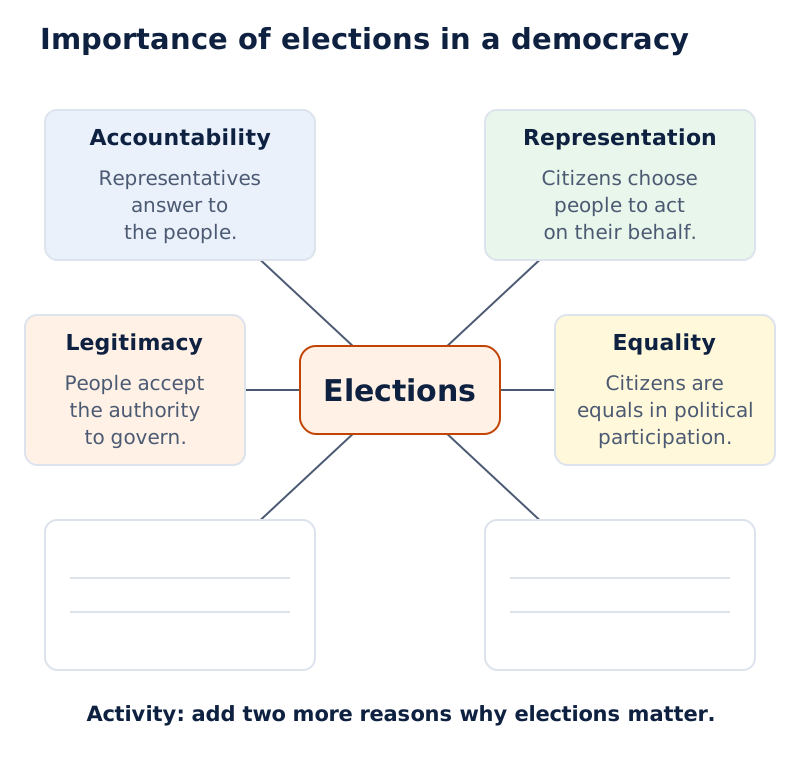
A circular diagram places “Elections” at the centre. Four surrounding segments are labelled Accountability, Representation, Equality and Legitimacy. Two further segments are blank for an activity.
Drawn by One Young India.
Equality means treating citizens as equals in political participation. Elections connect equality with representation: citizens express their choices, representatives act for them, and a later election provides another opportunity to assess their work. Fair procedures make this relationship meaningful.
How do direct and indirect elections differ?
In a direct election, citizens themselves vote to choose their representatives. In an indirect election, citizens choose representatives who then elect the holders of another public office. The distinction concerns who casts the votes in the election being considered.
The Lok Sabha is the directly elected House of the national Parliament, India's national law-making body. A Vidhan Sabha, or Legislative Assembly, is the directly elected law-making House of a State. Elections to these Houses are direct elections.
The President, Vice President and elected members of the Rajya Sabha, the Council of States in Parliament, are chosen through indirect elections. Members of State Legislative Assemblies elect their State's elected representatives in the Rajya Sabha.
| Basis | Direct election | Indirect election |
|---|---|---|
| Who votes? | Citizens vote directly for the representatives concerned. | Representatives chosen by citizens elect the office-holders concerned. |
| Examples | Lok Sabha and Vidhan Sabha elections. | Presidential, Vice-Presidential and Rajya Sabha elections. |
| Link with citizens | The public chooses the representative in that election. | The public's choice operates through an intervening body of representatives. |
How does the Rajya Sabha example illustrate indirect election?
A Member of the Legislative Assembly, abbreviated as MLA, participates in the election of the State's Rajya Sabha representatives. Here the voters are MLAs, rather than the general public. They rank candidates, the people standing for election, in order of preference.
This uses proportional representation, an electoral system concerned with representation in relation to voting support, through the single transferable vote method. In this method, voters rank candidates and votes can transfer according to later preferences during counting. A quota is the minimum number of votes required for election.
Worked example 1. Four Rajya Sabha members are to be elected by 200 MLAs in Rajasthan. With 200 votes polled, calculate the quota. The sign ÷ means division, + means addition, and = means equality. Use: quota = [total votes polled ÷ (number of members to be elected + 1)] + 1.
Answer: The number of members to be elected is 4 and the total votes polled is 200. The quota is [200 ÷ (4 + 1)] + 1 = 40 + 1 = 41 votes.
Note: Direct election is different from direct democracy. Direct democracy means citizens participate directly in making governmental decisions. Choosing representatives through a direct election still leaves those representatives responsible for making decisions on people's behalf.
How do the electoral rules affect the meaning of votes?
An electoral system is the method used to translate votes into representation. Different rules can produce different results from voting support. The sign % means per cent, or out of every hundred. Party letters are labels for imaginary political parties. The following imaginary examples distinguish the FPTP rule, a majority rule and a party-list form of proportional representation.
What do the imaginary examples show?
| Imaginary country | Arrangement and data | Meaning of the rule |
|---|---|---|
| Haritbhumi | A 25-seat Parliament uses FPTP. The sample vote shares are Party A: 40%, Party B: 35%, Party C: 25%. | The leading candidate wins a constituency even with less than half of its votes. |
| Ratnadweep | A 25-seat Parliament uses a majority system. First-round sample shares are Party X: 45%, Party Y: 40%, Party Z: 15%. Party Y receives 55% in the second round. | If nobody receives more than half in the first round, the leading two candidates compete again. The second-round result supplies the required majority. |
| Swarnalok | A nationwide party list fills 100 seats. Party M receives 40%, Party N 35%, Party O 15% and Party P 10%. | Seats are allocated proportionately: M receives 40 seats, N 35, O 15 and P 10. |
The letters A, B, C, X, Y, Z, M, N, O and P are labels for the imaginary parties. These figures illustrate electoral rules; the imaginary countries are not examples of real national elections.
Worked example 2. Swarnalok has 100 seats and distributes them in proportion to votes. Party M receives 40% of votes. How many seats does it receive? Here × means multiplication and ÷ means division.
Answer: Party M receives (40 ÷ 100) × 100 = 40 seats. Applying the same rule gives 35 seats to Party N, 15 to Party O and 10 to Party P. Together these allocations fill all 100 seats.
For FPTP, a party's overall vote percentage by itself does not reveal how many constituencies it has won. Constituency results determine seats. Distinguish a candidate's victory from the formation of a government, which cannot be inferred from the three overall vote percentages alone.
Note: Swarnalok's party-list illustration is different from India's indirect Rajya Sabha election. In the latter, MLAs rank candidates through the single transferable vote method; they do not simply allocate seats from this imaginary nationwide party list.
How do general elections, mid-term elections and by-elections differ?
A general election is an election to choose a new Lok Sabha or Legislative Assembly as a whole. The ordinary term of these elected Houses is five years. At the end of that term, voters choose a fresh House.
A mid-term election is a general election held when the Lok Sabha or a Legislative Assembly is dissolved before completing its normal term. Dissolution means ending the life of that House so that a new House must be elected.
A by-election fills an individual seat that becomes vacant between general elections, for example because its member dies or resigns. A seat is a place held by a representative in a legislative House. A by-election does not elect the whole House afresh.
| Type | Reason for holding it | Extent of election |
|---|---|---|
| General election at the normal time | The elected House completes its ordinary term. | A new House is elected. |
| Mid-term election | The elected House is dissolved before its term ends. | A new House is elected earlier than normally due. |
| By-election | An individual seat becomes vacant between general elections. | The vacant seat is filled. |
How can these categories be identified?
First establish whether the election replaces the whole House or fills a vacancy. If it replaces the House, establish whether the normal term ended or the House was dissolved early. The reason and extent of the election identify its category.
These categories answer a different question from “direct or indirect”. An election can be direct because citizens choose their representative, and a by-election because it fills a vacancy. The categories describe different features and should not be treated as competing alternatives.
Which constitutional provisions and laws support elections?
The Constitution, the country's basic framework of government, establishes electoral institutions and their authority. An Article is a numbered provision in the Constitution. An Act is a law passed by a legislature, a body authorised to make laws.
Article 324 places the supervision, direction and control of electoral rolls and specified elections in the Election Commission of India. An electoral roll is the official list of eligible voters for an electoral area. Articles 324 to 329 provide the constitutional framework for elections.
What do the main election Acts cover?
| Law | Main subject |
|---|---|
| Representation of the People Act, 1950 | Allocation of seats, delimitation of constituencies, and preparation and revision of electoral rolls. |
| Representation of the People Act, 1951 | Conduct of elections, nomination, campaigning, voting procedures, electoral offences and post-election disputes. |
| Presidential and Vice-Presidential Elections Act, 1952 | Elections to the offices of President and Vice President. |
Delimitation means determining seats and fixing the territorial boundaries of constituencies. A constituency is an electoral area whose voters choose a representative or representatives. Boundaries may change as population distribution changes, helping bring representation in relation to population as close to equal as possible.
Article 82 provides for readjustment following the census, the official population count. The Delimitation Commission is associated with this work. India's four Delimitation Commissions were constituted in 1952, 1963, 1973 and 2002.
The population example shows why boundaries matter: one Member of Parliament, or MP, might represent five lakh people while another represents twenty-five lakh. Such unequal population sizes defeat the objective of equal representation. Delimitation addresses this problem.
What does the anti-defection provision concern?
Defection means abandoning or switching the political party under whose banner a representative was elected. The Anti-Defection Law was introduced in 1985 through the 52nd Constitutional Amendment Act. An amendment is a formal change to the Constitution.
A member who voluntarily gives up party membership or votes against the party's voting instructions, called a whip, can be disqualified. The Speaker or Chairman, the officer presiding over the House, decides such cases. This is distinct from the Commission's administration of elections.
How is the Election Commission composed, and why is it independent?
The Election Commission of India, abbreviated as ECI, is an autonomous, permanent constitutional body established on 25 January 1950. Autonomous means able to exercise its assigned authority independently. Its responsibility is to administer elections impartially rather than favour the government or a political party.
The Commission consists of the Chief Election Commissioner, abbreviated as CEC, and two Election Commissioners. The President of India appoints them. The CEC presides over the Commission, but the three Commissioners have equal powers when taking election decisions collectively.
How did its composition develop?
| Period or year | Development |
|---|---|
| Before the 1989 change | The Commission was a single-member body. |
| 1989 | Two Election Commissioners were added before the general election; it later reverted to a single-member body. |
| 1993 | Two Election Commissioners were appointed again, restoring the multi-member arrangement. |
A multi-member body has more than one member participating in decisions. Sharing authority supports accountability within the Commission. The CEC's role as presiding member does not mean that the other Commissioners have less power in collective electoral decisions.
How does security of tenure protect independence?
Tenure means the period for which an office is held. Commissioners serve for six years or until reaching 65 years of age, whichever comes earlier. Protected tenure helps an election authority act without depending on the ruling party's approval.
The President can remove the CEC before the term ends following a recommendation by both Houses of Parliament supported by a special majority. Here this requires a majority of the House's total membership and at least two-thirds of members present and voting.
This safeguard helps prevent removal merely because the CEC refuses to favour the party in power. Independence matters because the government itself has an interest in election results. A credible election requires an administrator capable of applying the same rules impartially.
Which elections does the Commission conduct, and who assists it?
The ECI conducts elections to Parliament, State legislatures and the offices of President and Vice President. Its responsibilities cover the Lok Sabha, Rajya Sabha, Vidhan Sabha and Vidhan Parishad, or Legislative Council, the upper House in States that have one.
The ECI's responsibility should be distinguished from that of State Election Commissions. The latter administer local body elections, including elections to Panchayats, rural local government bodies, and municipalities, urban local government bodies. State Election Commissioners work independently of the ECI within their own field.
How is election work organised in the States?
The Chief Electoral Officer supervises election work in a State. The ECI appoints this officer from among civil servants, officials serving in government administration, in consultation with the State Government. This officer assists the ECI and is different from a State Election Commissioner.
Government officers also receive election duties as District Election Officers, who coordinate district election work; Returning Officers, who conduct the election for the assigned constituency; and Electoral Registration Officers, who deal with electoral rolls. These responsibilities connect national supervision with local administration.
The ECI has limited staff of its own and uses the administrative machinery of the Union and State governments. Once election work begins, these officers come under its control for their election-related duties. Their ordinary government employment does not place electoral work outside its authority.
The Commission can transfer officers, stop transfers or take action when officers fail to act impartially in election duties. Impartiality means treating competing parties and candidates fairly. Control over election staff makes the Commission's instructions effective throughout the electoral process.
How does the Commission prepare and revise electoral rolls?
Universal adult franchise means the right of adult citizens to vote without discrimination based on characteristics such as wealth, education or gender. The voting age is 18. Eligibility and entry on the electoral roll are both important: voters must have their names on the roll to vote.
The voting age was reduced from 21 to 18 in 1989. This widened participation by younger citizens. Electoral rolls must therefore be updated to include people who have newly become eligible, rather than remaining unchanged between elections.
What happens during roll preparation and revision?
- Collect information: Official enumerators, personnel who gather the required information, visit households to obtain details about eligible electors, or voters.
- Prepare the roll: Information is organised for each constituency and polling station, the place where voters attend to vote.
- Verify and correct entries: Eligible new voters are added, while entries requiring deletion or correction are examined.
- Invite claims and objections: People receive an opportunity to request inclusion or challenge entries in the revised roll.
- Settle claims and publish: Claims and objections are resolved before the final electoral roll is published.
Special Intensive Revision, abbreviated as SIR, involves updating, verifying and correcting electoral rolls. Its purpose is to avoid leaving eligible citizens out and including ineligible persons. Young people who have just turned 18 are among those whose inclusion matters.
Revision also addresses entries affected by death, change of residence, duplicate enrolment or a voter being permanently untraceable. The opportunity to raise claims and objections is an important part of the process. An accurate roll supports participation as well as confidence in the election.
How does the Commission organise an election from announcement to result?
The ECI decides the election schedule and dates. A schedule sets out the successive stages and their deadlines. It covers more than polling day because candidates must enter the contest, nominations must be checked, and votes must later be counted.
When arranging elections, the Commission considers weather, agricultural activities, school and university examinations, and festivals. These considerations help organise a large exercise across diverse regions. Elections must also be arranged when an elected House is dissolved before completing its term.
What are the main stages?
- Notification: The formal election announcement initiates the scheduled process and specifies the relevant dates.
- Nomination: A person seeking election files the required documents to become a candidate within the permitted period.
- Scrutiny: Nomination papers are examined to check whether they meet the required conditions.
- Withdrawal: Candidates may withdraw their candidature by the prescribed deadline.
- Campaigning and polling: Candidates seek public support, and voters cast their votes on the scheduled polling date.
- Counting and declaration: Votes are counted and the election result is announced.
How is the winner chosen in direct legislative elections?
Lok Sabha and Vidhan Sabha elections use the First-Past-The-Post system, abbreviated as FPTP and also called the plurality system. Each constituency elects one representative. The candidate who receives more votes than every other candidate in that constituency wins.
The winner need not receive more than half of all votes cast. Having the highest number of votes and having a majority are different conditions. Majority here means more than half. Election rules determine how votes translate into representation.
Diagram
Stages of an election
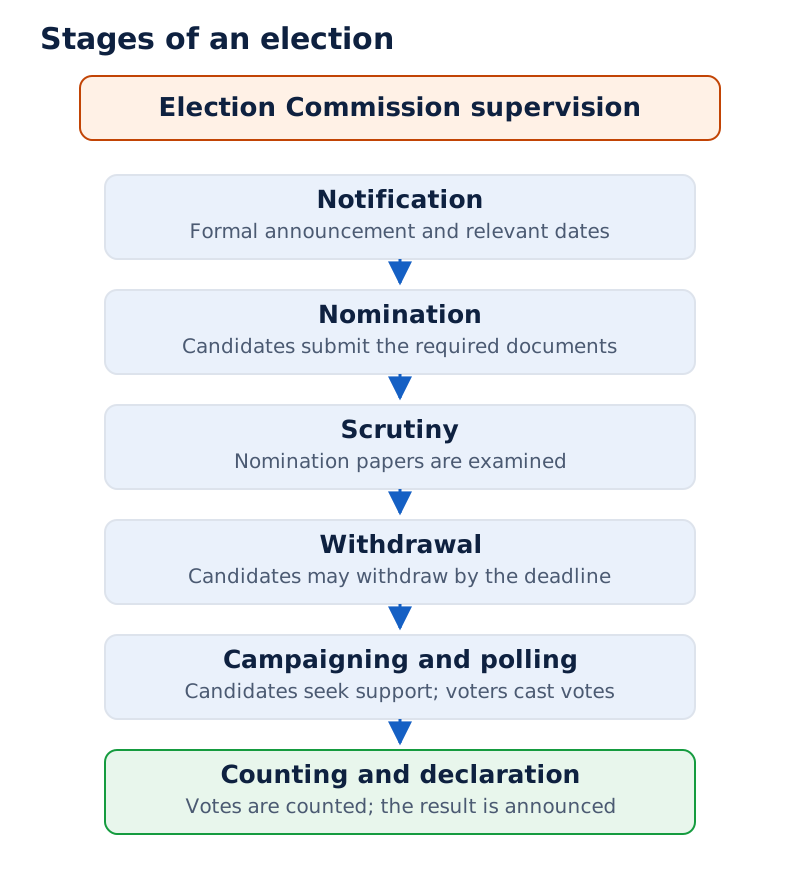
Draw labelled boxes for notification, nomination, scrutiny, withdrawal, campaigning and polling, and counting and declaration. Join them in that order with arrows. Place “Election Commission supervision” above the sequence.
Drawn by One Young India.
How does the Commission keep electoral competition fair?
The ECI registers political parties and recognises parties according to the prescribed criteria. An independent candidate contests without affiliation to a political party.
The Commission allocates election symbols, identifying signs used by parties and candidates. It also addresses disputes over party recognition and symbols. In doing so, it acts in a quasi-judicial capacity, meaning that it considers and decides disputes in a manner resembling a judicial authority.
How are campaign rules enforced?
The Model Code of Conduct is the set of conduct rules applied to political parties and candidates during elections. The Commission implements it to support fair competition. It also supervises the wider arrangements necessary for a free and fair poll.
The Representation of the People Act, 1951 identifies electoral offences and corrupt practices. These include gifts, offers or promises intended to influence a person to contest, withdraw, vote or refrain from voting. Appeals based on religion, caste, race, community or language are also prohibited.
Candidates, or people acting for them, are prohibited from obtaining election assistance from specified government-related personnel. These include gazetted officers, judges and magistrates, armed forces personnel, police personnel and excise officers. Official authority must not become a means of unfair electoral advantage.
What can the Commission do when fairness is threatened?
If conditions make a free and fair election impossible, the ECI can postpone or cancel the affected election. It can order a re-poll, a fresh vote, or a recount, a fresh counting of votes, when the circumstances require.
These are different remedies. A re-poll addresses the need to conduct voting again; a recount addresses the counting process. The Commission's control over election staff, schedules and these corrective steps gives practical effect to its responsibility for electoral fairness.
What do past cases show about the Commission's authority?
The Election Commission has had to organise elections in difficult circumstances, including militancy-affected areas such as Assam, Punjab and Jammu and Kashmir. Its responsibility is to assess whether people can participate freely and whether the electoral process can be conducted fairly.
What happened during the 1991 election?
In 1991, former Prime Minister Rajiv Gandhi was assassinated during election campaigning. The Commission faced the need to postpone the election process part-way through. This illustrates that an announced programme may need to change when serious events disrupt electoral conditions.
The purpose of scheduling is to conduct a meaningful election. Treating dates as unchangeable regardless of circumstances would overlook the Commission's responsibility to assess conditions. Its power to alter arrangements must be understood alongside the requirement of free and fair participation.
What happened in Gujarat in 2002?
In 2002, the Gujarat Legislative Assembly was dissolved and an election had to be held. The Commission found that unprecedented violence made it impossible to conduct free and fair elections immediately. It postponed the Assembly election by a few months.
The Supreme Court, India's highest court, upheld the Commission's decision. This case illustrates the significance of an independent assessment of electoral conditions. Dissolution created the need for an election, but the Commission also had to consider whether an immediate election could be fair.
Both cases connect authority with responsibility. Postponement is a means of responding to conditions that obstruct a proper election. The Commission's role therefore extends beyond collecting votes: it includes protecting the circumstances in which voters can make their choices.
How can elections become more inclusive and trustworthy?
Inclusive elections enable eligible people with different needs to participate. Access matters alongside formal voting rights. A person may have the right to vote yet require assistance with registration, reaching a polling station or using voting arrangements.
Which measures support participation?
The Saksham App provides services for persons with disabilities, including help with voter registration and locating polling stations. The Voter Helpline App provides voter services and election information. These measures support participation at stages before polling as well as on election day.
An Electronic Voting Machine, abbreviated as EVM, records votes electronically. Braille, a reading system using raised dots, assists visually impaired voters. Voter Verifiable Paper Audit Trail, abbreviated as VVPAT, provides a paper record through which a voter can verify the recorded choice.
What the figure shows
EVM with Braille
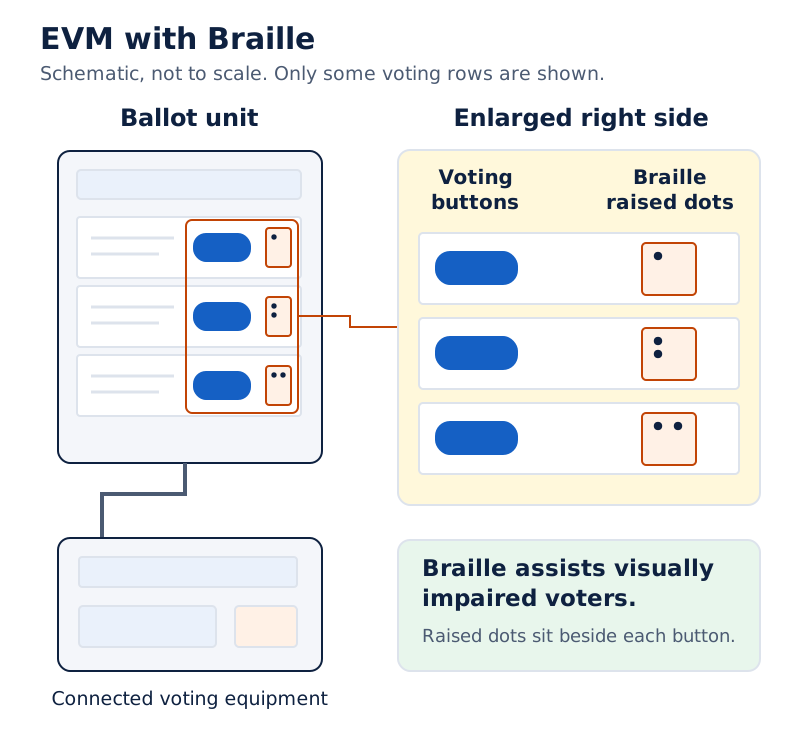
The illustration shows connected voting equipment and a magnified view of the right side of the ballot unit. Raised-dot markings appear beside the voting buttons.
Drawn by One Young India.
Voting from home for senior citizens above 85 years and persons with disabilities with a benchmark disability of 40% was extended across India for the first time in the 2024 General Elections. Benchmark disability refers here to the specified assessed level of disability.
What does Ishani's voting experience illustrate?
Ishani, aged 18, registered through the ECI's online portal. At the polling station, her disabled elder brother received a wheelchair and volunteers guided them. Her identity was checked using an alternative document, she saw the VVPAT slip after voting, and her 89-year-old grandmother voted from home.
The experience connects registration, assistance, identity verification and accessible voting. Home voting is available to eligible voters under specified conditions; not every elderly person uses it.
Misinformation, false or misleading information, and intimidation, pressure or threats used to frighten people, challenge fair elections. If fairness is not ensured, public confidence may gradually weaken. Constant vigilance and active citizen participation can make elections more representative and democracy more robust.
National Voters' Day is observed on 25 January each year. Responsible participation includes voting fearlessly and resisting inducements, offers intended to influence a choice. Electoral institutions, laws, parties and citizens all have roles in supporting trustworthy elections.
Glossary
- Election — A process in which voters choose representatives to act on their behalf in public affairs.
- Direct election — An election in which citizens themselves vote to choose the representatives concerned.
- Indirect election — An election in which representatives chosen by citizens elect the holders of another office.
- General election — An election held to choose a new Lok Sabha or Legislative Assembly as a whole.
- Mid-term election — A general election held after an elected House is dissolved before its normal term ends.
- By-election — An election held to fill an individual legislative seat that becomes vacant between general elections.
- Constituency — An electoral area whose voters choose a representative or representatives to a legislative body.
- Electoral roll — The official list of eligible voters prepared and revised for an electoral area.
- Universal adult franchise — The right of adult citizens to vote without discrimination based on wealth, education or gender.
- Delimitation — The process of determining seats and fixing territorial boundaries of electoral constituencies.
- Nomination — The process of formally submitting the required documents to stand as an election candidate.
- Model Code of Conduct — Conduct rules applied to political parties and candidates during the election process.
- Re-poll — A fresh vote ordered when circumstances require the voting process to be conducted again.
- Recount — A fresh counting of votes ordered when the earlier counting process requires reconsideration.
- Quota — The minimum number of votes a candidate needs for election under the relevant electoral method.
Common errors and misconceptions
- Misconception: Every election held before five years is a by-election. Correct: An early election following dissolution of the whole House is a mid-term election; a by-election fills an individual vacancy.
- Misconception: Citizens directly elect the President of India. Correct: The presidential election is indirect; Lok Sabha and Vidhan Sabha elections are direct.
- Misconception: Direct election means direct democracy. Correct: Direct election selects representatives; direct democracy involves citizens themselves taking governmental decisions.
- Misconception: The ECI conducts every election, including Panchayat elections. Correct: State Election Commissions administer local body elections independently within their own sphere.
- Misconception: The CEC has greater decision-making powers than the other Election Commissioners. Correct: The CEC presides, but the Commissioners have equal powers in collective election decisions.
- Misconception: Turning 18 automatically means a person can vote without checking the electoral roll. Correct: An eligible voter must also be included on the roll.
- Misconception: An FPTP winner must obtain more than half the votes. Correct: The winning candidate must obtain more votes than each rival; a majority is not required.
- Misconception: A re-poll and a recount are identical. Correct: A re-poll repeats voting, whereas a recount counts the votes again.
Exam-style questions with model answers
Q1. Citizens vote for Lok Sabha candidates, while State MLAs elect their State's Rajya Sabha representatives. Identify and explain the type of election in each case. [2 marks]
- The Lok Sabha election is direct because citizens themselves vote for the representatives concerned.
- The Rajya Sabha election is indirect because elected State MLAs choose their State's representatives.
Q2. Classify these elections and explain each classification: a new Assembly is elected after its five-year term ends; another Assembly is dissolved before five years and replaced through an election; one seat is filled after its member resigns. [3 marks]
- The first is a general election at the normal time. The Assembly has completed its five-year term and voters choose a new House as a whole.
- The second is a mid-term election. Early dissolution ends the Assembly's life, requiring a general election before the ordinary term is completed.
- The third is a by-election. Resignation creates an individual vacancy that must be filled without electing the whole Assembly again.
Q3. The President appoints a CEC and two Election Commissioners. The CEC presides, all three have equal powers in collective decisions, and they serve for six years or until age 65, whichever is earlier. Explain four features of this arrangement under membership, appointment, powers and tenure. [4 marks]
- The Commission consists of the Chief Election Commissioner and two Election Commissioners, forming a multi-member constitutional body for administering elections.
- The President of India appoints the Chief Election Commissioner and the other Election Commissioners to their respective offices.
- The CEC presides over the Commission, but all three Commissioners have equal powers when taking decisions collectively on election matters.
- Commissioners hold office for six years or until they reach the age of 65, whichever occurs earlier.
Q4. The ECI revises electoral rolls; sets nomination, scrutiny, withdrawal, polling and counting dates; registers and recognises parties, allocates symbols and settles related disputes; enforces the Model Code and controls election staff; and can postpone or cancel elections, order re-polls or require recounts. Explain how each of these five functions supports free and fair elections. [5 marks]
- The ECI supervises preparation and revision of electoral rolls so that eligible voters are included and erroneous or ineligible entries are addressed before polling.
- It determines the election schedule, including nomination, scrutiny, withdrawal, polling and counting dates, giving the different stages an organised timetable.
- It registers and recognises political parties, allocates election symbols, and addresses disputes concerning recognition and symbols so that electoral competition can proceed.
- It implements the Model Code of Conduct for parties and candidates and controls government personnel performing election duties to support impartial administration.
- It can postpone or cancel an affected election, order a fresh poll or require a recount when circumstances obstruct free voting or fair counting.
Q5. Four Rajya Sabha members are to be elected by 200 Rajasthan MLAs, with 200 votes polled. Use quota = [total votes polled ÷ (members to be elected + 1)] + 1. Calculate the quota and explain why this is an indirect election. [3 marks]
- The denominator is the number of members to be elected plus one: 4 + 1 = 5. The numerator is the 200 votes polled.
- The quota is [200 ÷ 5] + 1 = 40 + 1 = 41 votes, the minimum required in this example.
- This is an indirect election because the voters choosing the Rajya Sabha members are elected MLAs, rather than citizens voting directly for those members.
Q6. In 2002, the Gujarat Assembly was dissolved. The ECI found that unprecedented violence prevented an immediate free and fair election and postponed polling by a few months. The Supreme Court upheld this decision. Explain three lessons about the ECI's role. [3 marks]
- The Commission assesses whether electoral conditions permit a free and fair election. It must consider the effects of violence on meaningful participation, rather than simply announcing polling.
- Its scheduling power includes postponement when immediate voting cannot be free and fair. The few months' delay addressed the stated conditions in Gujarat.
- The Supreme Court's support in this case upheld the Commission's decision, illustrating the significance of its independent assessment of the conditions required for an election.
Q7. Ishani registered online, saw volunteers provide a wheelchair for her disabled brother at the polling station, verified her vote through a VVPAT slip, and learned that her 89-year-old grandmother had voted from home. Explain four ways these arrangements supported participation or confidence. [4 marks]
- Online registration helped Ishani complete the registration stage, connecting an eligible new voter with the electoral process before polling day.
- The wheelchair and volunteers helped her disabled brother reach and use the polling facilities, reducing a physical barrier to participation.
- The VVPAT slip enabled Ishani to verify her recorded voting choice, providing an additional means of checking the vote she cast.
- Home voting enabled her 89-year-old grandmother to participate from home, making voting accessible to an eligible elderly person in the passage.
Q8. Distinguish a re-poll from a recount by stating what is repeated in each. [2 marks]
- A re-poll repeats the voting process, allowing votes to be cast again under fresh polling arrangements.
- A recount repeats the counting of votes to reconsider the earlier counting process.
Key takeaways
- Elections allow citizens to choose representatives, hold them accountable and renew or change their support through periodic voting.
- Direct elections involve citizens choosing representatives themselves; indirect elections involve elected representatives choosing the holders of another public office.
- General elections choose a whole House, mid-term elections follow early dissolution, and by-elections fill individual vacancies.
- The Election Commission consists of the CEC and two Election Commissioners with equal powers in collective electoral decisions.
- The ECI administers parliamentary, State legislative, presidential and vice-presidential elections; State Election Commissions administer local body elections.
- Electoral rolls require preparation, verification, correction and opportunities for claims and objections before the final list is published.
- The Commission schedules elections, recognises parties, allocates symbols, supervises election staff and acts to protect fair voting and counting.
- Accessible facilities, voter information, impartial administration and active citizen participation help make electoral rights meaningful in practice.
Test yourself
Why does periodic voting matter?
It gives citizens repeated opportunities to choose representatives and hold them accountable for their actions.
What distinguishes a mid-term election from a by-election?
A mid-term election follows early dissolution of a whole House. A by-election fills an individual vacant seat between general elections.
Which Article gives the ECI its central electoral authority?
Article 324 gives the Commission authority over electoral rolls and the conduct of the specified elections.
Does the CEC have greater powers than the other Commissioners in collective decisions?
No. The CEC presides, but the three Commissioners have equal powers in collective decisions concerning elections.
Who administers Panchayat and municipal elections?
State Election Commissions administer these local body elections independently within their own sphere of responsibility.
Why are claims and objections invited during electoral roll revision?
They allow people to seek inclusion or challenge entries before the final electoral roll is published.
Must an FPTP winner obtain a majority of all votes?
No. The winner must obtain more votes than every other candidate in the constituency, even without a majority.
What did the Gujarat case of 2002 demonstrate?
The ECI could postpone an election when violence prevented immediate free and fair polling; the Supreme Court upheld its decision.
Try it
ICSE Class 9 Civics: Elections and the Election Commission of India Study Notes
Design a 2-step scenario interactive for a study note.
1What is the cornerstone of the representative democracy system in India?
While One Person, One Vote is a principle of Universal Adult Franchise, it is not the cornerstone of the system itself.
Universal Adult Franchise is the cornerstone of the representative democracy system in India, as it mandates that every Indian citizen who has attained the prescribed minimum age possesses the right to vote, without any discrimination.
Direct Elections are a mechanism used in the Indian electoral architecture, but they are not the cornerstone of the system.
2What is the main advantage of Direct Elections in the Indian electoral architecture?
This is an advantage of Indirect Elections, not Direct Elections.
Direct Elections have this advantage, as they allow citizens to cast their ballots directly to choose their representatives.
This is an advantage of Indirect Elections, not Direct Elections.
3What is the main reason for the independence of the Election Commission of India?
The Election Commission of India is independent to ensure that elections are free, fair, and transparent, not to favor a particular political party.
The Constitution vests the superintendence, direction, and control of elections in an autonomous body known as the Election Commission of India to ensure its independence from political executive interference.
This is not the main reason for the independence of the Election Commission of India.
4What is the consequence of the 61st Constitutional Amendment Act of 1988?
The 61st Constitutional Amendment Act of 1988 actually lowered the voting age to 18 years.
The 61st Constitutional Amendment Act of 1988 lowered the voting age to 18 years to acknowledge the political awareness of India's youth and broaden democratic participation.
The 61st Constitutional Amendment Act of 1988 changed the voting age, it was not kept at 21 years.
The Election Commission of India plays a crucial role in ensuring the integrity of the electoral process in India, and its independence is essential for maintaining the trust of the citizens in the democratic system.