
First Phase of the Indian National Movement (1885-1907) | ICSE Class 10 History & Civics Notes
On this page
This note covers the First Phase of the Indian National Movement from 1885 to 1907, its background, political and economic objectives, methods of struggle, leading personalities, social concerns, chronology, contemporary evidence, achievements, limitations and the transition towards more assertive politics.
What colonial background explains the emergence of the Early Nationalists?
Colonial rule means control of a country by a foreign power. In India, British control over resources and people's lives encouraged the growth of nationalism, the consciousness that Indians belonged to a common nation and should control their collective affairs.
Early Nationalists, also called Moderates, were leaders associated with the early approach of the Indian National Congress, an all-India political organisation, hereafter Congress. They sought reforms through constitutional methods: lawful political action, including formal written requests called petitions, discussion and public appeals. The first phase extended from 1885 to 1907.
How did regional associations prepare the ground?
Political associations developed after 1850, especially during the 1870s and 1880s. Most were led by English-educated professionals such as lawyers. They included the Indian Association and the Poona Sarvajanik Sabha. Sarvajanik means of or for all the people.
Many associations worked within particular regions, but expressed goals for all Indians. They supported the idea that the people should be sovereign, able to decide their affairs without outside interference. Their national outlook crossed distinctions of region, community and class.
Why did dissatisfaction grow?
The Arms Act of 1878 disallowed Indians from possessing arms. The Vernacular Press Act of 1878 targeted criticism in Indian-language newspapers. It allowed the government to seize newspaper property, including printing presses, for material it considered objectionable.
The Ilbert Bill controversy of 1883 concerned a proposal allowing Indian judges to try British or European persons. White opposition to the proposal exposed racial attitudes and deepened the desire for an all-India organisation of educated Indians.
Congress was established when 72 delegates, or representatives, met at Bombay in December 1885. A.O. Hume, a retired British official, helped bring Indians from different regions together. Its early leadership was largely from Bombay and Calcutta.
What political and administrative objectives did the Early Nationalists pursue?
The early Congress demanded a greater Indian voice in government and administration, meaning the management of public affairs. Its programme challenged exclusion from positions of responsibility and sought changes in the institutions through which British India was governed.
How were representative institutions to change?
Legislative Councils were bodies concerned with making laws. Congress wanted them to become more representative, receive greater powers and be introduced in provinces where none existed. A province was a major territorial unit of administration.
These demands were related but distinct. Broader representation concerned whose views entered the councils. Greater powers concerned what those bodies could do. Establishing councils in additional provinces concerned where such institutions existed. Together, the demands aimed at increasing Indian participation.
What did Indianisation mean?
Indianisation meant appointing more Indians to government service, including high offices. The civil service was the body of officials carrying out government administration. Congress demanded that its recruitment examinations be held in India as well as in London.
Most important government jobs were monopolised by white officials, and the British generally assumed that Indians could not hold responsible positions. Indianisation therefore challenged racism, discrimination based on supposed racial differences, as well as the existing distribution of public employment.
The judiciary refers to courts and judges; the executive carries out government decisions. Their separation was an administrative demand. Repeal means formally ending a law.
| Political objective | Meaning of the demand |
|---|---|
| More representative councils | Give Indians a greater voice in institutions involved in law-making. |
| Greater council powers | Increase the authority of those representative institutions. |
| Indianisation | Place Indians in higher government positions and hold recruitment examinations in India too. |
| Separation of judiciary and executive | Separate the work of judging cases from the work of administering government. |
| Freedom of speech and expression | Protect the ability to express opinions and criticise government policies. |
| Repeal of the Arms Act | End the legal validity of the restrictive law. |
These objectives sought institutional reform rather than merely a change in individual officials. A demand about judicial independence concerned the relationship between institutions, while Indianisation concerned who could hold positions within the administration.
Why were economic grievances central to the Moderate programme?
The Early Nationalists connected poverty with British policies. Congress argued that British rule had produced poverty and famines, or severe food shortages. It linked rising land revenue, the government's demand on agricultural land, with the impoverishment of cultivators and landholders.
Peasants were people who cultivated the land, while zamindars were landholders associated with the collection or payment of land revenue. Congress argued that higher revenue demands impoverished both groups and that grain exports to Europe created food shortages.
What was the drain of wealth?
The drain of wealth was the transfer of Indian wealth to Britain without a corresponding economic return to India. British officials sent a major part of their large salaries home. Nationalists connected these transfers with the country's economic difficulties.
Indianisation, it was hoped, would also reduce the drain to England. This was an expected benefit of employing more Indians, not proof that the drain had already ended. The same demand therefore had an economic purpose alongside its challenge to racial exclusion.
| Grievance or concern | Demand or political response |
|---|---|
| Burden of land revenue | Reduce the government's revenue demand. |
| Heavy military expenditure, meaning spending on armed forces | Cut military expenditure. |
| Need for irrigation, meaning the artificial supply of water to crops | Provide more funds for irrigation. |
| Salt tax, a government charge on salt | Pass resolutions drawing attention to the tax. |
| Indian labourers abroad and forest dwellers | Raise their treatment and suffering as political issues. |
A resolution is a formally adopted statement of an organisation's position. Congress passed many resolutions on economic and social grievances. Discussion of taxation, food shortages and forest administration, the official system governing forests and their use, showed that its concerns extended beyond the occupations of its educated leaders.
Diagram
Connections within the economic programme
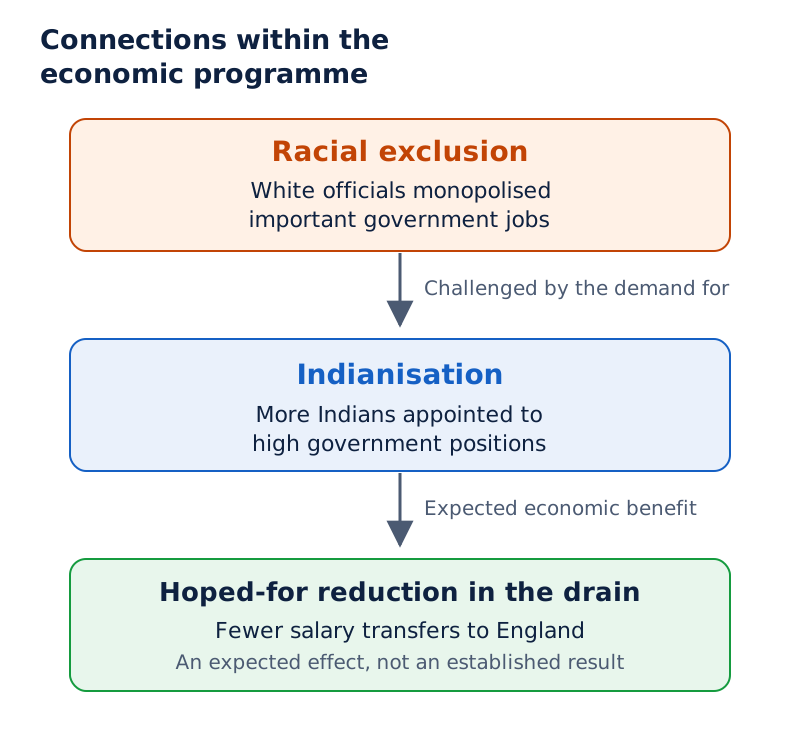
Draw three labelled boxes: racial exclusion, Indianisation, and hoped-for reduction in the drain. Link the first to the demand for Indianisation, then link Indianisation to its expected economic benefit.
Drawn by One Young India.
How did the Early Nationalists organise their methods of struggle?
The Moderates sought to make people aware of the unjust effects of British rule. They also wanted to persuade the rulers to accept Indian demands. Their approach combined public opinion, meaning people's shared views on public questions, with appeals to government.
How did persuasion operate?
They felt that the British respected freedom and justice and would accept just demands when those demands were clearly presented. This was the leaders' belief about how reform could be secured. It should not be confused with a guarantee that the government would agree.
Petitions were formal written requests for action. Along with resolutions and appeals, they expressed grievances through lawful political channels. The Moderates' reliance on such methods later became a subject of criticism from leaders who favoured stronger pressure.
How was public awareness developed?
- Newspapers: Leaders published newspapers to spread criticism of British rule beyond the people physically attending a meeting.
- Articles: Written arguments explained how government policies were contributing to the country's economic difficulties.
- Speeches: Public addresses criticised British rule and communicated political demands to listeners.
- Travelling representatives: Congress sent representatives to different parts of India to mobilise, or bring together, public opinion.
These activities linked political education with organisation. A grievance could be explained in an article, discussed at a meeting and expressed through a resolution or petition. This describes the relationship between the methods, rather than a compulsory sequence followed in every campaign.
Publishing an economic criticism and requesting administrative reform served connected purposes. The criticism explained why change was necessary; the request identified what should change. Moderate politics therefore involved both examining government policies and communicating alternatives.
Note: Peaceful constitutional methods did not mean acceptance of every British policy. The Moderates criticised racial discrimination, economic exploitation, meaning the use of Indian resources for British benefit, and restrictions on expression while believing that persuasion could bring reform.
Keep objectives, the changes sought, separate from methods, the means used to seek them. Holding civil service examinations in India was an objective. A petition requesting that change was a method. Confusing the two hides the logic of the programme.
How did Dadabhai Naoroji contribute to early nationalism?
Dadabhai Naoroji belonged to the early Congress leadership. A businessman and publicist settled in London, he also served for a time in the British Parliament, Britain's law-making institution. A publicist spreads ideas through writing, information and public speaking.
What was his economic contribution?
His book Poverty and Un-British Rule in India sharply criticised the economic effects of British rule. It associated the condition of India with the character of colonial government, making economic hardship a central subject of nationalist criticism.
This contribution fits the wider demand to examine how British administration affected Indian resources. Discussion of poverty was connected with questions about officials' salaries, the movement of wealth to Britain and the purposes for which public money was spent.
How did his leadership help the movement?
Naoroji guided younger nationalists. His place in early Congress leadership and his work as a publicist connected the spread of political ideas with the development of the movement's leadership. His role included public argument as well as economic criticism.
| Contribution | What to explain |
|---|---|
| Economic criticism | His book examined and strongly criticised the economic impact of British rule in India. |
| Guidance of younger nationalists | He helped guide the emerging leadership of the national movement. |
The book and the guidance are two separate contributions. His residence in London and membership of Parliament provide biographical context. Describing a contribution requires identifying what he did, such as criticising colonial economic effects or guiding younger political workers.
Naoroji's example also shows why economic and political history belong together. The demand for a greater Indian role in administration was connected with criticism of the way British rule affected the country's wealth and the lives of its people.
How did Surendranath Banerjee contribute through organisation and journalism?
Surendranath Banerjee was an important early Congress leader. His contributions combined political organisation with journalism, the work of producing news and public commentary. These activities offered related ways of bringing Indian grievances into public discussion.
What was his organisational contribution?
Banerjee helped found the Indian Association in 1876. This organisation belonged to the network of political associations that preceded Congress. Its significance lay in providing a forum for organised political activity before the establishment of the all-India Congress in 1885.
The Indian Association should not be confused with Congress. They were distinct organisations. Linking Banerjee with the Association explains his work in political organisation, while identifying him as an early Congress leader places him within the broader national movement.
What was his contribution to the press?
Banerjee used his newspaper, The Bengalee, to express nationalist views and shape public opinion. This was a contribution through journalism. It brought political arguments into print and supported the wider use of newspapers in nationalist political education.
Organisation and journalism served different functions. An association provided a forum for collective political work. A newspaper communicated ideas and criticism to readers. Together, these contributions illustrate the relationship between building political bodies and developing awareness of public issues.
- First contribution: He helped establish the Indian Association in 1876, contributing to organised political activity.
- Second contribution: He used The Bengalee to promote nationalist views and public awareness.
His work belongs within the early movement's emphasis on discussion, organisation and persuasion. The wider ambition of political associations was to speak about Indian interests across regional and community boundaries, even when their immediate work was concentrated in a particular area.
How did Gopal Krishna Gokhale contribute through service and public debate?
Gopal Krishna Gokhale was a leading Moderate. His public work connected political reform with service to society. Two important contributions were his establishment of the Servants of India Society and his use of legislative debate to press for reforms.
What was the purpose of the Servants of India Society?
Gokhale founded the Servants of India Society in 1905 to train workers for service to the country. Here, public service means organised work for the welfare of the people. The Society made such service a continuing organisational commitment.
This contribution concerned the preparation of people for sustained national work. The organisation's name should be connected with its purpose: developing workers devoted to the country's service. Naming the Society without explaining this purpose leaves the contribution incomplete.
How did he use legislative institutions?
Gokhale used legislative councils and budget debates, discussions of government income and spending, to criticise financial burdens and argue for reform. He advocated reduced taxation and military expenditure, and greater attention to education.
This was a constitutional method of political action. It used reasoned criticism within public institutions to examine government priorities. Discussion of taxation asked what burdens people faced; discussion of expenditure asked how government resources should be used.
| Contribution | Character of the work |
|---|---|
| Servants of India Society, 1905 | Organise and train workers for service to the country. |
| Legislative and financial criticism | Use council debates to advocate changes in taxation, spending and education. |
These contributions show two dimensions of Gokhale's activity: building an organisation for public service and arguing for changes in government policy. Both fitted the Moderate emphasis on organised, sustained work and constitutional reform rather than reliance on a single dramatic protest.
Which social groups participated or had their concerns represented?
Participation in leadership and representation of grievances are different matters. The early Congress was a body of the educated elite, a relatively privileged educated group. However, its programme raised issues affecting people outside that leadership circle.
Who formed the educated leadership?
Most early political associations were led by English-educated professionals such as lawyers. Early Congress leaders included Dadabhai Naoroji, Pherozeshah Mehta, Badruddin Tyabji and Surendranath Banerjee. Their background helps explain the prominence of speeches, newspapers and organised public debate.
How were cultivators and landholders represented?
Congress connected increased land revenue with the impoverishment of peasants and zamindars. Its demands for lower revenue and more irrigation funds addressed agricultural concerns. Grain exports and food shortages were also part of its criticism of British economic policy.
How were labourers and forest dwellers represented?
Congress passed resolutions about Indian labourers abroad and the suffering of forest dwellers under an interfering forest administration. These concerns extended beyond the interests of professionals and landholders.
Congress therefore did not speak only about its leaders' occupations. At the same time, raising an issue for a group does not establish that the group participated widely in Congress organisation. Its broad claim to representation must be distinguished from its immediate social composition.
In 1887, Congress President Badruddin Tyabji emphasised representation of India's different communities. This expressed the organisation's inclusive national ambition. It was a claim about whom Congress sought to represent, rather than a statistical account of participation by every community.
What timeline connects the background, first phase and transition?
The timeline, an arrangement of events in date order, begins with background developments and ends with the Congress split. Read it as a sequence linking political organisation, restrictions, public argument and disagreement over methods. Background dates explain developments before 1885.
| Date | Event | Connection with early nationalism |
|---|---|---|
| 1876 | Banerjee helped found the Indian Association. | Political organisation preceded the formation of Congress. |
| 1878 | The Arms Act was passed. | Its restrictions became a subject of nationalist demands for repeal. |
| 1878 | The Vernacular Press Act was enacted. | It sought to silence criticism in Indian-language newspapers. |
| 1880 | The need for an all-India organisation of educated Indians was already being felt. | The desire for national organisation preceded the Ilbert Bill controversy. |
| 1883 | The Ilbert Bill controversy developed. | White opposition exposed racial attitudes and strengthened the desire for organisation. |
| December 1885 | Congress was established at Bombay. | Seventy-two delegates met from different parts of India. |
| January 1886 | The Indian Mirror discussed the first Congress. | The newspaper expressed hope for its representative political future. |
| 1887 | Badruddin Tyabji addressed Congress as President. | He stressed representation of different Indian communities. |
| 1887 | Dinshaw Wacha wrote to Naoroji. | His letter questioned the effect of some leaders' private preoccupations on national work. |
| 1905 | Gokhale founded the Servants of India Society. | It organised training for service to the country. |
| 1905 | Bengal was partitioned. | Both Moderate and more assertive Congress leaders opposed the partition. |
| 1906 | Muslim landlords and nawabs formed the All India Muslim League at Dacca. | The League supported Bengal's partition, unlike both Congress groups. |
| 1907 | Congress split at Surat. | Disagreement about methods accompanied the division. |
The first phase from 1885 to 1907 overlaps with the opening of the second phase in 1905. Political approaches coexisted and competed. A period boundary does not mean that all leaders changed their methods simultaneously or that an older approach immediately disappeared.
How did political organisation develop after the first phase?
The following dates belong to the later national movement. They trace the reunion of the Congress groups and the growth of mass participation after the first phase ended in 1907.
| Date | Later development |
|---|---|
| 1909 | The government conceded the Muslim League's demand for separate electorates. Muslim voters elected representatives to seats reserved for Muslims. |
| December 1915 | The Moderate and Radical groups reunited in Congress. |
| 1916 | Congress and the Muslim League signed the Lucknow Pact, agreeing to work together for representative government. |
| 1917 | The Russian Revolution spread news of workers' and peasants' struggles and ideas of socialism, inspiring Indian nationalists. |
| 1918 | Gandhi led a successful millworkers' strike in Ahmedabad. |
| 6 April 1919 | Gandhi called for non-violent opposition to the Rowlatt Act through prayer and a hartal, or strike. |
| 1920 | A harsh British treaty imposed on the Turkish Sultan intensified the Khilafat agitation. Gandhi supported its leaders' call for non-cooperation. |
| 1921 to 1922 | The Non-Cooperation Movement gained momentum. Students left government-controlled institutions, lawyers gave up practices, and people boycotted legislatures and burned foreign cloth. |
| February 1922 | Gandhi called off Non-Cooperation after peasants set fire to a police station at Chauri Chaura, killing twenty-two policemen. |
How did Moderate methods differ from the emerging assertive approach?
By the 1890s, many Indians were questioning Congress's political style. Leaders including Bal Gangadhar Tilak, Bipin Chandra Pal and Lala Lajpat Rai explored more radical objectives and methods. Assertive Nationalists, also called Radicals, emphasised self-reliance and stronger popular pressure.
Self-reliance meant depending on people's own strength. Swaraj meant self-rule. The Radicals argued that Indians must struggle for swaraj rather than depend on the government's good intentions. Their criticism of Moderate petitioning concerned the effectiveness of persuasion.
Boycott means deliberate refusal to buy goods or take part in institutions as a protest. Mass mobilisation means organising large numbers of people for political action.
| Aspect | Moderate approach | Assertive approach |
|---|---|---|
| Expected route to change | Persuade the British to accept just Indian demands. | Rely on people's own strength and constructive work. |
| Political activity | Petitions, speeches, articles and organised public opinion. | Mass mobilisation and boycott of British institutions and goods. |
| Attitude to boycott | Moderates opposed its use, feeling that it involved force. | Radicals advocated it as a means of struggle for swaraj. |
| Bengal partition | Opposed the partition. | Also opposed the partition. |
The Swadeshi movement promoted Indian enterprise, national education, Indian languages and self-help while opposing British rule. Swadeshi means of one’s own country; here it refers to support for Indian goods and enterprise.
Viceroy Curzon, Britain's chief representative in India, partitioned Bengal in 1905. The government claimed administrative convenience. Perhaps the main British motives were to reduce Bengali politicians' influence and divide the Bengali people. Both Congress groups opposed the decision, despite differences over methods.
Congress split in 1907. Afterwards, Moderates dominated Congress while Tilak's followers worked outside it. Disagreement about methods did not mean that the groups had taken opposite positions on the partition of Bengal.
What do contemporary sources reveal about hopes and limitations?
Contemporary sources are records produced during the period being studied. Newspapers, speeches, letters and books reveal different aspects of political life. Their evidence is useful when the writer's purpose and the limits of each claim are considered.
What hopes did newspapers and speeches express?
In January 1886, The Indian Mirror described the Congress established in 1885 as the beginning of a future parliament for India. This reveals confidence in its potential as a representative body. It does not establish that Congress already possessed parliamentary authority.
Badruddin Tyabji's presidential address in 1887 emphasised that Congress represented different Indian communities. The speech illuminates its inclusive political ideal. It should be read as a statement of representative purpose, not as evidence that every Indian already participated in Congress.
What criticism appears within the movement?
In an 1887 letter to Naoroji, Dinshaw Wacha complained about Pherozeshah and Telang being occupied with personal work and the pursuit of wealth. His concern was that such priorities could hold back national progress.
This letter shows criticism within the Moderate circle. It supports discussion of the difficulty of sustaining political commitment alongside private interests. It does not justify describing every early nationalist as uninterested in public work or concerned only with wealth.
Naoroji's Poverty and Un-British Rule in India offers a different kind of evidence: a sustained criticism of colonial economic effects. Compared with a speech about unity or a private letter about colleagues, it focuses attention on the material consequences of British rule.
Read these records together. They reveal representative ambitions, economic criticism and internal concern about commitment. A balanced account can recognise these differences without turning either praise or criticism into an absolute judgement about the entire movement.
What were the significance and limitations of the first phase?
The early movement gave organised expression to the idea that Indian interests crossed regional and community boundaries. Congress brought delegates together, articulated demands and criticised the economic effects of British rule. These were significant forms of political work even without immediate acceptance of its programme.
What foundations did the movement establish?
Its public activity connected organisation, criticism and political education. Newspapers and speeches explained grievances, while petitions and resolutions formulated demands. The programme linked representation in government with economic questions such as revenue, military spending and the drain of wealth.
These connections helped make the condition of the country a subject of public argument. An administrative demand such as Indianisation could challenge racial exclusion and address economic concerns at the same time. Its importance cannot be understood through a list of isolated demands alone.
What limited its approach?
The leadership came from a relatively narrow educated social base, although its concerns extended further. Its strategy also rested on confidence that the British would respond to justice and reason. Many critics questioned this reliance on persuasion by the 1890s.
The disagreement sharpened as new methods developed around the opposition to Bengal's partition in 1905. The split in 1907 marked a division within Congress, but it did not erase the earlier work of developing political arguments, organisations and an inclusive national claim.
Diagram
The Moderate approach and its challenge
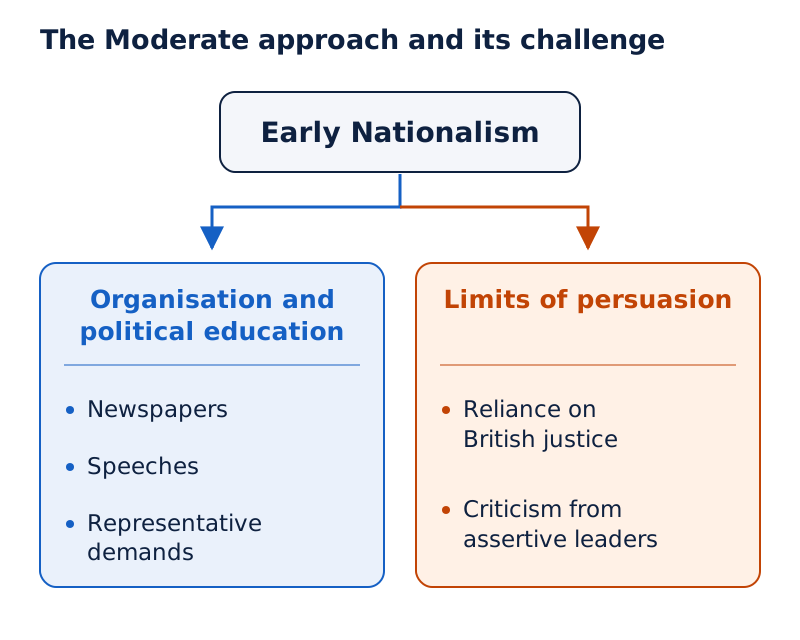
Make two branches from the heading Early Nationalism. Label one branch Organisation and political education, with newspapers, speeches and representative demands. Label the other Limits of persuasion, with reliance on British justice and criticism from assertive leaders.
Drawn by One Young India.
A balanced assessment distinguishes demands from achievements. Asking for powerful councils is not the same as obtaining them. The first phase's public criticism and organisational activity can be recognised without claiming that all its proposed reforms were achieved.
Glossary
- Nationalism — The consciousness of belonging to a common nation whose people should control their collective affairs.
- Early Nationalists — Leaders associated with the early Congress programme of reform through persuasion and constitutional political action.
- Constitutional methods — Lawful forms of political action, including petitions, discussion, resolutions and public appeals for reform.
- Indianisation — Appointment of more Indians to government service, including positions of responsibility previously dominated by British officials.
- Legislative Councils — Bodies concerned with law-making whose representation, powers and wider establishment were subjects of early Congress demands.
- Drain of wealth — Transfer of Indian wealth to Britain without a corresponding economic return to India.
- Petition — A formal written request asking an authority to take action or address a grievance.
- Resolution — A formally adopted statement expressing an organisation's position or demand on a public question.
- Public opinion — People's shared views on public questions, which nationalist writing, speeches and meetings sought to influence.
- Publicist — A person who spreads ideas through information, reports, writing and speeches at public meetings.
- Repeal — The formal ending of the legal validity of an existing law by the appropriate authority.
- Boycott — Deliberate refusal to buy goods or participate in institutions as a form of protest.
- Swaraj — Self-rule, pursued by nationalists who argued that Indians must rely on their own strength.
- Contemporary source — A record produced during the period being studied, such as a letter, newspaper or speech.
Common errors and misconceptions
- Misconception: Moderate politics meant support for every British policy. Correct: Moderates criticised economic exploitation and racial exclusion while seeking reform through persuasion and constitutional action.
- Misconception: Indianisation meant holding civil service examinations only in India. Correct: Congress demanded examinations in India as well as in London and greater Indian access to high office.
- Misconception: Congress discussed only the concerns of educated professionals. Correct: It also raised grievances of peasants, landholders, Indian labourers abroad and forest dwellers.
- Misconception: Congress's demand for stronger councils proves that it obtained them. Correct: A proposed reform must be distinguished from an achieved change.
- Misconception: Banerjee founded the Servants of India Society. Correct: Gokhale founded that Society in 1905; Banerjee helped establish the Indian Association in 1876.
- Misconception: Moderates supported Bengal's partition because they disagreed with the Radicals about boycott. Correct: Both groups opposed the partition while differing over methods.
- Misconception: Indianisation certainly ended the drain of wealth. Correct: It was hoped that Indianisation would reduce the drain; an expected effect is not an accomplished result.
Exam-style questions with model answers
Q1. Congress demanded civil service examinations in India as well as London, and the appointment of Indians to high government office. Identify two features of its Indianisation demand from this information. [2 marks]
- Recruitment examinations should be held in India as well as in London.
- Indians should be appointed to high positions in government administration.
Q2. Early Congress leaders wanted a greater Indian voice in government. They sought more representative Legislative Councils (law-making bodies), greater council powers and councils in provinces where none existed. Explain these three distinct demands using the information given. [3 marks]
- More representative councils would give Indians a greater voice in institutions concerned with making laws and considering government policy.
- Greater council powers would increase what these institutions could do, rather than changing their membership alone.
- Establishing councils in provinces without them would extend the presence of such institutions to additional administrative areas.
Q3. The Moderates published newspapers, wrote articles explaining economic harm, communicated criticism of British policies and demands in speeches, and sent representatives around India to organise public opinion. Explain four methods of political education shown here. [4 marks]
- Publishing newspapers carried political criticism to readers beyond the people who could attend a particular public meeting.
- Writing articles explained the economic effects of British policies and gave readers reasons for seeking changes in administration.
- Delivering speeches communicated criticism and demands directly to an audience, bringing government policy into public discussion.
- Sending representatives to different regions helped organise public opinion and spread political arguments across the country.
Q4. Consider these facts: Congress was established in 1885. Dadabhai Naoroji's Poverty and Un-British Rule in India criticised colonial economic effects, and he guided younger nationalists. Surendranath Banerjee helped found the Indian Association in 1876 and promoted nationalist views through The Bengalee. Gopal Krishna Gokhale founded the Servants of India Society in 1905 to train public workers and used legislative debates to advocate tax, spending and education reforms. State two contributions of each leader in six separate points. [6 marks]
- Dadabhai Naoroji's book Poverty and Un-British Rule in India strongly criticised the economic effects of British rule on India.
- Naoroji also guided younger nationalists, contributing to the development of leadership within the emerging national movement.
- Surendranath Banerjee helped found the Indian Association in 1876, contributing to organised political work before Congress was established.
- Banerjee used The Bengalee to communicate nationalist views and develop public opinion through the newspaper press.
- Gopal Krishna Gokhale founded the Servants of India Society in 1905 to train workers for service to the country.
- Gokhale used legislative debates to advocate reforms concerning taxation, government expenditure and education through constitutional political action.
Q5. Congress argued that higher land revenue impoverished peasants (cultivators) and zamindars (landholders), and that grain exports created food shortages. It demanded lower revenue, reduced military spending and more irrigation funds (for supplying water to crops). Explain five elements of its economic argument and programme using these facts. [5 marks]
- Congress identified increased land revenue as a source of impoverishment affecting both the people cultivating land and the landholders.
- It linked the export of grain with food shortages, treating the availability of food as a political and economic concern.
- Its demand for lower land revenue addressed the burden that the government's agricultural revenue claim placed on the countryside.
- Its call to reduce military expenditure challenged the amount of government money devoted to the armed forces.
- Its demand for more irrigation funds sought greater spending on the supply of water for agriculture, connecting financial priorities with cultivation.
Q6. In January 1886, The Indian Mirror viewed the Congress established in 1885 as the beginning of a future Indian parliament. In 1887, Tyabji said Congress represented different Indian communities. Identify one hope in each statement and one limit on what these statements prove. [3 marks]
- The Indian Mirror expressed hope that Congress would develop towards a representative parliamentary role for the country.
- Tyabji expressed the ideal that Congress should represent different Indian communities rather than speak for a single community.
- These statements reveal hopes and claims about representation; they do not prove that Congress already possessed parliamentary authority or included every Indian.
Q7. British officials sent a major part of their large salaries home. Nationalists hoped that appointing more Indians would reduce the drain of wealth to England. Explain the connection and preserve the uncertainty in the expected result. [2 marks]
- Replacing more British officials with Indians was connected with reducing salary transfers to Britain.
- A reduced drain was a hoped-for effect of Indianisation, not an established or guaranteed result.
Q8. Moderates expected just demands to persuade the British, while Radicals stressed people's own strength. Moderates used petitions and opposed boycott as involving force; Radicals advocated mass mobilisation and boycott. Both groups opposed Bengal's partition in 1905, and Congress split in 1907. Give three contrasts and one shared position from this information. [4 marks]
- Moderates relied on persuading the British through just demands, whereas Radicals emphasised reliance on the strength of the people themselves.
- Moderate methods included petitions, while Radical methods emphasised organising large numbers of people for political struggle.
- Moderates opposed boycott because they felt it involved force, whereas Radicals advocated it as a method of struggle.
- Both groups opposed the partition of Bengal in 1905, despite their disagreements about how political change should be pursued.
Key takeaways
- The first phase from 1885 to 1907 centred on organised demands, public education and constitutional political action.
- Political objectives included Indianisation, more representative and powerful councils, freedom of expression and separation of judiciary from executive.
- Economic criticism connected poverty with British policies and supported lower revenue, reduced military expenditure and increased irrigation funding.
- Newspapers, articles, speeches, petitions and travelling representatives connected the explanation of grievances with the organisation of public opinion.
- Naoroji criticised colonial economic effects and guided younger nationalists; Banerjee contributed through the Indian Association and The Bengalee.
- Gokhale founded the Servants of India Society in 1905 and used legislative debate to advocate public reforms.
- Congress had an educated leadership but raised concerns affecting peasants, landholders, labourers abroad and forest dwellers.
- Moderates and Radicals both opposed Bengal's partition; their disagreement over political methods accompanied the Congress split in 1907.
Test yourself
What is the difference between an objective and a method?
An objective is the change sought; a method is the means used to pursue that change.
Why did Indianisation have both political and economic significance?
It challenged racial exclusion from government jobs. It was also hoped that appointing more Indians would reduce transfers of wealth to England.
What two contributions distinguish Naoroji in this account?
His book criticised the economic impact of British rule, and he guided younger nationalists in the emerging movement.
Which association and newspaper are linked with Banerjee?
He helped found the Indian Association in 1876 and promoted nationalist views through The Bengalee.
What was the purpose of Gokhale's Servants of India Society?
Founded in 1905, the Society aimed to train workers for service to the country.
Why is it misleading to say Congress represented only professional concerns?
Congress also raised land revenue, irrigation, food shortages, the treatment of Indian labourers abroad and the suffering of forest dwellers.
What limitation should be remembered when reading Tyabji's statement about representation?
It expressed an inclusive national ambition, but did not prove that every community or individual actually participated in Congress.
Did differences over boycott mean Moderates supported the partition of Bengal?
No. Both Moderates and Radicals opposed the partition, although they disagreed about methods of struggle.
Write about it
Turn a question from this chapter into a paper.
The Writing Studio has a structure guide, a rubric and citation tools for 15 formats, from essays to research papers. Drafting is free with an account. Learnacy Essential adds feedback from an AI writing coach and submission to The OYI Review.
Learnacy Essential is ₹1,499 for the year. Publication depends on review and is not guaranteed.