
Human Memory | CBSE Class 11 Psychology Notes
On this page

This note covers the nature of memory, memory systems and control processes, working memory, levels of processing, types of long-term memory, memory measurement, the nature and causes of forgetting, and strategies for improving memory.
What is memory, and how do its three processes work?
Definition: Memory is the retention and recall of information over time, depending on the mental task being performed.
Memory supports our sense of identity, relationships, problem solving and decision-making. Remembering an unfamiliar telephone number until it is dialled and remembering methods of addition and subtraction over many years illustrate different demands on memory.
Memory involves three independent but interrelated processes: encoding, the initial registration of information; storage, its retention over time; and retrieval, bringing stored information back into awareness. Their relationship explains why remembering requires more than simply receiving information.
How does information become usable?
- Encoding: Information is registered for the first time in a form the memory system can use. An external stimulus, something acting on a sense organ, produces nerve signals that reach the brain. Meaning is derived and the information is represented for further processing.
- Storage: Encoded information is held over a period of time. Without retention, information received earlier would not be available for later use.
- Retrieval: Stored information is recovered into awareness so that it can support a task, such as solving a problem or making a decision.
Memory failure can occur at any of these stages. Information may not have been encoded properly, storage may have been weak, or the stored information may be inaccessible when required. Failure to recall therefore does not, by itself, establish which process failed.
The time for which information is needed depends on the task. The telephone-number example involves a brief interval, whereas arithmetic procedures can remain useful for years. Both involve registering, retaining and recovering information, despite the difference in duration.
How does the stage model compare the three memory systems?
The information processing approach views memory as a system that registers, stores and manipulates information. The computer analogy helped replace the earlier view of memory as simply a storehouse. Solving a mathematical problem, for example, requires activating stored knowledge of operations and using it.
Atkinson and Shiffrin proposed the stage model in 1968. It distinguishes sensory memory, short-term memory and long-term memory, each with different capacities, durations and functions.
What does each store do?
| System | Capacity and duration | Function and coding |
|---|---|---|
| Sensory memory | Large capacity; less than a second | Initially registers information from the senses with reasonable accuracy. |
| Short-term memory (STM) | Small capacity; usually 30 seconds or less | Holds attended information; primarily acoustic coding, meaning coding in terms of sound, in the stage model. |
| Long-term memory (LTM) | Vast capacity; described as a permanent store | Retains information beyond STM limitations; semantic coding means coding in terms of meaning. |
Sensory registers are stores for sensory information. The iconic register concerns vision, while the echoic register concerns sound. A trail of light after a bulb is switched off and the lingering reverberation after a sound stops illustrate these registers.
Information receiving attention enters short-term memory (STM). Unless rehearsed continuously, it may be lost in less than 30 seconds. STM is fragile, although less fragile than sensory registers, where information decays automatically in less than a second.
Long-term memory (LTM) holds material surviving STM's limitations. In the stage-model account, information entering this permanent store is not forgotten; apparent forgetting is failure to retrieve it. This account must be understood alongside the evidence questioning separate stores.
What the figure shows
The stage model of memory
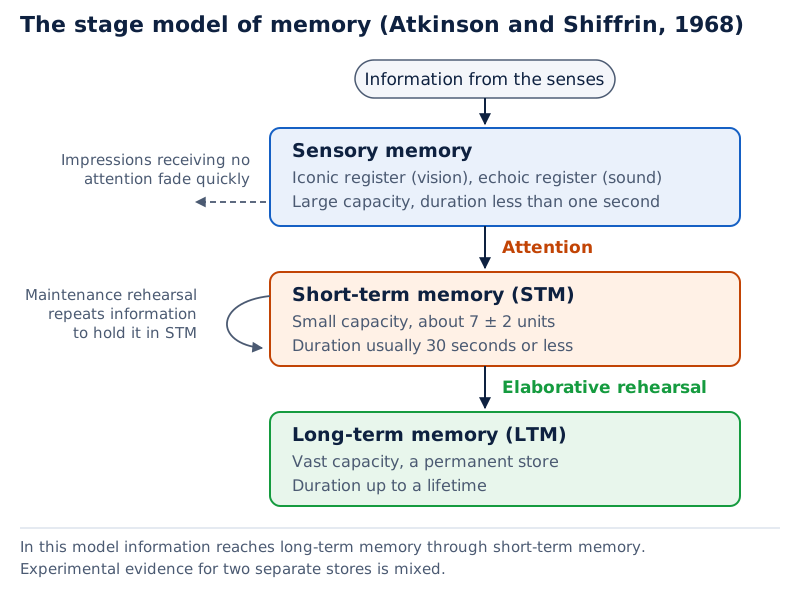
Boxes run from information to sensory memory, short-term memory and long-term memory. The connecting arrows are labelled Attention and Elaborative Rehearsals. Sensory duration is less than one second; short-term duration is less than 30 seconds; long-term duration is up to a lifetime.
Drawn by One Young India. See Fig. 6.1 in your NCERT textbook
How do control processes maintain and organise information?
Control processes regulate the movement of information through memory stores and help retain it. They explain how information moves between stores, rather than merely describing the stores' capacity and duration.
Selective attention, attending to some information rather than all sensory input, is the first control process. Only attended information moves from sensory registers into STM. Sense impressions that receive no attention fade quickly.
How do the two kinds of rehearsal differ?
| Control process | What it involves | Role in remembering |
|---|---|---|
| Maintenance rehearsal | Silent or spoken repetition of information | Maintains information in STM; when repetition stops, the information is lost. |
| Elaborative rehearsal | Connecting new information with knowledge already in LTM | Supports entry into long-term memory by developing associations and organisation. |
Elaborative rehearsal analyses the associations that information brings to mind. Understanding “humanity” becomes easier when the meanings of compassion, truth and benevolence are already known.
Incoming information can be placed in a logical framework, connected to similar memories or represented through a mental image. The number of associations created around new information determines its permanence in this account. Repetition and elaboration therefore perform different functions.
How does chunking help?
Chunking combines smaller units into larger meaningful groups. The stated STM capacity is 7 ± 2, meaning seven plus or minus two units; the symbol ± means “plus or minus”. Chunking expands the amount of information handled by grouping smaller units together.
The digit string 194719492004 can become 1947, 1949 and 2004. These groups connect to India's independence, adoption of the Indian Constitution, and the tsunami affecting coastal India and South East Asian countries, respectively. Their meaningful organisation helps hold the original string.
Chunking depends on discovering a principle linking the smaller units. It is both a control process within STM and an organisational strategy for improving memory more generally.
What is working memory, and why has the stage model been questioned?
Working memory is an active mental workbench where information is held, handled and transformed during tasks. Baddeley proposed this multicomponent view in 1986, suggesting that short-term memory is more than a passive store and may contain several components.
What are the components of working memory?
- Phonological loop: Holds a limited number of sounds. Unless rehearsed, these decay within 2 seconds.
- Visuospatial sketchpad: Stores visual information and spatial information, meaning information about space and location. Its capacity is also limited.
- Central executive: Organises information from the loop, sketchpad and LTM. It distributes attention and monitors, plans and controls behaviour during a mental task.
What evidence challenges separate stores?
Tests of the stage model have produced mixed results. Some experiments clearly support separate short-term and long-term stores, while others question their distinctiveness. Later evidence shows that STM can also use meaning and LTM can also use sound, contrary to a strict coding distinction.
Shallice and Warrington reported the case of KF, the identifying label used for a man, in 1970. Following an accident that damaged part of the left half of his brain, his STM was seriously affected while his LTM remained intact.
This raised a difficulty for a model in which information reaches LTM through STM. Other studies also found similar memory processes across retention lasting seconds or years. Such findings supported attempts to understand memory without assuming separate stores.
Note: Evidence supporting the stage model is mixed. Do not present sound-based STM and meaning-based LTM as an exclusive distinction.
How do levels of processing affect retention?
Craik and Lockhart proposed the levels of processing view in 1972. It links later retention to how information is initially perceived, analysed and understood. The approach has undergone revisions, but its basic concern with the manner of processing remains.
What are the three levels?
| Level | Focus | Example using the word “cat” |
|---|---|---|
| Structural processing | Physical appearance; the shallowest level | Attend to letter shapes, capital or small letters, or ink colour. |
| Phonetic processing | Sounds associated with letters; an intermediate level | Attend to the sounds making up the word. |
| Semantic processing | Meaning; the deepest level | Think about the animal, evoke its image and connect it with experience. |
Structural processing concerns outward form, and phonetic processing concerns sound. Memory produced at these two levels is fragile and likely to decay rather quickly. They are shallower than processing the meaning of the same information.
Semantic processing analyses and understands meaning. Thinking of a cat as an animal with fur, four legs and a tail, and connecting its image with experience, goes beyond noticing the printed word. Such processing produces memory that resists forgetting considerably.
What does this imply for learning?
While learning a lesson, elaborate its meaning and connect it to other facts, concepts and life experiences. This is different from relying on rote memorisation, learning through repetition without elaborating meaning.
The essential issue is what is done with information during learning. The same word can be processed through appearance, sound or meaning. Deeper analysis embeds new information within existing knowledge and supports longer retention, rather than simply increasing the number of repetitions.
How do declarative, procedural, episodic and semantic memories differ?
Long-term memory contains varied information and is therefore not treated as a single uniform store. One major distinction separates declarative memory, memory for facts, names and dates, from procedural memory, memory for performing tasks and skills.
Facts such as a rickshaw having three wheels belong to declarative memory. Riding a bicycle, making tea and playing basketball involve procedural memory, sometimes called nondeclarative memory. Declarative contents can be described verbally; procedural contents cannot be described easily.
How is declarative memory classified?
Tulving distinguished episodic memory, containing personal life experiences, from semantic memory, containing general knowledge, concepts, ideas and rules of logic. These are types of declarative memory, rather than two alternative names for procedural memory.
| Feature | Episodic memory | Semantic memory |
|---|---|---|
| Content | Biographical details and personal events | General awareness, concepts and knowledge |
| Emotional character | Generally emotional | Affect-neutral, meaning emotionally neutral |
| Dating | Concerns events in personal life | Not dated by the occasion on which knowledge was acquired |
| Example | Feelings on standing first in class | Knowing the meaning of non-violence |
Personal episodes may be hard to forget, but we do not remember every event in our lives. Some painful and unpleasant experiences are not remembered in as much detail as pleasant life experiences. Emotional content therefore does not imply complete preservation of every episode.
Semantic knowledge does not require remembering when it was learned. One perhaps cannot identify the date on which a familiar concept's meaning was acquired. Semantic memory is described as affect-neutral and not susceptible to forgetting, in contrast to changing recollection of personal events.
The distinction between knowing a fact and knowing a procedure is also important. Explaining facts about a game verbally is different from describing all that is involved in executing a practised skill such as bicycle riding.
What do flashbulb, autobiographical and implicit memories show?
Flashbulb memories are detailed memories of highly arousing or surprising events. They resemble scenes frozen in memory and are linked to particular places, dates and times. Their vividness illustrates the varied nature of long-term memory.
Perhaps people make greater efforts to form these memories. Highlighting details might encourage deeper processing and provide more cues for retrieval. These are possible explanations, rather than an unqualified claim that vividness itself guarantees complete recall.
How are personal memories distributed over life?
Autobiographical memory consists of personal memories, which are unevenly distributed across the lifespan. Childhood amnesia refers here to the absence of reported memories from early childhood, particularly the first 4 to 5 years.
The frequency of memories increases dramatically in the twenties. Perhaps emotionality, novelty and the importance of events contribute. Decline in certain kinds of memory begins around 30 years of age. In old age, the most recent years are likely to be well remembered.
Can memory operate outside awareness?
Implicit memory is memory of which a person is unaware and which is retrieved automatically. It can influence behaviour even without conscious awareness that a record of an experience exists.
Many people who can type cannot correctly label blank keys on a keyboard drawing. Their performance still uses knowledge of letter positions. Similarly, patients with brain injuries who could not recall a word list could produce its words when given initial letters.
Implicit memory also occurs in people with normal memory. It therefore concerns how stored information influences performance, not simply whether someone can deliberately describe what was learned. Conscious reports do not reveal every influence of past experience.
How can different kinds of memory be measured?
Different memory tasks require different methods of measurement. A method suited to one kind of memory may not suit another. Remembering facts or episodes, using general knowledge and showing the influence of learning without awareness place different demands on participants.
How do recall and recognition differ?
In free recall, participants learn words and later produce them in any order. Better recall means producing more of the learned words. The participant must generate the items rather than select them from an offered set.
In recognition, learned items appear alongside distracters, items not previously presented. Participants identify which items they learned earlier. A greater number of recognised old items indicates better memory in this method.
| Method | Task | What is assessed |
|---|---|---|
| Free recall | Generate previously learned items in any order. | Memory related to facts or episodes |
| Recognition | Identify learned items among distracters. | Memory related to facts or episodes |
| Sentence verification | Judge whether given sentences are true or false. | Semantic memory |
| Priming | Complete parts of previously seen and unseen words. | Information whose influence may occur without awareness |
What do sentence verification and priming reveal?
In a sentence verification task, faster true-or-false responses indicate better retention of the knowledge needed to verify the sentences. This method measures general knowledge rather than asking when the information was acquired.
Priming measures the effect of earlier exposure on later performance. After seeing words such as garden, playground and house, participants complete fragments such as gar, pla and ho more quickly than fragments of unseen words. They are often unaware of this influence and report guessing.
What is the pattern of forgetting, and can trace decay explain it?
Forgetting is the loss of stored information over time. Hermann Ebbinghaus made the first systematic exploration of memory in 1885, experimenting on himself. He found that learned material is not forgotten at an even rate or completely.
He memorised nonsense syllables, syllables without meaning, including NOK and SEP. These are CVC trigrams: three-letter sequences with a consonant, a vowel and a consonant; C denotes consonant and V denotes vowel. He measured the trials needed to relearn lists after different intervals.
What does the forgetting curve show?
The rate of forgetting is greatest during the first nine hours, particularly the first hour. It then slows, with little further forgetting even after many days. Ebbinghaus's early experiments were not very sophisticated, but they strongly influenced memory research.
What the figure shows
Ebbinghaus's curve of forgetting
The horizontal axis shows time since learning in days. The vertical scales show percentages retained and forgotten. The retention curve drops steeply at first and then flattens; annotations identify 20 minutes, 1 hour and 8.8 hours.
See Fig. 6.2 in your NCERT textbook
Why is trace decay inadequate?
Trace decay, also called disuse theory, assumes that memory produces physical changes in the brain called memory traces. It proposes that traces fade and become unavailable when unused for a long time.
This predicts more forgetting after sleep than after remaining awake, since traces cannot be used during sleep. Results show the opposite: people remaining awake after learning forget more than those sleeping. Trace decay therefore does not adequately explain forgetting.
The pattern of forgetting and its explanation are different issues. The curve describes how retention changes over time; trace decay proposes why it changes. Evidence of a declining curve does not remove the need to test the proposed cause.
How do interference and missing retrieval cues cause forgetting?
Interference is competition between learned associations at retrieval. Interference theory assumes that associations remain intact and coexist independently in memory, but compete when recalled. It has perhaps been the most influential theory of forgetting.
Proactive interference works forwards: earlier learning disrupts recall of later learning. Retroactive interference works backwards: later learning disrupts recall of earlier learning. The direction concerns which learning interferes and which learning must be recalled.
How are the two kinds tested?
In the following designs, A denotes the first learning material and B the second. An experimental group receives the interfering learning; a control group rests during that phase.
| Interference | Participant/group | Phase 1 | Phase 2 | Testing phase |
|---|---|---|---|---|
| Retroactive | Experimental participant/group | Learns A | Learns B | Recalls A |
| Retroactive | Control participant/group | Learns A | Rests | Recalls A |
| Proactive | Experimental participant/group | Learns A | Learns B | Recalls B |
| Proactive | Control participant/group | Rests | Learns B | Recalls B |
When someone learns two lists of nonsense syllables and recalls items from the second while trying to recall the first, later associations interfere with earlier ones. The target material in the test must therefore be identified before classifying the interference.
How does retrieval failure differ?
Retrieval cues are aids to recovering stored information. Tulving and his associates showed that memory contents may become inaccessible when cues are absent or inappropriate. Here, the difficulty concerns access rather than competing associations.
Category names can cue a list containing words such as hut, wasp, cottage, gold, bronze and ant. Places of living, insects and metals provide links to the words. Recall may become near total when category cues are supplied. The physical learning context also provides effective cues.
How are emotion and forgetting related?
Repression, in Freud's account, keeps painful, threatening or embarrassing memories outside consciousness. He posited that traumatic experiences, experiences that emotionally hurt a person, could be repressed into the unconscious and become unavailable for retrieval.
In some persons, trauma may produce psychological amnesia, psychologically associated loss of memory. A fugue state involves assuming a new identity, name or address. Forgetfulness under stress and high anxiety is not uncommon, including nervousness that disrupts recall of well-prepared material.
How do mnemonics use images and organisation?
Mnemonics are strategies for improving memory. Some create vivid, interacting images, while others impose order on material. Their purpose is to make information easier to retain and retrieve through imagery or organisation.
How do image-based methods work?
The keyword method connects an unfamiliar foreign word with a similar-sounding known word, then creates an interacting image. For the Spanish word Pato, meaning duck, the English keyword “pot” supports the image of a duck in a pot full of water.
This method is much superior to rote memorisation for learning foreign words. The English keyword serves as a sound link, while the imagined interaction connects it with the word's meaning. The image is therefore part of the learning method, rather than an unrelated picture.
The method of loci associates items with familiar physical locations in a specific sequence. It is particularly helpful for remembering items in serial order, meaning a particular sequence.
- Visualise familiar places or objects in a specific sequence.
- Imagine the items that need to be remembered.
- Associate the items one by one with the physical locations.
- Mentally follow the route to retrieve the items in sequence.
For bread, eggs, tomatoes and soap, imagine bread and eggs in the kitchen, tomatoes on a table and soap in the bathroom. A mental walk from kitchen to bathroom recalls the shopping items through their imagined locations.
How do organisational methods work?
Organisation imposes order on material and provides a framework that makes retrieval fairly easy. Chunking groups small units through an organising principle. The first letter technique selects the first letter of each word and arranges the letters into a word or sentence.
VIBGYOR represents Violet, Indigo, Blue, Green, Yellow, Orange and Red, the rainbow colours. Each letter points to one colour. Such organisation helps recall the sequence through a compact cue rather than treating all the words as unrelated items.
How can memory improvement become part of studying?
Mnemonic strategies are too simplistic and perhaps underestimate the complexity of memory tasks and the difficulties people experience. A more comprehensive approach applies knowledge of memory processes to learning, rather than relying on one memory device.
Which principles support improvement?
- Use deep processing: Ask questions, consider meaning and examine links with known facts. New information becomes part of existing knowledge, increasing the chances of remembering it.
- Minimise interference: Avoid studying very similar material consecutively, since it produces maximum interference. Choose an unrelated subject next or distribute practice with intermittent rest periods.
- Develop retrieval cues: Identify cues within the material and connect different parts to them. Cues are easier to remember than the whole content, and the links aid retrieval.
What are the steps of PQRST?
Thomas and Robinson developed PQRST, an abbreviation for Preview, Question, Read, Self-recitation and Test. It organises studying through the following sequence:
- Preview: Look briefly through the chapter to become familiar with its contents.
- Question: Raise questions whose answers can be sought in the lesson.
- Read: Read the material while searching for answers to those questions.
- Self-recitation: After reading, try to rewrite what has been read.
- Test: Check how much of the material has been understood.
No single method solves every retention problem or produces overnight memory improvement. Health, interest, motivation and familiarity with the subject also affect memory. Strategies need to be chosen in relation to the particular memory task.
A sequence to be recalled and a lesson whose meaning must be understood place different demands on memory. Image-based devices, organisation, deeper processing and retrieval cues offer different resources, while attention to interference helps protect what has been learned.
Glossary
- Encoding — Initial registration and representation of information in a form usable by the memory system.
- Storage — The process of retaining encoded information over time so that it can be used later.
- Retrieval — Bringing stored information into awareness for use in a mental task.
- Sensory memory — A large-capacity, very brief system initially registering information received through the senses.
- Short-term memory — A limited-capacity store holding attended information, usually for thirty seconds or less.
- Working memory — An active mental workbench that holds and transforms information while tasks are performed.
- Chunking — Combining smaller information units into larger organised groups through a meaningful linking principle.
- Elaborative rehearsal — Connecting new material with existing long-term knowledge through meaning, organisation and associations.
- Declarative memory — Long-term memory for facts, names and dates that can be described verbally.
- Procedural memory — Memory for carrying out tasks and skills whose contents are not easily described verbally.
- Episodic memory — Memory for personal life experiences and biographical details, generally emotional in character.
- Semantic memory — Memory for general knowledge, concepts, ideas and logical rules, rather than dated personal episodes.
- Proactive interference — Disruption of recall of later learning by information that was learned earlier.
- Retroactive interference — Disruption of recall of earlier learning by information that was learned later.
- Retrieval cues — Aids that help recover stored information by providing relevant links at recall.
Common errors and misconceptions
- Misconception: All forgetting proves that storage has failed. Correct: Failure may concern encoding, storage or retrieval; missing or inappropriate cues can make stored information inaccessible.
- Misconception: Maintenance and elaborative rehearsals are identical. Correct: Maintenance uses repetition, while elaboration links new information to existing knowledge through meaning and associations.
- Misconception: STM uses only sound and LTM only meaning. Correct: Later experimental evidence shows that STM can also encode meaning and LTM can also encode sound.
- Misconception: Semantic and procedural memory are interchangeable names. Correct: Semantic memory concerns general knowledge; procedural memory concerns performing tasks and skills.
- Misconception: The forgetting curve falls at a constant rate. Correct: Forgetting is initially rapid and later becomes much more gradual.
- Misconception: Earlier learning disturbing later recall is retroactive interference. Correct: It is proactive interference. Retroactive interference runs from later learning towards recall of earlier learning.
- Misconception: A mnemonic guarantees immediate improvement for every memory task. Correct: No single method solves all retention problems; task demands and factors such as motivation and familiarity also matter.
Exam-style questions with model answers
Q1. Define encoding and retrieval as processes of memory. [2 marks]
- Encoding registers incoming information for the first time and represents it in a form usable by the memory system.
- Retrieval brings stored information back into awareness so that it can be used in tasks such as problem solving.
Q2. Explain the phonological loop, visuospatial sketchpad and central executive in working memory. [3 marks]
- The phonological loop holds a limited number of sounds. These decay within 2 seconds unless they are rehearsed.
- The visuospatial sketchpad stores visual and spatial information. Like the phonological loop, its capacity for holding information is limited.
- The central executive organises information from these components and long-term memory, allocates attention, and monitors, plans and controls behaviour.
Q3. A learner examines the shape of the letters in “cat”, attends to its sound, and then considers the animal's meaning and connects its image with experience. Identify the three processing levels and explain their implications for retention. [4 marks]
- Examining letter shapes involves structural processing, which focuses on physical features and is the shallowest level of processing.
- Attending to the sound of the word involves phonetic processing, an intermediate level concerned with the sounds attached to letters.
- Considering the animal's meaning and connecting its image with experience involves semantic processing, the deepest level.
- Structural and phonetic processing produce fragile memory likely to decay rather quickly; semantic processing produces memory that resists forgetting considerably.
Q4. Distinguish declarative from procedural memory, then explain episodic and semantic memory as types of declarative memory. [4 marks]
- Declarative memory contains facts, names and dates. Its contents are open to verbal description, such as the fact that a rickshaw has three wheels.
- Procedural memory concerns performing tasks and skills, such as riding a bicycle. Its contents cannot be described easily in words.
- Episodic memory contains personal life experiences and biographical details. Its contents are generally emotional in nature.
- Semantic memory contains general awareness, concepts, ideas and logical rules. It is affect-neutral and not dated by when the knowledge was acquired.
Q5. Explain trace decay theory, its prediction about sleeping after learning, the actual sleep-wake finding, and two alternative explanations of forgetting. [5 marks]
- Trace decay theory assumes that memory creates physical changes called memory traces, which fade and become unavailable when unused for a long time.
- It predicts greater forgetting after sleep than after remaining awake because, on this account, traces cannot be used during sleep.
- The finding is the opposite: those remaining awake after learning forget more than those sleeping. This shows that trace decay explains forgetting inadequately.
- Interference theory proposes that learned associations compete at retrieval. Earlier learning may disrupt later recall, or later learning may disrupt earlier recall.
- Retrieval failure occurs when retrieval cues are absent or inappropriate at recall. Stored information can become inaccessible without competition from other associations.
Q6. A and B denote two sets of learning material. In one design, an experimental group learns A, learns B and recalls A; its control group learns A, rests and recalls A. In another design, an experimental group learns A, learns B and recalls B; its control group rests, learns B and recalls B. Identify each type of interference, explain the interfering learning in each, and state the role of the controls. [5 marks]
- The first design examines retroactive interference, because the test requires recall of the earlier material, A, after learning new material, B.
- Learning B supplies later associations that can compete with associations formed while learning A. This interference works backwards towards earlier learning.
- The second design examines proactive interference, because the test requires recall of later material, B, after the earlier learning of A.
- Learning A supplies earlier associations that can compete with recall of B. This interference works forwards towards the subsequent learning.
- The controls rest during the potentially interfering learning phase. They learn and recall the target material without the extra learning included in their experimental groups.
Q7. Explain the five steps of PQRST and state one caution about memory improvement. [6 marks]
- Preview: Give the chapter a brief initial look to become familiar with its contents before beginning the more detailed learning.
- Question: Raise questions about the material and seek answers from the lesson, giving the reading a set of questions to address.
- Read: Read the lesson while looking for answers to the questions already raised about the material being learned.
- Self-recitation: After reading, try to rewrite what has been read, bringing the material back rather than continuing to read it.
- Test: Check how much has been understood at the end of the process, assessing understanding of the material studied.
- Caution: No single method solves all retention problems or improves memory overnight. Strategies must suit the task and relevant personal factors.
Q8. “Pato” is the Spanish word for duck, and “pot” is a similar-sounding English word. Using these given words, explain the keyword method in three steps. [3 marks]
- Identify pot as the familiar English keyword because its sound resembles the foreign word Pato that is to be learned.
- Create an interacting mental image of a duck in a pot full of water, linking the keyword with the meaning of Pato.
- Use this vivid connection between the similar-sounding word and the meaning to remember the foreign word. The method combines a sound link with an interacting image.
Key takeaways
- Memory involves encoding, storage and retrieval; failure to remember can arise at any of these interrelated stages.
- The stage model distinguishes sensory, short-term and long-term stores, while experimental evidence about their separation is mixed.
- Maintenance rehearsal repeats information; elaborative rehearsal connects it with existing knowledge; chunking organises smaller units into larger groups.
- Meaning-based processing is deeper than processing appearance or sound and creates memory that resists forgetting considerably.
- Declarative memory concerns facts, while procedural memory concerns skills; episodic and semantic memories are types of declarative memory.
- Forgetting is initially rapid and later gradual; interference and unavailable retrieval cues help explain failures of recall.
- Proactive interference affects later learning through earlier learning; retroactive interference affects earlier learning through later learning.
- Memory improvement combines appropriate imagery, organisation, deeper processing, reduced interference and retrieval cues, with no universal overnight solution.
Test yourself
Which control process determines movement from sensory registers to STM?
Selective attention determines which sensory information enters short-term memory; unattended impressions fade quickly.
How do iconic and echoic registers differ?
The iconic register concerns visual information, while the echoic register concerns information received through hearing.
Why did KF's case challenge the stage model?
KF had seriously affected short-term memory but intact long-term memory, challenging the proposed route through STM into LTM.
What distinguishes free recall from recognition?
Free recall requires generating learned items; recognition requires identifying them among previously unseen distracter items.
When was forgetting most rapid in Ebbinghaus's findings?
It was greatest during the first nine hours, particularly the first hour, and then slowed considerably.
How can a category name improve recall?
It can act as a retrieval cue, helping recover stored words associated with that category.
What is the method of loci particularly helpful for?
It is particularly helpful for remembering items in serial order through associations with familiar physical locations.
What should be done when similar subjects cannot be separated in a study schedule?
Distribute learning or practice by taking intermittent rest periods to minimise interference between similar materials.
Write about it
Turn a question from this chapter into a paper.
The Writing Studio has a structure guide, a rubric and citation tools for 15 formats, from essays to research papers. Drafting is free with an account. Learnacy Essential adds feedback from an AI writing coach and submission to The OYI Review.
Learnacy Essential is ₹1,499 for the year. Publication depends on review and is not guaranteed.