
Methods of Enquiry in Psychology | CBSE Class 11 Psychology Notes
On this page

This note covers the goals of psychological enquiry, scientific research, approaches to understanding experience, psychological data, observation, experiments, relationships between variables, surveys, psychological tests, case studies, data analysis, limitations of measurement and research ethics.
What are the goals of psychological enquiry?
Psychology studies experiences, behaviour and mental processes. Its scientific character comes from its methods: formal, systematic observations help researchers address questions about behaviour. Different questions require different methods, so no single method can investigate every psychological problem.
Psychological enquiry pursues five connected goals. These concern what behaviour is like, when it may occur, why it occurs, how it can change and how knowledge can improve people's lives.
| Goal | Meaning | Illustration |
|---|---|---|
| Description | Record behaviour as accurately as possible and distinguish it from other behaviours. | Describe study habits through attendance, submitting assignments, planning study and daily revision. |
| Prediction | Forecast that behaviour may occur under certain conditions, within a certain margin of error. | A child spending more time studying is likely to obtain good marks when a relationship between study time and achievement has been established. |
| Explanation | Identify the causes or determinants of behaviour. | Investigate why some children are more attentive in class. |
| Control | Make behaviour happen, reduce it or enhance it by changing its conditions. | Psychological treatment can bring about changes in behaviour. |
| Application | Use psychological knowledge to solve problems and bring positive changes to people's lives. | Yoga and meditation help reduce stress and increase efficiency. |
Antecedent conditions are conditions that led to a particular behaviour. Explanation identifies these conditions, while control changes them. Prediction becomes more accurate as the number of persons observed increases. Scientific enquiry also develops theories that lead to further research.
How is scientific research conducted?
The scientific method investigates events objectively, systematically and in a testable manner. Objectivity means that independent investigators studying the same event should, to a great extent, reach the same conclusion.
A hypothesis is a tentative answer to a research problem. Data are information collected during enquiry; the singular is datum. A research design is the blueprint of the entire study. These terms connect the four steps of research.
- Conceptualise a problem. Select a topic, then narrow it into specific research questions using earlier research, observations and personal experiences. A study of study habits might focus on behaviour at home or in the classroom. Develop a hypothesis that can be examined.
- Collect data. Plan who will participate, which methods will gather information, which tools will be used and how collection will proceed. Decide whether tools will be administered individually or in groups, then carry out the collection.
- Draw conclusions. Analyse the information using statistical procedures and graphical representations to understand its meaning. The purpose is to examine the hypothesis and draw conclusions from the evidence collected.
- Revise research conclusions. Check whether the conclusions support the hypothesis or theory. If they do not, revise it or formulate an alternative, collect new data and test it again. Future researchers can verify the conclusions.
What the figure shows
Steps in Conducting Scientific Enquiry
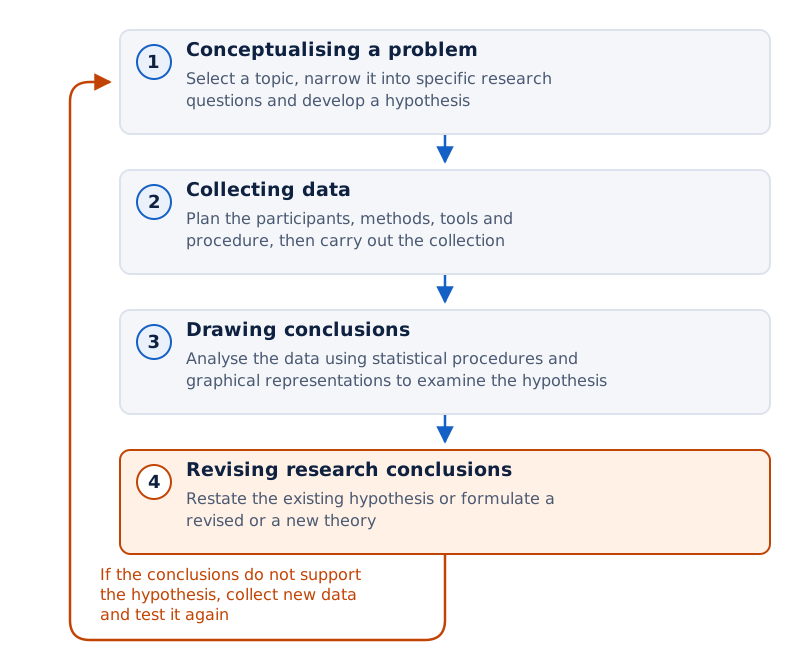
Four numbered boxes form a cycle linked by arrows: conceptualising a problem, collecting data, drawing conclusions and revising research conclusions. The final arrow returns to conceptualising a problem.
Drawn by One Young India. See Fig. 2.1 in your NCERT textbook
For example, a researcher might hypothesise that greater exposure to television violence is associated with greater aggression in children. This is a proposed answer to investigate, not a finding established simply by writing the hypothesis. Research is a continuous process.
How do research approaches and psychological data reflect context?
Scientific and interpretive approaches
A research paradigm is an approach to investigating and understanding a subject. The scientific approach assumes that behaviour is predictable, influenced by internal and external forces, and open to observation, measurement and control. Overt behaviour is behaviour that can be observed and measured.
The interpretive approach emphasises understanding over explanation and prediction. It explores the meanings people give events in particular contexts. Experiences of suffering after an earthquake or prolonged illness require attention to how individuals interpret their situations through past experiences.
Its aim is to explore experience without disturbing its natural flow. Psychological enquiry also includes reflection on one's own experiences, thought processes and behaviour, helping to understand the self.
Types and meaning of data
Psychological data include overt behaviour, covert behaviour, which is not directly observable, and subjective experiences, meaning experiences from the individual's own perspective. Data approximate reality to some extent. Their meaning depends on context, collection methods, theories, people and time.
| Type of information | What it concerns | Examples |
|---|---|---|
| Demographic information | Personal and social background | Age, gender, education, occupation, marital status and family income |
| Physical information | Environmental and living conditions | Housing, room size, school facilities and transport |
| Physiological data | Bodily characteristics and functioning | Height, weight, heart rate, sleep duration and blood pressure |
| Psychological information | Mental and behavioural characteristics and experiences | Interests, emotions, thought processes and subjective experiences |
Information may take the form of categories, such as high or low; ranks, which indicate order; or numerical scores. Researchers also collect verbal reports, diaries, observation records and field notes, meaning records made during work in the setting being studied.
People may behave differently alone and in groups. A student's report of behaviour may differ from what observation reveals. Data therefore require inference, or drawing meaning from evidence, in their proper context. They do not speak about reality by themselves.
How does scientific observation differ from everyday seeing?
Observation is a method of describing behaviour through careful attention and recording. Scientific observation involves selection, recording and analysis. It is more deliberate than seeing events during daily life without taking notice of them.
- Selection: Choose the behaviour to observe. A researcher studying school activities may prepare an activity list or explore the setting to discover what happens.
- Recording: Record selected behaviours using tallies, descriptive notes, photographs or video recordings.
- Analysis: Examine the records after observation to derive their meaning.
A skilled observer decides what and whom to observe, where and when to observe, how to record behaviour and how to analyse it. The method involves planned decisions throughout, rather than attention alone.
Which types of observation are used?
| Type | Defining feature |
|---|---|
| Naturalistic observation | Observe in a real-life setting, such as a school or home, without manipulating or controlling the situation. |
| Controlled laboratory observation | Observe in a laboratory where relevant conditions can be controlled. |
| Non-participant observation | Observe without joining the activities, for example from a classroom corner or through recorded classroom activity. |
| Participant observation | Become part of the group, taking time to build rapport, a relationship of acceptance with the group. |
The observer's degree of involvement varies with the study's focus. In non-participant observation, the observer's presence may itself change the behaviour of the teacher and students.
What are its advantages and limitations?
Observation allows behaviour to be studied in naturalistic situations as it occurs. However, it requires considerable labour and time and is susceptible to observer bias: the influence of the observer's beliefs and values on what is seen and interpreted.
To reduce this problem, record behaviour as it happens and avoid interpreting it during observation itself. What the observer thinks an action means may differ from what the participant actually means.
How do experiments use variables and comparison groups?
An experiment is a carefully regulated procedure in which one factor is changed and its effect on another is studied while other related factors remain constant. Experiments are generally conducted to establish a cause-effect relationship in a controlled setting.
A variable is a measurable stimulus or event that takes different values. An object itself is not a variable, but its attributes may be. A room is not a variable; its size is, because rooms have different sizes.
- The independent variable is the variable the researcher manipulates or alters.
- The dependent variable is the variable on which the effect of that manipulation is observed.
- Extraneous variables are other relevant influences on the dependent variable whose effects are not the focus of the study.
The independent and dependent variables are defined in relation to each other. The independent variable is not the only possible influence on behaviour, so researchers must control extraneous variables to identify the relationship being investigated.
What does the smoke experiment illustrate?
In 1970, Bibb Latane and John Darley studied Columbia University students completing a questionnaire in a waiting room. Smoke entered through a wall vent. Some students waited alone; others were with two people. Reporting the smoke was the behaviour being studied.
Confederates were people instructed by the researchers beforehand to do nothing. The presence or absence of other people was the independent variable, and the frequency of reporting smoke was the dependent variable.
| Condition | Group role | Reporting smoke |
|---|---|---|
| Student waiting alone | Control group | 75 per cent |
| Three students, not given instructions to remain inactive | Experimental group | 38 per cent of the time |
| Student waiting with two inactive confederates | Experimental group | 10 per cent of students |
An experimental group receives the independent-variable manipulation. A control group receives the same treatment except that the manipulated variable is absent. Most students waiting alone reported smoke; reporting in groups was far less. The control condition was being alone, not the absence of smoke.
How are experiments controlled, and what are their limitations?
Relevant influences include organismic variables, or characteristics of participants, such as anxiety; situational variables, such as noise and temperature; and sequential variables, arising from the order of experimental conditions. Repeated conditions may produce fatigue or practice effects that complicate interpretation.
Techniques for controlling relevant variables
- Elimination: Remove an extraneous influence where possible. A sound-proof, air-conditioned room can eliminate effects of noise and temperature.
- Holding constant: Where elimination is not possible, keep conditions unchanged so that their effects remain the same throughout the experiment.
- Matching: Equate relevant participant or background characteristics across conditions by using matched pairs.
- Counter-balancing: Change task order to minimise sequence effects. With tasks called A and B, half the group may receive A then B and the other half B then A; one person may receive A, B, B, A.
- Random assignment: Give each participant an equal chance of entering any group, eliminating potential systematic differences between groups.
In the smoke experiment, the rate of smoke entry, total smoke and room conditions were similar across groups. Participants were assigned randomly. These controls helped distinguish the influence of other people's presence from alternative influences.
Strengths, field experiments and quasi experiments
A well-designed experiment can provide, relatively speaking, convincing evidence of a cause-effect relationship. Laboratory results may not generalise well to real situations. This is the problem of low external validity, meaning limited applicability outside the study situation.
Some experiments are ethically impossible, such as deliberately starving children to study nutritional deficiency. It is also difficult to identify and control every relevant variable.
A field experiment takes place in a natural setting, such as a school comparison of demonstration and lecture teaching. Control is weaker than in the laboratory, and such experiments are more time-consuming and expensive.
In a quasi experiment, the independent variable is selected rather than varied by the researcher. Naturally occurring groups provide the comparison. For example, children who lost parents in an earthquake can be compared with children who experienced it without losing parents.
What does correlational research reveal about relationships?
Correlational research examines whether variables are associated, often for prediction. Instead of manipulating study time, a researcher measures its relationship with achievement. Covariation means that variables change together.
A correlation coefficient is a number showing the strength and direction of the relationship between two variables. Its value ranges from +1.0 through 0.0 to −1.0. The plus and minus signs indicate positive and negative directions respectively.
| Relationship | Meaning | Illustration |
|---|---|---|
| Positive correlation | Both variables increase together or decrease together. | More study time is associated with higher achievement and less study time with lower achievement. |
| Negative correlation | One variable increases as the other decreases. | More hours of study may be associated with fewer hours for other activities. |
| Zero correlation | No relationship exists between the two variables. | Values close to zero indicate no significant relationship. |
A coefficient of +.85 can indicate a strong positive association between study time and achievement. The stronger a positive association, the closer its coefficient is to +1.0. Generally, exact zero correlation is difficult to find; values such as −.02 or +.03 may occur.
Note: Correlational research identifies association without manipulating the variables. Its purpose differs from an experiment designed to establish a cause-effect relationship. Keep a prediction based on association distinct from an experimental explanation of causes.
How do surveys, interviews and questionnaires collect information?
Survey research studies opinions, attitudes and social facts. It initially described existing conditions, such as literacy or income levels. Surveys have also developed into techniques for inferring various kinds of causal relationships. Information can be collected through interviews, questionnaires, telephone surveys and controlled observation.
Interviews and interview schedules
An interview is a purposeful interaction in which an interviewer asks questions and a respondent answers them. It is generally face-to-face but can occur by telephone. An interview schedule is the list of questions prepared beforehand.
| Feature | Structured interview | Unstructured interview |
|---|---|---|
| Questions | Clearly prepared in a particular sequence | Flexible questions, wording and sequence |
| Interviewer freedom | Little or no freedom to alter wording or order | Freedom to decide what to ask and how |
| Responses | Sometimes specified in advance | Respondent answers in their chosen way |
Closed-ended questions provide possible responses in advance; open-ended questions allow respondents to choose their own wording. Interviews can involve one interviewer and one respondent, one interviewer and a group, a group interviewing one person, or a group interviewing another group.
A focus group discussion is a variant of one interviewer working with a group. Interviewers need training to put respondents at ease, recognise vague answers and seek specific information. Interviews provide depth and flexibility and can include children and non-literate persons, but require time.
Questionnaires and telephone surveys
A questionnaire contains predetermined questions that respondents read and answer on paper. It is a simple, versatile, low-cost self-report method, meaning people supply information about themselves. It can include both open-ended and closed-ended questions and can be distributed to groups or mailed.
A rating scale provides ordered response choices. For example, a three-point scale uses Agree, Undecided and Disagree. Questionnaires can collect background information, past behaviour, opinions, knowledge, expectations and aspirations. Poor response is a major difficulty with mailed questionnaires.
Telephone surveys save time, but respondents may be reluctant, uncooperative or give superficial answers. Those who respond may differ from non-respondents in age, education, income or psychological characteristics, leading to biased results.
Advantages and limitations of surveys
Surveys can gather information quickly and efficiently from thousands of people and obtain opinions soon after new issues arise. However, memory lapses, reluctance to disclose beliefs and answers chosen to please the researcher may produce inaccurate information.
For example, the December 2004 happiness survey covered 817 people aged 25 to 55 in eight cities. Its questions used a five-point happiness scale, fixed alternatives about money and questions about sources of happiness. Different question forms collected different kinds of information.
What makes a psychological test useful and standardised?
A psychological test is a standardised instrument, with specified procedures and group performance standards, used objectively to assess a person's standing relative to others on a mental or behavioural characteristic. Test questions are called items. Each item should relate to the clearly defined characteristic being assessed.
Standardisation involves specified testing procedures and the development of group performance standards. For objectivity, items must communicate the same meaning to different readers. Independent administrators should obtain more or less the same values for each person tested.
Reliability, validity and norms
Instructions, environmental conditions, time limits, individual or group administration and scoring procedures need to be specified. Test construction includes detailed analysis of the questions and the following characteristics.
- Reliability is consistency of a person's scores on the same test on two occasions. Test-retest reliability measures stability over time by correlating two sets of scores from the same people.
- Split-half reliability measures internal consistency, meaning agreement among items intended to assess the same domain. Divide the test into odd-numbered and even-numbered items and correlate the scores on the two halves.
- Validity asks whether a test measures what it claims to measure. A mathematics achievement test should assess mathematics achievement rather than language proficiency.
- Norms are the normal or average performance of a group. They allow an individual's score to be interpreted against others of the same group, with standards based on characteristics such as age and place of residence.
How do types of tests differ?
| Basis | Type | Distinguishing feature |
|---|---|---|
| Language and task form | Verbal test | Uses items written in language and requires literacy. |
| Language and task form | Non-verbal test | Uses symbols or pictures as items. |
| Language and task form | Performance test | Requires moving objects into a particular order. |
| Administration | Individual test | Administered face-to-face to one person at a time. |
| Administration | Group test | Administered to many people at the same time. |
| Time and difficulty | Speed test | Has a time limit and items of the same difficulty; assesses accurate answering within time. |
| Time and difficulty | Power test | Allows sufficient time without a time limit; items are generally arranged in increasing difficulty. |
Individual testing takes time but is important for children and people who do not know the language. Group testing is easier and less time-consuming, although respondents may lack motivation or give fake responses. Pure speed or power tests are difficult to construct; the majority combine both.
Note: Select and use tests carefully. A decision about a person should not depend on a single test. Combine test information with the person's background, interests and past performance.
How does a case study provide an in-depth understanding?
A case study is an intensive investigation of a particular case selected for its distinctive, informative features. The case may be an individual, a small group, an institution or a specific event. It need not be one person.
Researchers can combine interviews, observation and psychological tests, gathering information from several people associated with the case. Detailed accounts help explore feelings, fears, hopes, fantasies, experiences and upbringing. This method is valuable in clinical psychology and the study of human development.
Freud's observations of individual cases contributed to his theory. Piaget developed his theory through observations of his three children. Such work shows the importance of detailed records.
How should case-study evidence be handled?
Generalising from an individual case requires great caution. Establishing validity is challenging. Use multiple collection strategies, different information sources and several investigators. Plan collection carefully and preserve a chain of evidence linking the sources to the research questions.
Every method has advantages and limitations. A combination of two or more methods is desirable. When methods converge, meaning that they produce the same results, researchers can be more confident in the picture obtained.
How are quantitative and qualitative data analysed?
Quantitative analysis uses numerical information and statistical procedures to draw conclusions. Responses to tests, questionnaires and structured interviews can indicate the strength of an attribute or whether an answer is right or wrong.
For right and wrong responses, researchers normally assign 1 to a right answer and 0 to a wrong answer. Adding the assigned numbers gives an aggregate score, or total score. Researchers can compare a person's score with group performance or compare two groups using statistical methods.
Understanding descriptive information
Qualitative analysis examines descriptive information and the meanings of experiences. Narrative analysis studies a person's story to understand how an experience is organised and what it means to that person. Quantifying a mother's loss of her child would not reveal the organisation of her experience.
Participant observation and unstructured interviews generally produce descriptions: participants' words, field notes, photographs and recorded conversations. Content analysis identifies thematic categories, meaning groups of related ideas, and develops them using examples from the data.
Quantitative and qualitative methods are complementary rather than contradictory. A suitable combination helps in understanding a phenomenon in its totality. Choosing the form of analysis depends on the nature of the information and the question being investigated.
What limits psychological measurement and interpretation?
Lack of a true zero point
Psychological measurement lacks a true zero point, meaning a point representing complete absence of the characteristic. No person has zero intelligence. Psychologists adopt a zero point, so scores have relative rather than absolute value.
Ranks also do not indicate equal differences. If students score 48, 47 and 40 out of 50, their positions are first, second and third. The difference between first and second is not the same as between second and third.
Relative nature of psychological tools
Tests reflect the context for which they were developed. Urban test items may assume familiarity with multistoreyed buildings, aeroplanes or metro railways. Such items are unsuitable for children in tribal areas who would be more at ease with local plants and animals.
A test developed in Western countries may or may not apply in India. Tools need proper modification and adaptation to the characteristics of the setting in which they are used. Context therefore matters when selecting and interpreting a test.
Subjective interpretation of qualitative data
Qualitative information involves interpretation by both the researcher and the person supplying it. Meanings may vary between individuals. It is often suggested that several investigators conduct fieldwork, discuss observations and agree on interpretations. Involving respondents in meaning-making is also helpful.
What ethical responsibilities guide psychological research?
Research ethics are moral principles governing the conduct of a study. They include respect for privacy and choice, beneficence, meaning protection from harm, and justice, meaning sharing the benefits of research with all participants.
- Voluntary participation: People must be free to decide whether to join, without coercion or excessive inducement. After the study begins, they must remain free to withdraw without penalty.
- Informed consent: Before collecting data, explain what will happen so that potential participants can make an informed choice. This matters when private information or unpleasant experiences are involved.
- Debriefing: After the study, supply information needed for a complete understanding of the research. This is particularly important after deception, meaning the use of false information or feedback. Reassure participants and remove anxiety or other adverse effects.
- Sharing results: Return to participants and explain the findings. This fulfils their expectations, and their opinions may sometimes give the researcher new insights.
- Confidentiality: Keep information private and use it only for research. It must not be passed to other interested parties. Protecting the source of data respects participants' right to privacy.
Debriefing ensures that participants leave in the same physical and mental state as when they entered. It is an obligation towards participants, not simply a report of the results.
The most effective protection of confidentiality is not recording identities. Where this is impossible, place code numbers on data sheets and keep the names and matching codes separately. Destroy the identification list as soon as the research is over.
Glossary
- Hypothesis — A tentative answer to a research problem that is examined through systematic investigation.
- Objectivity — Independent investigators should, to a great extent, reach the same conclusion about an event.
- Variable — A measurable stimulus or event that can take different values.
- Independent variable — The variable manipulated or altered by the researcher during an experiment.
- Dependent variable — The variable on which the effect of the independent variable is observed.
- Control group — A comparison group treated like the experimental group except for the absent manipulation.
- Correlation coefficient — A number representing the strength and direction of a relationship between two variables.
- Interview schedule — A list of questions prepared before conducting an interview with respondents.
- Reliability — Consistency of an individual's scores on the same test on two different occasions.
- Validity — Whether a psychological test measures the characteristic it claims to measure.
- Norms — Normal or average group performance used to compare and interpret individual test scores.
- Case study — An in-depth investigation of a distinctive individual, group, institution or event.
- Informed consent — Agreement to participate after receiving information about what will happen during the research.
- Debriefing — Providing necessary information after research to complete participants' understanding and address adverse effects.
- Confidentiality — Safeguarding participants' privacy by keeping the information they provide in strict confidence.
Common errors and misconceptions
- Misconception: Prediction guarantees that behaviour will occur. Correct: Behaviour may occur under certain conditions within a margin of error.
- Misconception: Psychological data have meaning independently of their setting. Correct: Context, people, time, theory and methods affect the information and its interpretation.
- Misconception: Naturalistic observation requires the observer to join the group. Correct: Naturalistic refers to the setting; participant observation refers to involvement in the group.
- Misconception: The independent variable is the outcome measured. Correct: It is manipulated; the dependent variable is the outcome on which its effect is observed.
- Misconception: Reliability and validity mean the same thing. Correct: Reliability concerns consistency; validity concerns measuring the intended characteristic.
- Misconception: Every psychological test has a time limit. Correct: Power tests provide sufficient time without a time limit; the majority of tests combine speed and power.
- Misconception: Qualitative and quantitative methods contradict each other. Correct: They are complementary and can be combined to understand a phenomenon more fully.
- Misconception: Agreeing to participate removes the right to withdraw. Correct: Participants remain free to withdraw without penalty after research begins.
Exam-style questions with model answers
Q1. Distinguish reliability from validity in psychological testing. [2 marks]
- Reliability concerns consistency of the scores an individual obtains on the same test on two different occasions.
- Validity concerns whether the test measures the characteristic it claims to measure, such as mathematics achievement rather than language proficiency.
Q2. Describe the four steps of scientific research in their correct sequence. [4 marks]
- Conceptualise a problem by selecting a topic, narrowing it into specific questions and developing a tentative answer or hypothesis.
- Collect data after planning the participants, methods, tools and procedure within a research design.
- Draw conclusions by analysing the collected information through statistical procedures and graphical representations to examine the hypothesis.
- Revise research conclusions when findings do not support the hypothesis, then test the revised or alternative explanation using new data.
Q3. Students complete a questionnaire while smoke enters a waiting room. Some wait alone, some with two other uninstructed students, and some with two confederates instructed to remain inactive. Reporting smoke is recorded. Identify both variables and explain which conditions are control and experimental groups. [4 marks]
- The independent variable is the presence or absence of other people in the room, varied across the waiting conditions.
- The dependent variable is the frequency of reporting smoke, which records the behaviour affected by the manipulation.
- The students waiting alone form the control group because the manipulated presence of other people is absent.
- The conditions with other uninstructed students and with inactive confederates form the two experimental groups because other people are present.
Q4. A researcher observes children's play at a nursery school without attempting to influence or control it. Identify the observation type by setting, describe the three stages of scientific observation and give one limitation. [5 marks]
- This is naturalistic observation because behaviour is studied in its real-life nursery-school setting without manipulating or controlling the situation.
- Selection requires deciding which aspects of children's play to observe, rather than trying to record every behaviour encountered in the setting.
- Recording requires documenting the selected behaviour as it occurs, using suitable means such as tallies, detailed notes, photographs or video recording.
- Analysis follows observation: the researcher examines the recorded information to derive meaning from it and understand the behaviour being studied.
- Observer bias is a limitation because beliefs and values may affect interpretation. Recording behaviour without interpreting it during observation helps address this problem.
Q5. Explain three general limitations of psychological enquiry. For the issue of ranks, use students scoring 48, 47 and 40 out of 50, placed first, second and third respectively. [3 marks]
- Psychological measurement lacks a true zero and has relative value. The given ranks are consecutive, but the score gaps between successive students are unequal.
- Psychological tools reflect their original context. Tests developed for one setting may require modification and adaptation before use in another.
- Qualitative data involve interpretation by researchers and respondents, so meanings may differ. Several investigators discussing observations, with respondents involved, can help develop agreement.
Q6. Explain the five important ethical responsibilities of a psychologist conducting research with human participants. [5 marks]
- Ensure voluntary participation: people choose whether to participate without coercion or excessive inducement and may withdraw without penalty after the research begins.
- Obtain informed consent by explaining what will happen during the study before collecting data, enabling participants to make an informed decision.
- Debrief participants after the study, especially following deception. Complete their understanding, offer reassurance and address anxiety or other adverse effects caused by the study.
- Share findings with participants by returning to explain the results. This fulfils expectations, and their responses may sometimes provide new insights.
- Protect confidentiality by keeping information private and using it only for research. Avoid recording identities where possible; otherwise, put code numbers on data sheets and keep the names with their matching codes in a separate identification list.
Q7. Explain one advantage and one limitation of questionnaire surveys. [2 marks]
- Questionnaires provide a simple, versatile and low-cost way of collecting information through a predetermined set of questions.
- A mailed questionnaire may receive poor responses, reducing the information the researcher obtains from the people contacted.
Q8. A study reports a correlation coefficient of +.85 between study time and achievement. Identify its direction and strength, and distinguish this research from an experiment. [3 marks]
- The direction is positive: higher study time is associated with higher achievement, while lower study time is associated with lower achievement.
- The value +.85 indicates a strong positive association. Stronger positive relationships have coefficients closer to +1.0.
- Correlational research examines association without manipulating study time. An experiment changes an independent variable while controlling related factors to investigate a cause-effect relationship.
Key takeaways
- Psychological enquiry aims at description, prediction, explanation, control and application of knowledge to improve people's lives.
- Scientific research moves through conceptualising a problem, collecting data, drawing conclusions and revising conclusions in a continuing cycle.
- Psychological data acquire meaning within their physical and social contexts and through the methods used to collect them.
- Observation selects, records and analyses behaviour; experiments manipulate variables while attempting to control other relevant influences.
- Correlation represents the direction and strength of association, while surveys gather information about opinions, attitudes and social facts.
- Psychological tests require clear procedures, reliability, validity and norms; decisions should also consider background and past performance.
- Case studies offer detailed understanding, but generalisation requires caution; combining methods can increase confidence when results converge.
- Ethical research protects voluntary choice, informed consent, participants' understanding, access to results and the confidentiality of information.
Test yourself
What are the three meanings of control as a research goal?
Control means making a behaviour happen, reducing it or enhancing it by changing the conditions responsible for it.
What four decisions are required when planning data collection?
Decide the participants, methods of data collection, research tools and procedure through which the data will be collected.
How does participant observation differ from non-participant observation?
A participant observer joins the group and builds acceptance; a non-participant observer records behaviour without joining its activities.
Why are extraneous variables controlled in experiments?
They can influence the dependent variable, making it difficult to identify the effect of the independent variable.
What does a negative correlation indicate?
It indicates that an increase in one variable is associated with a decrease in the other variable.
How does split-half reliability assess a test?
It divides the test into odd-numbered and even-numbered items and correlates scores on the halves to assess internal consistency.
Why should a test developed in one context be used cautiously in another?
Its items may assume experiences unfamiliar in the new setting, so proper modification and adaptation may be necessary.
How can confidentiality be protected when identities must be recorded?
Use code numbers on data sheets, keep names and codes separately, and destroy the identification list when the research is over.
Write about it
Turn a question from this chapter into a paper.
The Writing Studio has a structure guide, a rubric and citation tools for 15 formats, from essays to research papers. Drafting is free with an account. Learnacy Essential adds feedback from an AI writing coach and submission to The OYI Review.
Learnacy Essential is ₹1,499 for the year. Publication depends on review and is not guaranteed.