
Motivation and Emotion | CBSE Class 11 Psychology Notes
On this page
This note covers motivation and the motivational cycle, biological and psychosocial motives, Maslow’s hierarchy of needs, the nature and expression of emotions, cultural differences in emotional labelling, managing negative emotions and examination anxiety, and enhancing positive emotions.
What is motivation, and how does the motivational cycle work?
Definition: Motivation is the process of persistent behaviour directed towards a specific goal under the influence of driving forces. It helps explain what moves behaviour.
The word motivation comes from the Latin movere, referring to movement or activity. A motive is a general state that helps explain and predict behaviour across situations. Motivation is one determinant of behaviour, rather than a complete explanation of every action.
How do motives explain everyday behaviour?
People may attend school or college to learn, make friends, obtain a qualification for a good job, or make their parents happy. A combination of these reasons may explain the decision to pursue higher education. The same activity can therefore involve several motives.
Goal-seeking behaviour, meaning behaviour directed towards achieving an objective, tends to persist until that objective is achieved. People plan and undertake activities to reach their goals. A strong desire to meet standards of excellence can support hard work in school, sport, business or music.
What connects need, drive and achievement?
A need is a lack or deficit of some necessity. A drive is the state of tension or arousal produced by a need. Arousal refers here to activation that energises activity. The motivational cycle connects this activation with action and the reduction of tension.
- A need arises because some necessity is lacking.
- The need produces a drive, a state of tension or arousal.
- The drive energises initially random activity.
- When an activity leads towards a goal, behaviour becomes directed towards achieving it.
- Achievement reduces the drive and arousal; the organism stops being active and returns to a balanced state.
What the figure shows
The motivational cycle
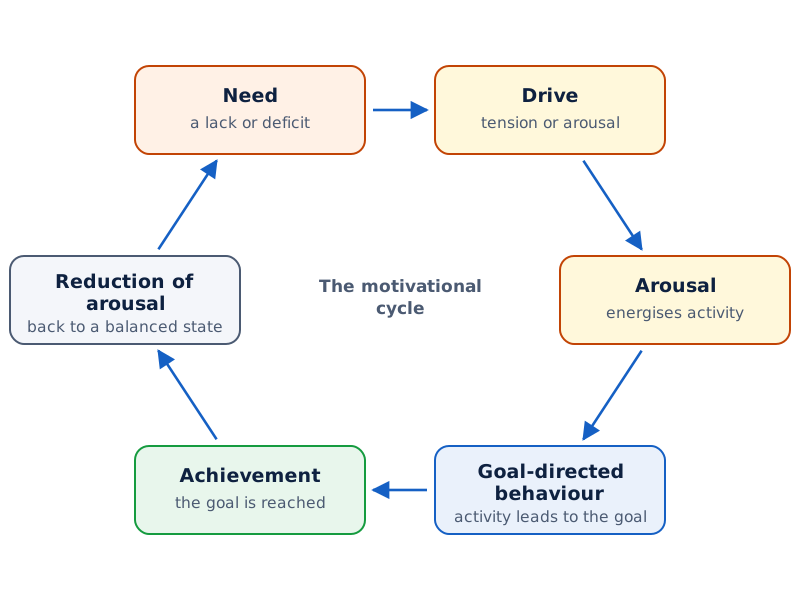
Arrows form a circle connecting Need, Drive, Arousal, Goal-directed behaviour, Achievement and Reduction of arousal, in that order, with the cycle returning towards Need.
Drawn by One Young India. See Fig. 8.1 in your NCERT textbook
How do biological and psychosocial motives combine in hunger?
Biological motives, also called physiological motives, are guided mostly by the body’s mechanisms. Psychosocial motives are primarily learned through interaction with the environment. Psychological and social influences interact in their development. These two categories are interdependent: no motive is absolutely biological or psychosocial by itself.
How do the two types differ?
| Basis of comparison | Biological motives | Psychosocial motives |
|---|---|---|
| Main emphasis | Innate biological causes and bodily mechanisms | Psychological, social and environmental influences |
| Development | Guided mostly by physiological mechanisms | Primarily learned through interaction with the environment |
| Examples | Hunger, thirst and sex | Affiliation (seeking closeness to others), achievement (meeting standards of excellence), power (influencing others), curiosity (seeking novelty) and exploration (investigating the environment) |
In some situations biological factors trigger a motive; in others psychosocial factors do so. Motives arise through varying combinations of both. The classification identifies the main emphasis without treating the two categories as completely separate explanations.
An instinct is an inborn, biologically determined pattern of behaviour rather than a learned pattern. Early explanations of motivation emphasised instincts as urges directing behaviour in predictable ways. Examples include curiosity, flight, repulsion, reproduction and parental care.
What the figure shows
Types of motives
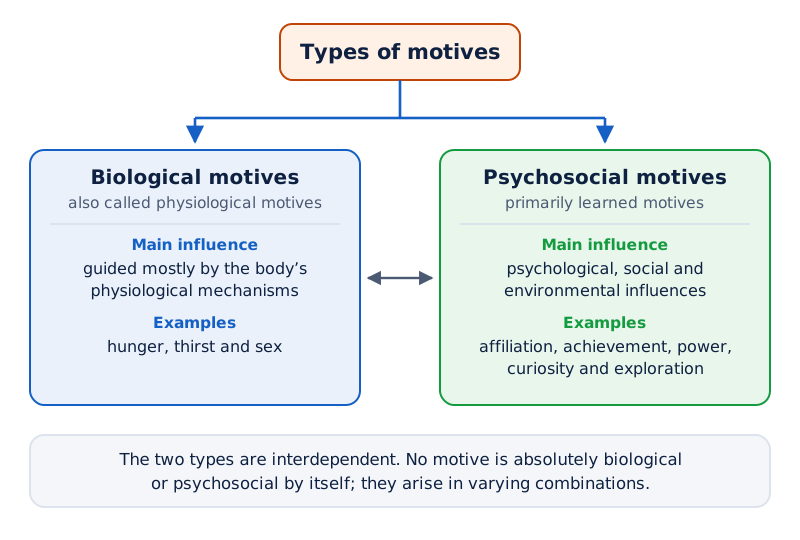
A box labelled Types of Motives branches into Biological Motives and Psychosocial Motives. The two lower boxes describe their main influences and give examples of each type.
Drawn by One Young India. See Fig. 8.2 in your NCERT textbook
What makes a person feel hungry?
Hunger motivates obtaining and consuming food. Events inside and outside the body may trigger or inhibit it. Internal signals include stomach contractions, low blood glucose, a low protein level and the amount of stored fat. Glucose is the sugar present in the blood.
The liver responds to a lack of bodily fuel by sending nerve impulses to the brain. The aroma, taste or appearance of food may also produce a desire to eat. Seeing others eat, food colour and smell contribute external cues.
None of these signals alone gives the feeling of hunger. They operate in combination. A complex feeding-satiety system, regulating eating and the feeling of having eaten enough, involves the hypothalamus, a brain structure, the liver, other body parts and environmental cues.
What controls thirst, and how is the sex drive different?
How does the body regulate thirst?
Thirst is the motivation to drink water. After several hours without water, the mouth and throat become dry. However, a dry mouth does not always produce drinking behaviour. Processes within the body control thirst, and water must sufficiently reach the tissues to remove the dryness.
Dehydration means loss of water from body tissues or cells. The motivation to drink is mainly triggered by loss of water from cells and a reduction in blood volume. When bodily fluids lose water, water leaves the interiors of cells.
The anterior, or front, part of the hypothalamus contains osmoreceptors. These are nerve cells that generate nerve impulses when cells become dehydrated. Thirst therefore involves bodily conditions and nerve signals, rather than simply the sensation of a dry mouth.
Why is sex not identical to hunger and thirst?
The sex drive is motivation to engage in sexual activity. It is one of the most powerful drives in animals and humans and strongly influences human behaviour. Yet sex is far more than a biological motive and differs from other primary motives.
Homeostasis is the organism’s tendency to maintain constancy or restore equilibrium when it is disturbed.
| Feature | Distinctive aspect of sexual motivation |
|---|---|
| Individual survival | Sexual activity is not necessary for an individual’s survival. |
| Internal balance | Homeostasis is not the goal of sexual activity. |
| Development | The sex drive develops with age. |
In lower animals the sex drive depends on many physiological conditions. In humans it is very closely regulated biologically, yet it is sometimes very difficult to classify sex purely as a biological drive.
How do affiliation, power, achievement and curiosity motivate behaviour?
Social motives are mostly learned or acquired. Family, neighbourhood, friends and relatives contribute to their development. These complex motives result mainly from a person’s interaction with the social environment, and they influence different ways of seeking relationships, accomplishment and new experiences.
What is the need for affiliation?
Affiliation means seeking other people and wanting physical and psychological closeness with them. It involves motivation for social contact. Most people need company or some form of relationship. Perceived similarities and liking help people form groups.
The need for affiliation is aroused when people feel threatened or helpless and also when they are happy. People high in this need are motivated to seek others’ company and maintain friendly relationships. It is therefore not confined to moments of difficulty.
How is the need for power expressed?
The need for power concerns producing intended effects on another person’s behaviour and emotions. Its goals include influencing, controlling, persuading, leading and charming others, and especially enhancing one’s reputation in their eyes. David McClelland described four general ways of expressing this motive:
- Strength from outside oneself: reading about sports stars or attaching oneself to a popular figure.
- Strength from within oneself: building the body or mastering urges and impulses.
- Individual influence: arguing or competing with another person to have an impact on that person.
- Organisational influence: using an organisation, as a political party leader may use the party apparatus, to influence others.
One way may dominate in an individual, but it varies with age and life experience. Power motivation therefore has several forms of expression rather than a single fixed pattern.
What characterises achievement motivation?
Achievement motivation is the desire to meet standards of excellence. The need for achievement, abbreviated n-Ach, energises and directs behaviour and influences how situations are perceived. It develops during the formative years through parents, other role models and sociocultural influences.
People high in achievement motivation tend to prefer moderately difficult and challenging tasks. They have a stronger-than-average desire for feedback, information about how they are performing. This allows them to adjust their goals to meet a challenge.
Why do people explore without a clear goal?
Curiosity describes behaviour whose primary motive appears to lie in the activity itself. Novel experiences and obtaining information can give pleasure without a specific identifiable goal. Exploration, investigating the environment, expresses curiosity and the need for varied sensory stimulation, or input through the senses.
Curiosity is found in animals as well as humans. Repetitive experiences can become boring, encouraging a search for something new. In infants and small children, exploration is very dominant. Being allowed to explore brings satisfaction. Children become easily distressed when their motive to explore is discouraged.
How does Maslow’s hierarchy organise human needs?
Maslow’s hierarchy of needs arranges needs in an ascending order from basic bodily requirements to the fullest development of personal potential. Abraham H. Maslow’s account is also known as the Theory of Self-actualisation. A hierarchy is an arrangement of levels, represented here as a pyramid.
What are the five levels?
| Level, from bottom to top | Meaning |
|---|---|
| Physiological needs | Basic needs for survival, including hunger and thirst. |
| Safety needs | Physical and psychological security from threatened danger. |
| Belongingness needs | Seeking other people, loving and being loved. |
| Esteem needs | Developing self-worth, or a sense of one’s own value. |
| Self-actualisation needs | Developing one’s potential to the fullest extent. |
In this model, lower physiological needs dominate while unsatisfied. Only when these needs are met does the need for freedom from threatened danger arise. Belongingness follows safety; after these needs are fulfilled, the individual strives for esteem and then self-actualisation.
Once lower needs are adequately satisfied, higher needs occupy attention and effort. Very few people reach the highest level because most people remain more concerned with lower needs. The movement through the hierarchy thus depends on the satisfaction of needs at lower levels.
What the figure shows
Maslow’s hierarchy of needs
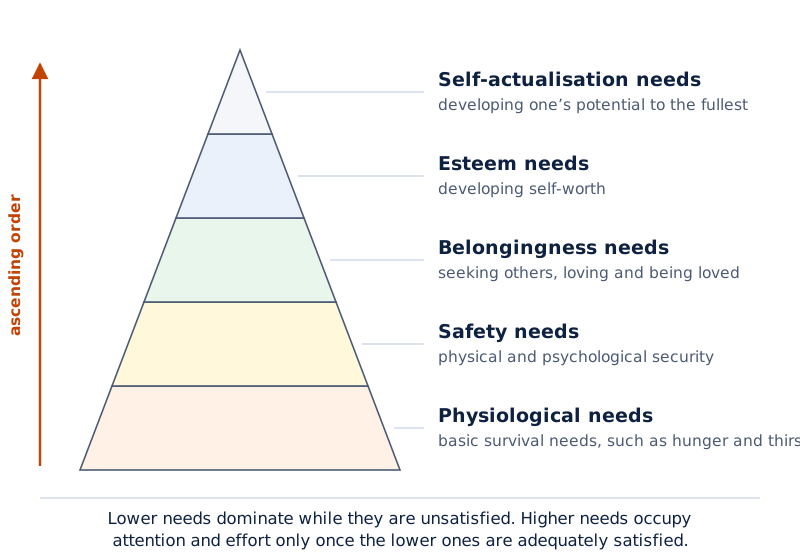
A pyramid has five horizontal bands. From its broad base to its tip, the labels are Physiological needs, Safety needs, Belongingness needs, Esteem needs and Self-actualisation needs.
Drawn by One Young India. See Fig. 8.3 in your NCERT textbook
What is a self-actualised person like?
A self-actualised person is self-aware, socially responsive, creative, spontaneous and open to novelty and challenge. Such a person also has a sense of humour and the capacity for deep interpersonal relationships. Self-actualisation concerns developing potential rather than merely obtaining approval.
Note: Actual actions sometimes contradict the hierarchy. Soldiers, police officers and fire personnel have protected others while facing very dangerous situations, seemingly contradicting the prominence of safety needs. The hierarchy should be understood alongside this qualification.
What are emotions, and how do they differ from feelings and moods?
Emotion is a complex pattern involving bodily arousal, subjective feeling and cognitive interpretation, meaning how a person understands and labels an experience. It involves physiological and psychological reactions. Emotional experience is subjective, so it varies from person to person.
How are the three terms related?
| Term | Meaning | Distinguishing feature |
|---|---|---|
| Emotion | A complex pattern of arousal, feeling and interpretation. | Includes bodily activation and conscious experience. |
| Feeling | The pleasure or pain dimension of emotion. | Usually involves bodily functions. |
| Mood | An affective, or feeling, state lasting a long time. | Has less intensity than emotion. |
Although people often use these words as synonyms, feeling and mood are narrower concepts than emotion. Emotions differ in intensity, such as high or low strength, and quality, such as happiness, sadness or fear. These are different dimensions of emotional experience.
Which emotions are considered basic?
Basic emotions are emotions identified as fundamental in accounts of emotional experience. At least six have been noted as experienced and recognised everywhere: anger, disgust, fear, happiness, sadness and surprise. Different accounts identify different sets and combinations.
Izard proposed ten basic emotions: joy, surprise, anger, disgust, contempt, fear, shame, guilt, interest and excitement. Contempt means scorn, shame a painful sense of disgrace, and guilt a feeling associated with wrongdoing. Combinations of the basic emotions produce other emotional blends.
Plutchik proposed eight primary emotions in four opposite pairs: joy and sadness, acceptance and disgust, fear and anger, and surprise and anticipation. Here, acceptance means a welcoming response, and anticipation means looking ahead to an expected event.
The emotional labels describe such experiences as delight or joy, revulsion or disgust, alarm or fear, and sorrow or sadness. The lists differ in which experiences count as basic; they should not be treated as identical classifications.
What influences emotional experience?
Subjective factors and the situation influence emotion. These factors include gender, personality and certain kinds of psychopathology, meaning psychological disturbance. Evidence indicates that women experience all emotions except anger more intensely than men, while men are prone to greater intensity and frequency of anger.
This gender difference has been attributed to social roles associated with men, such as competitiveness, and women, such as affiliation and caring. It is an account of differences in emotional experience linked to social roles, not a claim that every individual responds identically.
How are emotions expressed through words, faces and movements?
Emotion is an internal experience that other people cannot observe directly. They infer emotions, or work out what someone may be feeling, from verbal and non-verbal expressions. These channels allow people both to express their own emotions and understand the feelings of others.
What are the main communication channels?
- Verbal expression: spoken words communicate emotional experience.
- Paralanguage: non-verbal vocal features, including pitch, loudness and the timing characteristics of speech.
- Facial expression: changes in the face convey emotional information.
- Kinetic behaviour: gestures, posture and body movement communicate feelings.
- Proximal behaviour: physical distance during face-to-face interaction contributes to communication.
Facial expression is the most common channel of emotional communication. The face is exposed to others’ view, making the information it conveys easy to comprehend. It can communicate both the intensity of an emotion and its pleasant or unpleasant character.
What the figure shows
Sketches of facial expressions of emotions
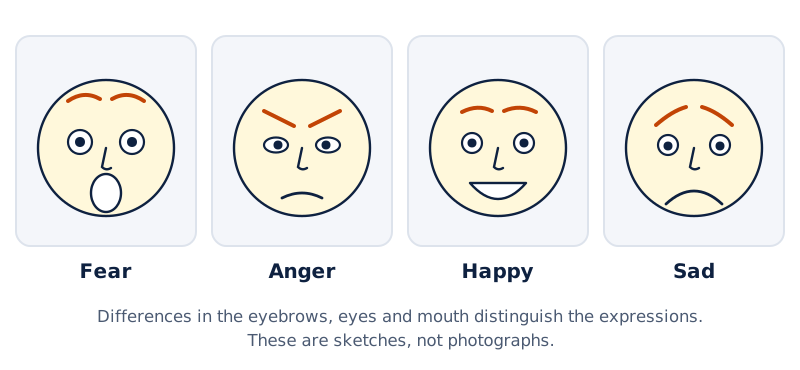
Four drawn faces appear in a row, labelled Fear, Anger, Happy and Sad. Differences in eyebrows, eyes and mouth distinguish the expressions; these are sketches, not photographs.
Drawn by One Young India. See Fig. 8.4 in your NCERT textbook
There has been some research evidence supporting Darwin’s view that facial expressions for basic emotions are inborn and universal. The emotions associated with this claim are joy, fear, anger, disgust, sadness and surprise.
How do body movements communicate?
Body movements further support emotional communication. Theatre and drama show how changes in movement convey different feelings. Indian classical dances, including Bharatanatyam, Odissi, Kuchipudi and Kathak, use movements of the eyes, legs and fingers to express emotions.
Dancers are rigorously trained in body movement and non-verbal communication. Through these movements they express joy, sorrow, love, anger and other emotional states. Gestures and physical distance also have significant roles, so emotional communication extends beyond spoken words and the face.
How does culture influence emotional expression and labelling?
Culture, the shared social ways within which people live, influences processes involved in emotion. Differences appear in gaze during conversation and in the labels used to describe emotional states. Emotional communication therefore needs attention to both shared expressions and cultural variation.
How does gaze vary?
Latin Americans and Southern Europeans have been observed directing their gaze towards the eyes of the person with whom they are interacting. Asians, particularly Indians and Pakistanis, prefer a peripheral gaze, meaning looking away from the conversational partner during interaction.
This is a difference in communication behaviour. Gaze is one of the ways culture shapes emotional expression, alongside the wider use of bodily movements and non-verbal channels. An expression is interpreted within a social interaction rather than in isolation from its cultural setting.
How do emotional labels differ?
Emotional labelling means giving names or categories to emotional experiences and expressions. Basic emotions differ in the extent to which languages elaborate and categorise them. The following examples show differences in the number of labels or responses associated with particular emotions.
| Language or group | Emotion or expression | Labels or responses reported |
|---|---|---|
| Tahitian language | The English word anger | 46 labels |
| North American subjects | Facial expression of anger | 40 different responses |
| North American subjects | Facial expression of contempt | 81 different responses |
| Japanese subjects | Facial expression of happiness | 10 labels |
| Japanese subjects | Facial expression of anger | 8 labels |
| Japanese subjects | Facial expression of disgust | 6 labels |
Ancient Chinese literature lists seven emotions: joy, anger, sadness, fear, love, dislike and liking. Ancient Indian literature identifies eight: love, mirth, energy, wonder, anger, grief, disgust and fear. Here, mirth means amusement, wonder means amazement, and grief means sorrow.
Western literature uniformly treats happiness, sadness, fear, anger and disgust as basic. Surprise, contempt, shame and guilt are not accepted as basic to all.
It might be said that certain basic emotions are expressed and understood across cultural and ethnic differences, while others are specific to a particular culture. Acknowledging common emotions therefore does not erase differences in their expression or naming.
How can negative emotions be managed, and what is post-traumatic stress disorder?
Negative emotions include unpleasant states such as fear, anger and disgust. Emotions are part of daily life and interpersonal relations. Effective emotion management supports social functioning. The following approaches might prove useful in achieving a balance of emotions.
How can awareness and thinking help?
- Self-awareness: recognise emotions and feelings, and examine how and why they arise.
- Objective appraisal: evaluate the situation. It has been proposed that evaluation of an event precedes emotion.
- Self-monitoring: continually or periodically evaluate past accomplishments, emotional and physical states, and real or vicarious experiences, meaning experiences gained through others.
- Self-modelling: observe the best parts of past performance and use them as inspiration for future improvement.
- Perceptual reorganisation and cognitive restructuring: view an event differently and reorganise thoughts to encourage positive, reassuring feelings and eliminate negative thoughts.
Experiencing an event as disturbing activates the sympathetic nervous system, the part of the nervous system involved here in bodily activation during stress. In the proposed appraisal account, an event not experienced as disturbing does not produce stress. Positive self-appraisal can strengthen confidence and contentment.
How can activities and relationships help?
Developing an interest or hobby provides an activity that interests and amuses. Nurturing good relationships also matters: in the company of happy and cheerful friends, a person will feel happy in general. These approaches connect emotional management with everyday activities and social relationships.
Empathy means trying to understand another person’s feelings. Seeking and providing mutual support can make relationships meaningful. Community service, such as helping an intellectually challenged child learn an adaptive skill, can provide insight into one’s own difficulties. An adaptive skill helps a person manage everyday demands.
What can follow a disaster?
A disaster seriously disrupts society and causes widespread material or environmental loss that existing resources cannot immediately address. It may be natural, such as an earthquake, cyclone or tsunami, or human-made, such as war. Trauma may range from perceiving the event to actually encountering it.
Either condition may lead to post-traumatic stress disorder (PTSD). A person tends to re-experience the event through flashbacks, or vivid returns of the experience, and overwhelming thoughts even after considerable time. The person becomes emotionally disturbed and fails to use an appropriate coping strategy in regular activities.
Emotions manifest in recognisable patterns involving maladaptive behaviour, meaning behaviour that does not help adjustment, and autonomic arousal, or activation of the body’s automatic functions.
How can examination anxiety be managed?
Examination anxiety is anxiety associated with the potentially stressful situation of being examined and evaluated. Anxiety involves worry and heightened emotional and bodily arousal. For most people, performing a task while knowing that performance will be evaluated is anxiety-provoking.
A certain level of anxiety is essential because it motivates effort towards the best performance. A high level, however, obstructs optimum performance and achievement. A highly anxious individual is strongly aroused physiologically and emotionally and cannot perform to the best of their abilities.
What does monitoring involve?
Monitoring means taking effective, direct action to deal with a stressful situation. It includes preparation and ways to develop confidence before the examination. These strategies address the situation and the thoughts associated with it.
- Prepare well: begin in advance and allow enough time. Familiarity with question-paper patterns and frequently asked questions increases predictability and control, reducing the examination’s stress potential.
- Rehearse: take a mock examination, ask a friend to test knowledge, or mentally visualise taking the examination calmly and confidently.
- Inoculation: prepare for stress through exposure in rehearsals and role-playing. Here the term means becoming better prepared physically and mentally for the examination situation.
- Positive thinking: list worrying thoughts systematically and deal with them rationally one at a time. Emphasise strengths and encourage positive, enthusiastic thinking.
- Seek support: ask friends, parents, teachers or seniors for help. Discussing the stressful situation with someone close can bring relief and insight.
What does blunting involve?
Blunting means avoiding the stressful situation. Avoidance is neither desirable nor possible in an examination situation, but relaxation and exercise may prove useful. This qualification prevents blunting from being confused with a recommendation to avoid taking the examination.
Relaxation generally involves sitting or lying comfortably in a quiet place, relaxing muscles, reducing external stimulation, minimising the flow of thoughts and focusing. It calms the nerves and offers an opportunity to reframe thoughts.
Exercise channels the excess energy produced when stress overactivates the sympathetic nervous system. A brief period of light exercise or active sport helps concentration on studies. Monitoring and these useful blunting techniques thus address different aspects of examination stress.
How can anger be managed and positive emotions enhanced?
What role does thinking play in anger?
Anger is a negative emotion that carries the mind away, with loss of control over behavioural functions. The major source of anger is frustration of motives, meaning that a motive is blocked or remains unfulfilled. Anger results from thinking and is neither an automatic reflex nor uncontrollable.
Anger is a self-induced choice and is controllable by one’s own thoughts only. Self-talk means what a person says internally to themselves. Avoiding self-talk that intensifies negative feelings is therefore central to this approach.
- Recognise the power of thoughts and realise that you can control anger.
- Avoid self-talk that magnifies negative feelings.
- Do not assign hidden intentions or ulterior motives to other people.
- Resist irrational beliefs about people and events.
- Find constructive ways to express anger, controlling its degree and duration.
- Look inward for control and allow time and effort to change the habit.
Why are both negative and positive emotions significant?
Emotions support adaptation to a changing environment, survival and well-being. Fear, anger and disgust prepare people mentally and physically for immediate action towards a threat. Excessive or inappropriate use of negative emotions, however, can harm the immune system, the body’s defence system, and have serious health consequences.
Positive emotions, such as hope, joy, optimism, contentment and gratitude, energise people and improve emotional well-being. Optimism involves positive expectations, contentment satisfaction, and gratitude thankfulness. Positive affect, a positive feeling state, encourages a preference for a wider variety of actions and ideas.
People shown films depicting joy and contentment generated more ideas about things they wanted to do than those shown films evoking anger and fear. Positive emotions help people consider more possibilities, cope with adverse circumstances and return quickly to a normal state.
What can strengthen positive emotions?
Positive emotions help people form new relationships and establish long-term plans and goals. The following ways of enhancing them involve personal outlook, meaningful activity and supportive connections:
- Develop optimism, hopefulness, happiness and positive self-regard, meaning a favourable view of oneself.
- Find positive meaning in dire circumstances.
- Maintain quality connections and a supportive network of close relationships.
- Engage in work and gain mastery.
- Draw on a faith that provides social support, purpose and hope, and lead a purposeful life.
- Interpret most daily events positively.
Glossary
- Motivation — The process of persistent, goal-directed behaviour resulting from driving forces that move a person towards action.
- Need — A lack or deficit of a necessity that can produce a motivational drive.
- Drive — A state of tension or arousal produced by a need that energises activity.
- Instinct — An inborn pattern of behaviour that is biologically determined rather than acquired through learning.
- Homeostasis — The organism’s tendency to maintain internal constancy or restore equilibrium when that constancy is disturbed.
- Affiliation — Seeking other human beings and wanting physical and psychological closeness through social contact.
- Achievement motivation — The desire to meet standards of excellence, directing behaviour and influencing the perception of situations.
- Self-actualisation — The motive towards the fullest development of an individual’s potential, placed highest in Maslow’s hierarchy.
- Emotion — A complex pattern of physiological activation, subjective feeling and cognitive interpretation of an experience.
- Mood — An affective state that lasts a long time but has less intensity than emotion.
- Paralanguage — Non-verbal vocal features such as pitch, loudness and the timing characteristics of speech.
- Self-monitoring — Constant or periodic evaluation of accomplishments, physical and emotional states, and real or vicarious experiences.
- Monitoring — A coping strategy involving effective and direct action to deal with a stressful situation.
- Blunting — A coping strategy involving avoidance of the stressful situation, contrasted with directly addressing it.
Common errors and misconceptions
- Misconception: Biological and psychosocial motives operate independently. Correct: They are interdependent, and no motive is absolutely biological or psychosocial by itself.
- Misconception: An empty stomach alone explains hunger. Correct: Bodily signals combine with environmental cues such as food appearance, smell and seeing others eat.
- Misconception: A dry mouth always makes a person drink. Correct: A dry mouth does not always produce drinking; cell water loss and reduced blood volume mainly trigger thirst.
- Misconception: People high in achievement motivation prefer the easiest tasks. Correct: They tend to prefer moderately difficult and challenging tasks and want stronger-than-average performance feedback.
- Misconception: Every action follows Maslow’s hierarchy without exception. Correct: Actual actions sometimes contradict it, as when people endanger themselves to protect others.
- Misconception: Emotion, feeling and mood mean exactly the same thing. Correct: Feeling concerns pleasure or pain; mood lasts longer with lower intensity; emotion is the broader concept.
- Misconception: All anxiety should disappear before an examination. Correct: A certain level supports effort, while a high level interferes with optimum performance.
- Misconception: Negative emotions have no useful purpose. Correct: They prepare people to respond to threats, although excessive or inappropriate use can harm health.
Exam-style questions with model answers
Q1. Define need and drive, distinguishing their roles in motivation. [2 marks]
- A need is a lack or deficit of some necessity.
- A drive is the tension or arousal produced by that need; it energises activity directed towards reducing the deficit.
Q2. Explain how internal bodily signals and external cues combine to regulate hunger. Give three points. [3 marks]
- Internal signals include stomach contractions, low blood glucose, a low protein level and stored fat. The liver also signals a lack of bodily fuel to the brain.
- External cues include the aroma, taste, colour and appearance of food, as well as seeing other people eat.
- No signal alone produces hunger. They combine within a complex feeding-satiety system involving the hypothalamus, liver, other body parts and environmental cues.
Q3. Explain McClelland’s four general ways of expressing the power motive, giving an example of each. [4 marks]
- People obtain a sense of power from outside themselves, for example by reading about sports stars or identifying with a popular figure.
- They develop power from within, for example by building their bodies or mastering impulses and urges.
- They influence others individually, for example by arguing or competing with another person.
- They act through organisations, for example when a political party leader uses the party apparatus to influence others.
Q4. Explain the five levels of Maslow’s hierarchy in order from the base to the top, including how movement towards higher needs occurs. [5 marks]
- Physiological needs form the base and include hunger and thirst. They dominate while unsatisfied; adequate satisfaction allows attention and effort to move towards higher needs.
- Safety needs follow the satisfaction of basic bodily needs. They involve freedom from threatened danger and security of both a physical and psychological kind.
- Belongingness needs involve seeking other people, loving and being loved. They follow safety in the hierarchy.
- Esteem needs involve developing self-worth. The individual strives for esteem after the preceding needs have been fulfilled.
- Self-actualisation is the fullest development of potential and occupies the highest level. Very few reach it because most remain more concerned with lower needs.
Q5. Distinguish emotion, feeling and mood in three points. [3 marks]
- Emotion is a complex pattern combining physiological activation, subjective feeling and cognitive interpretation. It involves both psychological and bodily reactions.
- Feeling refers specifically to the pleasure or pain dimension of emotion and usually involves bodily functions. It is narrower than emotion.
- Mood is an affective state of long duration but less intensity than emotion. It too is narrower than the broader concept of emotion.
Q6. Describe four non-verbal channels of emotional communication: paralanguage, facial expression, kinetic behaviour and proximal behaviour. [4 marks]
- Paralanguage includes non-verbal vocal features such as pitch, loudness and the timing of speech, which contribute to emotional communication.
- Facial expression communicates the intensity and pleasantness or unpleasantness of an emotional state and is the most common emotional channel.
- Kinetic behaviour includes gestures, posture and bodily movement, which help people express and recognise emotions.
- Proximal behaviour concerns the physical distance maintained during face-to-face interaction and contributes to the communication of feelings.
Q7. Explain all five monitoring strategies for managing examination anxiety. [5 marks]
- Prepare well in advance, allowing enough time and learning the question-paper pattern and frequently asked questions. Predictability and a sense of control reduce stress potential.
- Rehearse through a mock examination, a friend’s questions or mental visualisation of taking the examination calmly and confidently.
- Use inoculation: exposure through rehearsals and role-playing prepares the person physically and mentally to face the examination with greater confidence.
- Practise positive thinking by listing worrying thoughts and dealing with them rationally one by one. Emphasise strengths and encourage enthusiasm.
- Seek support from friends, parents, teachers or seniors. Talking to someone close can bring relief and help the person gain insight into the stressful situation.
Q8. During free labelling, North American subjects gave 40 responses for anger and 81 for contempt; Japanese subjects gave 10 labels for happiness, 8 for anger and 6 for disgust. Identify the largest response count in each group and explain what these examples show about emotional labelling. Give four points. [4 marks]
- Among the North American responses provided, contempt received the largest count, with 81 different responses compared with 40 for anger.
- Among the Japanese labels provided, happiness received the largest count, with 10 labels compared with 8 for anger and 6 for disgust.
- The examples show that emotional expressions can receive varied labels and that the extent of elaboration differs across groups and expressions.
- Cultural differences in labelling coexist with shared basic emotions. Common emotional experiences do not require identical labels or identical numbers of labels across cultures.
Key takeaways
- Motivation helps explain persistent goal-directed behaviour; a need produces drive, and achieving the goal reduces arousal.
- Biological and psychosocial motives are interdependent, with different combinations contributing to motivation in different situations.
- Hunger involves combined internal and external signals, while cell water loss and reduced blood volume mainly trigger thirst.
- Affiliation, power, achievement and curiosity illustrate motives acquired mainly through interaction with the social environment.
- Maslow places physiological needs below safety, belongingness, esteem and self-actualisation. Actual actions sometimes contradict the hierarchy.
- Emotion combines arousal, subjective feeling and interpretation; feeling and mood are narrower concepts with distinct meanings.
- Culture influences gaze and emotional labelling, while words, vocal features, faces and bodily movements communicate emotions.
- Managing emotions involves awareness, appraisal and constructive action; positive emotions widen possibilities and support coping, relationships and long-term goals.
Test yourself
Why can attending college reflect more than one motive?
A person may want to learn, make friends, obtain a qualification for a job and make their parents happy. A combination may explain attendance.
What are osmoreceptors, and where are they located?
They are nerve cells in the anterior hypothalamus that generate nerve impulses when cells become dehydrated.
What does n-Ach stand for, and what tasks do people high in it tend to prefer?
It stands for need for achievement. People high in it tend to prefer moderately difficult and challenging tasks.
List Plutchik’s four pairs of opposite primary emotions.
The pairs are joy and sadness, acceptance and disgust, fear and anger, and surprise and anticipation.
What is peripheral gaze?
It means looking away from the conversational partner during an interaction, rather than directing the gaze towards their eyes.
How does self-modelling differ from self-monitoring?
Self-modelling uses the best parts of past performance as inspiration. Self-monitoring evaluates accomplishments, emotional and physical states, and real or vicarious experiences.
Why does using blunting techniques not mean avoiding the examination?
Avoidance is neither desirable nor possible in an examination situation, but relaxation and exercise may prove useful in managing its stress.
How do positive emotions support problem solving?
They encourage a wider variety of actions and ideas, helping people consider more possibilities and options for solving problems.
Write about it
Turn a question from this chapter into a paper.
The Writing Studio has a structure guide, a rubric and citation tools for 15 formats, from essays to research papers. Drafting is free with an account. Learnacy Essential adds feedback from an AI writing coach and submission to The OYI Review.
Learnacy Essential is ₹1,499 for the year. Publication depends on review and is not guaranteed.