
Self and Personality | CBSE Class 12 Psychology Notes
On this page

This note covers self and identity, self-esteem, self-efficacy, self-regulation, culture and self, personality types and traits, psychodynamic, behavioural, cultural and humanistic approaches, and methods of personality assessment.
What is the self, and how does it develop?
Definition: The self is the totality of an individual's conscious experiences, ideas, thoughts and feelings about herself or himself. These define the individual's existence at personal and social levels.
The self lies at the core of personality. A newborn has no idea of its self; this idea emerges with growth. Parents, friends, teachers and other significant people help shape it through interaction, experience and the meanings given to experiences.
The structure of self is modifiable. Our own experiences and our experiences of other people can change it. Describing oneself as honest, hardworking, a singer or a dancer reveals different ways of mentally representing oneself.
How do personal and social identities differ?
| Concept | Meaning | Illustration |
|---|---|---|
| Personal identity | Attributes that distinguish a person from others | One's name, qualities, capabilities or beliefs |
| Social identity | Aspects linking a person to a social or cultural group, or derived from it | Describing oneself as North Indian or South Indian |
| Personal self | An orientation primarily concerned with oneself | Personal freedom, responsibility, achievement and comfort |
| Social self | A self emerging in relation to others and valuing relationships | Cooperation, unity, affiliation, sacrifice, support and sharing |
The social self is also called the familial or relational self because it values family and social relationships. The personal self develops from biological needs and, subsequently, psychological and social needs within the environment.
How can the self be both subject and object?
As a subject, the self acts and knows: “I am a dancer” describes an actor. As an object, it is affected, observed and known: describing oneself as easily hurt presents this other aspect. The self is both knower and something that can be known.
How do self-concept, self-esteem, self-efficacy and self-regulation differ?
Self-concept means how we perceive ourselves and what we believe about our attributes and competencies. It can be positive or negative overall, but also differ between areas: someone may view their reading ability positively and their mathematical skills negatively.
What are self-esteem and self-efficacy?
Self-esteem is our value judgement about our own worth. By 6 to 7 years, children seem to have formed self-esteem at least in academic competence, social competence, physical or athletic competence, and physical appearance. These evaluations become more refined with age.
Separate evaluations can combine into an overall sense of self-esteem. Children with high academic self-esteem perform better in schools; those with high social self-esteem are more liked by peers. Children with low self-esteem in all areas are often found to display anxiety, depression and increasing antisocial behaviour.
Warm, positive parenting helps children feel competent and worthwhile. Children whose parents help or decide for them even when assistance is unnecessary often suffer from low self-esteem.
Self-efficacy is belief in having the abilities or behaviours required by a particular situation. Bandura's social learning theory, which emphasises learning by observing and imitating others, provides its basis. Beliefs about effectiveness influence chosen behaviours and the amount of risk undertaken.
A strong sense of self-efficacy allows people to select, influence and even construct their circumstances, and they feel less fearful. Society, parents and positive experiences can strengthen it by presenting positive models during children's formative years.
How can behaviour be regulated?
Self-regulation is the ability to organise and monitor one's behaviour. High self-monitoring means being able to change behaviour according to external demands. Self-control means learning to delay or defer the gratification, or satisfaction, of needs; it helps fulfil long-term goals.
- Observation of one's own behaviour: Gather information that can help change, modify or strengthen aspects of self.
- Self-instruction: Tell oneself what to do and how to behave in the desired way.
- Self-reinforcement: Reward behaviours that have pleasant outcomes, such as seeing a film with friends after doing well in an examination.
These techniques have been found quite effective for self-regulation and self-control. Indian traditions also provide mechanisms such as fasting in vrata or roza and non-attachment to worldly things for developing self-control.
How does culture influence the boundaries of self?
Several aspects of self seem to be linked to the characteristic features of one's culture. An important distinction between Indian and Western views concerns the boundary between self and other: whether it is relatively fixed or capable of shifting.
In the Western view, this boundary appears to be relatively fixed. This view seems to hold clear distinctions between self and other, human beings and nature, and subjective and objective experience. Individual members maintain their individuality within the group.
In the Indian view, the boundary shifts. At one moment the self expands to include others or fuse with the cosmos; at another, it seems completely withdrawn and focused on personal needs or goals. Such clear divisions between self and other are not made.
What the figure shows
Self and group boundaries
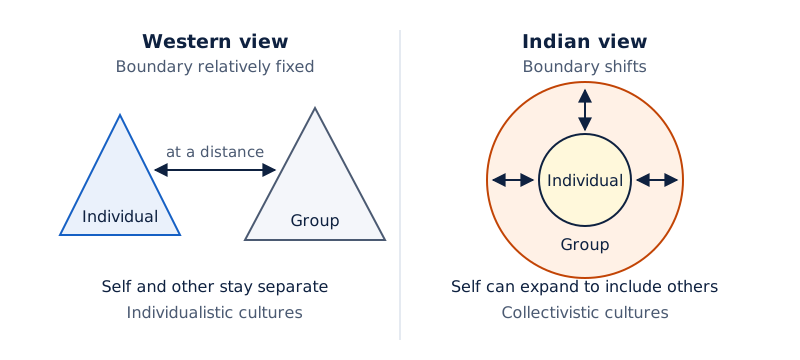
The Western perspective shows separate triangles labelled Individual and Group, connected by arrows. The Indian perspective places an Individual circle within a larger Group circle, with arrows between the inner and outer boundaries.
Drawn by One Young India. See Fig. 2.1 in your NCERT textbook
In Indian culture, the self is generally not separated from its own group; they coexist harmoniously. In Western culture, self and group often remain at a distance. Many Western cultures are therefore characterised as individualistic, emphasising individual separateness, while many Asian cultures are collectivistic, emphasising connectedness with the group.
What is personality, and how do type approaches describe it?
Personality consists of unique, relatively stable qualities characterising behaviour across situations and over time. It includes physical and psychological components. Its main features do not easily change, but it is dynamic: some features may change with internal or external demands, helping adaptation.
Personality describes how someone behaves in most circumstances. Situational variations do occur. An honest person is more likely to remain honest across situations, but personality does not mean identical behaviour everywhere. The word derives from the Latin persona, the mask worn by Roman theatre actors.
Which related terms need to be distinguished?
| Term | Meaning |
|---|---|
| Temperament | A biologically based characteristic way of reacting |
| Trait | A stable, persistent and specific way of behaving |
| Disposition | A tendency to respond to a given situation in a particular way |
| Character | The overall pattern of regularly occurring behaviour |
| Habit | An overlearned mode of behaving |
| Values | Goals and ideals considered important and worthwhile |
How are personality types constructed?
Type approaches place people in broad behavioural categories. Hippocrates proposed four types based on bodily fluids or humours. The Charak Samhita uses vata, pitta and kapha, the three humoural elements called tridosha, to describe prakriti, a person's basic nature or temperament.
The trigunas are three attributes present in everyone in different degrees. Sattva includes truthfulness, cleanliness and discipline; rajas includes intensive activity, dissatisfaction and desire for sense gratification; tamas includes anger, laziness and helplessness. Dominance of a guna may lead to a particular behaviour.
Sheldon's body typology links endomorphs, with soft, round bodies, to relaxed sociability; mesomorphs, with strong muscles and rectangular builds, to energy and courage; and ectomorphs, with thin, long, fragile builds, to being brainy, artistic and introvert, or socially withdrawn. These simple typologies have limited predictive use and resemble stereotypes.
In Jung's typology, introverts prefer solitude, tend to avoid others and withdraw during emotional conflict. Extraverts are sociable and outgoing, favour work involving people, and respond to stress through social activity.
Friedman and Rosenman's Type-A individuals seem highly motivated, impatient, hurried and burdened by work. They find relaxing difficult. Type-B means the absence of Type-A traits. Morris's proposed Type-C describes cooperative, unassertive, patient people who suppress negative emotions and comply with authority. Type-D is characterised by proneness to depression.
Note: Personality typologies are usually appealing but too simplistic. Human behaviour is complex and variable, and people do not fit neatly into these categories.
How do trait theories explain individual differences?
The trait approach identifies relatively enduring attributes along which people differ in degree. Traits are relatively stable over time and generally consistent across situations. Their strengths and combinations differ between individuals. A type groups people broadly; a trait locates them along a specific quality.
The interactional approach emphasises situational characteristics, including rewards and threats. Cross-situational consistency of traits is found to be quite low. Behaviour in a market, courtroom or place of worship illustrates the compelling influence of situations.
What did Allport and Cattell propose?
| Allport's category | Scope | Example |
|---|---|---|
| Cardinal traits | Highly generalised dispositions around which an entire life seems to revolve | Mahatma Gandhi's non-violence |
| Central traits | Less pervasive but still quite generalised dispositions | Warmth, sincerity and diligence, as used in recommendations |
| Secondary traits | The least generalised characteristics | Liking mangoes or preferring ethnic clothes |
Gordon Allport used descriptive language to identify traits. He acknowledged situations but argued that traits influence reactions to them. People sharing a trait might express it differently. Traits intervene between a situation and a person's response.
Raymond Cattell used factor analysis, a statistical technique for discovering common structures, to identify 16 primary or source traits. These stable building blocks interact to produce surface traits. He described source traits as opposing tendencies and developed the Sixteen Personality Factor Questionnaire, abbreviated 16PF.
What are Eysenck's dimensions and the Big Five?
H.J. Eysenck proposed biologically and genetically based dimensions. Neuroticism versus emotional stability ranges from anxiety, moodiness and loss of control to calmness and reliability. Extraversion versus introversion ranges from social outgoingness and thrill-seeking to quietness, caution and reserve.
He later added psychoticism versus sociability, interacting with the other dimensions. A high psychoticism score tends to indicate hostility, egocentricity and antisocial behaviour. The Eysenck Personality Questionnaire assesses these dimensions.
Paul Costa and Robert McCrae's Five-Factor Model, or Big Five, organises personality around the following factors. It has been useful in understanding personality profiles across cultures and has support from different languages and methods of study.
| Factor | High-score characteristics | Opposite characteristics |
|---|---|---|
| Openness to experience | Imaginative, curious, interested in new ideas and cultural pursuits | Rigid |
| Extraversion | Socially active, assertive, outgoing, talkative, fun-loving | Shy |
| Agreeableness | Helpful, cooperative, friendly, caring, nurturing | Hostile and self-centred |
| Neuroticism | Emotionally unstable, anxious, worried, fearful, distressed, irritable, hypertensive, meaning having high blood pressure | Well adjusted |
| Conscientiousness | Achievement-oriented, dependable, responsible, prudent, hardworking, self-controlled | Impulsive |
How does Freud explain consciousness and personality structure?
The psychodynamic approach examines emotional conflicts, their sources and consequences, and how people handle them. Sigmund Freud developed it through clinical practice. He used free association, openly reporting thoughts, feelings and ideas as they arise, alongside dream analysis and analysis of errors.
What are the three levels of consciousness?
- Conscious: Thoughts, feelings and actions of which people are aware.
- Preconscious: Mental activity that people may become aware of only by attending closely to it.
- Unconscious: Mental activity of which people are unaware.
Freud regarded the unconscious as a store of instinctive drives and concealed wishes, hidden perhaps because they produce psychological conflict. In his account, most such conflicts arise from sexual desires that cannot be openly expressed and are repressed, or kept outside awareness.
Psychoanalysis is Freud's therapeutic procedure for bringing repressed unconscious material into consciousness. Its goal is to help people live with greater self-awareness and integration. Dreams, jokes, forgetting and mispronunciations provide routes towards understanding unconscious processes.
How do id, ego and superego differ?
| Element | Function | Ice-cream illustration |
|---|---|---|
| Id | Source of instinctual energy; seeks immediate satisfaction through the pleasure principle, seeking pleasure and avoiding pain | Urges a boy to grab and eat the cone |
| Ego | Grows from the id; follows the reality principle, seeking satisfaction in accordance with reality | Recognises possible punishment and favours asking permission |
| Superego | Moral branch of functioning; internalises parental authority and judges whether satisfaction is ethical | Regards asking his mother for the cone as morally correct |
Freud treated these as competing forces whose relative strengths determine personal stability. Libido is the instinctual life force energising the id. Freud also proposed a death instinct but focused more on the life, or sexual, instinct.
What the figure shows
Personality structure
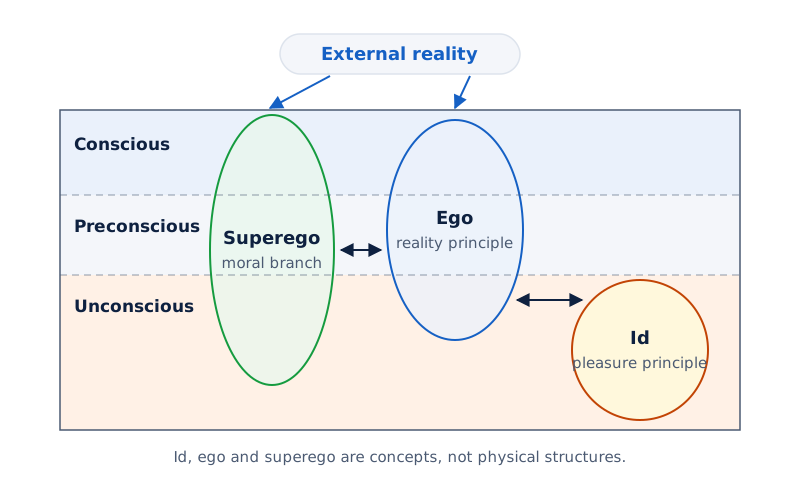
A layered drawing labels Conscious, Preconscious and Unconscious. Circles labelled Superego, Ego and Id occupy different positions, with arrows connecting them and arrows labelled External Reality above. These are psychological concepts, not physical structures.
Drawn by One Young India. See Fig. 2.2 in your NCERT textbook
How do defence mechanisms and psychosexual stages work in Freud's theory?
A defence mechanism reduces anxiety by distorting reality. Freud believed that such mechanisms protect the ego from awareness of instinctual needs. Some defence is normal and adaptive; extensive distortion of reality can produce maladjustment. People using these mechanisms are often unaware of doing so.
Which defence mechanisms are important?
| Mechanism | Meaning | Illustration |
|---|---|---|
| Repression | Anxiety-provoking thoughts or behaviours are dismissed by the unconscious | A person becomes totally unaware of the repressed wish or desire |
| Projection | Attributing one's own traits to others | An aggressive person may see others as excessively aggressive towards them |
| Denial | Totally refusing to accept reality | A person altogether denies an illness |
| Reaction formation | Adopting behaviour opposite to one's true feelings | Strong sexual urges are channelled into religious fervour |
| Rationalisation | Making unreasonable feelings or behaviour seem reasonable and acceptable | After poor examination performance, a student buys new pens and claims these will improve performance |
Freud's claims about defences have been questioned. In particular, the claim that projection reduces anxiety and stress has not found support in several studies.
What are the five developmental stages?
Freud proposed psychosexual development, a sequence in which the focus of pleasure changes. He claimed that core personality features form early, remain stable and are difficult to change. Problems at a stage may arrest development and have long-term effects.
- Oral stage: The newborn's pleasure centres on the mouth through feeding, thumb sucking, biting and babbling. Basic feelings about the world develop during these early months.
- Anal stage: Around ages two and three, controlling urination and defecation becomes important. Pleasure in bowel movements conflicts with demands for controlled behaviour.
- Phallic stage: Around ages four and five, interest centres on the genitals and awareness of sex differences. The Oedipus complex involves a boy's love for his mother, hostility towards his father and fear of punishment by him. Resolution involves identification with the father. For girls, the Electra complex follows a slightly different course: attachment to the father gives way to identification with the mother.
- Latency stage: From about seven years until puberty, sexual urges are relatively inactive. Energy is directed towards social or achievement-related activities.
- Genital stage: Psychosexual maturity develops; earlier sexuality, fears and repressed feelings reappear. People learn socially and sexually mature ways of relating to the opposite sex.
Fixation means development becomes arrested at an earlier stage after failure to pass through it successfully. Regression means returning to an earlier stage and displaying less mature behaviour when resolution of developmental problems is inadequate. These describe different developmental difficulties within Freud's theory.
How did post-Freudian thinkers change the psychodynamic approach?
Post-Freudian, or neo-analytic, theories reduce the prominence of sexual and aggressive tendencies and expand the role of the ego. They give greater attention to creativity, competence, problem-solving and social relationships. Their explanations differ from one another as well as from Freud's account.
What did Jung, Horney and Adler emphasise?
Carl Jung's analytical psychology stresses balancing competing forces within the individual. People are guided as much by aims and aspirations as by sex and aggression. His collective unconscious contains inherited archetypes, primordial images such as God or Mother Earth, found in myths, dreams and art.
Jung held that the self seeks unity and oneness. Increasing awareness of personal and collective unconscious wisdom, and living in harmony with it, help achieve wholeness.
Karen Horney emphasised growth and challenged the view of women as inferior. She argued that neither sex is superior. Disturbed childhood relationships produce basic anxiety, insecurity arising from indifferent, discouraging or erratic parenting, and basic hostility, deep resentment towards parents.
Alfred Adler's individual psychology treats behaviour as purposeful and goal-directed. People can choose and create; personal goals motivate them. His inferiority complex refers to feelings of inadequacy and guilt arising from childhood. Overcoming this complex is essential for optimal personality development.
What did Fromm and Erikson contribute?
Erich Fromm viewed people as social beings whose personality develops through relationships. Growth and fulfilment of potential arise from desires for freedom, justice and truth. Social experience shapes character, while dominant character traits also help shape social processes and culture.
Erik Erikson emphasised rational, conscious ego processes and lifelong development. Ego identity, a meaningful sense of unity and purpose, is central. His adolescent identity crisis concerns the need to establish a central perspective and direction for one's life.
What are the limitations of psychodynamic theories?
- They rely largely on case studies and lack a rigorous scientific basis.
- Generalisations are drawn from small and atypical samples.
- Concepts are not properly defined and are difficult to test scientifically.
- Freud used males as the prototype and overlooked female experiences and perspectives.
How do behavioural and cultural approaches explain personality?
The behavioural approach emphasises definable, observable and measurable data. Personality is understood as an individual's response to the environment. For most behaviourists, a response, behaviour emitted to satisfy a need, is the structural unit of personality.
How does learning shape behaviour?
Development involves learning new responses to new environments and stimuli, meaning events or conditions eliciting responses. Reinforcement, such as parental appreciation, helps maintain behaviour. Children may initially eat vegetables to gain appreciation; later they may also acquire a liking for their taste.
Learning theories explain behaviour from different angles. Bandura's observational learning emphasises thought processes, observation and imitation of others, and self-regulation. Other behavioural learning accounts focus on stimulus-response connections and reinforcement; the observational account gives particular importance to learning through watching people.
How does culture shape adaptation?
The cultural approach links personality to ecology, the environmental conditions of group life, and culture. A group's economic maintenance system, its means of livelihood, influences settlement, social organisation, division of labour and child-rearing. Together these constitute children's learning environment.
Climate, terrain and available food influence economic activities. People develop behavioural qualities that help them adapt. Rituals, ceremonies, religious practices, arts, recreation and games provide ways in which personality is expressed within a culture.
The Birhor of Jharkhand illustrate hunting-gathering life. Most live a nomadic life, moving in small bands between forests for game and forest products. Children receive considerable freedom to learn hunting and gathering, encouraging independence, autonomy and achievement orientation.
In agricultural societies, socialisation encourages obedience to elders, care for younger people and responsibility towards duties. These qualities support agricultural life, whereas independence and risk-taking are more functional in hunting-gathering societies. Different economic pursuits and cultural demands foster different personality patterns.
What does the humanistic approach say about a healthy personality?
The humanistic approach emphasises subjective experience, choice and positive possibilities. Carl Rogers and Abraham Maslow developed major versions. Self-actualisation means reaching one's fullest potential. Rogers describes a fully functioning person as someone expressing capabilities, talents and potential as fully as possible.
How are the real and ideal selves related?
Rogers assumes that behaviour is goal-directed and worthwhile, and that people are innately good and will almost always choose adaptive, self-actualising behaviour. The real self concerns the person as they actually are; the ideal self is the person they would like to be.
Correspondence between real and ideal selves generally brings happiness. Discrepancy often brings unhappiness and dissatisfaction. Personality development is continuous: people learn to evaluate themselves and master self-actualisation as the self grows, expands and becomes more social.
What the figure shows
Adjustment and self-concept
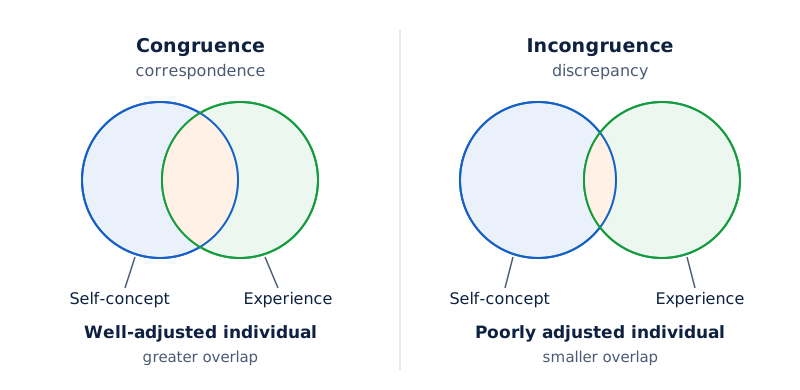
Two pairs of overlapping circles are labelled Self-concept and Experience. Greater overlap appears under Congruence, meaning correspondence, and Well-adjusted individual; smaller overlap appears under Incongruence, meaning discrepancy, and Poorly adjusted individual.
Drawn by One Young India. See Fig. 2.3 in your NCERT textbook
Positive social conditions support high self-concept and self-esteem. People with these are generally flexible and open to new experiences. Unconditional positive regard, an atmosphere of acceptance without conditions, supports this growth; Rogers's client-centred therapy attempts to create that atmosphere.
What did Maslow emphasise?
Maslow viewed people optimistically as capable of love, joy and creativity, and free to shape their lives. Biological, security and belongingness needs are survival needs shared by animals and humans. The pursuit of self-esteem and self-actualisation concerns higher development.
For humanistic thinkers, health involves more than adjustment to society. Healthy people know their feelings and limits, accept themselves and responsibility for their lives, and experience the here-and-now, the present moment. They are not trapped in the past or anxious expectations of the future.
How do self-report measures assess personality?
Personality assessment is a formal effort to understand personality and predict behaviour with minimum error and maximum accuracy. It evaluates or differentiates people using psychological characteristics and supports diagnosis, training, placement and counselling. Different methods reflect different theoretical orientations.
Self-report measures are fairly structured, often theory-based measures requiring verbal responses, usually on rating scales. Individuals report their feelings about items. Responses are accepted at face value, scored quantitatively and interpreted against norms, the test's developed standards for interpreting scores.
Which self-report measures are used?
| Measure | Developer | Features and uses |
|---|---|---|
| Minnesota Multiphasic Personality Inventory (MMPI) | Hathaway and McKinley | Developed to assist psychiatric diagnosis; the revised MMPI-2 has 567 true-or-false statements and 10 subscales |
| Eysenck Personality Questionnaire (EPQ) | Eysenck | Initially assessed introversion-extraversion and emotional stability-instability, characterised by 32 traits; psychoticism was added later |
| Sixteen Personality Factor Questionnaire (16PF) | Cattell | Uses statements and choices between alternatives; useful for career guidance, vocational exploration and occupational testing |
Mallick and Joshi developed the Jodhpur Multiphasic Personality Inventory, abbreviated JMPI, along MMPI lines for India. The 16PF can be used with high-school students and adults. In the EPQ, high psychoticism tends to involve hostility, egocentricity and antisocial behaviour.
What limitations affect self-reports?
Social desirability is the tendency to endorse items in a socially desirable way. Acquiescence is agreeing with items irrespective of their content, often by saying yes. Both make assessment less reliable, meaning less dependable.
Note: Personality testing and interpretation require substantial skill and supervised training. Familiarity with test names or sample items is insufficient for assessing another person's personality.
How do projective techniques explore unconscious motives?
Projective techniques are indirect methods intended to assess unconscious motives and feelings. They assume that relatively unstructured situations allow people to project their needs, desires and feelings. Experts interpret the responses; the method differs from asking people directly about themselves.
Stimuli are poorly defined, and the person is usually not told the assessment's purpose or scoring method. There are no correct or incorrect responses. Each response is considered meaningful; scoring and interpretation are lengthy and sometimes subjective. Qualitative analysis requires rigorous training.
How are the Rorschach and TAT administered?
Hermann Rorschach's Rorschach Inkblot Test has 10 symmetrical inkblots: five black and white, two with some red, and three in pastel colours. During performance proper, the person describes what each card shows. During inquiry, the examiner asks where, how and why the response arose.
What the figure shows
Rorschach inkblot example
The figure shows a roughly symmetrical blue inkblot with a central vertical form and irregular shapes spreading on either side. It carries no object labels.
See Fig. 2.4 in your NCERT textbook
Morgan and Murray's Thematic Apperception Test, abbreviated TAT, uses 30 black-and-white picture cards and one blank card. Twenty cards are appropriate for a subject, although fewer, even five, have been successfully used. Cards are presented individually for story construction.
The story should explain what led to the situation, what is happening, what will happen, and what the characters think and feel. A standard scoring procedure exists. Versions serve children and older people; Uma Chaudhury developed an Indian adaptation.
What the figure shows
Drawing of a TAT card
The illustration shows a younger-looking face in the foreground looking sideways, with an older-looking face behind and a hand near the mouth. No speech or written story accompanies the drawing.
See Fig. 2.5 in your NCERT textbook
What other projective methods are used?
- Rosenzweig's Picture-Frustration Study: Cartoon-like situations show one person frustrating another. The respondent says what the frustrated person will say or do. Analysis examines the type and direction of aggression. Pareek adapted it for India.
- Sentence Completion Test: The respondent finishes incomplete sentences. Endings are held to reflect attitudes, motivation and conflicts. Prompts include “My greatest fear is” and “I am proud of”.
- Draw-a-Person Test: The respondent draws a person, generally then a person of the opposite sex, and finally creates a story about the drawn person as a character.
Projective methods can help explore deep conflicts and emotional complexes, but interpretation requires specialised skills. There are problems with scoring reliability and validity, whether interpretations accurately represent what they claim to assess. Practitioners have nevertheless found these techniques quite useful.
How does behavioural analysis assess personality?
Behavioural analysis uses behaviour in different situations to understand personality. Observer reports may draw on interviews, observation, ratings, nominations and situational tests. These procedures gather different kinds of evidence about how a person generally behaves.
What can interviews and observation reveal?
An interview involves conversation and specific questions. Unstructured interviews form an impression through flexible questioning. Structured interviews use specific questions and a set procedure to support objective comparison. Diagnostic interviews probe beyond initial replies; rating scales may enhance objectivity.
Observation systematically examines behaviour using trained observers and detailed guidelines. A clinical psychologist may observe a client's interaction with family and visitors. Both observation and interviewing demand time-consuming training and professional maturity. An observer's presence may alter the behaviour being studied.
What biases affect ratings?
Behavioural ratings usually come from people who know the person well or have observed them. Clear behavioural anchors, descriptions specifying the behaviour represented by a rating, reduce confusion associated with numbers or broad adjectives.
- Halo effect: A single favourable or unfavourable trait colours the overall judgement.
- Middle category bias: Raters avoid extremes and place people near the scale's middle.
- Extreme response bias: Raters avoid middle categories and choose extreme positions.
Appropriate rater training and scales designed to minimise response bias can overcome these tendencies. Ratings are frequently used in educational and industrial settings.
How do nomination and situational tests work?
Nomination asks people who know one another well to choose group members with whom they would work, study or play, sometimes explaining why. The choices reveal behavioural qualities. The technique has been found highly dependable, although personal biases may affect it.
A situational stress test examines behaviour under stress. The person performs a task with others instructed to be uncooperative and interfering. Role performance is observed, and a verbal report is obtained. The situation may be realistic or created through a video play.
Glossary
- Self — The totality of conscious experiences, thoughts, ideas and feelings concerning oneself at personal and social levels.
- Self-concept — The way a person perceives their own attributes and competencies, generally or in specific areas.
- Self-esteem — The value judgement a person makes about their own worth as an individual.
- Self-efficacy — Belief that one possesses the abilities or behaviours required to meet a particular situation.
- Self-regulation — The ability to organise and monitor one's own behaviour in everyday life.
- Personality — Unique and relatively stable qualities characterising behaviour across situations and over time.
- Source traits — Cattell's stable primary traits, regarded as the basic building blocks of personality.
- Unconscious — The level of mental activity of which a person is not aware.
- Defence mechanism — A way of reducing anxiety by distorting reality to protect the ego.
- Fixation — Arrest of development at an earlier stage following failure to pass through it successfully.
- Self-actualisation — A state in which a person reaches their own fullest potential.
- Projective techniques — Indirect assessment methods using relatively unstructured stimuli to explore unconscious feelings, needs and motives.
Common errors and misconceptions
- Misconception: Self-esteem and self-efficacy mean the same thing. Correct: Self-esteem evaluates personal worth, whereas self-efficacy concerns belief in the abilities or behaviours needed for a particular situation.
- Misconception: A stable personality means behaving identically everywhere. Correct: Personality is relatively stable, but situational variations occur and some features may change to support adaptation.
- Misconception: A personality type and a trait are interchangeable. Correct: Types group people into broad patterns; traits describe specific attributes along which people vary in degree.
- Misconception: Id, ego and superego are physical structures. Correct: They are concepts describing competing forces in Freud's theory, inferred from behaviour rather than identified as bodily structures.
- Misconception: Fixation and regression are identical. Correct: Fixation means development is arrested at a stage; regression means returning to behaviour characteristic of an earlier, less mature stage.
- Misconception: A projective response has one plainly correct interpretation. Correct: Interpretation requires specialised training, and these techniques have problems of scoring reliability and interpretation validity.
- Misconception: Any positive impression gives an objective personality rating. Correct: A favourable trait may produce a halo effect, colouring judgement of the whole person rather than each trait separately.
Exam-style questions with model answers
Q1. Distinguish self-esteem from self-efficacy. [2 marks]
- Self-esteem is the value judgement individuals make about their own worth.
- Self-efficacy is their belief that they possess the abilities or behaviours needed in a particular situation.
Q2. Explain the three psychological techniques of self-control, with the function of each. [3 marks]
- Observation of one's behaviour supplies information about one's actions. This information can be used to change, modify or strengthen particular aspects of self.
- Self-instruction means directing oneself to act in a desired way. Such instructions are quite effective in regulating one's behaviour.
- Self-reinforcement means rewarding behaviour with pleasant outcomes, such as watching a film with friends after doing well in an examination.
Q3. A boy wants an ice-cream cone. Grabbing it would satisfy him immediately, but taking it without asking may bring punishment. He considers asking his mother instead. Explain the roles of id, ego and superego in Freud's account. [3 marks]
- The id urges him to grab and eat the cone immediately. It follows the pleasure principle, seeking satisfaction without considering social or moral requirements.
- The ego recognises the possibility of punishment and favours asking permission. Its reality principle seeks an appropriate way of satisfying the desire.
- The superego judges the approach morally. Asking his mother for the cone is regarded as ethically acceptable, avoiding guilt associated with wrongdoing.
Q4. Describe Freud's five psychosexual stages in their developmental order. [5 marks]
- Oral: The newborn's mouth is the main pleasure centre. Feeding, sucking, biting and babbling provide gratification, while basic feelings about the world develop.
- Anal: Around ages two and three, pleasure associated with bowel movements meets demands for control of urination and defecation, creating conflict over controlled behaviour.
- Phallic: Around ages four and five, the genitals become the focus. Resolving the Oedipus or Electra complex involves identification with the same-sex parent.
- Latency: From about seven years until puberty, sexual urges are relatively inactive. Much energy is channelled into social and achievement-related activities.
- Genital: Psychosexual maturity develops, earlier feelings reappear, and the person learns socially and sexually mature ways of relating to members of the opposite sex.
Q5. Explain four major criticisms of psychodynamic theories. [4 marks]
- They rely largely on case studies rather than a rigorous scientific basis, weakening the support for their broad explanations of personality.
- Their generalisations draw on small, atypical samples, creating difficulty when applying the resulting conclusions to people more widely.
- Important concepts are not properly defined, making it difficult to submit the theories to scientific testing.
- Freud used males as the prototype of personality development and overlooked the experiences and perspectives of females.
Q6. A student buys new pens after performing poorly in an examination and claims, “I will do much better with these pens”. Identify and explain the defence mechanism illustrated. [2 marks]
- The illustrated defence mechanism is rationalisation.
- The student makes the purchase seem reasonable and acceptable by claiming that new pens will improve examination performance.
Q7. Describe four features of the Rorschach Inkblot Test: its material, performance proper, inquiry and interpretation requirements. [4 marks]
- The material consists of 10 symmetrical inkblots: five black and white, two with some red, and three in pastel colours.
- In performance proper, cards are shown individually and the person says what they see in each blot.
- In inquiry, the examiner asks where, how and on what basis each response was made, preparing a detailed report.
- Interpretation needs fine judgement to place responses in context and extensive training to use the test meaningfully.
Q8. Explain social desirability, acquiescence and the halo effect as three distinct problems in personality assessment. [3 marks]
- Social desirability occurs when respondents endorse self-report items in a socially desirable manner, affecting the dependability of their reported feelings or characteristics.
- Acquiescence occurs when respondents agree with items regardless of content, often saying yes. This also makes self-report assessment less reliable.
- The halo effect is a rater's tendency to let one favourable or unfavourable trait colour the overall judgement of the person.
Key takeaways
- The self develops through interaction and experience, includes personal and social aspects, and can be understood as both subject and object.
- Self-esteem concerns worth, self-efficacy concerns perceived capability, and self-regulation concerns organising and monitoring behaviour; these concepts should be distinguished.
- Personality is unique and relatively stable, yet situational variations and adaptation remain part of its nature.
- Type approaches group broad behavioural patterns, while trait approaches describe dimensions on which individuals differ in strength and combination.
- Freud explains personality through unconscious conflict, the interplay of id, ego and superego, defence mechanisms and psychosexual development.
- Post-Freudian theories expand the importance of ego and social relationships, while humanistic theories emphasise choice, positive growth and self-actualisation.
- Behavioural explanations focus on learned responses, while cultural explanations connect personality with adaptation to ecological conditions and cultural demands.
- Self-reports, projective techniques and behavioural analysis reveal different aspects of personality, each requiring attention to training, interpretation and possible bias.
Test yourself
What makes the self both a subject and an object?
As subject, the self actively knows and acts. As object, it is observed and known or is affected by experience.
How do Indian and Western views differ in their self-other boundary?
The Western boundary appears relatively fixed. The Indian boundary shifts, and the self is generally not separated from its own group.
Which three categories of traits did Allport distinguish?
Cardinal traits are highly generalised; central traits are less pervasive but still generalised; secondary traits are the least generalised characteristics.
What are the Big Five personality factors?
They are openness to experience, extraversion, agreeableness, neuroticism and conscientiousness. The model organises traits and has been useful across cultures.
How does Horney explain basic anxiety?
Indifferent, discouraging or erratic parental behaviour makes a child feel insecure. This basic anxiety can lead to deep resentment towards parents, called basic hostility.
How does Rogers relate real and ideal selves to happiness?
Correspondence between them generally brings happiness. Discrepancy often leads to unhappiness and dissatisfaction as the person experiences distance from the desired self.
What does a TAT story need to describe?
It describes what led to the pictured situation, what is happening now, what will happen later, and what the characters think and feel.
How do middle category bias and extreme response bias differ?
Middle category bias avoids extremes and places people near the scale's middle. Extreme response bias avoids the middle and favours extreme positions.
Write about it
Turn a question from this chapter into a paper.
The Writing Studio has a structure guide, a rubric and citation tools for 15 formats, from essays to research papers. Drafting is free with an account. Learnacy Essential adds feedback from an AI writing coach and submission to The OYI Review.
Learnacy Essential is ₹1,499 for the year. Publication depends on review and is not guaranteed.