
Variations in Psychological Attributes | CBSE Class 12 Psychology Notes
On this page
This note covers individual differences, psychological assessment, intelligence and its theories, heredity and environment, intelligence testing, intellectual disability and giftedness, cultural and emotional aspects of intelligence, aptitude, and creativity.
What are individual differences and psychological attributes?
Individual differences are the distinctiveness and variations in people's characteristics and patterns of behaviour. People differ in physical features and in how they perceive, learn, think and perform tasks. Each person has a particular combination of traits, with different traits present in varying degrees.
Situationism gives relatively greater importance to external circumstances in explaining behaviour. A generally aggressive person may behave submissively before a top boss. Sometimes situational influences are so powerful that people with different personality traits respond in almost the same ways.
What does assessment involve?
Definition: Psychological assessment means measuring individuals' psychological attributes and evaluating them, often through multiple methods, against standards of comparison.
Formal assessment is objective, standardised and organised. Informal assessment varies between situations and assessors and is open to subjective interpretation. Psychologists receive training in formal assessment. Scientific measurement provides a basis for establishing an attribute's presence.
The purpose determines which attribute is assessed. Intellectual strengths and weaknesses may be examined to help a student having difficulty with examinations. Personality may be assessed when someone has adjustment difficulties, while interests and preferences may be assessed when motivation is poor.
Assessment supports predictions and possible intervention. For example, assessing Harish as dominant may lead to a prediction that he will most likely lead a team in an authoritarian manner. This is a probable outcome, and assessment can help identify a need for behavioural change.
Which domains can be assessed?
Psychological attributes are usually multi-dimensional: they involve several aspects rather than one simple dimension. A complete assessment considers functioning in cognitive, emotional and social domains, including thinking, feelings and relationships.
| Attribute | Meaning and purpose of assessment |
|---|---|
| Intelligence | General capacity to understand the world, reason and use resources effectively in facing challenges; tests assess general cognitive competence. |
| Aptitude | Underlying potential to acquire skills; tests predict what appropriate training and environment may enable a person to do. |
| Interest | Preference for particular activities relative to others; assessment helps with satisfying choices of subjects and occupations. |
| Personality | Relatively enduring characteristics that distinguish a person; assessment helps explain and predict behaviour. |
| Values | Enduring beliefs about ideal behaviour; these guide personal action and judgements about others. |
How are psychological attributes assessed?
Assessment can draw on several methods. The method must suit the information required: a measure of ability, a person's account, observation of behaviour, or a detailed understanding of an individual. These methods contribute different kinds of evidence.
What are the main assessment methods?
| Method | What it involves | Use or limitation |
|---|---|---|
| Psychological test | An objective, standardised measure of mental or behavioural characteristics. | Used for clinical diagnosis, guidance, personnel selection, placement and training. |
| Interview | Seeking information from a person through one-to-one interaction. | Used in counselling, employee selection and journalistic interviews. |
| Case study | Detailed study of an individual's attributes and psychological history within the social, psychological and physical environment. | Widely used by clinical psychologists; combines information from several methods. |
| Observation | Systematic, organised and objective recording of naturally occurring behaviour in real time. | Useful for mother-child interaction; limited control and subjective interpretations are possible problems. |
| Self-report | A person's factual information about themselves or account of their opinions and beliefs. | May use a questionnaire, interview schedule, psychological test or personal diary. |
A case study can combine interviews, observations, questionnaires and psychological tests. It is therefore a detailed investigation using different sources of data, rather than simply another name for an interview. Studying the lives of great people can also illuminate their experiences.
Observation concerns behaviour as it occurs. Its organised procedures do not remove every difficulty: the observer has little control over the situation, and personal interpretation may influence the report. Recording naturally occurring behaviour and interpreting that behaviour are connected but distinct parts of the method.
Self-report identifies who supplies the information. The person describes their own facts, opinions or beliefs. Information can be collected through several instruments, so self-report is not restricted to a single kind of questionnaire.
How do definitions and psychometric theories explain intelligence?
Intelligence helps explain differences in how people adapt to their environment. Alfred Binet defined it through judging, understanding and reasoning well. Wechsler emphasised the overall capacity to think rationally, act purposefully and deal effectively with the environment.
Gardner and Sternberg also recognised that an intelligent person actively modifies or shapes the environment. Intelligent behaviour therefore involves more than learning quickly or reproducing information accurately.
How do the two approaches differ?
The psychometric approach, also called the structural approach, treats intelligence as an aggregate of abilities and expresses performance through a single index of cognitive ability. The information-processing approach examines the processes used in reasoning and problem solving, focusing on how intelligent action occurs.
| Theory | Main explanation |
|---|---|
| Binet's one-factor theory | One similar set of abilities is used to solve problems across an individual's environment. |
| Spearman's two-factor theory | A general factor, abbreviated as g-factor, contains mental operations common to all performances; specific factors, abbreviated as s-factors, support particular abilities. |
| Thurstone's primary mental abilities | Seven primary abilities are relatively independent of one another. |
| Jensen's hierarchical model | Level I involves associative learning, where output is more or less similar to input. Level II involves higher-order cognitive competence that transforms input. |
| Guilford's structure-of-intellect model | Intellectual traits are classified through operations, contents and products. |
Spearman proposed his theory in 1927 using factor analysis, a statistical method for analysing abilities. A singer, scientist or athlete may have high general ability as well as the specific abilities needed to excel in a particular field.
What are Thurstone's seven abilities?
- Verbal comprehension: understanding words, concepts and ideas.
- Numerical abilities: speed and accuracy in numerical and computational work.
- Spatial relations: visualising patterns and forms.
- Perceptual speed: noticing details quickly.
- Word fluency: using words fluently and flexibly.
- Memory: accurately recalling information.
- Inductive reasoning: deriving general rules from given facts.
In Guilford's model, operations are what a respondent does, contents are the materials or information used, and products are the forms in which information is processed. Its six operations, five contents and six products make 180 cells. Each cell is expected to contain at least one ability; some may contain more.
What are Gardner's eight multiple intelligences?
Howard Gardner's theory of multiple intelligences treats intelligence as distinct kinds of ability rather than a single entity. Having one kind does not necessarily indicate being high or low in another. Different intelligences also interact and work together in solving a problem.
Gardner studied people with exceptional abilities in their respective areas. His account extends intelligent functioning across language, logical reasoning, space, music, movement, relationships, self-understanding and awareness of nature.
| Intelligence | Meaning | Illustration |
|---|---|---|
| Linguistic | Using language fluently and flexibly to express thought and understand others. | Poets and writers are strong in this component. |
| Logical-mathematical | Thinking logically and critically, reasoning abstractly and using symbols to solve mathematical problems. | Scientists are likely to be strong in it. |
| Spatial | Forming, using and transforming mental images. | Pilots, architects and surgeons are likely to have highly developed spatial ability. |
| Musical | Producing, creating and manipulating musical patterns. | Sensitivity to sounds and vibrations supports the creation of new sound patterns. |
| Bodily-kinaesthetic | Using the whole body or its parts flexibly and creatively for display, construction or problem solving. | Dancers, athletes and surgeons are likely to have this ability. |
| Interpersonal | Understanding other people's motives, feelings and behaviour to form comfortable relationships. | Counsellors and social workers are likely to possess high interpersonal intelligence. |
| Intrapersonal | Understanding one's own feelings, motives, desires, strengths and limitations. | Philosophers and spiritual leaders provide examples. |
| Naturalistic | Awareness of relationships with nature and ability to distinguish features of the natural world. | Farmers, botanists and bird watchers possess more of this intelligence. |
Interpersonal ability concerns understanding others, while intrapersonal ability concerns understanding oneself. Knowledge of one's own strengths and limitations can also help in relating effectively to others. Independence among intelligences does not mean that they cannot cooperate in an activity.
How does Sternberg's triarchic theory explain intelligent behaviour?
Robert Sternberg proposed the triarchic theory in 1985. It describes intelligence through three types: componential, experiential and contextual. Intelligence involves adapting to, shaping and selecting environments to achieve one's goals and those of one's society and culture.
What does each type involve?
- Componential or analytical intelligence involves analysing information to solve problems. People high in this ability think analytically and critically and succeed in school.
- Experiential or creative intelligence involves using past experience creatively to solve new problems. Different experiences are integrated in original ways, supporting discoveries and inventions.
- Contextual or practical intelligence involves dealing with everyday environmental demands. It may be called street smartness or business sense.
Practical intelligence enables adaptation to the present environment, selection of a more favourable environment, or modification of the environment to fit one's needs. Experiential intelligence includes quickly identifying which information is crucial in a situation.
What are the components of analytical intelligence?
The knowledge acquisition component supports learning and acquiring ways of doing things. The meta component, a higher-order component, plans what to do and how to do it. The performance component carries out the action.
What the figure shows
Elements of triarchic theory of intelligence
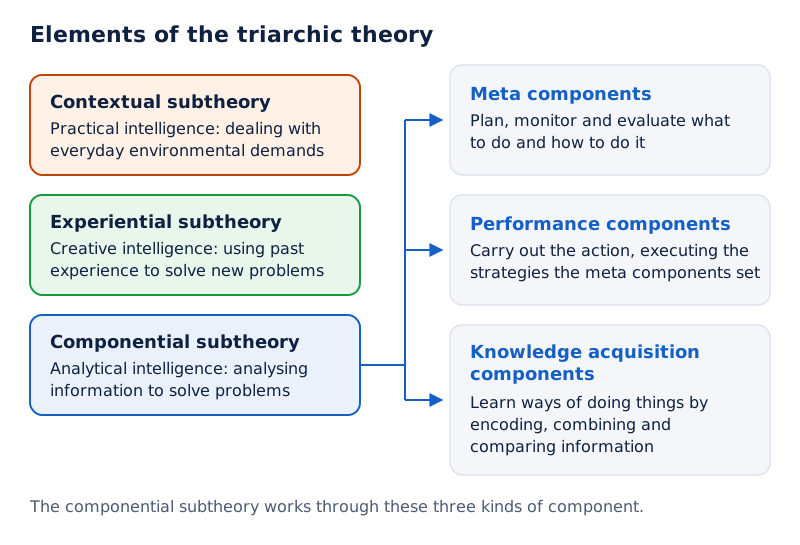
Boxes identify contextual, experiential and componential subtheories. The componential box connects to metacomponents, performance components and knowledge acquisition components. Their labels describe controlling and evaluating processing, executing strategies, and encoding, combining and comparing information.
Drawn by One Young India. See Fig. 1.1 in your NCERT textbook
This is an information-processing theory: it explains the mental processes involved in intelligent behaviour. The account connects the analysis of information with creative use of experience and practical management of environmental demands.
How does the PASS model describe intellectual activity?
PASS stands for Planning, Attention-arousal, and Simultaneous-successive processing. J.P. Das, Jack Naglieri and Kirby developed this model in 1994. It describes intellectual activity through the interdependent functioning of three neurological systems, or functional units of the brain.
These units are responsible for arousal and attention, coding or processing, and planning. The processes are interactive and dynamic, although each has a distinctive function. They operate on knowledge acquired formally through reading, writing and experiments or informally through the environment.
How do attention and processing work?
Arousal, the state that enables attention to stimuli, is basic to behaviour. An optimal level focuses attention on relevant information. Too much or too little arousal interferes with attention. Information about an approaching test may arouse attention to reading, learning and revision.
Simultaneous processing integrates relationships among concepts into a meaningful pattern. In Raven's Progressive Matrices, abbreviated as RPM, a person chooses a missing part that completes a design. Understanding relationships among the figures calls on simultaneous processing.
Successive processing involves remembering information in sequence, so that recalling one item leads to recalling another. Learning digits, alphabets and multiplication tables provides examples of this form of processing.
How is planning used?
Planning becomes active after information is attended to and processed. It involves considering possible actions, implementing them, evaluating effectiveness and modifying an unsuccessful plan. Preparing for a scheduled test illustrates this process:
- Set goals for the chapters to be learned.
- Plan a study timetable for reaching those goals.
- Seek clarification when difficulties arise.
- If the chapters remain difficult, change the approach, for example by allowing more time or studying with a friend.
Das and Naglieri developed the Cognitive Assessment System (CAS), a battery or collection of tests for people aged 5 to 18. Its verbal and non-verbal tasks measure basic cognitive functions presumed to be independent of schooling. Results can help remedy cognitive difficulties in children with learning problems.
How do heredity, environment and IQ explain differences in intelligence?
Heredity refers here to inherited influences, while environment refers to the conditions and opportunities in which development occurs. Studies of twins and adopted children provide evidence about their contributions to intelligence.
A correlation expresses the association between measures. Identical twins have the same genetic constitution; fraternal twins are non-identical twins. Intelligence correlations are almost 0.90 for identical twins reared together, 0.72 for identical twins reared apart, almost 0.60 for fraternal twins reared together, about 0.50 for siblings reared together, and about 0.25 for siblings reared apart.
Adoption studies show greater similarity between children's intelligence and their biological parents' intelligence than their adoptive parents' intelligence. However, as children grow older, their intelligence level tends to move closer to that of their adoptive parents.
Children from disadvantaged homes adopted into families with higher socio-economic status show large increases in intelligence scores. Environmental deprivation lowers intelligence, while rich nutrition, a good family background and quality schooling increase it.
Note: Intelligence results from a complex interaction between heredity and environment. Heredity can best be viewed as setting a range within which environmental support and opportunities shape development.
How is intelligence quotient calculated?
Binet and Theodore Simon first successfully measured intelligence formally in 1905. Their revised scale introduced Mental Age (MA) in 1908: intellectual development measured relative to people of an age group. Chronological Age (CA) is biological age measured from birth.
William Stern introduced Intelligence Quotient (IQ) in 1912. Both ages in the formula use the same unit. Here / means division, × means multiplication and = means equals. The multiplier 100 is used to avoid the decimal point.
IQ = (MA / CA) × 100
A 10-year-old child with a mental age of 12 has IQ = (12 / 10) × 100 = 120. The same chronological age with a mental age of 7 gives IQ = (7 / 10) × 100 = 70.
When mental and chronological ages are equal, IQ is 100. A higher mental age gives an IQ above 100; a lower mental age gives an IQ below 100. Average IQ in the population is 100, irrespective of age.
How are IQ scores distributed?
Most IQ scores tend to fall in the middle range, while few are very high or very low. Their distribution tends to approximate a normal curve, a bell-shaped curve symmetrical around the mean or central value.
Table: Classification of people on the basis of IQ
| IQ range | Descriptive label | Per cent in the population |
|---|---|---|
| Above 130 | Very superior | 2.2 |
| 120 - 130 | Superior | 6.7 |
| 110 - 119 | High average | 16.1 |
| 90 - 109 | Average | 50.0 |
| 80 - 89 | Low average | 16.1 |
| 70 - 79 | Borderline | 6.7 |
| Below 70 | Intellectually disabled | 2.2 |
What the figure shows
Normal curve showing the distribution of IQ scores
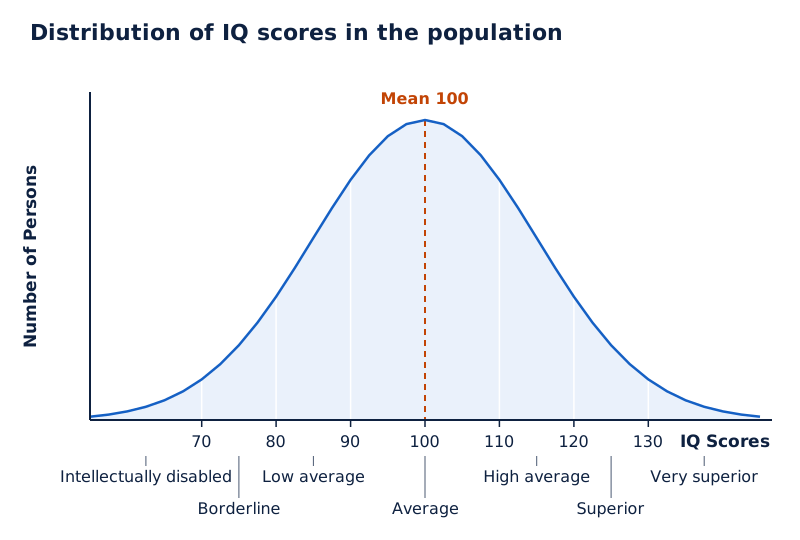
The horizontal axis is labelled IQ Scores and the vertical axis Number of Persons. A bell-shaped curve peaks at the mean of 100. Average scores occupy the centre, with progressively lower and higher categories towards either side.
Drawn by One Young India. See Fig. 1.2 in your NCERT textbook
How do intellectual disability and giftedness differ?
Intelligence tests help identify people at the extremes of intellectual functioning. Those with IQ below 70 are suspected to have intellectual disability. Identification needs the wider definition, rather than an IQ score alone.
What characterises intellectual disability?
The definition used by the American Association on Mental Deficiency (AAMD) combines significantly below-average intellectual functioning, deficits in adaptive behaviour, and manifestation during the developmental period.
Adaptive behaviour is the capacity to function independently and deal effectively with the environment. The developmental period here is 0 to 18 years. These features distinguish the broader definition from a simple numerical classification.
| Level | IQ range |
|---|---|
| Mild | 55 to approximately 70 |
| Moderate | (35 to 40) to approximately (50 to 55) |
| Severe | (20 to 25) to approximately (35 to 40) |
| Profound | Below (20 to 25) |
Development with mild disability is typically slower than among peers, but people can function quite independently, hold jobs and have families. Moderate disability involves delays in language and motor skills; training can develop self-care and simple social and communication skills, with moderate supervision.
People with severe and profound disability need constant care throughout their lives. There is wide variation in abilities within the overall group of people with intellectual disability.
What distinguishes giftedness from talent?
Giftedness is exceptional general ability expressed through superior performance across many areas. Talent is remarkable ability in a specific field. Highly talented individuals are sometimes called prodigies. Giftedness should not be equated with brilliant academic performance alone.
Gifted children show advanced logical thinking and problem solving, rapid information processing, superior generalisation (forming broader conclusions) and discrimination (distinguishing differences), original thinking, high intrinsic motivation (motivation from within) and self-esteem (self-worth), independent and non-conformist thinking (thinking beyond accepted views), and a preference for prolonged solitary academic activities.
Gifted students have different strengths and personalities. Teachers' judgements, achievement records, parents' interviews, and peer and self-ratings can supplement intelligence tests.
Special educational attention helps gifted children realise their potential. Enrichment programmes may develop productive thinking, planning, decision-making and communication. Psychologists have suggested that teachers' understanding of giftedness involves high ability, high creativity and high commitment together.
How do intelligence tests differ, and what are their limitations?
Intelligence tests can be classified by administration, the nature of their items, and their cultural appropriateness. The purpose of assessment helps determine the choice of test.
How do administration and test materials differ?
| Type | Distinctive features |
|---|---|
| Individual test | Administered to one person at a time. The examiner establishes rapport, a comfortable working relationship, and attends to feelings, moods and expressions. |
| Group test | Administered to several people simultaneously. Responses are generally written, usually in a multiple-choice format. |
| Verbal test | Requires spoken or written verbal responses and is administered only to literate people. |
| Non-verbal test | Uses pictures or illustrations as items, as in Raven's Progressive Matrices. |
| Performance test | Requires manipulation of objects or materials. Answering items does not require written language. |
An individual test may allow oral responses, written responses or manipulation of objects. Group tests do not provide the same opportunity to become familiar with each participant's feelings. A test can contain verbal, non-verbal or performance items, or a mixture.
In Kohs' Block Design Test, wooden blocks are arranged within a time limit to produce a given design. Performance tests can be easily administered to people from different cultures.
What the figure shows
A Raven's Progressive Matrices item
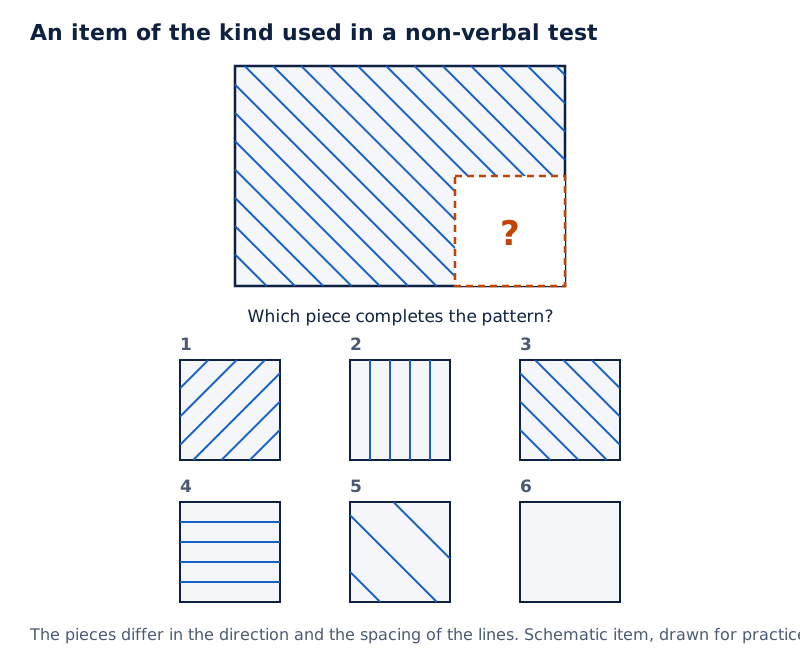
A patterned rectangle contains a blank, shaped gap. Six numbered alternatives are arranged below it in two rows. The task is to choose the alternative that completes the pattern.
Drawn by One Young India. See Fig. 1.3 in your NCERT textbook
What does culture-fair testing mean?
Culture-fair tests seek not to discriminate against people from different cultures. Culture-biased tests favour a particular cultural background. Many tests reflect the urban, middle-class culture in which they were developed, with standards of comparison drawn from western groups.
It is nearly impossible to design a test equally meaningful in all cultures. Culture-fair items draw on shared experiences or avoid requiring language. Non-verbal and performance tests help reduce the cultural bias usually associated with verbal tests.
In India, S.M. Mohsin pioneered an intelligence test in Hindi in the 1930s. C.H. Rice worked on standardising Binet's test in Urdu and Punjabi, and Mahalanobis attempted this in Bengali. Bhatia's Battery of Performance Tests is quite popular among Indian tests.
What can go wrong in testing?
Poor scores may stigmatise children and affect performance and self-respect. Tests may encourage discrimination, while class-biased tests may underestimate disadvantaged children's IQ. Intelligence tests do not capture creative potential or practical intelligence and do not relate much to success in life.
Trained psychologists should help analyse strengths and weaknesses. Intelligence can contribute to achievement, but an intelligence test score does not provide a complete account of a person's possibilities or success.
How does culture influence the meaning of intelligence?
Culture is a shared system of customs, beliefs, attitudes, and achievements in art and literature. It provides the context for intellectual development. A person's intelligence is likely to be tuned by these cultural features.
Vygotsky argued that culture shapes the social context in which people grow and understand their world. Elementary mental functions are universal, while higher functions, such as thinking and problem solving, are largely culture-produced. Cultures also change and specify what counts as successful intellectual development.
How do technological and integral intelligence differ?
Technological intelligence emphasises attention, observation, analysis, performance, speed and achievement orientation. Technologically advanced societies foster generalisation, abstraction, mental manipulation and efficient performance through their child-rearing practices. Western intelligence tests look for these skills.
Technological intelligence is not so valued in many Asian and African societies. Some non-western societies value self-reflection and collectivistic orientation, or concern with the group. Boundaries between these orientations are gradually vanishing under western cultural influence.
Integral intelligence in the Indian tradition emphasises connection with the social and wider world. It integrates cognitive processes, such as knowledge and understanding, with non-cognitive processes, including feelings and motivation.
Buddhi is the Sanskrit term often used for intelligence. J.P. Das describes it as including mental effort, determined action, feelings, opinions, knowledge, discrimination and understanding. It also concerns self-knowledge based on conscience, will and desire.
- Cognitive capacity: sensitivity to context, understanding, discrimination, problem solving and effective communication.
- Social competence: respect for social order, commitment to elders, the young and the needy, concern for others and recognition of their perspectives.
- Emotional competence: monitoring and regulating emotions, honesty, politeness, good conduct and self-evaluation.
- Entrepreneurial competence: commitment, persistence, patience, hard work, vigilance and goal-directed behaviour.
What is emotional intelligence and why does it matter?
Definition: Emotional intelligence is the set of skills involved in accurately appraising, expressing and regulating emotions. It includes processing emotional information accurately and efficiently.
Salovey and Mayer introduced the concept. It involves monitoring one's own and others' emotions, distinguishing between them, and using that information to guide thought and action. Emotional Quotient (EQ) expresses emotional intelligence, just as IQ expresses intelligence.
Good intellectual test scores and academic achievement are not enough for success in life. Some academically talented people experience difficulties in family, workplace and interpersonal relationships. Some psychologists believe that these problems may arise from a lack of emotional intelligence.
What characterises an emotionally intelligent person?
- Sensitivity to their own feelings and emotions.
- Recognition of others' emotions through body language, voice, tone and facial expressions.
- Connecting emotions with thoughts when solving problems and making decisions.
- Understanding the powerful influence of the nature and intensity of emotions.
- Regulating emotions and their expression when dealing with oneself and others to achieve harmony and peace.
Programmes that improve students' emotional intelligence have beneficial effects on academic achievement. They encourage cooperative behaviour and reduce antisocial activities. They also help prepare students for stresses and challenges beyond the classroom.
This concept broadens intelligence beyond intellectual functioning. It connects with the Indian tradition's inclusion of emotional and motivational processes, while directing attention specifically to understanding and managing emotional information.
How is aptitude different from interest and general intelligence?
Aptitude is a combination of characteristics indicating the capacity to acquire particular knowledge or skills after training. Intelligence tests assess general mental ability, while aptitude concerns special abilities in particular fields. People with similar intelligence may differ widely in acquiring specific skills.
Interest is a preference for an activity; aptitude is the potential to perform it. Someone may like an activity without having the relevant aptitude, or have the aptitude without an interest. Successful performance in a field requires both.
A student with high mechanical aptitude and a strong interest in engineering is more likely to become a successful mechanical engineer. Appropriate training can considerably enhance specific abilities, and aptitude assessment helps predict future performance.
How is aptitude measured?
Independent aptitude tests assess specialised areas, such as clerical, mechanical, numerical or typing aptitude. Multiple aptitude tests form batteries measuring several separate but homogeneous areas, meaning areas with related characteristics.
Examples include Differential Aptitude Tests (DAT), the General Aptitude Tests Battery (GATB), and the Armed Services Vocational Aptitude Battery (ASVAB). Among these, DAT is most commonly used in educational settings.
DAT has eight independent subtests: Verbal Reasoning, Numerical Reasoning, Abstract Reasoning, Clerical Speed and Accuracy, Mechanical Reasoning, Space Relations, Spelling, and Language Usage. Together they provide information across different areas of potential ability.
J.M. Ojha developed an Indian adaptation of DAT. Other Indian tests assess scientific, scholastic, literary, clerical and teaching aptitudes. The value of this assessment lies in relating a person's potential to opportunities for learning and training.
How is creativity related to intelligence and how is it assessed?
Creativity involves producing ideas, objects or solutions that are novel, appropriate and useful. It can appear in scientific discoveries, poems and paintings, as well as ordinary activities such as pottery, carpentry and cooking. People differ in both its level and its area of expression.
At one level, creativity produces altogether new ideas, theories or products, as in Einstein's theory of relativity. Another level modifies existing things, places them in a new perspective or gives them new uses.
What influences creative development?
Heredity sets limits to creative potential, while environmental factors stimulate its development. Motivation, commitment, family support, peer influences and training opportunities largely determine how much potential is realised, when, and in what form.
Research suggests that children develop imagination early but express creativity mostly through physical and non-verbal activities. Verbal expression develops when language, intellectual functions and knowledge are sufficiently developed. In some cases, opportunities are needed before hidden creative potential can emerge.
Does high intelligence ensure creativity?
Terman found in the 1920s that people with high IQ were not necessarily creative. Creative ideas could also come from people without very high IQ. Both high and low creativity occur among highly intelligent children and children of average intelligence.
The relationship is positive: creative work needs some capacity to acquire, understand, retain and retrieve knowledge. A writer needs language ability and a scientist needs reasoning. A certain level of intelligence is necessary, but beyond that intelligence does not correlate well with creativity.
How do creativity and intelligence tests differ?
Most creativity tests are open-ended. They allow different answers drawn from experience and imagination. They assess divergent thinking, which moves in different directions to generate varied ideas, discover new relationships, guess causes and consequences, or place things in new contexts.
Intelligence tests mostly involve convergent thinking, which works towards the right solution. They emphasise memory, logical reasoning, accuracy, perception and clear thinking, with little scope for spontaneity, originality and imagination.
Creativity tests may use words, figures, actions or sounds. Some assess creativity in specific fields, such as literature, science or mathematics. Their standardised procedures, manuals and interpretation guides require extensive training in administration and interpretation.
Glossary
- Individual differences — Distinctiveness and variations among people's characteristics and patterns of behaviour.
- Situationism — The view that situations and circumstances influence behaviour, giving relatively greater emphasis to external factors.
- Psychological assessment — Measurement and evaluation of psychological attributes against standards of comparison, often using several methods.
- Intelligence — General capacity to understand the world, reason and use available resources effectively when facing challenges.
- Aptitude — Underlying potential to acquire particular knowledge or skills with appropriate training and environmental support.
- Interest — An individual's preference for engaging in particular activities rather than other available activities.
- Values — Enduring beliefs about ideal behaviour that guide personal actions and judgements of other people.
- Mental age — A measure of intellectual development relative to the performance of people in an age group.
- Intelligence quotient — Mental age divided by chronological age and multiplied by one hundred.
- Adaptive behaviour — Capacity to function independently and deal effectively with the demands of one's environment.
- Giftedness — Exceptional general ability shown through superior performance across a wide variety of areas.
- Simultaneous processing — Perceiving relationships among different concepts and integrating them into a meaningful pattern for understanding.
- Successive processing — Remembering information serially so that recalling one item leads to recalling another item.
- Emotional intelligence — Skills underlying accurate appraisal, expression and regulation of one's own and others' emotions.
- Creativity — Capacity to produce ideas, objects or problem solutions that are novel, appropriate and useful.
Common errors and misconceptions
- Misconception: People with similar intelligence must have similar special abilities. Correct: Their capacity to acquire particular knowledge and skills may differ widely; aptitude assessment examines these specific potentials.
- Misconception: Interest and aptitude mean the same thing. Correct: Interest concerns preference, while aptitude concerns potential performance after training. A person can possess either without the other.
- Misconception: High IQ guarantees creativity. Correct: Some intelligence is necessary for creativity, but high intelligence does not ensure it. Highly intelligent children may show high or low creativity.
- Misconception: PASS processes function independently of one another. Correct: The neurological systems function interdependently. Each process has a distinctive function, but they interact on a knowledge base.
- Misconception: An IQ below 70 alone supplies the full definition of intellectual disability. Correct: The definition also includes deficits in adaptive behaviour and manifestation during the developmental period.
- Misconception: Non-verbal tests remove all cultural bias. Correct: They help reduce bias usually associated with verbal tests. A test equally meaningful in all cultures is nearly impossible to design.
- Misconception: Giftedness means outstanding school results alone. Correct: It includes superior performance beyond academics, and identification can combine tests with judgements, records and ratings.
Exam-style questions with model answers
Q1. Distinguish aptitude from interest. [2 marks]
- Aptitude is the potential to acquire particular knowledge or skills through appropriate training.
- Interest is a preference for an activity. Liking an activity does not necessarily imply having the potential to perform it successfully.
Q2. Using IQ = (MA / CA) × 100, where IQ is intelligence quotient, MA is mental age in years and CA is chronological age in years, calculate IQ for a 10-year-old with MA of 12 years and for a 10-year-old with MA of 7 years. [2 marks]
- For mental age 12 and chronological age 10, IQ = (12 / 10) × 100 = 120.
- For mental age 7 and chronological age 10, IQ = (7 / 10) × 100 = 70.
Q3. Explain the three types of intelligence in Sternberg's triarchic theory. [3 marks]
- Componential intelligence involves analysing information to solve problems. Its components support acquiring knowledge, planning what to do and how, and carrying out actions.
- Experiential intelligence uses past experiences creatively to solve new problems. It combines experiences in original ways and helps identify crucial information.
- Contextual intelligence deals with everyday environmental demands. It supports adapting to an environment, choosing a more favourable one, or changing it to meet one's needs.
Q4. Explain attention-arousal, simultaneous processing, successive processing and planning in the PASS model. [4 marks]
- Attention-arousal enables information processing and attention to relevant stimuli. Too much or too little arousal interferes with attention.
- Simultaneous processing integrates relationships among concepts into a meaningful pattern, helping a person understand how different pieces of information fit together.
- Successive processing organises information serially, so recall of one item leads to another, as in learning multiplication tables.
- Planning considers and implements actions, evaluates their effectiveness, and modifies unsuccessful plans. These processes work interdependently on a knowledge base.
Q5. Explain five methods used to assess psychological attributes. [5 marks]
- A psychological test objectively and systematically measures mental or behavioural characteristics through standardised procedures. Uses include guidance, clinical diagnosis, selection and training.
- An interview obtains information through one-to-one interaction with a person. It is used, for example, in counselling and employee selection.
- A case study investigates an individual in depth, placing attributes and psychological history within the social, psychological and physical environment and combining several data-collection methods.
- Observation systematically records naturally occurring behaviour in real time. Limited control and the observer's subjective interpretations can create difficulties.
- Self-report obtains the person's own factual information, opinions or beliefs through instruments such as questionnaires, interview schedules, tests or personal diaries.
Q6. Describe the four competencies associated with intelligence in the Indian tradition. [4 marks]
- Cognitive capacity includes understanding, sensitivity to context, discrimination, problem solving and effective communication. It concerns how knowledge and thinking are used.
- Social competence includes respect for social order, commitment to elders, the young and the needy, concern about others, and recognition of others' perspectives.
- Emotional competence includes monitoring and regulating emotions, honesty, politeness, good conduct and evaluating oneself.
- Entrepreneurial competence includes commitment, persistence, patience, hard work, vigilance and goal-directed behaviour. These competencies form part of an integrated view of intelligence.
Q7. Give six points explaining the relationship between creativity and intelligence and the differences between their tests. [6 marks]
- Creativity and intelligence have a positive relationship because creative activity needs some capacity to acquire, understand, retain and retrieve relevant knowledge.
- A certain level of intelligence is necessary for creativity, but beyond that level intelligence does not correlate well with creativity.
- High intelligence does not ensure creativity. Both high and low creativity are found among highly intelligent children and children of average intelligence.
- Most creativity tests are open-ended, allowing different answers based on personal experience and imagination, rather than requiring one specified answer.
- Creativity tests assess divergent thinking, including varied ideas, unusual relationships, and new contexts for familiar things or problems.
- Intelligence tests mostly assess convergent thinking towards a right solution, emphasising memory, reasoning and accuracy, with little scope for originality and imagination.
Q8. Explain three limitations or possible misuses of intelligence tests. [3 marks]
- Poor performance may attach a stigma to children. This can adversely affect both their later performance and their self-respect, and testing may encourage discriminatory treatment.
- Tests biased towards middle-class and higher-class experience may underestimate the IQ of children from disadvantaged backgrounds, creating an unfair picture of their abilities.
- Intelligence tests do not capture creative potential or the practical side of intelligence and do not relate much to success in life. Trained interpretation is therefore important.
Key takeaways
- Individual differences involve unique combinations of characteristics, while situations can strongly influence how those characteristics appear in behaviour.
- Psychological assessment examines several domains and can combine standardised tests, interviews, case studies, observations and self-reports.
- Psychometric theories describe the structure of abilities; information-processing theories explain the mental processes underlying intelligent behaviour.
- Gardner identifies eight intelligences, Sternberg distinguishes three types, and the PASS model describes interacting attention, processing and planning functions.
- Intellectual development reflects heredity and environment together; an intelligence score alone does not describe a person's complete potential.
- Culture shapes valued abilities, while emotional intelligence includes accurately understanding and regulating emotional information in oneself and others.
- Aptitude concerns potential to acquire skills after training, whereas interest concerns preference; successful performance requires both.
- Creativity requires some intelligence but is not guaranteed by high IQ, and most creativity tests encourage varied, original responses.
Test yourself
What makes formal assessment different from informal assessment?
Formal assessment is objective, standardised and organised. Informal assessment varies between cases and assessors and is open to subjective interpretation.
How are Spearman's general and specific factors different?
The general factor involves mental operations common to all performances. Specific factors represent particular abilities that support performance in individual fields.
Which Gardner intelligence concerns understanding oneself?
Intrapersonal intelligence involves understanding one's feelings, motives, desires, internal strengths and limitations, and using that knowledge effectively.
What distinguishes simultaneous from successive processing?
Simultaneous processing integrates relationships into a meaningful pattern. Successive processing remembers information serially, so recalling one item leads to another.
What is the difference between giftedness and talent?
Giftedness is exceptional general ability expressed across many areas. Talent is remarkable ability in a specific field.
Why are non-verbal and performance tests useful across cultures?
They help reduce cultural bias usually associated with verbal tests. Performance tests require manipulating materials and do not require written language for answers.
What does emotional quotient express?
Emotional quotient expresses emotional intelligence, which concerns accurate appraisal, expression and regulation of emotions.
Does high intelligence guarantee high creativity?
No. Some intelligence is necessary for creativity, but highly intelligent people can have high or low creativity.
Write about it
Turn a question from this chapter into a paper.
The Writing Studio has a structure guide, a rubric and citation tools for 15 formats, from essays to research papers. Drafting is free with an account. Learnacy Essential adds feedback from an AI writing coach and submission to The OYI Review.
Learnacy Essential is ₹1,499 for the year. Publication depends on review and is not guaranteed.