
Attitude and Social Cognition | CBSE Class 12 Psychology Notes
On this page
This note covers social behaviour, the meaning and components of attitudes, attitude properties, learning and changing attitudes, the relationship between attitudes and behaviour, prejudice, discrimination, and strategies for handling prejudice.
What are attitudes, and how do they help explain social behaviour?
Social psychology studies how other people and the social environment affect individual behaviour. It includes behaviour in the actual, imagined or implied presence of others. Being social therefore means more than simply being physically surrounded by people.
Understanding social influences requires studying both behaviour and social cognition, the processes through which people make sense of social behaviour. Explanations must go beyond common sense and folk wisdom, because apparently simple behaviour may involve complex psychological processes.
Definition: An attitude is an evaluative state of mind towards a topic, accompanied by feelings and a tendency to act in a particular way. The topic towards which it is directed is the attitude object.
What are the three components?
An evaluation can be positive, negative or neutral. An attitude combines thoughts, emotions and a tendency towards action. The letters in A-B-C stand for affective, behavioural and cognitive respectively.
| Component | Meaning | Green environment example |
|---|---|---|
| Affective | The emotional component | Feeling happy at greenery, or sad and angry when trees are cut down |
| Behavioural or conative | The tendency to act towards the attitude object | Participating in a tree plantation campaign expresses this component |
| Cognitive | The thought component | Holding a positive view of a green environment on the basis of information |
Attitudes are not themselves behaviour. They cannot be directly observed from outside. Although the three components are generally expected to point in the same direction, they may not do so in every situation. Strong positive thoughts and feelings may coexist with a neutral behavioural component.
How do beliefs and values differ from attitudes?
Beliefs constitute the cognitive component on which attitudes rest. Values are beliefs or attitudes with a sense of what one should or ought to do, such as working hard or being honest. Values are difficult to change because they become inseparable from a person's outlook.
Attitudes provide a background for deciding how to act in new situations. For example, an attitude towards foreigners may indirectly guide behaviour when meeting a foreigner. This guiding role does not make attitudes an infallible predictor of action.
Which properties distinguish one attitude from another?
Besides their three components, attitudes have four significant properties: valence, extremeness, simplicity or complexity, and centrality. These properties describe different aspects of an attitude and should be kept distinct.
How do valence and extremeness differ?
Valence indicates whether the attitude is positive or negative; a neutral attitude has neither positive nor negative valence. Extremeness indicates how positive or negative the attitude is. The following scale expresses attitudes towards nuclear research.
| Rating | Meaning | Interpretation |
|---|---|---|
| 1 | Very bad | Extreme negative attitude |
| 2 | Bad | Negative, less extreme than 1 |
| 3 | Neutral, neither good nor bad | Lowest extremeness |
| 4 | Good | Positive, less extreme than 5 |
| 5 | Very good | Extreme positive attitude |
Ratings of 1 and 5 are equally extreme, although their directions are opposite. Similarly, 2 and 4 are less extreme. A high numerical rating on this particular scale indicates positivity, but does not by itself mean greater extremeness than every lower rating.
What are complexity and centrality?
Complexity, or multiplexity, concerns how many member attitudes form a broader attitude system. A simple system contains one or a few attitudes; a complex system contains many. Each member attitude has its own affective, behavioural and cognitive components.
An attitude towards health and well-being is likely to include views about physical and mental health, happiness, and how to achieve these. By contrast, an attitude towards a particular person is likely to consist mainly of one attitude.
Centrality concerns the influence of a particular attitude within the system. A central attitude influences other attitudes much more than a peripheral, or less central, attitude. In an attitude system concerning world peace, opposition to high military expenditure may be central.
Note: Member attitudes and A-B-C components are different. Complexity counts the attitudes within a broader system; A-B-C describes the thoughts, feelings and behavioural tendency within each attitude.
Through which learning processes are attitudes formed?
In general, attitudes are learned through personal experience and interaction with others. A few studies suggest an inborn aspect, but genetic factors influence attitudes only indirectly, alongside learning. Most social psychologists therefore focus on the conditions under which attitudes are learned.
What are the five learning processes?
- Association: Positive qualities of a teacher may become linked with the subject taught. Students often develop a liking for a subject through this association with a teacher they regard positively.
- Reward and punishment: Praise for an attitude makes its further development highly likely. A teenager honoured for regularly practising yogasanas, or yoga postures, may develop a positive attitude towards yoga and health. A child repeatedly falling ill after eating junk food is likely to develop a negative attitude towards it.
- Modelling: This means learning by observing others. Children may develop respect for elders after seeing their parents show such respect and receive appreciation for it. The learner observes the consequences experienced by someone else.
- Group or cultural norms: Norms are unwritten rules about behaviour expected in particular circumstances. Offering money, sweets, fruit and flowers at a place of worship is normative in some religions. Observing this expected and approved behaviour may produce positive attitudes and feelings of devotion.
- Exposure to information: Information supplied through media can produce positive or negative attitudes without another person being physically present. Reading biographies of self-actualised persons, meaning people who realise their potential, may produce a positive attitude towards hard work as a means of success.
Do these processes operate separately?
Learning through group or cultural norms may involve association, reward or punishment, and modelling together. The processes identify ways in which attitudes develop; they do not require every attitude to arise through a single isolated route.
The distinction between direct reward and modelling is especially useful. In the first, a person experiences praise or other consequences. In the second, the person observes someone else's thoughts or behaviour being rewarded or punished.
How do family, groups, experiences and media shape attitudes?
The context of learning helps explain why people develop different attitudes. Family and school, reference groups, personal experiences and media provide settings and influences through which the learning processes operate.
What is the role of family, school and reference groups?
Family and school influence attitudes at different stages. Parents and other family members are especially significant early in life. School later becomes an important setting. Learning in both usually involves association, rewards and punishments, and modelling.
Reference groups provide standards for acceptable thought and behaviour. Attitudes towards occupations, political and religious groups, and national or social issues are often influenced by them. Their influence is particularly noticeable at the beginning of adolescence, when belonging to a group becomes important.
The desire to belong means that reference-group influence may also involve reward and punishment. A group's standards provide a context for learning attitudes through group or cultural norms.
How can experience and information change an outlook?
Personal experience can produce a drastic change. An army driver narrowly escaped death on a mission in which all his companions died. He left the army, returned to his village in Maharashtra and became an active community leader, developing a strong positive attitude towards community upliftment.
Media-related influences include audio-visual media, the Internet and school textbooks. They first strengthen cognitive and affective components, and subsequently may affect behaviour. They can inform people, create consumerist attitudes, which emphasise consuming goods, or encourage social harmony.
These influences can be good or bad. There may be no check on the information gathered, and therefore no control over the attitudes formed or the direction in which existing attitudes change. Access to more information does not itself determine a positive outcome.
How does balance explain attitude change?
Attitudes can change while they are forming and after they have developed. Attitudes still resembling opinions are much more likely to change than firmly established attitudes that have become values. Fritz Heider's balance concept explains change through relationships among a person, another person and an attitude object.
What does the P-O-X triangle represent?
P is the person whose attitude is being studied; O is another person; and X is the attitude object. All three can also be persons. The links P-O, O-X and P-X represent the attitudes between these elements.
| Pattern of relationships | State |
|---|---|
| All three positive | Balance |
| Two negative and one positive | Balance |
| All three negative | Imbalance |
| Two positive and one negative | Imbalance |
Imbalance is logically uncomfortable, so an attitude changes towards balance. The concept does not equate balance with every attitude being favourable: a triangle with two negative links and one positive link is also balanced.
How does the dowry example illustrate the process?
Suppose P favours dowry and plans his son's marriage to O's daughter. O opposes dowry but initially likes P. There are two positive relationships, P towards dowry and O towards P, and one negative relationship, O towards dowry.
This arrangement is unbalanced. P might begin to oppose dowry, O might begin to favour it, or O might begin to dislike P. Each change would produce either three positive relationships or two negative relationships and one positive relationship.
Diagram
Balance triangle
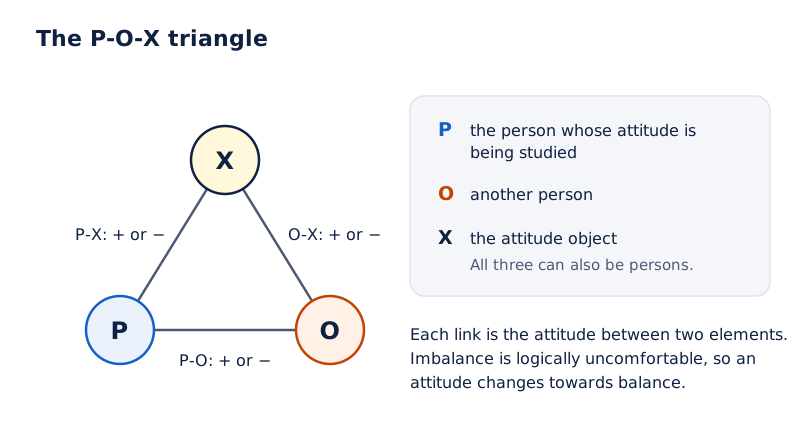
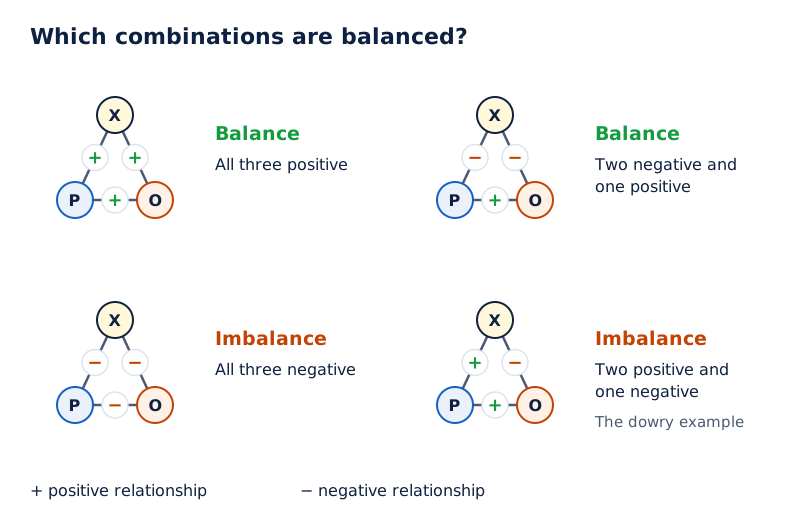
Draw a triangle labelled P, O and X, with their meanings beside it. Mark each relationship as positive or negative. Use the table to distinguish balanced from unbalanced combinations.
Drawn by One Young India.
How do cognitive dissonance and consistency explain change?
Leon Festinger's cognitive dissonance concept focuses on thoughts. A cognition is an idea or thought. Cognitions are consonant when they fit logically together and dissonant when they are out of line with each other.
When two cognitions conflict, one changes towards consonance. In the pan masala example, the thought that pan masala causes fatal mouth cancer conflicts with the thought that one eats it. Stopping consumption changes the second cognition and reduces the inconsistency.
What happened in the experiment involving a lie?
Festinger and Carlsmith examined dissonance after students participated in a very boring experiment. The dollar sign, $, denotes dollars in the payments described below.
- After the experiment, students were asked to tell another group waiting outside that it had been very interesting.
- Half of the students who told this lie received $1; the other half received $20.
- After some weeks, participants were asked to recall the experiment and report how interesting it had been.
- The $1 group described it as more interesting than the $20 group. The $20 group continued to rate it as very boring.
The $1 group experienced dissonance between finding the task boring and saying it was interesting for such a small payment. They changed their attitude, reasoning that they would not have lied for only $1 and that the experiment must actually have been interesting.
The $20 group did not experience cognitive dissonance. They explained their lie through the payment and did not change their attitude. The finding therefore does not support the idea that a larger reward necessarily produces greater attitude change.
What connects dissonance with balance?
Cognitive consistency means that elements of an attitude or attitude system fit logically together and point in the same direction. Both balance and dissonance illustrate this requirement. Inconsistency causes mental discomfort and brings change towards a logically consistent arrangement.
How does the two-step concept explain attitude change?
S.M. Mohsin's two-step concept explains change through a relationship between a source and a target. The target is the person whose attitude is to change. The source is the person through whose influence that change takes place.
What are identification and behavioural change?
In the first step, the target identifies with the source. Identification involves liking and regard for the source. The source must also hold a positive attitude towards the target, so that regard and attraction are mutual.
In the second step, the source demonstrates a changed attitude by actually changing behaviour towards the attitude object. On observing this change, the target also changes attitude through behaviour. This is a form of imitation or observational learning.
How does Preeti's example apply the concept?
Preeti enjoys a particular soft drink but reads that it is extremely harmful. Her favourite sportsperson advertises the same drink. Because Preeti identifies with the sportsperson, she would like to imitate that person.
To change people's attitudes, the sportsperson must show positive feelings towards fans and actually change the habit of consuming the drink, perhaps substituting a health drink. If this behaviour changes, it is very likely that Preeti will also change her attitude and stop consuming the drink.
The central point is the combination of mutual regard and demonstrated change. Merely presenting information leaves out the source's own behavioural example. The concept explains how observing someone with whom the target identifies can influence both attitude and behaviour.
How do existing attitudes and source characteristics affect change?
Attitude change depends partly on what the attitude is already like and partly on who presents the message. A message is information intended to bring about attitude change. Different properties of the existing attitude affect how readily it changes.
Which attitudes are easier to change?
In general, positive attitudes are easier to change than negative attitudes. Extreme and central attitudes are more difficult to change than less extreme and peripheral attitudes. Simple attitudes are easier to change than multiple attitudes.
| Type of change | Meaning | Example of direction |
|---|---|---|
| Congruent change | Change in the same direction as the existing attitude | A positive attitude becomes more positive, or a negative attitude more negative |
| Incongruent change | Change in the opposite direction | A positive attitude becomes less positive or negative; a negative attitude becomes less negative or positive |
Reading about a successful woman may strengthen a somewhat positive attitude towards women's empowerment. This is congruent change. If the reader instead worries that women may become too powerful and neglect family responsibilities, the positive attitude may weaken or reverse, producing incongruent change.
In general, congruent changes are easier to bring about than incongruent changes. Incongruence does not require complete reversal: becoming less positive or less negative also qualifies.
Why do credibility and attractiveness matter?
Source credibility concerns how believable the source is; attractiveness concerns the source's appeal to the target. A highly credible source is more likely to change attitudes than a source with low credibility.
Adults buying a laptop are more convinced by a computer engineer than by a schoolchild presenting the same information. Schoolchildren, however, may be more convinced by another schoolchild. For products such as cars, publicity by popular public figures may increase sales without expert endorsement.
What the figure shows
Laptop advertisements
The drawing contrasts an adult in a suit holding a laptop with a schoolchild beside one. Their speech bubbles repeat the same claims about storage, low weight and success, directing attention to the person presenting the message.
See Fig. 6.1 in your NCERT textbook
How do the message and the target influence persuasion?
The effects of a message depend on its amount of information, type of appeal, activated motives and method of transmission. The person receiving it also matters. Persuasibility means the readiness to have one's attitude changed through persuasion.
What makes a message effective?
Information should be just enough, neither excessive nor insufficient. A rational appeal presents reasons, such as a pressure cooker saving fuel and money. An emotional appeal connects the message with feelings, such as concern for a family's nutrition.
What the figure shows
Rational and emotional appeals
A family is drawn around a dining table. One speech bubble promotes a pressure cooker through savings on cooking gas; another promotes it through concern for family nutrition. The labels distinguish saving money from caring for the family.
See Fig. 6.2 in your NCERT textbook
Motives, the aims activated by the message, also affect change. Milk may be advertised through health and good looks, or through energy and success at work. These appeals direct attention towards different desired outcomes.
A message may change attitudes in its intended direction or in the opposite direction. Frightening pictures of dental cavities may be disbelieved and make attitudes towards dental care less positive. Fear sometimes persuades, but excessive fear turns off the receiver and has little persuasive effect.
How does the method of communication matter?
Face-to-face transmission is usually more effective than indirect communication through letters, pamphlets or mass media. Direct conversations with social workers and doctors can more effectively create positive attitudes towards Oral Rehydration Salts (ORS) than radio descriptions alone.
What the figure shows
Direct conversation and radio transmission
One drawing shows people listening to a speaker in person; the other shows people gathered around a radio. Both speech bubbles present an ORS message about protecting a child from summer heat.
See Fig. 6.3 in your NCERT textbook
Television and Internet transmission can resemble face-to-face interaction, but they are not a substitute for it. The comparison concerns how a message reaches its audience and influences attitudes.
Which characteristics of the target matter?
Open and flexible people change more easily. Strong prejudices, usually negative attitudes towards a group, make change less likely. Lower self-esteem, or sense of one's own worth, is associated here with easier attitude change than higher self-esteem.
More intelligent people may change less easily than people with lower intelligence. However, sometimes they change more willingly because their attitudes rest on more information and thinking. Intelligence therefore cannot be reduced to a single fixed rule about willingness to change.
When do attitudes and behaviour agree or disagree?
Behaviour is usually expected to follow attitudes, but attitudes may not always appear in action. Actual behaviour can even contradict an attitude. Understanding the attitude-behaviour relationship therefore requires attention to the conditions under which the person acts.
What conditions support consistency?
- The attitude is strong and central within the attitude system.
- The person is aware of the attitude.
- There is very little or no external pressure to behave in a particular way, such as group pressure to follow a norm.
- The behaviour is not being watched or evaluated by others.
- The person expects a positive consequence and therefore intends to perform the behaviour.
What did LaPiere's study show?
Richard LaPiere studied attitudes towards Chinese people in the United States. He asked a Chinese couple to travel and stay at different hotels. The couple was refused service only once during these occasions.
Later, questionnaires asked hotel and tourist-home managers in the same areas whether they would accommodate Chinese guests. A very large percentage said they would not. These negative expressed attitudes were inconsistent with the positive behaviour shown towards the travelling couple.
The study illustrates why an expressed attitude may not predict actual behaviour. It does not establish that attitudes never influence behaviour, or that the conditions supporting consistency are unimportant.
Can behaviour influence attitude?
Sometimes behaviour decides the attitude. In the Festinger and Carlsmith experiment, the students paid $1 had already told others the experiment was interesting. They then concluded that they liked it, reasoning from their behaviour for a small payment to a more positive attitude.
What are prejudice and discrimination, and where do they come from?
Prejudice is an attitude towards a particular group and is usually negative. In many cases it may be based on a stereotype, a cluster of ideas about a group's characteristics that are assumed to apply to all its members.
How do thoughts, feelings and behaviour differ?
| Aspect | Meaning in prejudice |
|---|---|
| Cognitive | Stereotyped ideas about the group's characteristics |
| Affective | Dislike or hatred frequently accompanying those ideas |
| Behavioural | Discrimination, when prejudice becomes less positive treatment of the target group than of a favoured group |
Discrimination can occur without prejudice, and prejudice can exist without discrimination. They nevertheless go together very often. Where both exist, conflict between groups in the same society is very likely.
Discriminatory behaviour can in many cases be curbed by law. The cognitive and emotional components of prejudice are more difficult to change. Preventing a discriminatory action therefore does not necessarily remove the underlying ideas and feelings.
What are the five sources of prejudice?
- Learning: Association, rewards and punishments, observation, group norms and information can teach prejudice. Family, reference groups, experience and media may contribute. People learning prejudice may develop a prejudiced personality, with low adjusting capacity, anxiety and hostility towards other groups.
- Strong social identity and ingroup bias: Social identity is a sense of oneself through group membership. The ingroup is one's own group; an outgroup is another group. Ingroup bias means favouring one's own group. People with a strong social identity and a very positive ingroup attitude boost this attitude by holding negative attitudes towards other groups.
- Scapegoating: A majority blames a minority outgroup for its own social, economic or political problems. The minority is too weak or small to defend itself against the accusations. This group expression of frustration often produces prejudice against the weaker group.
- Kernel of truth: People sometimes maintain stereotypes because they believe that widely repeated claims about a group must contain some truth. Even a few examples can sustain this belief.
- Self-fulfilling prophecy: In some cases, a target group may behave in ways that confirm negative expectations and continue the prejudice. Members described as dependent and unable to progress may act in ways that appear to justify that description.
The kernel of truth describes a belief used to maintain stereotypes; it does not establish that every group member has the attributed characteristic. Likewise, self-fulfilling prophecy is a possibility in some cases, not an inevitable response by every target of prejudice.
How can prejudice be handled?
Understanding the sources of prejudice is the first step towards handling it. Strategies need to address how prejudices are learned, how they persist and how group membership becomes a basis for evaluating people.
What goals should strategies pursue?
- Reduce opportunities for learning prejudice, so that prejudiced attitudes are less readily acquired.
- Change existing prejudiced attitudes, addressing attitudes already present.
- De-emphasise a narrow ingroup identity, reducing the emphasis placed on belonging to one's own group.
- Discourage self-fulfilling prophecy among targets of prejudice, reducing the tendency to act in ways that confirm negative expectations.
Which methods help achieve these goals?
Education and information dissemination, meaning the spread of information, can correct stereotypes about particular groups and address strong ingroup bias. This approach works on the ideas through which a target group is understood and judged.
Intergroup contact allows direct communication, helps remove mistrust and may reveal positive qualities in the outgroup. Contact strategies are successful only when the following conditions are met:
- The groups meet in a cooperative rather than competitive setting.
- The interaction is close enough for members to know one another better.
- The groups do not differ in power or status.
Individual identity should be highlighted instead of group identity. This weakens the importance of both ingroup and outgroup membership as a basis for evaluating another person.
Note: Simply bringing groups together is not a sufficient description of effective contact. Cooperation, close interaction and equal power or status are essential conditions in this account of prejudice reduction.
Glossary
- Attitude — An evaluative state of mind towards a topic, accompanied by emotion and a tendency to act.
- Attitude object — The topic, person or issue towards which an attitude is directed.
- Valence — The positive or negative direction of an attitude towards its object.
- Extremeness — The degree to which an attitude is positive or negative.
- Multiplexity — The complexity of an attitude system in terms of its member attitudes.
- Centrality — The influence of a particular attitude on other attitudes within its system.
- Cognitive dissonance — Logical inconsistency between cognitions that brings pressure towards a more consonant arrangement.
- Cognitive consistency — Agreement in direction and logical fit among elements of an attitude system.
- Identification — Liking and regard for a source whose influence can produce attitude change.
- Congruent change — Attitude change that continues in the direction of the existing attitude.
- Incongruent change — Attitude change in the opposite direction, including weakening an existing attitude.
- Stereotype — A cluster of ideas about characteristics assumed to belong to all members of a group.
- Prejudice — An attitude towards a particular group that is usually negative.
- Discrimination — Less positive behaviour towards a target group than towards a favoured group.
- Scapegoating — Blaming a weaker minority outgroup for the majority group's own problems.
Common errors and misconceptions
- Misconception: An attitude is an observable action. Correct: It is a mental state with thoughts, feelings and a behavioural tendency; actual behaviour may differ.
- Misconception: A-B-C components always agree. Correct: They generally are expected to be consistent, but strong thoughts and feelings may accompany a neutral behavioural component.
- Misconception: A rating of 5 is more extreme than 1 on the nuclear-research scale. Correct: They are equally extreme and differ in valence.
- Misconception: Incongruent change must reverse an attitude completely. Correct: Becoming less positive or less negative also counts as incongruent change.
- Misconception: The $20 group changed its attitude more. Correct: The $1 group experienced dissonance and later rated the experiment as more interesting.
- Misconception: Prejudice and discrimination must occur together. Correct: Either can exist without the other, although they go together very often.
- Misconception: More intelligent people invariably resist persuasion. Correct: They may change less easily, but sometimes change more willingly through information and thinking.
- Misconception: Any intergroup contact reduces prejudice. Correct: Successful contact requires cooperation, close interaction and no difference in power or status.
Exam-style questions with model answers
Q1. Distinguish a belief from a value. [2 marks]
- A belief is the cognitive component of an attitude and provides the ground on which the attitude rests.
- A value is an attitude or belief containing a sense of what one should or ought to do; it becomes part of one's outlook.
Q2. A person supports a green environment after learning about it, feels happy at greenery and angry at tree cutting, and joins a tree plantation campaign. Identify and explain the three attitude components shown. [3 marks]
- The cognitive component appears in the positive view of a green environment based on information. It concerns thoughts and evaluation of the attitude object.
- The affective component appears in happiness at greenery and anger at tree cutting. These feelings express the emotional aspect of the attitude.
- The behavioural component is expressed through participation in the tree plantation campaign. It concerns the tendency to act towards the attitude object.
Q3. An attitude towards nuclear research is rated from 1, very bad, through 2, bad, 3, neutral, and 4, good, to 5, very good. Compare ratings 1 and 5 in valence and extremeness, and interpret rating 3. [3 marks]
- Rating 1 has negative valence because it evaluates nuclear research as very bad. Rating 5 has positive valence because it evaluates it as very good.
- Ratings 1 and 5 are equally extreme. Their directions differ, but neither is less extreme than the other on this scale.
- Rating 3 is neutral, with neither positive nor negative valence. It is the lowest point in extremeness, although numerically it lies between the endpoints.
Q4. P, the person studied, favours dowry, the attitude object X. O, another person, opposes dowry but likes P. Using Heider's balance concept, identify the state and explain three possible changes that would restore balance. [4 marks]
- The state is unbalanced: P towards X and O towards P are positive, while O towards X is negative. Two positive relationships and one negative relationship produce imbalance.
- P could begin opposing dowry. The triangle would then contain two negative relationships and one positive relationship.
- O could begin favouring dowry. All three relationships would then be positive, producing balance.
- O could begin disliking P. There would again be two negative relationships and one positive relationship, producing balance.
Q5. Students completed a very boring experiment and told waiting students it was interesting. Half received $1, meaning one dollar, and half received $20, meaning twenty dollars. Some weeks later, the $1 group rated it as more interesting; the $20 group still rated it as very boring. Explain these findings through cognitive dissonance in five points. [5 marks]
- Cognitive dissonance occurs when cognitions, or thoughts, do not fit logically together. It creates pressure for change towards consonance, in which the thoughts agree.
- The $1 students knew that the experiment was boring, but had said it was interesting. They had told this lie for only a small payment.
- These students experienced dissonance. They reasoned that they would not have told a lie for only $1, so the experiment must actually have been interesting.
- They therefore changed their attitude towards the experiment. Their later, more favourable rating reduced the inconsistency between their thoughts and their earlier behaviour.
- The $20 students did not experience cognitive dissonance. They explained the lie by the payment, retained their original attitude and continued to judge the experiment very boring.
Q6. Explain the five conditions under which attitudes and behaviour are consistent. [5 marks]
- The attitude should be strong and occupy a central place in the person's attitude system. Its strength and significance support consistency with behaviour.
- The person should be aware of the attitude. Awareness is one of the conditions under which behaviour and the attitude are found to agree.
- There should be very little or no external pressure to act in a particular way, such as pressure from a group to follow a norm.
- The behaviour should not be watched or evaluated by other people. The absence of such observation or evaluation is another condition supporting consistency.
- The person should expect the behaviour to have a positive consequence and therefore intend to perform it. Expected outcomes and the resulting intention matter.
Q7. Explain three methods of handling prejudice, giving all three conditions required for successful intergroup contact as separate points. [6 marks]
- Education and information dissemination can correct stereotypes about particular target groups and tackle strong ingroup bias, or favouritism towards one's own group.
- Increasing intergroup contact allows direct communication, can remove mistrust and can reveal positive qualities in another group. Its effectiveness depends on the following conditions.
- The groups must meet in a cooperative rather than competitive context. Bringing groups together in competition does not satisfy this condition for successful contact.
- Interactions between the groups must be close enough to help their members know one another better. Merely being present together does not express this requirement.
- The groups must not differ in power or status. Equal standing is a condition for successful contact alongside cooperation and close interaction.
- Highlight individual identity rather than group identity. This weakens the importance of both one's own group and other groups as bases for evaluating a person.
Key takeaways
- Attitudes combine evaluation, feelings and a behavioural tendency; they are mental states rather than directly observable actions.
- Valence, extremeness, complexity and centrality describe different properties, while A-B-C identifies the components within an attitude.
- Attitudes are generally learned through association, consequences, modelling, norms and information within family, group, personal and media contexts.
- Balance and cognitive dissonance explain change towards consistency; Mohsin's two-step concept emphasises identification and the source's changed behaviour.
- Existing attitudes, the source, the message and the target all influence whether attitudes change and how much.
- Attitudes may not always predict behaviour, and behaviour can sometimes influence the attitude a person comes to hold.
- Prejudice is usually negative and may involve stereotypes; discrimination is unequal treatment, and either can occur without the other.
- Prejudice reduction involves education, individual identity and contact under cooperative conditions with close interaction and equal power or status.
Test yourself
What is the difference between an attitude object and an attitude?
An attitude is an evaluative state of mind, accompanied by feelings and a tendency to act. The attitude object is the topic towards which those thoughts, feelings and behavioural tendency are directed.
Why is complexity different from the A-B-C components?
Complexity concerns the number of member attitudes in a system. Each member attitude itself has affective, behavioural and cognitive components.
Which relationship patterns produce balance in Heider's triangle?
Balance occurs when all three relationships are positive, or when two are negative and one is positive.
Does incongruent change require a positive attitude to become negative?
No. A positive attitude becoming less positive also counts, as does a negative attitude becoming less negative.
What must accompany identification in Mohsin's account?
The source must reciprocate positive regard and demonstrate changed behaviour; observing this change influences the target's attitude and behaviour.
Why can excessive fear reduce a message's effect?
Too much fear turns off the receiver and has little persuasive effect, although fear sometimes works well.
How does scapegoating differ from a kernel-of-truth belief?
Scapegoating blames a weaker minority for majority problems. A kernel-of-truth belief maintains that repeated stereotypes must contain some truth.
What three conditions make intergroup contact successful?
The groups cooperate rather than compete, interact closely enough to know each other better, and do not differ in power or status.
Write about it
Turn a question from this chapter into a paper.
The Writing Studio has a structure guide, a rubric and citation tools for 15 formats, from essays to research papers. Drafting is free with an account. Learnacy Essential adds feedback from an AI writing coach and submission to The OYI Review.
Learnacy Essential is ₹1,499 for the year. Publication depends on review and is not guaranteed.