
Human Development | CBSE Class 11 Psychology Notes
On this page

This note covers the meaning of human development, the life-span perspective, heredity and environment, developmental contexts, prenatal influences, infancy, childhood, adolescence, and the changing responsibilities and relationships of adulthood and old age.
What is development, and how does it differ from growth and maturation?
Definition: Development is the pattern of progressive, orderly and predictable changes beginning at conception and continuing throughout life. It mostly involves change, including both growth and decline.
Development includes changes in thinking, language, social relationships and the body. These changes occur together in the person. A temporary alteration caused by a brief illness is not developmental change: development has a direction and connects earlier changes with later ones.
Which processes work together?
- Biological processes involve bodily development influenced by inherited genes, the genetic material received from parents. Changes in height, weight, brain, heart and lungs illustrate this process.
- Cognitive processes involve knowing and experiencing, including thought, perception, attention and problem solving.
- Socio-emotional processes involve changes in interactions, emotions and personality. A child's affectionate hug and an adolescent's sorrow after losing a match illustrate them.
These processes are interwoven. Studying one separately does not mean that it develops independently of the others. Development concerns the whole individual throughout life.
How do the related concepts compare?
| Concept | Meaning | Important distinction |
|---|---|---|
| Growth | Measurable increase in the size of body parts or the whole organism. | Height and weight illustrate growth, which is one aspect of development. |
| Development | Directed changes connected with what precedes and follows them. | Includes changes in size, proportions and features, as well as acquiring new features. |
| Maturation | Orderly changes largely dictated by the genetic blueprint. | Readiness matters: special efforts do not accelerate a behaviour when an infant is not maturationally ready. |
| Evolution | Species-specific changes passed between generations. | Proceeds very slowly; natural selection favours those best adapted to survive and reproduce. |
Natural selection is the evolutionary process favouring better-adapted individuals or species. Maturation, by contrast, concerns the individual's orderly development. Most children sit unsupported by 7 months, stand with support by 8 months and walk by one year, with adequate environment and little practice once physically ready.
What are the main features of the life-span perspective?
The life-span perspective studies development across the whole course of life. It includes gains and losses rather than treating childhood as the only period of development. Changes are dynamic: change in one aspect goes together with changes in others.
Which assumptions guide this perspective?
- Development is lifelong. It extends from conception to old age, and gains and losses interact throughout this period.
- Processes are interwoven. Biological, cognitive and socio-emotional changes jointly shape the developing person.
- Development is multidirectional. Some abilities may increase while others decrease. Experience may make adults wiser, while performance on speed-based tasks such as running is likely to decline with age.
- Development is highly plastic. Plasticity means the possibility of modifying psychological development within a person. Skills and abilities can improve throughout life, although plasticity varies among individuals.
- Historical conditions matter. Young adults living through India's freedom struggle had different experiences from young adults living in another historical setting.
- Several disciplines study development. Psychology, anthropology, sociology and the neurosciences contribute different approaches to understanding development throughout life.
- People respond to and act on contexts. Inherited characteristics and physical, social, historical and cultural surroundings influence development. People also act within these settings.
Why does context prevent a single fixed account of life?
Life events differ between individuals. A parent's death, an accident or an earthquake can alter a life course, as can winning an award or obtaining a good job. People continue changing as their contexts change.
Note: Lifelong development does not mean uninterrupted improvement. Gains and losses can coexist, and people differ in how far particular abilities can change.
How do heredity and environment interact in development?
Heredity is the transmission of characteristics between generations. The inherited human genetic code explains shared human characteristics. Differences between people also involve the interaction of inherited characteristics with the environment, the conditions in which they develop.
A genotype is a person's actual genetic material or genetic heritage. A phenotype is its expression in observable and measurable characteristics. Height, weight, eye colour, intelligence, creativity and personality illustrate such characteristics.
Not all inherited material is distinctly observable. Most human characteristics involve combinations of many genes. Genes provide a blueprint and timetable, but they operate within an environment rather than in isolation.
How can environmental experiences differ?
A child predisposed towards introversion, or an inward-oriented disposition, may become a little more extroverted, or socially outgoing, in surroundings encouraging social interaction.
Sandra Scarr's account connects inherited predispositions and environments in several ways:
- Parents provide environments. Their own genetic predispositions influence these to some extent. Parents who are intelligent and good readers would provide books, with the likely outcome that children enjoy reading.
- Children evoke responses. A cooperative and attentive child is likely to receive more pleasant responses from parents and teachers than an uncooperative or inattentive child.
- Children seek environments. Children may perform well in music or sport because of their genotype and will seek settings that allow them to exercise these abilities.
These interactions change from infancy through adolescence. Environmental influences are complex, just as inheritance is complex. Explaining development therefore requires examining their interaction rather than assigning every characteristic wholly to one influence.
How do social and cultural contexts shape development?
A developmental context is the setting of experiences within which a person changes. Entering school, finding work, marrying and retiring involve both biological changes and changes in surroundings. The environment can alter at any point in the life-span.
What are Bronfenbrenner's five systems?
Urie Bronfenbrenner's contextual view emphasises environmental influences. Its systems distinguish immediate relationships, connections between settings, indirect influences, culture and changes through time.
| System | Meaning | Example or feature |
|---|---|---|
| Microsystem | The immediate settings in which the child directly interacts. | Family, peers, teachers and neighbourhood. |
| Mesosystem | Relations between the child's immediate settings. | Parents' relations with teachers or their views of the child's friends. |
| Exosystem | Settings without the child's direct participation that affect immediate experiences. | A parent's transfer may create tension affecting interactions with the child or available amenities. |
| Macrosystem | The culture in which the individual lives. | The wider cultural setting surrounding immediate relationships. |
| Chronosystem | Life-course events and the socio-historical circumstances of the time. | Parents' divorce or an economic setback and its effects on the child. |
What the figure shows
Bronfenbrenner's contextual view of development
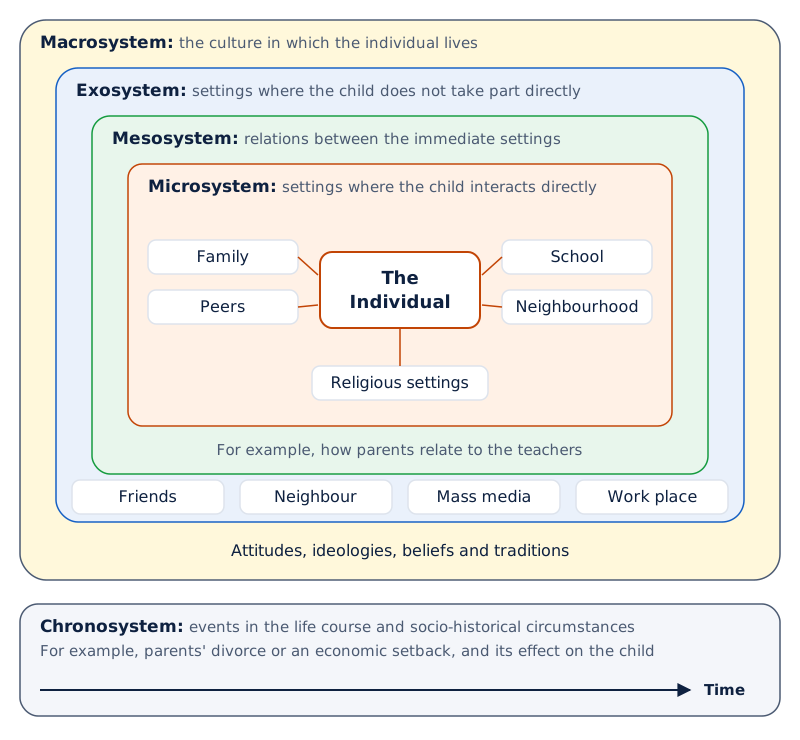
The individual appears at the centre of nested systems. Family, school, peers, religious settings and neighbourhood surround the centre. Outer labels include friends, neighbour, mass media and work place. The macrosystem includes attitudes, ideologies, beliefs and traditions. A time arrow accompanies the chronosystem below.
Drawn by One Young India. See Fig. 3.1 in your NCERT textbook
How does Sinha's model explain the Indian context?
Durganand Sinha's ecological model, an account of the child's interacting surroundings, has two concentric layers. The visible upper layer includes home conditions, schooling and peer interactions. Space, overcrowding, toys, school facilities and activities with peers belong here.
The surrounding layer includes the geographical environment, institutions shaped by caste and class, and amenities such as drinking water, electricity and entertainment. These influences are not always clearly visible.
The layers constantly interact and may have different developmental consequences for different people. Understanding individual differences therefore requires attention to experience. Home or school cannot be understood as an influence operating entirely independently of the wider setting.
What are developmental tasks, and what influences the prenatal period?
Developmental stages are assumed temporary periods, often distinguished by a dominant characteristic. Individuals vary in how quickly they move through them. Certain skills and behaviours are learned more easily and successfully during particular stages.
Developmental tasks are accomplishments that become social expectations for a stage. Accepting physical maturity and establishing an identity are adolescent tasks; exploring adult living and developing a stable life structure are tasks of early adulthood.
What happens before birth?
The prenatal period extends from conception to birth and typically lasts about 40 weeks. Conception marks the beginning of development following fertilisation. Both genetic and environmental factors affect development during this period and after birth.
Maternal characteristics, meaning characteristics of the mother, include age, nutrition and emotional state. Maternal diseases or infections can adversely affect prenatal development. Maternal malnutrition and drug use may also affect development before birth.
Teratogens are environmental agents causing deviations in normal development that can lead to serious abnormalities or death. Drugs, infections, radiation and pollution are examples. The foetus is the developing unborn child.
Alcohol, tobacco and certain drugs taken during pregnancy may harm the foetus and increase congenital abnormalities, meaning abnormalities present at birth. Radiation such as X-rays and certain industrial chemicals can cause permanent genetic changes. Carbon monoxide, mercury and lead are also dangers to the unborn child.
Note: Prenatal development is not determined by inheritance alone. Maternal conditions and environmental exposure also matter, and the prenatal period typically lasts about 40 weeks.
What develops during infancy?
Infancy covers the first two years of life. Brain development is rapid before and after birth. Newborns have most but not all brain cells just before birth, and connections between nerve cells develop rapidly.
Newborns can breathe, suck, swallow and discharge bodily wastes. In their first week, they can indicate a sound's direction, distinguish their mother's voice from other women's voices and imitate simple gestures such as mouth opening.
How do reflexes support movement?
Reflexes are automatic, built-in responses to stimuli, meaning events that elicit responses. They provide survival mechanisms before learning and form building blocks for motor development, the development of movement skills. Some, including blinking and coughing, persist; others disappear as voluntary control develops.
| Reflex | Description | Developmental course |
|---|---|---|
| Rooting | Turning the head and opening the mouth when touched on the cheek. | Disappears between 3 and 6 months. |
| Moro | A loud noise makes the baby throw the arms outward, arch the back and bring the arms together as if grasping something. | Disappears in 6 to 7 months (although reaction to loud noises is permanent). |
| Grasp | Fingers close around a finger or other object pressed against the palm. | Disappears in 3 to 4 months; replaced by voluntary grasping. |
| Babinski | Stroking the bottom of the foot makes the toes fan out and then curl. | Disappears in 8 to 12 months. |
How do sensory and cognitive abilities develop?
Sensory abilities allow infants to receive information through seeing, hearing, touch, smell and taste. Infants hear immediately after birth, respond to touch and pain, and possess smell and taste capacities. Their ability to locate sounds improves.
Vision is estimated to be lower than adult vision. It improves by 6 months and is almost adult-like by about the first year. Newborns might distinguish red from white, but in general are colour deficient; full colour vision develops by 3 months.
Object permanence means recognising that objects continue to exist when not perceived. A young infant does not search for a hidden toy. Gradually, by 8 months, the infant starts pursuing an object partially covered in their presence. Babbling begins sometime between 3 and 6 months.
How do attachment and trust develop?
Attachment is the close emotional bond of affection between infants and their parents or caregivers. Infants prefer familiar faces. As they become more mobile by 6 to 8 months, they begin preferring their mother's company and show distress at separation or unfamiliar faces.
What did Harlow and Harlow investigate?
In Harlow and Harlow's study, baby monkeys were separated from their mothers approximately 8 hours after birth. For 6 months they were reared with surrogate mothers, meaning substitutes, one made of wire and the other of cloth.
Half received food from the wire mother and half from the cloth mother. Regardless of which supplied food, the monkeys preferred the cloth mother and spent much more time with her. This demonstrated the importance of contact-comfort, comfort provided by bodily contact, in attachment.
Feeding was not crucial to attachment in this study. A child's attachment to a favourite blanket or toy likewise can provide comfort without the child mistaking the object for the mother. Such objects are abandoned as children become more sure of themselves.
How does sensitive care support trust?
For Erik Erikson, the first year is a key period for trust or mistrust, expectations about whether the world is secure and good. Responsive, sensitive parenting builds physical comfort and a sense of trust.
Sensitive, affectionate and accepting parents provide a strong base for exploration. Their infants are likely to develop secure attachment. Insensitivity and fault-finding can create self-doubt. Warm, interactive relationships with adults support healthy development; cultural differences in child rearing can affect attachment patterns.
How do physical abilities and thinking change during childhood?
Growth in early childhood is slower than in infancy. Children gain height and weight, run, jump and play with a ball. Increasing brain maturation and opportunities to experience the world contribute to developing cognitive abilities.
Which principles guide physical development?
The cephalocaudal trend means development from the head towards the lower body. Control of upper body parts develops before lower parts. The proximodistal trend means development from the body's centre towards its extremities: control of the trunk precedes control of outer parts.
Gross motor skills involve arms, legs and movement through the environment. Fine motor skills involve finger dexterity and eye-hand coordination. Both improve during early childhood, and a preference for the left or right hand develops.
| Age in years | Gross motor skills | Fine motor skills |
|---|---|---|
| 3 years | Hopping, jumping, running | Build blocks, pick objects with forefinger and thumb |
| 4 years | Climb up and downstairs with one foot on each step | Fit jigsaw puzzle precisely |
| 5 years | Run hard, enjoy races | Hand, arm, and body all coordinate with eye movement |
What are Piaget's stages?
Jean Piaget viewed children as active constructors of understanding. Successive stages differ in ways of thinking, rather than simply in the quantity of information acquired. Symbolic thought represents absent objects mentally; operations are mental actions, including actions that can be reversed.
- Sensorimotor stage: Approximately 0-2 years. Infants coordinate sensory experiences and physical actions to explore the world.
- Preoperational stage: Approximately 2-7 years. Symbolic thought develops and object permanence is established, but different physical attributes of an object cannot yet be coordinated.
- Concrete operational stage: Approximately 7-11 years. Children reason logically about concrete events, classify objects and perform reversible mental operations on representations of objects.
- Formal operational stage: Approximately 11-15 years. Adolescents apply logic more abstractly and develop hypothetical thinking, reasoning about possibilities beyond actual concrete experiences.
Why do children's explanations change?
Egocentrism is self-focused thinking that prevents appreciating another viewpoint. Animism attributes life-like qualities to non-living things, as when a child who slips says that the road caused the hurt. Centration focuses on one feature, such as a glass's height rather than its width.
Between approximately 4 and 7 years, intuitive thought appears as children seek answers about why things are as they are. Concrete operations later permit more flexible thought, attention to several characteristics and a decline in egocentrism.
Conservation means recognising that a quantity remains unchanged despite a change in form. Presented with two identical clay balls, one rolled into a thin strip, a child of 7 or 8 recognises equal amounts by imagining the strip becoming a ball again.
How do self-understanding, gender and morality develop?
The developing self is a child's sense of who they are and whom they identify with. Early self-descriptions emphasise physical features. During middle and late childhood, descriptions are likely to include internal qualities, social groups and comparisons with others.
How do initiative and gender roles develop?
Erikson linked parents' responses to self-initiated activity with initiative or guilt. Initiative means taking action independently. Opportunities for play and answers to questions support it. Belittling questions and activities is likely to produce guilt that may persist later.
Sex refers to the biological dimension of being male or female; gender refers to its social dimension. Gender roles are expectations about how females and males should think, act and feel. Most children begin acquiring male or female gender identity by about 3 years.
Parents often use rewards and punishments in gender socialisation, the process of learning gender expectations. Peers and media also contribute. Gender stereotypes are socially patterned expectations about males and females, reinforced through portrayals such as dependent domestic roles for women.
Children also actively organise their world around learned gender standards. Gender typing occurs when individuals become ready to encode and organise information according to what society regards as appropriate or typical for males and females.
How does moral reasoning change?
Moral development includes distinguishing right from wrong, feeling guilt, taking others' perspectives and helping people in trouble. Lawrence Kohlberg studied children's reasons for decisions about moral dilemmas, situations requiring a choice about what is right.
Before 9 years, children reason through external authority: punishment makes an action wrong and reward makes it right. By early adolescence, they internalise others' rules, accepting them as their own to be virtuous and gain approval rather than merely avoid punishment.
At this point, rules are treated as absolute guidelines and moral thinking is relatively inflexible. With further development, individuals gradually form a personal moral code. Adolescents can explore alternative moral courses and show some flexibility rather than treating every social rule as absolute.
What physical and cognitive changes occur in adolescence?
Adolescence is the transition between childhood and adulthood. It commonly begins with puberty, the attainment of sexual maturity or reproductive capacity. Physical changes are universal, but social and psychological experiences depend on cultural context. Adolescence itself is not universal across cultures.
What changes accompany puberty?
Puberty is gradual rather than sudden. Primary sex characteristics directly concern reproduction; secondary sex characteristics are signs of sexual maturity. Changes in boys include accelerated growth, facial hair and voice changes.
Menarche is the onset of menstruation. Girls' rapid height growth usually begins about two years earlier. The growth spurt, a period of rapid growth, generally begins at 12 or 13 for boys and 10 or 11 for girls.
Variation in the pubertal sequence is normal. Genetics and environment both contribute. Adolescents develop new awareness of sexual feelings and increased interest in sexual matters, while many lack adequate knowledge or hold misconceptions.
Developing a sexual identity, which guides sexual behaviour, is an important task. So is accepting physical maturity and forming a realistic, acceptable image of one's physical appearance. Puberty involves social and cognitive changes alongside physical ones.
How does adolescent reasoning differ?
Formal operational thinking is abstract, logical and idealistic. Adolescents consider ideal characteristics and compare actual people with those standards. They reason beyond immediate experience and examine their own thoughts and other people's thoughts.
Hypothetical deductive reasoning is systematic reasoning about possible courses of action and explanations, followed by seeking solutions. It contrasts with the trial-and-error approach used at earlier stages. More flexible moral reasoning enables consideration of alternative choices and a personal code.
What is adolescent egocentrism?
David Elkind identified two components. The imaginary audience is the belief that others are as preoccupied with the adolescent as the adolescent is with themselves. A boy may imagine everyone notices the ink spot on his shirt.
The personal fable is a sense of uniqueness, including the belief that nobody understands one's feelings. An adolescent hurt by a friend's betrayal may believe nobody else can understand that hurt. Personal fables are often part of adolescent diaries.
How are identity and major adolescent challenges connected?
Identity concerns who a person is and their values, commitments and beliefs. Adolescence's primary task is establishing an identity separate from parents. Developing a personalised set of beliefs can involve conflict with parents and within oneself.
What influences identity formation?
Cultural and ethnic background, family and societal values, and socio-economic status influence the search for a place in society. Adolescents who cope with conflicting identities develop a new sense of self. Difficulty coping can produce identity confusion, uncertainty about one's sense of self.
Adolescents may want independence while fearing it, shifting between confidence and insecurity. Peers provide opportunities to refine social skills and try behaviours. Parents and peers generally serve complementary functions and fulfil different needs, though conflict with parents may increase identification with peers.
Vocational commitment, commitment towards an occupation, also shapes identity. It requires thinking about the future and setting realistic goals. Cultural settings vary in freedom to choose occupations. Career counselling provides information and guidance for these decisions.
What concerns may arise?
- Delinquency ranges from socially unacceptable behaviour to legal offences and criminal acts, including truancy, stealing and vandalism. It is often associated with low parental support, inappropriate discipline and family discord. Most delinquent children do not remain delinquent forever.
- Substance abuse involves misuse of substances such as alcohol and drugs. Peer pressure, wanting adult-like status or escaping pressures could contribute. Continued drug use can lead to physiological dependency, or addiction. Positive relationships play an important preventive role.
- Anorexia nervosa is an eating disorder involving a relentless pursuit of thinness through starvation. Preoccupation with the body, peer comparisons and media images of thinness are relevant concerns.
- Bulimia is an eating disorder involving a binge-and-purge pattern: episodes of eating followed by attempts to expel food, sometimes alternating with fasting.
Adolescence can involve loneliness, anxiety and self-doubt, but adolescents are also likely to experience excitement, joy and competence as they overcome challenges. Peer influence can be positive or negative. Changes in peers, positive models, responsibility and self-worth help reduce delinquent behaviour.
What changes and responsibilities characterise adulthood and old age?
An adult is generally understood as responsible, mature, self-supporting and integrated into society. The timing of adult roles varies with social context. Early adulthood involves exploring possible ways of living and developing a stable life structure.
How do work and family create transitions?
Choosing an occupation, earning a living and developing a career are important in the twenties and thirties. Entering work requires adjustment to competition, performance demands, responsibilities and expectations. Evaluating and developing a career becomes an adult task.
Marriage involves adjusting to a partner's preferences and sharing responsibilities, especially when both work. Parenthood can be difficult and stressful, although usually accompanied by love for the baby. Its experience depends on family size, social support and the couple's relationship.
Single working parents and families with two working parents face pressures involving childcare, schoolwork, illness and workloads. Despite stresses, parenting can offer growth and satisfaction through guiding the next generation.
Does every ability decline with age?
Almost all middle-aged people notice gradual deterioration in some physical functions, though rates vary. Examples include vision, hearing and appearance. Some cognitive abilities are believed to decline while others do not. Memory tends to decline, while wisdom may improve.
Short-term memory retains information briefly; long-term memory retains it over longer periods. Remembering a telephone number immediately and after several days illustrates the distinction. Decline is greater in long-term than short-term memory tasks. Individual differences remain: not all adults show wisdom.
How do older adults adapt?
The beginning of old age is difficult to fix. Its experience depends on socio-economic conditions, healthcare, attitudes, expectations and support. Some people beyond seventy remain energetic, creative and socially valued.
Retirement, withdrawal from active vocational life, is viewed differently. Some experience separation from a source of satisfaction and self-esteem; others welcome time for interests. Older adults open to new experiences and inclined to remain active are better adjusted.
Changing family structures bring new roles such as grandparenting. Children may establish independent homes, and some older adults experience loneliness or financial dependence. A sense of security, belonging and being cared for matters.
A spouse's death is usually seen as the most difficult loss. Grief, loneliness, financial loss and health risks can follow. Support from children, grandchildren and friends can help the individual cope with the loss of a spouse. Death can occur at any developmental point, although it is more likely in late adulthood.
Glossary
- Development — Progressive, orderly and predictable changes beginning at conception and continuing throughout the individual's life.
- Maturation — Orderly developmental changes largely dictated by the inherited genetic blueprint of the individual.
- Plasticity — The possibility of modifying psychological development and improving abilities, with differences between individuals.
- Genotype — The actual genetic material or genetic heritage inherited by a particular person.
- Phenotype — Observable and measurable characteristics expressing genotype through interaction between inherited traits and environment.
- Developmental tasks — Accomplishments that become social expectations associated with a particular stage of development.
- Teratogens — Environmental agents causing deviations in normal development that can produce serious abnormalities or death.
- Reflexes — Automatic, built-in responses to stimuli that provide early survival mechanisms and support motor development.
- Object permanence — Awareness that objects continue to exist even when they are not currently perceived.
- Attachment — The close emotional bond of affection between an infant and parents or caregivers.
- Centration — Focusing on a single feature or characteristic when trying to understand an event.
- Conservation — Recognising that a quantity remains unchanged when the form of an object changes.
- Imaginary audience — The adolescent's belief that others are as preoccupied with them as they are with themselves.
- Personal fable — An adolescent's sense of uniqueness, including the belief that others cannot understand their feelings.
- Identity — A person's sense of who they are, including their values, commitments and beliefs.
Common errors and misconceptions
- Misconception: Development means becoming physically bigger. Correct: Growth concerns measurable size; development includes cognitive and socio-emotional changes, and both gains and losses across life.
- Misconception: Every child reaches milestones at exactly the same age. Correct: Stages have characteristic patterns, but the time and rate of development vary between individuals.
- Misconception: Genotype and phenotype are interchangeable. Correct: Genotype is genetic heritage; phenotype is its observable expression through interaction with the environment.
- Misconception: Attachment depends simply on who feeds an infant. Correct: Harlow and Harlow's monkeys preferred the cloth mother regardless of feeding, showing the importance of contact-comfort.
- Misconception: A later cognitive stage means only knowing more facts. Correct: Piaget distinguished stages by ways of thinking, including symbolic representation and reversible mental operations.
- Misconception: The imaginary audience and personal fable mean the same thing. Correct: The first concerns feeling constantly noticed; the second concerns feeling uniquely different and misunderstood.
- Misconception: Adolescence inevitably means permanent delinquency. Correct: Most delinquent children do not remain delinquent forever, and adolescence also includes joy, excitement and growing competence.
- Misconception: Ageing means every ability declines and everyone becomes incapable. Correct: Some abilities decline while others do not; wisdom may improve, and many older people remain active.
Exam-style questions with model answers
Q1. An increase in height is measurable. Sitting without support becomes possible as the underlying physical structure becomes ready through an orderly, largely genetic sequence. Identify and distinguish the two processes. [2 marks]
- The measurable increase in height is growth, an increase in the size of a body part or the organism.
- The orderly readiness for sitting illustrates maturation, changes largely dictated by the genetic blueprint rather than size increase alone.
Q2. Consider four observations: change continues into old age; physical, thinking and emotional changes interact; experience may improve wisdom while running speed is likely to decline; and abilities can improve, with variation between people. Explain the four corresponding life-span assumptions. [4 marks]
- Development is lifelong: continuing change in old age shows that development extends across the whole life-span.
- Developmental processes are interwoven: physical, cognitive and socio-emotional changes interact within the same developing person.
- Development is multidirectional: wisdom may improve through experience while performance in speed-based activities is likely to decrease.
- Development is plastic: abilities can improve or be modified throughout life, although this possibility differs between individuals.
Q3. Classify five influences using Bronfenbrenner's systems: direct family interaction; relations between parents and teachers; a parent's workplace transfer affecting home interactions although the child does not participate in that workplace; the culture in which the child lives; and parental divorce considered as an event in the child's life course. Explain each classification. [5 marks]
- Direct family interaction belongs to the microsystem, the immediate setting in which the child interacts with other people.
- Relations between parents and teachers belong to the mesosystem, because they connect two of the child's immediate settings.
- The workplace transfer belongs to the exosystem: the child does not participate directly there, yet its events influence home experiences.
- The surrounding culture belongs to the macrosystem, the cultural context within which the child's development takes place.
- Divorce considered through the child's life course belongs to the chronosystem, which includes events and circumstances across time.
Q4. A newborn turns towards cheek contact and opens the mouth; the fingers close around an object pressed against the palm; stroking the sole makes the toes fan out and curl. These responses disappear, respectively, between 3 and 6 months, in 3 to 4 months, and in 8 to 12 months. Identify and describe each reflex with its supplied developmental course. [3 marks]
- Rooting: cheek contact produces head turning and mouth opening. This reflex disappears between 3 and 6 months.
- Grasp: pressure against the palm makes the fingers close around the object. This reflex disappears in 3 to 4 months.
- Babinski: stroking the sole makes the toes spread and then curl. This reflex disappears in 8 to 12 months.
Q5. Harlow and Harlow separated baby monkeys from their mothers approximately 8 hours after birth and reared them for 6 months with wire and cloth substitutes. Half were fed by each substitute. Regardless of feeding, monkeys preferred and spent much more time with the cloth substitute. Explain the design, finding and implication in four points. [4 marks]
- The monkeys were separated approximately 8 hours after birth and reared with substitute mothers for 6 months.
- The comparison involved wire and cloth substitutes, with half the monkeys receiving food from each kind of mother.
- Both feeding groups preferred the cloth mother and spent much more time with her, regardless of which supplied food.
- The finding demonstrates the importance of contact-comfort in attachment; providing nourishment was not crucial to attachment in this study.
Q6. Two identical clay balls contain equal amounts. One is rolled into a thin strip without adding or removing clay. A child of 7 or 8 says both still contain equal clay and imagines rolling the strip back into a ball. Identify the cognitive stage and explain three features of the reasoning. [4 marks]
- The response illustrates the concrete operational stage, in which a child reasons logically about concrete objects and events.
- Imagining the strip returning to a ball shows reversibility, mentally undoing the change that was physically performed.
- Recognising equal clay despite altered shape shows conservation: the quantity remains unchanged by the transformation.
- The child considers more than one characteristic rather than focusing only on the strip's length or the ball's height.
Q7. An adolescent with an ink spot on his shirt believes everyone is noticing it. Another, hurt by a friend's betrayal, believes nobody can understand her feelings. Name Elkind's two concepts and distinguish their shared basis from their different emphases. [3 marks]
- The ink-spot belief illustrates the imaginary audience: the adolescent imagines others are continually observing and noticing them.
- The belief that nobody understands the hurt illustrates the personal fable, a sense that one's feelings are unique.
- Both belong to adolescent egocentrism, but the imaginary audience concerns others' attention, whereas the personal fable concerns personal uniqueness.
Q8. Adult development involves choosing and evaluating a career, adjusting to a partner's preferences and shared responsibilities, parenting with available social support, variable physical changes and memory decline while wisdom may improve, differing views of retirement, and coping with a spouse's death with family and friends' support. Explain these six areas of adjustment without treating them as identical for everyone. [6 marks]
- Career: choosing and evaluating work creates responsibilities and demands adjustment as an individual develops an adult working life.
- Marriage: partners adjust to each other's preferences and work out how to share responsibilities within their relationship.
- Parenthood: bringing up children creates responsibilities, while available social support influences how adults experience and manage parenting.
- Age-related changes: physical changes vary between individuals; memory tends to decline, but wisdom may improve rather than every ability declining.
- Retirement: people interpret leaving work differently, so adjustment depends partly on whether this transition is experienced positively or negatively.
- Bereavement: coping with a spouse's death involves major loss, and support from family members and friends can help the individual adjust.
Key takeaways
- Development continues throughout life and involves biological, cognitive and socio-emotional processes, with gains and losses occurring together.
- Growth concerns measurable size, while maturation follows an orderly sequence largely dictated by the genetic blueprint.
- Genotype and environment interact to produce observable characteristics; children also influence responses and seek particular environments.
- Developmental contexts include immediate relationships, connections between settings, indirect influences, culture and changes across time.
- Infants possess reflexes and sensory abilities, while object permanence, attachment and trust develop through maturation and experience.
- Piaget's stages distinguish ways of thinking, from sensory action through symbolic and concrete thought to abstract reasoning.
- Adolescence involves physical maturity, identity formation and changing relationships, with cultural differences shaping social and psychological experiences.
- Adulthood and old age involve work, family and loss, but support and individual differences shape adjustment.
Test yourself
Why is growth narrower than development?
Growth concerns measurable increases in size. Development includes growth alongside cognitive, emotional and social changes, and also involves decline.
What does plasticity mean in the life-span perspective?
Psychological development can be modified and abilities can improve throughout life, although plasticity differs between individuals.
How does a mesosystem differ from a microsystem?
A microsystem is an immediate setting of interaction; a mesosystem consists of relationships between such settings, such as parents' relations with teachers.
What does an infant's search for a partly covered object suggest?
It suggests developing object permanence, the awareness that an object continues to exist when it is not perceived.
How do the cephalocaudal and proximodistal trends differ?
Cephalocaudal development proceeds from the head towards the lower body; proximodistal development proceeds from the body's centre towards its extremities.
What does imagining a clay strip becoming a ball again demonstrate?
It demonstrates a reversible mental operation, supporting the recognition that the amount of clay has remained the same.
Why should puberty not be treated as a sudden, identical event?
Puberty is gradual, and normal variation exists in its sequence and timing. Both genetics and environment play a part.
Why can retirement be experienced differently by different people?
Some experience separation from work-related satisfaction and self-esteem, while others welcome more time to pursue personal interests.
Write about it
Turn a question from this chapter into a paper.
The Writing Studio has a structure guide, a rubric and citation tools for 15 formats, from essays to research papers. Drafting is free with an account. Learnacy Essential adds feedback from an AI writing coach and submission to The OYI Review.
Learnacy Essential is ₹1,499 for the year. Publication depends on review and is not guaranteed.