
Pollution | ICSE Class 9 Geography Notes
On this page

This note covers pollution and pollutants; air, fresh water, marine, soil, radiation and noise pollution; their sources and effects; river pollution case studies; and preventive measures involving transport, energy use, waste treatment and organic farming.
What is pollution, and how are its main types distinguished?
Definition: Environmental pollution is the harmful deterioration of the environment associated with the release of substances or energy from human activities. A pollutant is a substance or form of energy responsible for pollution.
Pollution can involve matter, such as waste chemicals, or energy, such as unwanted sound. It affects the surroundings in which people, plants and animals live. Identifying the affected part of the environment helps distinguish different forms of pollution.
Chemical fertilisers supply plant nutrients; pesticides control pests, organisms that damage crops. Biomedical waste is waste generated during medical diagnosis, treatment or related healthcare activities. Improper disposal makes it a source of soil pollution.
X-rays are a form of high-energy electromagnetic radiation, energy travelling as linked electric and magnetic disturbances. Radioactive fallout means radioactive particles settling on the Earth's surface after release into the atmosphere. Radioactive materials emit radiation as their unstable atomic nuclei change.
How do the five types compare?
| Type | Meaning | Sources |
|---|---|---|
| Air pollution | Harmful contamination of the air | Vehicles, industries and burning garbage |
| Water pollution | Deterioration of water quality through contamination | Domestic waste from homes and industrial waste from factories |
| Soil pollution | Contamination of soil by harmful wastes or chemicals | Chemical fertilisers, pesticides and biomedical waste |
| Radiation pollution | Harmful exposure of the environment or living things to radiation, energy transmitted as waves or particles | X-rays and radioactive fallout from nuclear plants |
| Noise pollution | Unwanted or harmful sound that causes discomfort or harm | Traffic, factories, construction sites, loudspeakers and airports |
Why distinguish a source from a pollutant?
A source is the activity or place releasing pollution; a pollutant is what causes the contamination or disturbance. A factory is a source, while its smoke, waste chemicals and unwanted sound represent different pollution problems.
Fresh water includes river, lake and underground water; marine means relating to seas and oceans. Pollution of either affects water quality. The distinction concerns the receiving environment, while domestic and industrial wastes remain important sources to identify.
What causes air pollution, and what are its effects?
Air pollution involves contaminants such as dust, fumes, gases, smoke or vapour present in proportions and for durations that may harm living organisms and property. Both the amount of a contaminant and the duration of its presence matter.
Which activities release pollutants into the air?
Vehicular pollution comes from vehicles. Burning petrol and diesel releases pollutants into the atmosphere. Fossil fuels, including coal, petroleum and natural gas, are energy resources formed from the remains of ancient organisms. Their combustion, meaning burning, is a major pollution source.
Industrial pollution includes smoke, dust and gases released during production and fuel use. Chemical and paper factories, brick kilns, refineries and metal-processing plants are examples. Burning garbage is another source of air pollution.
Particulate matter consists of small solid or liquid particles carried in the air, including dust, mist and smoke particles. Gaseous pollutants include sulphur dioxide and carbon monoxide. These gases and airborne particles should be distinguished from the activities that release them.
How are health and the environment affected?
Air pollution causes diseases affecting the respiratory system, which enables breathing; the nervous system, which transmits and coordinates signals; and the circulatory system, which moves blood around the body. It also adversely affects animals, plants, buildings and the atmosphere.
Urban smog is smoky fog over cities caused by atmospheric pollution. It is very harmful to human health. Air pollution can also cause acid rain, rainfall made more acidic by atmospheric pollutants.
Note: Pollution is not restricted to visible smoke. Undesirable gases are also air pollutants. A description of air pollution should therefore include both gases and particulate matter.
Control measures must address the source. Using less fossil fuel, reducing unnecessary vehicle use and controlling industrial discharges all address activities that release pollutants. The health effects explain why reducing emissions, meaning releases into the environment, is important.
How do domestic and industrial wastes pollute fresh water?
Water pollution occurs when contamination degrades water quality and makes it unfit for use. Rivers and lakes contain small quantities of suspended particles and dissolved substances naturally. Trouble arises when their concentrations increase beyond the water's capacity to purify itself.
What enters water from homes and factories?
Sewage is municipal wastewater containing human excreta, organic matter and microbes. Organic matter includes material derived from living organisms. Microbes are microscopic organisms; many microbes in sewage are pathogenic, meaning disease-causing.
Untreated sewage is often discharged directly into rivers. This increases pollution and water-borne disease. Water-borne diseases spread through contaminated water. Examples include diarrhoea, frequent loose or watery stools; intestinal worm infections, caused by worms living in the intestine; and hepatitis, inflammation of the liver.
Industrial effluent is liquid waste discharged from an industrial process. Paper, pulp, textile, leather and chemical industries are important water polluters. Their wastes can contain dyes, detergents, acids, salts and metals such as lead and mercury.
Most industrial wastes are disposed of in running water or lakes. Poisonous substances consequently reach rivers and reservoirs, damaging the organisms living there. This links waste disposal at a factory with environmental effects beyond its immediate surroundings.
How can pollution move from land into water?
Run-off is water flowing over the land surface. It can wash fertilisers and pesticides into rivers, lakes and tanks. Infiltration is the entry of water into soil; dissolved chemicals can travel with it and reach groundwater, water beneath the Earth's surface.
- Chemical fertilisers or pesticides are applied to agricultural land.
- Water washes some of these chemicals across the surface or into the soil.
- Surface flow carries chemicals into rivers, lakes or tanks.
- Water entering the soil can carry chemicals towards groundwater, connecting soil contamination with water pollution.
Fertilisers increase the nitrate content of surface water. Nitrates are nitrogen-containing compounds. Thus pollution prevention includes managing agricultural chemicals as well as treating domestic sewage and industrial effluent.
The same receiving river can contain wastes from several activities. Identifying only one source, such as a factory, does not explain sewage entering from towns or chemicals arriving from fields. Effective control must take these different routes into account.
How does marine pollution differ from freshwater pollution?
Freshwater pollution concerns water bodies such as rivers and lakes, as well as groundwater. Marine pollution concerns seas and oceans. Both involve a decline in water quality, but they occur in different receiving environments.
| Point of comparison | Fresh water | Marine water |
|---|---|---|
| Receiving environment | Rivers, lakes and groundwater | Seas, oceans and coastal waters near the shore |
| Important waste sources | Domestic sewage and industrial effluent | Land-based municipal and industrial run-off, and sea-based activities |
| Examples of contaminants | Waste chemicals, disease-causing microbes and agricultural chemicals | Oil, toxic chemicals, disease-causing organisms and plastic refuse |
Why are coastal waters vulnerable?
Coastal waters near large cities and river mouths are often overwhelmed by human contamination. Toxic chemicals, oil, disease-causing organisms and plastic waste adversely affect marine regions. Pollution can enter from land-based municipal and industrial run-off as well as sea-based operations.
Algal blooms are abundant growths of algae, simple photosynthetic organisms. Blooms regularly deplete oxygen in ocean water and kill fish and other marine life. Such blooms are sometimes poisonous. These are effects on living communities, not merely changes in water's appearance.
What principles help prevent water pollution?
Careful disposal of domestic, industrial and agricultural wastes is essential. Careful handling of oil and petroleum products can greatly reduce the water pollution they cause. Prevention must address the activities introducing contaminants, including those occurring on land.
For freshwater systems, treating sewage before disposal makes it less polluting. Industrial control also includes treating effluent and reusing water. These measures address the source of contamination before waste enters the receiving water body.
Fresh water and marine water should therefore be compared through three questions: where pollution occurs, what enters the water, and which activity releases it. Naming a water body alone does not explain the source or the effect of its pollution.
How do soil pollution and waste disposal affect land and health?
Soil pollution involves contamination by harmful substances or wastes. Chemical fertilisers, pesticides and biomedical waste are important sources. Untreated industrial waste and dumped garbage also damage land and can contaminate water beneath it.
How do agricultural chemicals affect the surroundings?
Overuse of chemical fertilisers contributes to environmental pollution. Pesticides used against crop pests can pollute soil, groundwater, fruits, vegetables and crop plants. Weedicides, chemicals used to remove unwanted plants called weeds, also pollute soil.
Soil and water pollution are closely related. Rainwater can pass through contaminated ground while carrying pollutants. Therefore, dumping waste on land can affect groundwater as well as the soil at the disposal site.
Diagram
Movement of pollutants from land to groundwater
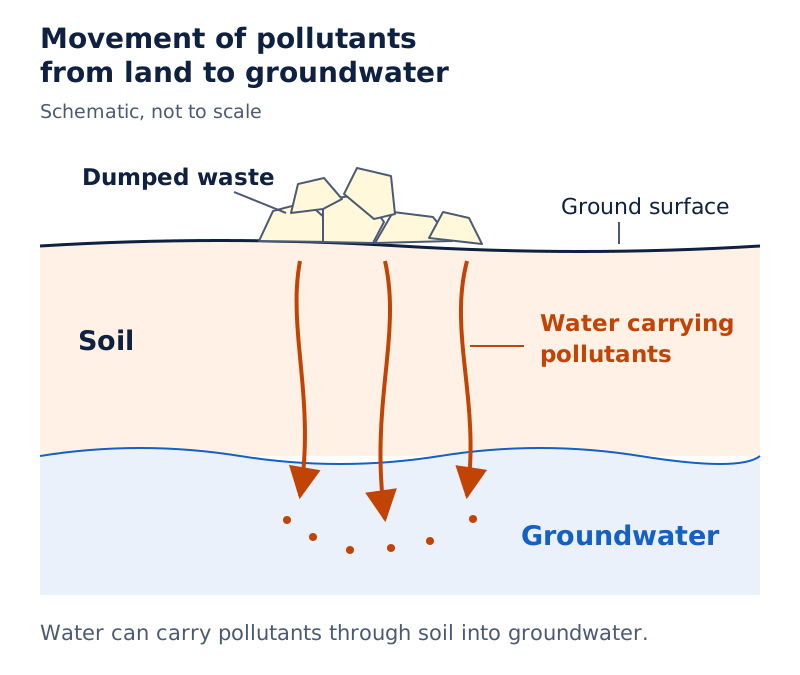
Draw a ground surface with dumped waste above it. Below, label soil and groundwater. Add downward arrows labelled “water carrying pollutants” to show how contamination can move through the soil.
Drawn by One Young India.
Why is careless waste disposal a health problem?
Solid waste includes discarded articles such as broken glass, plastic containers, polythene bags and ash. Domestic establishments and industrial or commercial establishments produce it. Uncollected waste accumulates on streets, open spaces and wasteland.
Waste heaps produce unpleasant smells and harbour flies and rodents. These animals can carry disease. Careless handling, wind and rainwater spread waste, extending the problem beyond the place where it was first dumped.
Biomedical waste must be recognised as a distinct source from agricultural chemicals. Its origin is healthcare activity, while fertilisers and pesticides are associated with farming. Both belong in an account of soil pollution, but their sources should be identified separately.
Preventing pollution therefore requires attention to both material and movement. Identify the waste, how it reaches the soil, and whether water carries it further. Clearing visible rubbish addresses accumulation; preventing harmful discharges addresses the continuing source of contamination.
What causes noise pollution, and how can it be reduced?
Noise pollution is unwanted or harmful sound that makes surroundings uncomfortable or damages health. Traffic, factories, construction sites, loudspeakers and airports are important sources. Noise involves sound energy rather than a chemical contaminant left in soil or water.
How do source, distance and exposure matter?
Factories and construction activities use machinery, generators, saws and drills that make noise. Loudspeakers and sirens add periodic disturbances. Traffic noise varies with the type and condition of vehicles and the condition of roads.
Noise pollution is location-specific, and its intensity declines as distance from the source increases. Intensity is a measurable property of sound, whereas perceived loudness also depends on the listener's hearing ability.
Sound levels are commonly expressed in decibels, abbreviated dB. Even a small rise in decibel level represents a large increase in sound intensity. The following values describe familiar sounds; they are not legal exposure limits.
| Sound | Sound level in decibels | Qualification |
|---|---|---|
| Rustling leaves | A few dB | Very soft sound, around a few decibels |
| Normal conversation | About 60 dB | Approximate value |
| Firecrackers | Can exceed 100 dB | Very loud sound; not a fixed value for every firecracker |
What are the effects and controls?
Noise causes irritation and stress. It can also cause hearing impairment, increased heart rate and increased blood pressure. Exposure above recommended limits, especially for long durations, can affect health, sleep and hearing. Prolonged loud sound can lead to hearing loss.
Generators should be fitted with silencers, devices that reduce noise. Noise-absorbing materials can also be used. Almost all machinery can be redesigned to improve energy efficiency and reduce noise. Earplugs provide personal protection where appropriate.
The distinction between source control and personal protection is useful. Reducing machinery noise acts on the source, while earplugs protect the wearer. Distance, duration and source characteristics all help explain why different noise situations have different effects.
Why are X-rays and radioactive fallout pollution concerns?
Radiation pollution concerns harmful exposure to radiation. X-rays and radioactive fallout from nuclear plants are the sources to recognise. Radiation must be distinguished from ordinary solid waste, and harmful exposure must be distinguished from controlled useful applications.
What makes X-ray exposure a concern?
X-rays are used in medical diagnosis and in treating certain forms of cancer, involving uncontrolled cell growth. They damage or destroy living tissues and organisms. Care must therefore be taken to avoid unnecessary exposure or overexposure.
A useful application does not remove the need for careful control. Conversely, identifying X-rays as a pollution concern does not mean that every diagnostic use should be described as environmental contamination. The issue is harmful or unnecessary exposure.
How can nuclear wastes affect the environment?
Radioactive substances appear among pollutants of land and water. Wastes from nuclear power plants and nuclear weapon production facilities cause cancers, birth defects and miscarriages. These effects connect waste management with protection of living organisms.
Birth defects are abnormalities present at birth; and miscarriage means the loss of a pregnancy before the developing baby can survive independently. These terms describe different health outcomes and should not be treated as synonyms.
Radioactive fallout is the deposition of radioactive particles after their atmospheric release. X-rays, by contrast, are radiation itself. Distinguishing radiation from radioactive material helps explain why exposure and contamination are related but different ideas.
Note: Remember both radiation sources: X-rays and radioactive fallout from nuclear plants. When discussing X-rays, retain the need to avoid unnecessary or excessive exposure alongside their useful medical applications.
The environmental link is that harmful radioactive substances can contaminate land or water, while the health link is damage to living tissues. A complete explanation therefore identifies a source, the kind of exposure or contamination, and its consequences.
What does the Ganga and Yamuna case study show about river pollution?
Case study: How do urban and industrial wastes affect these rivers?
The Ganga and Yamuna illustrate how urban waste, industrial activity and agricultural run-off combine in river pollution. Different stretches receive wastes from different activities, so the problem extends along the river rather than belonging to a single discharge point.
Downstream means in the direction of river flow. A confluence is the meeting of rivers. A barrage is a gated structure across a river used to control water. Carcasses are dead animal bodies.
| River | Polluted stretches | Pollution sources or pressures |
|---|---|---|
| Ganga | Downstream of Kanpur; downstream of Varanasi; Farrakka Barrage | Industrial pollution from towns such as Kanpur; domestic waste from urban centres; dumping of carcasses |
| Yamuna | Delhi to its confluence with the Chambal; Mathura and Agra | Water extraction for irrigation; agricultural run-off; domestic and industrial waste from Delhi |
Diagram
Polluted stretches of the Ganga
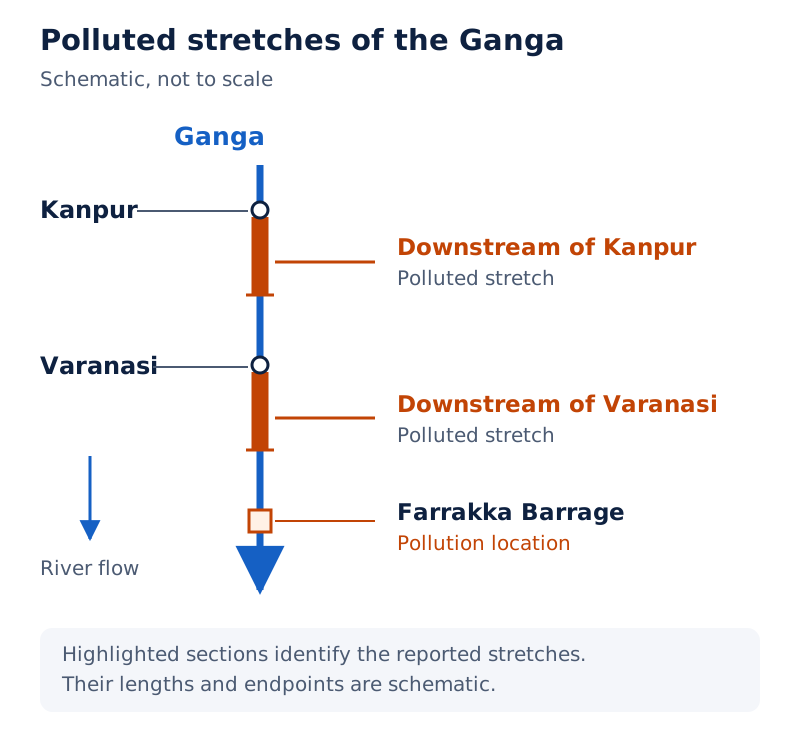
On an outline map, trace the Ganga and label Kanpur, Varanasi and Farrakka Barrage. Highlight the stretches downstream of Kanpur and Varanasi, and mark Farrakka Barrage as another pollution location.
Drawn by One Young India.
Diagram
Polluted stretches of the Yamuna
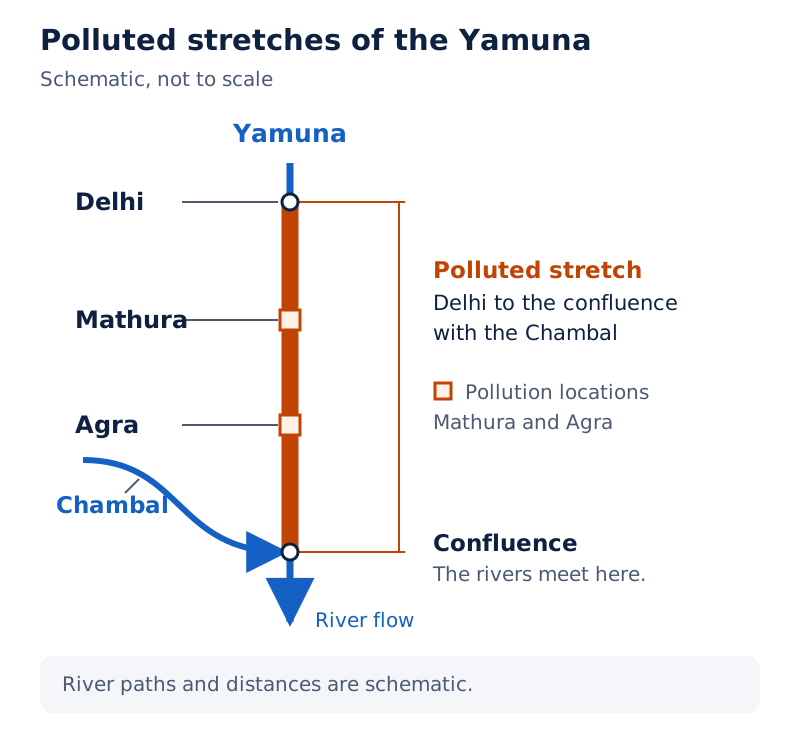
On an outline map, trace the Yamuna and label Delhi, Mathura, Agra and the confluence with the Chambal. Highlight the stretch from Delhi to this confluence and mark Mathura and Agra as pollution locations.
Drawn by One Young India.
Kanpur, Prayagraj, Varanasi, Patna and Kolkata release domestic waste into the Ganga. Delhi releases domestic waste into the Yamuna. Agricultural chemicals washed from fields provide another route through which rivers become polluted.
What the figure shows
Photograph of a boat on the polluted Yamuna
The photograph shows people in a narrow boat amid a broad pale layer of foam. Caption: “Cutting Through Effluent : Rowing through a pervasive layer of foam on the heavily polluted Yamuna on the outskirts of New Delhi”.
What measures address pollution of the Ganga?
The Namami Gange Programme includes sewage treatment systems in towns, monitoring industrial effluent, river-surface cleaning and public awareness. It also includes riverfront development and tree planting along the banks to increase the variety of living organisms.
The case connects source and response. Domestic wastewater requires sewage treatment; industrial discharges require monitoring and control; surface waste requires cleaning. Public awareness addresses the addition of pollutants through human activities.
These actions work at different points in the pollution pathway. Cleaning the surface concerns waste already present, whereas treatment concerns waste before discharge. Both are relevant when a river receives pollution from settlements along its course.
What does the Daurala case study reveal about pollution control?
Case study: What happened at Daurala?
Daurala, near Meerut, provides an example of industrial wastewater contaminating groundwater. Untreated wastewater from local industries was passing into the groundwater, contaminating it with heavy metals. Heavy metals here means metallic pollutants such as lead and mercury.
The condition of residents attracted civil society's attention in 2003. A non-governmental organisation conducted a door-to-door health survey. It then worked with the village community, people's representatives, industry officials and government officials to seek solutions.
A metre is a unit of length used to measure the additional pipeline.
| Aspect of the case | Reported detail | Meaning |
|---|---|---|
| Year the condition attracted attention | 2003 | Civil society's attention was drawn to the condition of Daurala's residents |
| Residents | Twelve thousand | Population of Daurala |
| Additional pipeline | 900 metres | Extra length laid to supply drinking water |
| Tree planting | 1000 trees | Planting undertaken to improve the environment |
| Period before efforts bore fruit | Three years | Time taken for the restoration efforts to bear fruit |
The pipeline figure measures additional length; it does not measure the amount of water supplied. The population and time span describe this case, rather than a general rule about pollution control.
Which measures were taken?
The capacity of the village's overhead water tank was increased, and the extra pipeline supplied potable water, meaning water suitable for drinking. The silted village pond was cleaned by removing deposited sediment, a process called desilting.
Removing silt created space for water and helped recharge aquifers, underground formations that store and transmit water. Rainwater harvesting, the collection and storage of rainwater, also helped dilute groundwater contaminants after the monsoons. Tree planting improved the environment.
The case used the polluter pays principle, under which those responsible for pollution bear the cost of addressing it. Community participation and cooperation with industry connected the identification of pollution with practical measures to protect health and restore the surroundings.
How can transport, energy choices and farming help prevent pollution?
Prevention addresses activities that generate pollution. Important measures include carpools, public transport, no-smoking zones, restricted fossil-fuel use, energy saving and organic farming. Each measure should be linked to the source or activity it is intended to change.
How can transport and energy use change?
Carpooling means sharing a car journey. Public transport carries passengers in shared services rather than each person relying on a separate private vehicle. Both measures can reduce separate vehicle journeys and the fuel burned for them.
A no-smoking zone is an area where smoking is prohibited. It helps prevent exposure to tobacco smoke in that space. This addresses a local source of air pollution rather than industrial or traffic emissions.
Restricting fossil-fuel use and saving energy address pollution associated with burning fuels. Energy saving includes switching off electrical appliances when they are not needed. It complements improvements in equipment efficiency, meaning obtaining the required service with less energy.
How does organic farming help?
Organic farming uses biological approaches to maintain soil fertility and manage pests while reducing dependence on chemical fertilisers and pesticides. Biofertilisers are organisms that enrich the nutrient quality of soil. They help reduce dependence on chemical fertilisers.
Biocontrol means controlling plant diseases and pests through biological methods. Organic farming uses interactions among organisms to keep pests at manageable levels. It does not require the elimination of every insect in a field.
The ladybird beetle helps control aphids, small plant-feeding insects. Such biological control reduces dependence on toxic pesticides. Protecting useful organisms is therefore part of managing the field rather than a separate concern.
How does waste treatment support prevention?
Factories can reuse water and treat effluent before releasing it. Sewage treatment makes domestic wastewater less polluting. Filtration removes particles by passing water through a filtering medium; sedimentation allows suspended solids to settle.
- Remove floating debris from sewage through filtration.
- Allow grit and other settling solids to separate through sedimentation.
- Pass the liquid into tanks where air is supplied and useful microbes grow.
- Let these microbes consume the major part of the organic matter, reducing the wastewater's pollution potential.
Preventive measures are strongest when matched to the problem: transport choices address vehicle use, organic farming addresses agricultural chemicals, and wastewater treatment addresses sewage or effluent. No single measure replaces attention to all the different pollution sources.
Glossary
- Pollution — Harmful deterioration of the environment associated with the release of substances or energy from human activities.
- Pollutant — A substance or form of energy responsible for environmental contamination, disturbance or harm.
- Particulate matter — Small solid or liquid particles carried in air, including dust, mist and smoke particles.
- Urban smog — Smoky fog over cities resulting from atmospheric pollution and harmful to human health.
- Sewage — Municipal wastewater containing human excreta, organic matter and microbes, many of which cause disease.
- Industrial effluent — Liquid waste discharged from industrial processes that may carry harmful chemicals into water bodies.
- Run-off — Water flowing over the land surface that can carry agricultural chemicals into rivers and lakes.
- Groundwater — Water beneath the Earth's surface that can be contaminated by pollutants moving through soil.
- Biomedical waste — Waste generated during medical diagnosis, treatment or related healthcare activities, requiring appropriate handling and disposal.
- Noise pollution — Unwanted or harmful sound that causes discomfort, stress or damage to health and hearing.
- Radioactive fallout — Radioactive particles that settle on the Earth's surface following their release into the atmosphere.
- Carpooling — Sharing a car journey to reduce the need for separate vehicle trips.
- Biofertilisers — Organisms that enrich the nutrient quality of soil and reduce dependence on chemical fertilisers.
- Biocontrol — The use of biological methods to control plant diseases and agricultural pests.
- Potable water — Water suitable for drinking, distinguished from water that contains harmful contaminants.
Common errors and misconceptions
- Misconception: Pollution means visible rubbish alone. Correct: It includes harmful substances and energy; gases, unwanted sound and radiation also matter.
- Misconception: A factory is itself a pollutant. Correct: A factory is a source; its smoke, waste chemicals and unwanted sound cause different pollution problems.
- Misconception: Water pollution comes only from factories. Correct: Domestic sewage and agricultural run-off also pollute water.
- Misconception: Dumping waste on soil cannot affect water. Correct: Water passing through contaminated soil can carry pollutants into groundwater.
- Misconception: Noise causes annoyance but cannot harm health. Correct: It can affect sleep and hearing and cause increased heart rate and blood pressure.
- Misconception: Every use of X-rays is environmental pollution. Correct: X-rays have useful medical applications, but unnecessary exposure and overexposure must be avoided.
- Misconception: Organic farming aims to remove every insect. Correct: Biological approaches keep pests at manageable levels and conserve useful organisms.
- Misconception: Firecrackers have a fixed sound level of 100 dB. Correct: Their sound can exceed 100 dB; this is not a single fixed value or a safety limit.
Exam-style questions with model answers
Q1. A factory releases smoke into air and untreated liquid waste into a river. A source releases pollution; a pollutant causes it. Identify the source and identify the two releases as pollutants. [2 marks]
- The factory is the source because its activities release substances into the surrounding environment.
- The smoke and untreated liquid waste are pollutants, affecting the air and river water respectively.
Q2. Water flowing over fields is called run-off; water entering soil is called infiltration. Agricultural chemicals can travel with both. Explain three stages connecting chemical application on fields with pollution of surface water and groundwater. [3 marks]
- Chemical application places potential pollutants on the fields, providing material that water can carry away from the area where it was used.
- Run-off carries some agricultural chemicals across the land surface into receiving water bodies, connecting field use with surface-water pollution.
- Infiltration carries chemicals into the soil and towards groundwater, creating a second pollution route below the land surface.
Q3. Normal conversation is about 60 dB, where dB means decibels. Firecrackers can exceed 100 dB. Prolonged exposure to loud sound can cause hearing loss, and sound intensity decreases with distance. Explain four conclusions, preserving each qualification. [4 marks]
- Normal conversation has an approximate sound level of 60 decibels; the word “about” means that the figure should not be treated as exact.
- Firecrackers can produce levels above 100 decibels; the statement does not assign every firecracker one fixed sound level.
- Prolonged loud-sound exposure can cause hearing loss, so duration matters when considering possible harm.
- Sound intensity decreases with increasing distance from the source, so distance also affects exposure.
Q4. At Daurala, untreated industrial wastewater contaminated groundwater with heavy metals. Measures included increasing the overhead tank's capacity, laying an extra 900 m pipeline for potable water, desilting a pond, harvesting rainwater to dilute contaminants after monsoons, and planting 1000 trees. Here m means metres, potable means suitable for drinking, and desilting means removing deposited sediment. Describe these five measures. [5 marks]
- The capacity of the overhead water tank was increased, expanding the village's water-supply storage as part of the response to contaminated groundwater.
- An additional pipeline of 900 metres was laid to supply potable water, giving the community water suitable for drinking.
- The pond was desilted by removing accumulated sediment, making more space available for water in the pond.
- Rainwater harvesting structures were constructed to collect rainwater, helping dilute groundwater contaminants after the monsoon rains.
- A total of 1000 trees were planted as an environmental improvement measure alongside the water-supply and pond-restoration work.
Q5. Match each of six pollution-prevention measures to its purpose. The measures are carpools, public transport, no-smoking zones, restricted fossil-fuel use, saving energy, and organic farming. Their purposes are sharing car journeys, shared passenger services, preventing tobacco-smoke exposure locally, reducing fuel burning, avoiding unnecessary energy consumption, and reducing dependence on chemical fertilisers and pesticides through biological methods. Give six separate links. [6 marks]
- Carpools share car journeys, reducing the need for people making the shared trip to use separate vehicles for their journeys.
- Public transport provides shared passenger services, reducing reliance on separate private vehicle journeys by the people who use those services.
- No-smoking zones prevent smoking within designated areas, addressing local exposure to tobacco smoke rather than emissions from every pollution source.
- Restricting fossil-fuel use reduces the burning of these fuels, addressing an activity associated with the release of air pollutants.
- Saving energy avoids unnecessary consumption, linking everyday energy use with efforts to reduce the demand for fuel and power.
- Organic farming uses biological approaches to fertility and pest management, reducing dependence on chemical fertilisers and pesticides in agricultural production.
Q6. X-rays are used for medical diagnosis and treatment of certain cancers, but damage living tissues. Unnecessary exposure and overexposure must be avoided. Explain why useful applications and exposure control are both relevant. [2 marks]
- X-rays have useful medical applications in diagnosis and treatment of certain cancers, so their uses should be recognised.
- Their capacity to damage living tissues requires care to avoid unnecessary exposure or overexposure.
Q7. The Ganga receives domestic waste from urban centres, industrial waste from towns such as Kanpur, and waste dumped into the river. A control programme includes sewage treatment, industrial-effluent monitoring, river-surface cleaning and public awareness against adding pollutants. Explain the purpose of each of these four measures. [4 marks]
- Sewage treatment addresses domestic wastewater from urban centres before its discharge, matching a treatment measure to an identified source of river pollution.
- Industrial-effluent monitoring checks the liquid wastes discharged by industries, addressing pollution associated with industrial towns such as Kanpur.
- River-surface cleaning removes waste already present on the surface of the river.
- Public awareness encourages people to avoid adding pollutants, addressing continued waste disposal into the river.
Q8. Sewage treatment first removes floating debris by filtration, then removes grit by sedimentation. Air is supplied in later tanks so useful microbes grow and consume the major part of the organic matter. Filtration separates particles using a filter; sedimentation lets solids settle. Explain the three operations and their roles. [3 marks]
- Filtration separates floating debris from the sewage, removing material physically before the later treatment of the liquid wastewater.
- Sedimentation allows grit and other settling solids to separate from the liquid, providing another physical removal step after filtration.
- Supplying air supports useful microbial growth; the microbes consume the major part of the organic matter, making the wastewater less polluting.
Key takeaways
- Pollution involves harmful substances or energy; identify the source, the pollutant and the affected environment separately.
- Air pollution comes from vehicles, industries and burning garbage, and harms human health, other organisms and property.
- Domestic sewage, industrial effluent and agricultural chemicals pollute water through direct discharge, run-off and movement through soil.
- Freshwater and marine pollution affect different receiving environments, while domestic and industrial wastes contribute to both.
- Soil pollution and water pollution are connected because water can transport contaminants through the ground.
- Noise can harm sleep, hearing and health; source characteristics, exposure duration and distance all matter.
- X-rays have useful medical applications, but unnecessary exposure and overexposure must be avoided because they damage living tissues.
- Carpools, public transport, no-smoking zones, reduced fossil-fuel use, energy saving and organic farming address different pollution sources.
Test yourself
How does a pollution source differ from a pollutant?
A source releases pollution, while a pollutant is the substance or energy causing contamination or harm.
What are the three named sources of soil pollution?
Chemical fertilisers, biomedical waste and pesticides are the three named sources of soil pollution.
How can agricultural chemicals reach groundwater?
Water entering the soil can carry agricultural chemicals downwards and contaminate groundwater.
Which five noise sources should be recognised?
Traffic, factories, construction sites, loudspeakers and airports are important sources of noise pollution.
What does dB stand for, and what is it used to express?
It stands for decibels, the units commonly used to express sound levels.
Which two radiation sources should be identified?
X-rays and radioactive fallout from nuclear plants are the two radiation sources to identify.
Why are biofertilisers useful in pollution prevention?
They enrich soil nutrient quality and help reduce dependence on chemical fertilisers.
What caused groundwater contamination in the Daurala case?
Untreated industrial wastewater entered the groundwater and contaminated it with heavy metals.
Write about it
Turn a question from this chapter into a paper.
The Writing Studio has a structure guide, a rubric and citation tools for 15 formats, from essays to research papers. Drafting is free with an account. Learnacy Essential adds feedback from an AI writing coach and submission to The OYI Review.
Learnacy Essential is ₹1,499 for the year. Publication depends on review and is not guaranteed.