
Water | ICSE Class 6 Chemistry Notes
On this page
This note covers the importance and sources of water, water as a solvent, solutes and solutions, soluble and insoluble materials, the water cycle, water pollution, conservation, rainwater harvesting and a household water audit.
Why is water essential for life and everyday activities?
Water is essential for the survival of living things. People, other animals and plants need it. Its importance extends from drinking water at home to watering crops and using water in industries. A shortage therefore affects several parts of everyday life together.
How do we use water?
Domestic uses are uses within the home. They include drinking, cooking, bathing, washing and cleaning. Water is also used for flushing toilets, cleaning floors and washing cars. These activities explain why a household needs water throughout the day.
Agriculture, the growing of crops, also requires water. Watering garden plants is another familiar use. Industries use water too. Water is therefore a resource needed by households, farming and industry, rather than something used for drinking alone.
| Where water is used | Examples of its use | What the examples show |
|---|---|---|
| Home | Drinking and cooking | Water supports daily needs for drink and food preparation. |
| Home | Bathing, washing and cleaning | Water is used repeatedly for keeping ourselves and our surroundings clean. |
| Gardens and fields | Watering plants and growing crops | Plants and agriculture depend on an available water supply. |
| Industry | Industrial purposes | Water is needed beyond homes and farms. |
Why does water matter to living things?
Water can dissolve a large number of materials, and this ability is important in the functioning of our bodies. Dissolving means that a substance mixes into water so that its separate pieces are no longer seen. This ability is one reason water is useful to living things.
Some gases also dissolve in water. Oxygen, a gas present in air, is one example. Dissolved oxygen is very important for the survival of animals and plants living in water. Thus, the usefulness of water includes what can dissolve in it.
Knowing how water is used helps us recognise why it deserves care. Saving water and keeping it clean both protect a resource on which living things depend.
Where do we obtain water, and why can it become scarce?
A water resource is a source from which water is available. Familiar examples include rivers, lakes, ponds and wells. People also obtain water using hand pumps. A survey of a neighbourhood can record which of these sources people actually use.
What is the difference between freshwater and saline water?
Saline water is salty water, such as that found in seas and oceans. Freshwater is water with much less dissolved salt than seawater. Freshwater occurs in rivers and lakes, in ice sheets and snow, and underground.
Groundwater means water present below the ground. A well or hand pump can provide access to this water. A tap is a point at which water is supplied; identifying the resource means finding where that supplied water originally comes from.
Water covers about two-thirds of the Earth's surface. Most of this water is in oceans and seas. Their saline water cannot be used directly for our ordinary domestic, agricultural and industrial needs. A large amount of water on Earth does not mean a large usable supply everywhere.
Freshwater in ice sheets and snow, or underground, is difficult to access. A very small fraction of the freshwater present in ponds, rivers, lakes and wells is easily accessible. The distinction between water being present and being accessible is therefore important.
What does water scarcity mean?
Water scarcity is a shortage of water to meet needs. As the population increases, the number of people using water rises. Increasing demand causes shortages in many parts of the world. Freshwater sources are limited, and access to them is unequal.
In some places, people have to walk long distances to fetch drinking water. A neighbourhood survey should therefore record both the sources and people's access to them. It should use actual observations rather than assume that every home receives water in the same way.
Note: Most water is in the oceans, but only a small portion of the water available on Earth is fit for use by plants, animals and humans. Water availability and water usability are different questions.
Why is water called a universal solvent?
A solvent is a substance that dissolves another substance. Water is considered a universal solvent because it can dissolve a large number of substances. The name describes its wide dissolving ability; it does not mean that water dissolves everything.
Which materials dissolve in water?
A material that dissolves in water is called soluble in water. Salt and sugar are familiar examples. When they dissolve, their separate grains are no longer visible in the water. They have mixed into the water rather than simply ceased to exist.
Sodium chloride is the chemical name of common salt. Sodium carbonate and sodium sulphate are two other salts that dissolve in water. Here, a salt means a member of a group of chemical compounds that includes these substances, not just the salt used in cooking.
A compound is a substance made from two or more elements chemically combined in fixed proportions; an element is a substance that cannot be broken into simpler substances by chemical means. For these examples, the main observation is that the named salts dissolve in water.
Seawater has many salts dissolved in it. The salts explain why the water is salty. This is an everyday example of water containing dissolved substances, although seawater is not suitable for direct use as ordinary drinking water.
Which materials do not dissolve?
A mixture contains substances mixed together. A material that does not dissolve in water is called insoluble in water. Sand is an example. Stirring sand with water does not produce the uniform mixture formed when salt dissolves. Sand particles remain visible and settle with time.
Use the whole phrase “soluble in water” when comparing materials. It identifies the liquid used in the observation. The important contrast is between a material becoming dissolved and one remaining separately visible after mixing and stirring.
Definition: Water is considered a universal solvent because it dissolves a large number of substances. “Universal” does not mean that every substance is soluble in water.
What are a solute, a solvent and a solution?
A solute is the substance that gets dissolved. A solution is the homogeneous mixture formed by a solute and a solvent. Homogeneous means having a uniform composition throughout: the substances are evenly mixed through the mixture.
The components of a mixture are the substances that make it up. In a solution, the component present in the larger quantity is the solvent. In the salt, sugar and copper sulphate solutions considered here, that solvent is water.
How do we identify the three parts?
When common salt dissolves in water, common salt is the solute. Water, which dissolves it, is the solvent. The resulting salt solution includes both. The name “solution” belongs to the whole mixture, rather than to the salt or water separately.
The same distinction applies when sugar dissolves in water. Sugar is the solute, water is the solvent and sugar solution is the resulting mixture. Changing the dissolved material changes the identity of the solute while water can remain the solvent.
| Solution formed | Solute | Solvent |
|---|---|---|
| Common salt solution | Common salt, also called sodium chloride | Water |
| Sugar solution | Sugar | Water |
| Copper sulphate solution | Copper sulphate | Water |
What does the copper sulphate example show?
Copper sulphate is a salt used to demonstrate solution formation. When it dissolves in water, copper sulphate is the solute and water is the solvent. A beaker is a laboratory container for holding liquids, and a glass rod can be used for stirring.
This example helps separate the role of a substance from the equipment used. The beaker holds the mixture, and the rod helps stir it. Neither the container nor the stirring rod is named as the solute or solvent.
Note: To identify a solution correctly, name the substance dissolved, the substance doing the dissolving and the whole mixture formed. “Salt”, “water” and “salt solution” answer different parts of that description.
How does a homogeneous solution differ from sand mixed with water?
In a homogeneous solution, the components are distributed uniformly. A well-stirred mixture in which sugar has dissolved in water is equally sweet in the first and last sip. This illustrates uniform composition; it is not an instruction to taste laboratory mixtures.
What does uniform composition tell us?
Uniform composition means that different parts of the mixture have the same composition. Sugar solution remains homogeneous. The sugar is mixed throughout the water, rather than present as a visibly separate layer of sugar grains at the bottom.
By contrast, a heterogeneous mixture is a mixture whose composition is not uniform throughout. Sand stirred into water is an example. Its particles are easily visible, and they settle with time. Stirring the mixture does not make sand soluble.
| Feature | Sugar dissolved in water | Sand mixed with water |
|---|---|---|
| Type of mixture | Homogeneous mixture, or solution | Heterogeneous mixture |
| Uniformity | Composition is uniform throughout. | Composition is not uniform throughout. |
| Separate solid particles | Dissolved sugar grains are no longer separately visible. | Sand particles are easily visible. |
| Behaviour on standing | The solution remains homogeneous. | Sand particles settle with time. |
Why is mixing alone not enough?
Both examples begin by putting a solid into water and stirring. Their different results show that the action of stirring does not decide whether a solution forms. The material's ability to dissolve in water matters.
Do not describe every mixture containing water as a solution. First ask whether the added material has dissolved and whether the mixture is uniform. These observations distinguish a solution from the sand-and-water example without relying simply on the fact that water was used.
The words solute and solvent describe solution formation. In a sand-and-water mixture, it would be incorrect to call the undissolved sand a dissolved solute. Describing what is observed prevents this confusion.
How can an activity compare soluble and insoluble materials?
An investigation can compare sugar, salt, chalk powder, sand and sawdust in water. Chalk powder is finely divided chalk, while sawdust consists of small wood particles produced by sawing. The activity records whether each material disappears from separate view after stirring.
What steps should be followed?
- Collect small amounts of sugar, salt, chalk powder, sand and sawdust. Take five glass tumblers and fill them about two-thirds with water.
- Add a teaspoonful of sugar to the first tumbler, salt to the second, chalk powder to the third, sand to the fourth and sawdust to the fifth.
- Make a prediction, meaning a statement of what you expect to happen, for each material before stirring.
- Use a spoon to stir the contents of each tumbler well. Keep track of which material is in each tumbler.
- Wait a few minutes and observe what happens. An observation is what you actually notice during the activity.
- Record whether each material disappears from separate view in water. Compare the observations with the predictions and use them to classify the materials.
Sugar and common salt dissolve in water. Sand does not dissolve. For each material tested, the record should describe the actual result. A prediction and an observation belong in separate parts of the record because they need not agree.
How should we interpret the evidence?
When a material dissolves, saying it “disappears” describes the loss of visible separate pieces. It does not mean the material has been destroyed. The sugar example is useful: the grains are no longer seen, but the solution is sweet.
What the figure shows
Soluble and insoluble materials in water
The figure contains two photographs of glasses. Photograph (a), labelled “Soluble material in water”, shows a clear-looking liquid. Photograph (b), labelled “Insoluble material in water”, shows a brownish mixture with darker material towards the bottom.
The photographs compare appearance, but their labels do not name the materials added. Do not identify the photographed substances as particular salts or powders merely from their colour. In an investigation, record the known material as well as its observed behaviour.
How does the water cycle connect different water resources?
The water cycle is the circulation of water between the Earth's surface and the atmosphere. The atmosphere is the layer of air surrounding Earth. This circulation links water in oceans and on land with water in the air and returning rain.
Which changes help water circulate?
Water vapour is water in its gaseous state. It is invisible and is present in the air around us. Evaporation is the change of liquid water into water vapour. Water can evaporate without being boiled.
Condensation is the change of water vapour into liquid water. As air moves higher above Earth's surface, it becomes cooler. At certain heights, the water vapour turns into droplets, which are generally formed around dust particles.
- Water from the oceans and Earth's surface evaporates into the atmosphere as water vapour.
- Water vapour condenses into small droplets as the air cools. These droplets form clouds.
- Many droplets join together into bigger drops. Some become heavy enough to fall as rain.
- Water ultimately flows back towards the oceans, continuing the circulation between Earth's surface and the atmosphere.
Under special conditions, water might also fall as hail or snow. Hail is falling lumps of ice, while snow consists of ice crystals or flakes. Rain, hail and snow are different forms in which water can return from the atmosphere.
What the figure shows
Change of states and movement of water
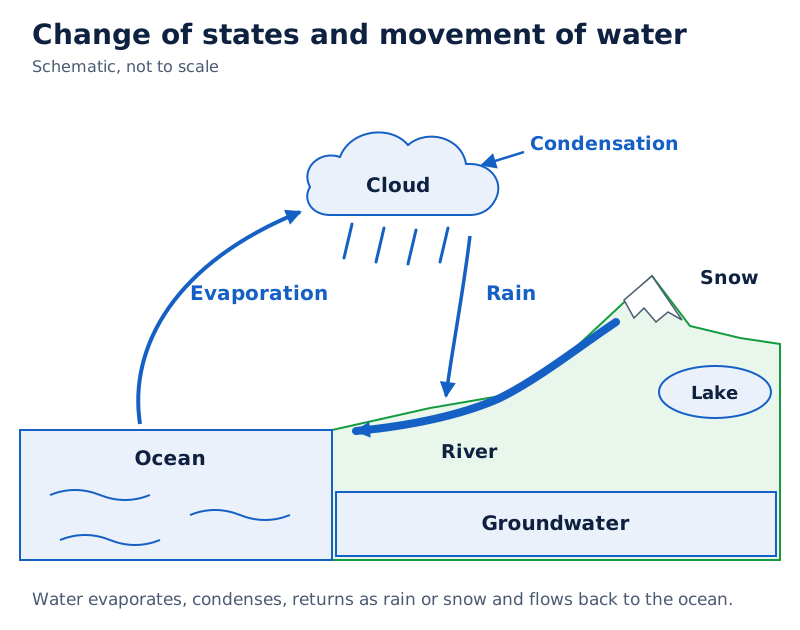
The drawing shows the sea, land, a winding river, mountains, clouds, falling drops and arrows. Upward arrows rise from the sea, and downward arrows occur below clouds. A word bank is provided for labelling the drawing.
Drawn by One Young India.
Does circulation remove the need to save water?
The water cycle describes water moving through the environment. It does not mean that usable freshwater is equally available everywhere. Most water is in oceans, and only a small portion is fit for use. Conservation, the careful use and protection of water, remains necessary.
What causes water pollution, and how can we prevent it?
Water pollution is the contamination of water by unwanted or harmful materials. Contamination means making something impure by introducing such materials. Water sources become polluted when waste is dumped into them. This damages their usefulness to living things.
Which activities pollute water sources?
Throwing trash, meaning waste materials, into freshwater sources pollutes them. Plastic bags and wrappers floating on water are familiar visible examples. Waste from homes and industries also pollutes water sources when it is dumped into them.
Polluted water is not fit for consumption by living beings. Consumption here means taking water into the body, especially by drinking it. Pollution therefore matters even where water is physically present: the available water may no longer be fit for use.
| Cause of pollution | Connection with water sources | Preventive action |
|---|---|---|
| Discarded plastic bags and wrappers | Waste enters rivers, lakes or other freshwater sources. | Keep plastic waste out of water bodies. |
| Waste from homes | Dumping household waste pollutes the receiving water. | Prevent household waste from being dumped into water sources. |
| Waste from industries | Industrial waste pollutes water when dumped into it. | Prevent the dumping of industrial waste into water sources. |
Why are prevention and conservation connected?
Preventing pollution protects the quality of water, while avoiding wastage protects the available supply. Both are needed. Saving water at home does not replace the need to keep rivers and ponds clean, and clean sources should still be used carefully.
When discussing a local water source, separate an observed fact from an assumption. A visible wrapper can be recorded as waste. The observation alone does not identify which home or industry produced it. A useful account describes the evidence without inventing a cause.
Communities can build awareness about keeping water resources clean. The central practical message is to avoid throwing waste into water and to prevent waste from homes and industries from reaching the sources on which living things depend.
How do conservation and rainwater harvesting help save water?
Water conservation includes using water carefully, avoiding waste and protecting water sources. Using it judiciously means using it thoughtfully and with care. Conservation is important because usable freshwater is limited and people do not have equal access to it.
Which everyday actions reduce waste?
Turn off taps when they are not in use. Fix water leakages, which are losses of water through unintended openings. These measures reduce wastage during everyday activities. Watering plants carefully is another way to ensure that the water supplied is used rather than wasted.
Recycling water means processing used water so that it can be used again. Recycling and water harvesting can help save water. The aim is to care for the available supply while continuing to meet necessary needs such as drinking, cooking and cleaning.
What is rainwater harvesting?
Rainwater harvesting means collecting and storing rainwater for later use. Many buildings collect rainwater in this way. Homes, residential societies and schools can use water harvesting, which is an age-old practice in India.
What the figure shows
Rainwater harvesting
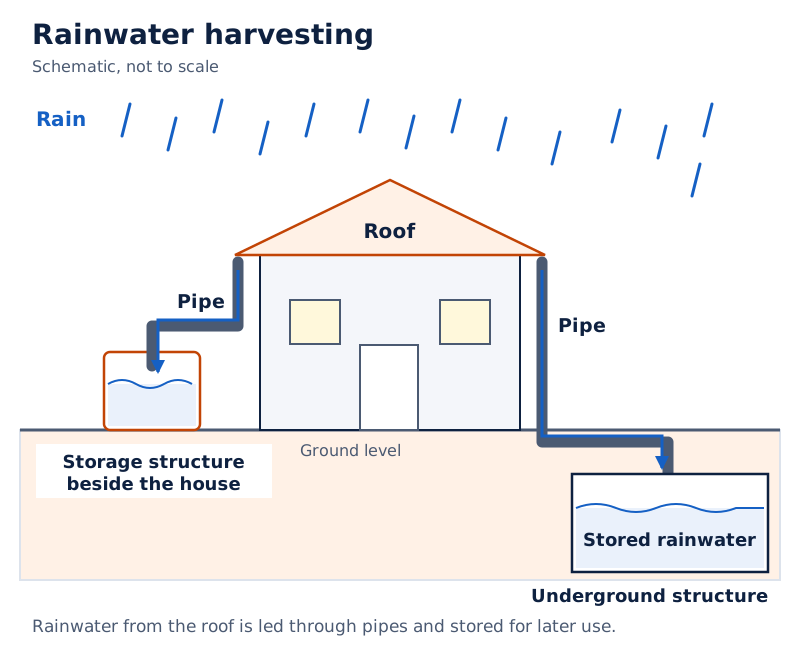
The drawing shows rain falling onto a house roof, pipes along the building and water led towards structures beside the house. A cutaway on the right shows an underground structure containing water.
Drawn by One Young India.
A labelled drawing should make the collection of rainwater and its movement towards storage clear. It should show why harvesting differs from simply allowing rain to fall on a building: the water is collected for later use.
How do stepwells store water?
A stepwell is a well reached by steps. Stepwells are commonly called Bawadi in Rajasthan and Vav in Gujarat. They were built for water harvesting in response to water scarcity in these regions.
Stepwells store not only rainwater but also water seeping from nearby lakes, ponds and rivers. Seepage is the slow movement of water through surrounding material. The walls of their trenches are lined with stone blocks that allow water to seep through.
A trench is a long, deep hole dug in the ground. The stepwell example shows that a water-harvesting structure can receive water in more than one way. Collecting rainfall and allowing seepage both contribute to its stored water.
How can a household water audit guide conservation?
A water audit is a record and review of how water is used. A household audit records the approximate amount used for different purposes each day. Approximate means estimated rather than exact. Its purpose is to identify ways to reduce consumption at home.
What should be recorded?
Include drinking, bathing, washing, toilets, cleaning floors and car washing where these activities occur. Record the purpose alongside the approximate amount used. The record should describe the household's actual use, rather than copy invented amounts from another family.
The litre is a unit used to measure the volume of water. Volume is the amount of space occupied. If litres are used in the audit, write the unit with each recorded amount so that the estimates can be understood and compared.
- List the activities at home that use water during the day. Include regular uses rather than recording drinking alone.
- Prepare a table with space for the purpose and the approximate daily amount of water used.
- Record estimates based on the household's actual activities. State the unit used and make clear that the values are approximate.
- Review the completed record to identify where water is being wasted or where use could be reduced.
- Choose practical changes, such as turning off unused taps or fixing leakages, and discuss how the household can follow them.
How should the results be interpreted?
A water audit connects observation with action. Its value is not simply a list of quantities. The record helps a family examine what the water is being used for and identify avoidable losses while recognising necessary daily uses.
A large amount used for an activity does not by itself prove that all of it is wasted. Ask how the water was used and where loss occurred. Likewise, a small visible leak deserves attention because fixing leakages is a direct conservation measure.
Combine the audit with care for water quality. Avoiding waste at home and preventing pollution of shared water resources support the same aim: using water responsibly and keeping it available for living things.
Glossary
- Solute — The substance that gets dissolved in a solvent when a solution is formed.
- Solvent — The substance that dissolves the solute and is present in the larger quantity in the solution.
- Solution — A homogeneous mixture formed when a solute dissolves in a solvent.
- Homogeneous mixture — A mixture with uniform composition throughout, with its components evenly mixed.
- Heterogeneous mixture — A mixture whose composition is not uniform throughout, such as sand mixed with water.
- Universal solvent — A description of water based on its ability to dissolve a large number of substances.
- Soluble in water — Able to dissolve in water, as common salt and sugar do.
- Insoluble in water — Unable to dissolve in water, as illustrated by sand mixed with water.
- Evaporation — The process in which liquid water changes into its gaseous state, water vapour.
- Condensation — The process in which water vapour changes back into liquid water.
- Water cycle — The circulation of water between Earth's surface and the atmosphere through changes and movement.
- Water pollution — Contamination of water by unwanted or harmful materials, including waste from homes and industries.
- Water conservation — Careful use and protection of water, including reducing wastage and preventing pollution.
- Rainwater harvesting — The collection and storage of rainwater so that it can be used later.
- Water audit — A record and review of water use to identify opportunities for reducing consumption and wastage.
Common errors and misconceptions
- Misconception: A universal solvent dissolves everything. Correct: Water receives this description because it dissolves a large number of substances. Materials such as sand remain insoluble in water.
- Misconception: Salt is the solvent in salt solution. Correct: Salt is the solute because it dissolves. Water is the solvent because it dissolves the salt.
- Misconception: A solution is another name for its solute. Correct: The solution is the whole homogeneous mixture, including both the dissolved solute and the solvent.
- Misconception: Every stirred mixture of a solid and water becomes homogeneous. Correct: Sand mixed with water remains heterogeneous; its particles are visible and settle with time.
- Misconception: Dissolved sugar has been destroyed because its grains cannot be seen. Correct: The sugar remains in the solution, which is sweet despite having no separately visible sugar grains.
- Misconception: Water is plentiful everywhere because it covers much of Earth. Correct: Most water is in oceans, while easily accessible freshwater is limited and access is unequal.
- Misconception: Saving water means only turning off taps. Correct: Fixing leaks, collecting rainwater and preventing pollution also help conserve or protect water resources.
- Misconception: A stepwell receives only rainwater. Correct: Stepwells also store water seeping from nearby lakes, ponds and rivers through their stone-lined walls.
Exam-style questions with model answers
Q1. A small amount of common salt dissolves completely in a larger quantity of water. Identify the solute and the solvent, giving a reason for each. [2 marks]
- Common salt is the solute because it is the substance that gets dissolved.
- Water is the solvent because it dissolves the salt and is present in the larger quantity.
Q2. Define a solution and explain what the word homogeneous means. [2 marks]
- A solution is the mixture formed when a solute dissolves in a solvent.
- It is homogeneous because its composition is uniform throughout, with the components evenly mixed.
Q3. Sugar dissolves in water to form a uniform mixture. Sand stirred into water remains visible and settles with time. Compare the two mixtures in three points using these observations. [3 marks]
- The sugar-and-water mixture is a solution because the sugar dissolves. The sand-and-water mixture is not a solution because the sand remains undissolved.
- Sugar solution is homogeneous, with uniform composition throughout. The sand-and-water mixture is heterogeneous because its composition is not uniform throughout.
- The sugar is no longer seen as separate grains in the solution. Sand remains visible as separate particles and settles with time.
Q4. Explain why water is called a universal solvent. Give one soluble material and one insoluble material as examples. [3 marks]
- Water is called a universal solvent because it can dissolve a large number of substances. The term does not mean that it dissolves every material.
- Common salt is soluble in water. When it dissolves, salt becomes the solute and water acts as the solvent in the resulting solution.
- Sand is insoluble in water. Mixing and stirring do not dissolve it, and its particles can remain visible and settle with time.
Q5. Explain in five points why plentiful water on Earth's surface does not remove the need for conservation. Include its distribution, direct usability, access to freshwater, demand and pollution. [5 marks]
- Most water is found in oceans and seas. The presence of a large amount of water on Earth therefore does not mean that most of it is freshwater.
- Ocean and sea water is saline, or salty. It cannot be used directly for our ordinary domestic, agricultural and industrial requirements.
- Freshwater in ice sheets and snow, or underground, is difficult to access. A very small fraction of the freshwater present in ponds, rivers, lakes and wells is easily accessible.
- The population is increasing, so the number of people using water is increasing. Growing demand causes water shortages in many parts of the world.
- Dumping waste from homes and industries pollutes water sources. Polluted water is unfit for consumption by living beings, making protection of usable supplies necessary.
Q6. Define rainwater harvesting, identify a place where it can be practised, and describe two ways in which stepwells receive water. [4 marks]
- Rainwater harvesting is the collection and storage of rainwater for later use. It is a method of conserving water.
- It can be practised in buildings such as homes, residential societies or schools, where rainwater is collected and stored.
- Stepwells receive and store rainwater. They are traditional water-harvesting structures built in response to water scarcity.
- Stepwells also receive water seeping from nearby lakes, ponds and rivers. Their stone-lined trench walls allow this water to seep through.
Q7. A household plans a water audit. Describe five steps, including what to record, how to report amounts and how to use the findings for conservation. No calculation is required. [5 marks]
- List the household activities that use water, such as drinking, bathing, washing, using toilets and cleaning floors. Include the activities that actually occur at home.
- Prepare a table that links each purpose with its approximate daily water use. Keeping the purpose and quantity together makes the record easier to review.
- Record estimates from the household's actual activities, using a stated unit such as litres. Make clear that these amounts are approximate rather than exact measurements.
- Review the table and observations to identify wastage and opportunities to reduce consumption. Consider how water was used, rather than assuming that every large use was unnecessary.
- Discuss and adopt suitable changes, such as turning off unused taps and fixing leakages. The audit should guide practical conservation instead of ending with the written record.
Q8. State two causes of water pollution and one preventive action corresponding to each cause. [4 marks]
- Throwing household trash into freshwater sources causes pollution. Plastic bags and wrappers are examples of waste that can enter water bodies.
- Prevent this pollution by keeping household trash out of rivers, lakes and other sources, rather than dumping it into the water.
- Waste from industries pollutes water sources when it is dumped into them. This makes the affected water unsuitable for consumption by living beings.
- Prevent this source of pollution by stopping industrial waste from being dumped into water resources, helping protect the quality of the available water.
Key takeaways
- Water supports living things and is needed for drinking, cooking, washing, cleaning, growing crops and industrial purposes.
- Most water is in oceans and seas; readily accessible freshwater is limited, so available supplies need careful use.
- Water is called a universal solvent because it dissolves many substances, although materials such as sand remain insoluble.
- The solute dissolves in the solvent, while the solution is the complete homogeneous mixture formed from both components.
- A homogeneous solution has uniform composition throughout; sand mixed with water remains heterogeneous and settles with time.
- Waste from homes and industries pollutes water sources when dumped into them, reducing the usefulness of the available water.
- Turning off unused taps, fixing leakages, collecting rainwater and protecting water sources are ways to conserve water.
- A household water audit records approximate daily use and helps identify practical ways to reduce consumption and wastage.
Test yourself
What is the solvent when copper sulphate dissolves in water?
Water is the solvent because it dissolves the copper sulphate; copper sulphate is the solute.
Why is sand mixed with water not a homogeneous solution?
Sand does not dissolve. Its particles remain visible and settle with time, so the mixture is not uniform throughout.
Does the name universal solvent mean that water dissolves everything?
No. It means that water dissolves a large number of substances, while some materials remain insoluble.
How do evaporation and condensation differ?
Evaporation changes liquid water into water vapour. Condensation changes water vapour back into liquid water.
Why should household and industrial waste be kept out of water sources?
Dumping this waste pollutes the water and makes it unfit for consumption by living beings.
What is collected during rainwater harvesting, and why?
Rainwater is collected and stored so that it can be used later, helping conserve water.
Besides rain, what supplies water to stepwells?
Water seeps into stepwells from nearby lakes, ponds and rivers through their stone-lined trench walls.
What should a household do after completing a water audit?
Review the recorded uses, identify wastage and discuss practical changes such as turning off unused taps and fixing leaks.
Write about it
Turn a question from this chapter into a paper.
The Writing Studio has a structure guide, a rubric and citation tools for 15 formats, from essays to research papers. Drafting is free with an account. Learnacy Essential adds feedback from an AI writing coach and submission to The OYI Review.
Learnacy Essential is ₹1,499 for the year. Publication depends on review and is not guaranteed.