
Agriculture | ICSE Class 6 Geography Notes
On this page

This note covers the meaning and importance of agriculture, factors affecting farming, subsistence and commercial farming, intensive and extensive farming, shifting cultivation, food and cash crops, major crop regions, plantations, traditional and modern methods, the Green Revolution, and farm case studies from India and the United States of America.
What is agriculture and why is it important?
Definition: Agriculture is the cultivation of soil, growing of crops and rearing of livestock. A crop consists of plants of the same kind cultivated at one place on a large scale. Livestock are farm animals reared for useful products.
Agriculture, also called farming, includes growing fruits, vegetables and flowers as well as grain crops and raising animals. It supplies food and materials used to make other goods. Its importance therefore extends beyond the people working in fields.
How does farming connect with other work?
A primary activity obtains or produces natural resources. Growing wheat is a primary activity. A secondary activity processes resources into other products, as when wheat flour is used to bake bread and biscuits.
A tertiary activity provides services supporting production and processing. Transport carries agricultural goods, trade involves buying and selling them, and banking provides financial services. These activities connect the farm with factories and consumers, the people who use the finished goods.
Agriculture produces raw materials, meaning materials used to make other products. Cotton supplies the cotton textile industry, which makes cloth. Jute supplies material for bags, mats and ropes. Sugarcane supplies material for making sugar.
Such industries are called agro-based industries because they use agricultural products as raw materials. Farming also provides livelihoods, or means of earning a living. Understanding agriculture means studying both the natural conditions needed by crops and the work that connects farms with the wider economy.
Which natural and human factors influence farming?
Agriculture depends on the relationship between the natural environment and human effort. Topography means the shape and slope of the land. Climate means the usual weather conditions of a region over a long period. Soil, climate and topography influence where crops can grow.
Arable land is land on which crops are grown. Important natural conditions include sunshine, temperature, rainfall, soil and slope. Different crops have different needs, so a place suitable for one crop need not provide suitable conditions for another.
What are inputs, processes and outputs?
A farm system connects inputs, processes and outputs. Inputs are resources used in farming. Processes are the activities performed with those resources. Outputs are the products obtained. This helps explain a farm as a connected set of activities.
| Part of the system | Meaning | Examples |
|---|---|---|
| Inputs | Resources used for production | Seeds, machinery, fertilisers and labour |
| Processes | Work carried out on the farm | Ploughing, sowing, irrigation, weeding and harvesting |
| Outputs | Products obtained from farming | Crops, wool, dairy and poultry products |
Labour is human work. Fertilisers are chemicals rich in particular plant nutrients, the substances plants need for growth. Dairy products come from milk; poultry products come from farm birds such as hens. Machinery helps farmers perform agricultural work.
Ploughing loosens and turns soil; sowing places seeds in the soil. Irrigation supplies water to crops at regular intervals. Weeding removes unwanted plants growing with a crop. Harvesting means cutting the mature crop.
What the figure shows
The farm system of an arable farm
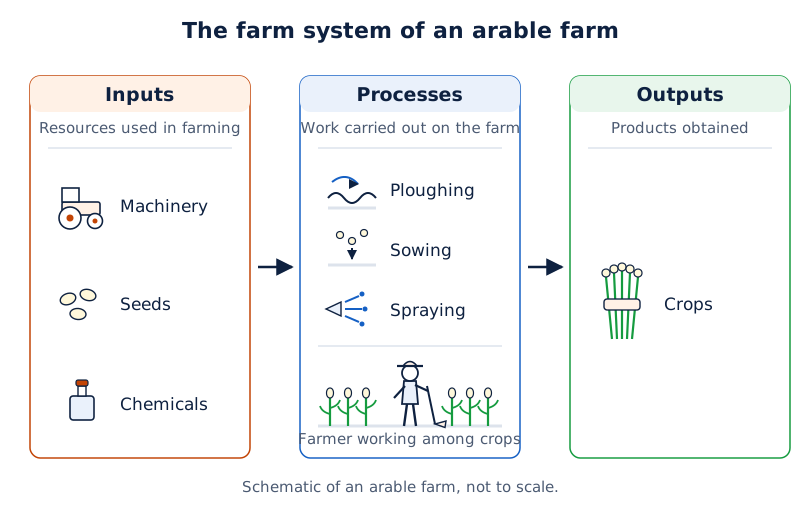
The drawing places machinery, seeds and chemicals under “Inputs”. Arrows lead towards a farmer working among crops under “Processes”, labelled ploughing, sowing and spraying. Tied bundles of harvested crops appear under “Outputs”, labelled “Crops”.
Drawn by One Young India.
Human factors also include demand for produce, available labour and the level of technology, meaning the tools and methods used. The farming method depends on these factors together with geographical conditions.
What are subsistence farming and intensive farming?
Subsistence farming is practised to meet the needs of the farmer's family. Traditionally, it uses low levels of technology and household labour to produce a small output. The main purpose of production is an important clue when identifying this farming type.
Subsistence farming includes intensive subsistence farming and primitive subsistence farming. The latter includes shifting cultivation, in which cultivators move to another plot after the soil loses fertility. Soil fertility is its ability to support plant growth by supplying needed nutrients.
What makes intensive subsistence farming intensive?
In intensive subsistence farming, a farmer works a small plot using simple tools and more labour. The word intensive draws attention to the concentrated effort used on limited land. It does not mean that the farm must cover a large area.
Fertile soils and a climate with many days of sunshine permit more than one crop to be grown annually on the same plot. “Annually” means each year. Rice is the main crop; other crops include wheat, maize, pulses and oilseeds.
Pulses are crops such as peas and gram whose seeds are eaten as food. Oilseeds are seeds used to obtain oil. Intensive subsistence agriculture is prevalent in thickly populated parts of the monsoon regions of south, southeast and east Asia.
Monsoon regions experience seasonal winds associated with a distinct rainy season. Where many people depend on limited land, farmers seek greater production from small holdings. A holding is the land used by a farmer for agricultural work.
Note: “Subsistence” describes the purpose of farming, while “intensive” describes concentrated effort on the land. They can describe the same farm: intensive subsistence farming uses a small plot and considerable labour to meet family needs.
How does shifting cultivation work?
Shifting cultivation is a form of primitive subsistence agriculture. It is practised in thickly forested parts of the Amazon basin, tropical Africa, southeast Asia and Northeast India. These areas receive heavy rainfall and have quick regrowth of vegetation.
The tropics are the warm regions between the Tropic of Cancer and the Tropic of Capricorn. A river basin is the area drained by a river and its branches. The Amazon basin is one of the regions associated with shifting cultivation.
What is the sequence of operations?
- A cultivator clears a plot by cutting down trees.
- The cut vegetation is burnt, giving this method its other name, slash-and-burn agriculture.
- The ashes are mixed with the soil, and crops such as maize, yam, potatoes and cassava are grown.
- After the soil loses fertility, the plot is abandoned and the cultivator moves to a new plot.
The word “shifting” refers to moving cultivation between plots. The change of plot follows a decline in soil fertility. It does not simply mean changing the crop on the same field.
In Northeast India, shifting cultivation is known as jhumming. It is called milpa in Mexico and Central America, and roca in Brazil. These names refer to the same broad farming practice in different parts of the world.
Clearing and burning vegetation distinguish this system from permanent cultivation of a field. When describing it, connect the clearing, burning, cultivation and movement into a sequence. Listing these actions without explaining the loss of fertility leaves out why the cultivator moves.
How do extensive farming and commercial farming differ from intensive subsistence farming?
Extensive farming uses large areas of land with relatively little labour per unit of land. Commercial farming means growing crops or rearing animals for sale in the market. These terms describe different features: the use of land and labour, and the purpose of production.
In commercial farming, the area cultivated and the amount of capital, meaning money invested in production, are large. Most of the work is done by machines. Commercial grain farming provides an example of farming spread over large areas.
Where is commercial grain farming practised?
Wheat and maize are common commercial grain crops. Major areas include the temperate grasslands of North America, Europe and Asia. Temperate regions lie between tropical and polar regions; grasslands are areas where grasses form the main natural vegetation.
These commercial grain-growing areas are sparsely populated, meaning that relatively few people live across a given area. Farms spread over hundreds of hectares, a unit used to measure land area. Severe winters restrict the growing season, and only a single crop can be grown there.
| Feature | Intensive subsistence farming | Commercial grain farming |
|---|---|---|
| Main purpose | Meeting family needs | Producing grain for sale |
| Land | Small plots | Large farms covering hundreds of hectares |
| Work | Simple tools and more labour | Most work done by machines |
| Examples | Rice, with wheat and other crops also grown | Wheat and maize |
Commercial agriculture also includes mixed farming, which combines food and fodder crops with livestock rearing. Fodder means food grown or provided for farm animals. Plantation farming is another commercial form, concentrating on a single crop.
The distinction is useful: a farm may be both extensive and commercial. A crop name alone does not identify its farming purpose. The same crop can be grown for family use in one setting and for sale in another.
What is the difference between food crops and cash crops?
Food crops are crops grown for human consumption. Rice and wheat are major examples. Cash crops are crops grown mainly for sale to earn income. Cotton, jute and sugarcane are important examples used when comparing these categories.
Food crops are identified by their use as food, while cash crops are identified by their commercial purpose. The categories can overlap. Rice sold in a market remains a food crop, even though the farmer is producing it commercially.
How can crops be grouped by their products?
| Crop group | Examples | Main connection |
|---|---|---|
| Food grains | Rice and wheat | Food for people |
| Fibre crops | Cotton and jute | Materials for cloth, bags and other goods |
| Sugar crop | Sugarcane | Raw material for sugar production |
| Beverage crops | Tea and coffee | Products used to prepare drinks |
A fibre crop provides fibres, the thread-like material used to make products such as cloth and rope. A beverage crop provides material used to prepare a drink. These labels explain a crop's use, rather than the size of the farm.
Rice illustrates why rigid divisions can mislead. In Haryana and Punjab, it is a commercial crop; in Odisha, it is a subsistence crop. The degree to which farming is directed towards sale varies from one region to another.
When comparing crops, identify what they produce and why they are grown. When comparing farming systems, identify the purpose, land area, labour and technology. This keeps the crop's product separate from the organisation of the farm.
What conditions do rice and wheat need, and where are they grown?
Rice needs high temperature, humidity and rainfall. Humidity is the moisture present in the air. It grows best in alluvial clayey soil, meaning river-deposited soil containing enough clay to retain water. A staple food is a food eaten regularly as a main part of the diet.
Rice is a staple food in tropical and subtropical regions. Subtropical means adjoining the tropical regions. In favourable climatic conditions, as in West Bengal and Bangladesh, two to three rice crops are grown in a year.
How do the growing conditions compare?
Wheat requires a cool growing season and bright sunshine at ripening. It thrives best in well-drained loamy soil. “Well-drained” means that excess water can pass away; loamy soil contains a mixture of sand, silt (fine soil particles) and clay.
In the table, °C means degrees Celsius, the temperature unit, and cm means centimetres, a unit of length used to express rainfall depth. Annual rainfall is the rainfall received in a year.
| Crop | Temperature or seasonal condition | Annual rainfall requirement |
|---|---|---|
| Rice | High temperature, above 25°C | Above 100 cm; irrigation supports cultivation in areas of less rainfall |
| Wheat | Cool growing season and bright sunshine at ripening | 50 to 75 cm, evenly distributed over the growing season |
Irrigation helps rice grow in areas of less rainfall. Therefore, rainfall is an important influence, but the water supplied by farmers must also be considered. A comparison of two regions should include both natural rainfall and irrigation facilities.
Which regions belong on a crop map?
Rice-growing countries include China, India, Japan, Sri Lanka and Egypt. Wheat is grown extensively in the United States of America, Canada, Argentina, Russia, Ukraine, Australia and India. In India, wheat is grown in winter.
Draw and label
Rice and wheat regions
On two outline world maps, label the rice-growing countries China, India, Japan, Sri Lanka and Egypt, and the wheat-growing countries United States of America, Canada, Argentina, Russia, Ukraine, Australia and India. Use a key identifying the crop on each map. Country labels identify examples, not every field within those countries.
What conditions favour cotton, jute and sugarcane?
Cotton is a major raw material for the cotton textile industry. It requires high temperature, light rainfall, 210 frost-free days and bright sunshine. “Frost-free” means without frost, the ice deposit associated with freezing conditions. Cotton grows best on black and alluvial soils.
Jute, known as the golden fibre, grows well on alluvial soil. It needs high temperature, heavy rainfall and a humid climate. It is grown in tropical areas, including India and Bangladesh. Jute is used for bags, mats, ropes, yarn and carpets; yarn is spun thread.
How does sugarcane differ from fibre crops?
Sugarcane supplies sugar rather than textile fibre. It grows well in a hot, humid climate, with temperatures of 21°C to 27°C and annual rainfall between 75 cm and 100 cm. Irrigation is required in regions of low rainfall.
| Crop | Numerical growing condition | Other important condition |
|---|---|---|
| Cotton | 210 frost-free days | High temperature, light rainfall and bright sunshine |
| Sugarcane | 21°C to 27°C; annual rainfall 75 cm to 100 cm | Hot and humid climate; irrigation in low-rainfall regions |
Sugarcane can grow on a variety of soils and needs manual labour from sowing to harvesting. Manual labour means work performed by people. It takes almost a year to grow, so its growing period differs from that of many grain crops.
Examples of cotton-producing countries include China, the United States of America, India, Pakistan, Brazil and Egypt. Sugarcane-producing states in India include Uttar Pradesh, Maharashtra, Karnataka, Tamil Nadu, Andhra Pradesh, Telangana, Bihar, Punjab and Haryana.
Link each crop's product with its natural requirements. Cotton and jute are both fibre crops, but cotton requires light rainfall while jute requires heavy rainfall. Their shared use does not mean that their growing conditions are identical.
What is plantation farming, and where are tea, coffee and rubber grown?
Plantation farming is commercial farming in which a single crop is grown over a large area. Tea, coffee and rubber are examples. Plantations require large amounts of labour and capital. They link agriculture with industries that process the produce.
The produce may be processed on the farm itself or in nearby factories. A transport network is essential for moving it between plantations, processing facilities and markets. A plantation is therefore connected with both farming and industrial activity.
What conditions do the plantation crops require?
Tea bushes need a warm, moist, frost-free climate throughout the year. Frequent showers distributed through the year support continuous growth of tender leaves. Tea grows well in deep, fertile, well-drained soil rich in humus, the organic material formed from decayed plant and animal remains.
Tea requires abundant skilled labour. Large numbers of workers are needed to pick the leaves. Tea is processed within the tea garden to preserve freshness. Assam and the hills of Darjeeling and Jalpaiguri in West Bengal are important Indian tea-growing areas.
Coffee requires a warm, wet climate and well-drained loamy soil. Hill slopes are more suitable for its growth. Brazil and India are examples of coffee-producing countries. Coffee plantations are important in Karnataka.
Rubber is an industrial raw material. It is an equatorial crop, meaning a crop associated with the region around the Equator, the imaginary line dividing Earth into northern and southern halves. Under special conditions, it is also grown in tropical and subtropical areas.
Rubber requires a moist, humid climate, rainfall of more than 200 cm and temperature above 25°C. Malaysia is an example of a rubber-plantation region. In India, rubber is mainly grown in Kerala, Tamil Nadu, Karnataka, the Andaman and Nicobar Islands and the Garo hills of Meghalaya.
Draw and label
Examples of plantation regions
On an outline world map, label Malaysia for rubber, Brazil for coffee, and India and Sri Lanka for tea. Use a separate symbol for each crop and define every symbol in a key. These labels show examples of plantation locations.
A useful plantation explanation connects the single crop, large area, labour, capital, processing and transport. Naming tea or coffee alone identifies a crop, but does not explain how plantation farming is organised.
How do traditional and modern farming methods compare?
Traditional methods use tools and practices such as bullock-drawn ploughs and hand harvesting. Modern methods include tractor-driven equipment, seed drills, improved irrigation and soil testing. The difference concerns how work is performed, rather than whether the work is agricultural.
A seed drill is a machine that places seeds at equal distances and depths and covers them with soil. A cultivator is equipment used to loosen soil; tractor-driven cultivators save labour and time. Machinery can change the speed and organisation of farm operations.
Which changes can improve production?
| Operation | Traditional example | Modern example |
|---|---|---|
| Preparing soil | Plough drawn by bullocks | Tractor-driven cultivator |
| Sowing | Funnel-shaped sowing tool | Tractor-operated seed drill |
| Harvesting | Cutting by hand with a sickle | Machine harvester |
A sickle is a hand tool for cutting crops. After harvesting, threshing separates grain from the chaff, the material surrounding it. A combine performs both harvesting and threshing. This brings together operations that otherwise require separate work.
Soil testing checks the nutrients in soil and helps farmers plan fertiliser use. Pests are organisms that damage crops; pesticides are substances used to control them. Fertilisers supply nutrients, while pesticides protect crops against pests. Their functions are different.
Manure is decomposed plant or animal waste added to soil. It replenishes nutrients and improves the soil's texture and ability to retain water. Chemical fertilisers are manufactured substances rich in particular nutrients. Using a modern machine does not remove the need to care for soil.
Traditional and modern practices can occur together. A farmer may rent a tractor, use family labour and keep livestock. These combinations make it more useful to describe the actual methods on a farm than to assume that every operation fits one label.
How did the Green Revolution contribute to agricultural development?
Agricultural development means efforts to increase farm production to meet the growing demand of an increasing population. It can involve improved irrigation, better seeds, fertilisers, machinery, a larger cropped area or more crops grown on the same land.
The Green Revolution increased agricultural production through a package of improved methods, including high-yielding variety seeds, chemical fertilisers and pesticides. High-yielding variety (HYV) seeds are seeds of crop varieties developed for higher output. Yield means the amount of crop produced per unit of land.
Why did a package of improvements matter?
Improved seeds formed part of a wider set of inputs and practices. Irrigation improved the supply of water, fertilisers supplied nutrients, and crop protection helped deal with pests. The changes connected seed choice with the conditions needed to support crop growth.
In India, the Green Revolution helped the growth of winter crops in Punjab, Haryana, western Uttar Pradesh and parts of Rajasthan. Agricultural development was concentrated in a few selected areas. It did not bring an identical level of change to every region.
Mechanisation means using machines for farm operations. It is another aspect of agricultural development. However, increasing production also involves decisions about water, seeds and soil, so machinery alone does not explain the whole process.
Why must development include care for resources?
Fertilisers have helped farmers obtain better crop yields, but excessive use has made soil less fertile and contributed to water pollution. Manure improves soil texture and water retention. Increasing production therefore needs to be considered alongside maintaining the resources used by farming.
The ultimate aim is food security: all people, at all times, having access to sufficient, safe and nutritious food that meets their dietary needs and preferences for an active, healthy life. Producing food and making it accessible are both important.
What do farm case studies from India and the United States show?
Farms differ in size, labour, equipment and access to information. Comparing individual farms makes these differences concrete. The United States of America is abbreviated as USA. The examples below describe particular farms rather than every farmer in either country.
Case study: How does Munna Lal farm in Uttar Pradesh?
Munna Lal farms in Adilabad village in Ghazipur district, Uttar Pradesh. He has about 1.5 hectares of farmland and lives in the main village. His land is fertile, and he grows at least two crops annually, normally wheat or rice and pulses.
He buys HYV seeds every alternate year. He takes advice from friends, elders and government agricultural officers. He rents a tractor for ploughing, although some friends still use bullocks. He also rents the use of a nearby tubewell for irrigation.
A tubewell draws underground water through a tube sunk into the ground. Munna Lal's example shows that using modern equipment does not necessarily mean owning it. Renting gives him access to machinery and irrigation for his small holding.
All family members help with farm work. He has two buffaloes and a few hens and sells milk at a nearby town's cooperative store. A cooperative society is an organisation whose members work together for mutual benefit.
Sometimes he takes credit, meaning borrowed money, from a bank or agricultural cooperative society to buy seeds and tools. He sells produce in the nearby town's mandi, an agricultural market. His activities connect crops, livestock, family work, advice and finance.
Case study: How does Joe Horan farm in Iowa?
Joe Horan farms in Iowa in the Midwest USA and owns about 300 hectares. He grows corn, another name for maize, after checking that soil and water resources meet the crop's needs. He also takes measures to control crop-damaging pests.
From time to time, he sends soil samples to a laboratory to check nutrients. The results guide his fertiliser programme. His computer receives satellite information that provides a precise picture of the field, helping him apply fertilisers and pesticides where required.
He uses tractors, seed drills, a leveller, a combine harvester and a thresher. A leveller makes the field surface level. Grain is kept in automated storage, where equipment controls storage operations, or sent to market agencies.
| Feature | Munna Lal's farm | Joe Horan's farm |
|---|---|---|
| Land area | About 1.5 hectares | About 300 hectares |
| Crops described | Normally wheat or rice and pulses | Corn |
| Information | Friends, elders and agricultural officers | Soil tests and satellite information |
| Equipment | Rented tractor | Several machines for different operations |
The comparison connects farm size with methods, information and resources. Munna Lal combines family work with rented facilities; Joe Horan uses extensive machinery and detailed field information. These are specific examples of how farming is organised under different circumstances.
Glossary
- Agriculture — The cultivation of soil, growing of crops and rearing of livestock to obtain useful products.
- Arable land — Land on which crops are grown as part of agricultural activity.
- Subsistence farming — Farming practised mainly to meet the needs of the farmer's own family.
- Intensive subsistence farming — Cultivation of a small plot using simple tools and more labour to meet family needs.
- Extensive farming — Farming large areas of land with relatively little labour per unit of land.
- Shifting cultivation — Farming in which cultivators clear and burn vegetation, grow crops, and move after soil fertility declines.
- Commercial farming — Growing crops or rearing farm animals for sale in the market.
- Plantation farming — Commercial farming of a single crop over a large area, requiring substantial labour and capital.
- Food crop — A crop grown for human consumption, such as rice or wheat.
- Cash crop — A crop grown mainly for sale in order to earn income.
- Irrigation — The supply of water to crops at regular intervals to support their growth.
- Manure — Decomposed plant or animal waste added to soil to replenish nutrients and improve its condition.
- Mechanisation — The use of machines to carry out agricultural operations such as ploughing, sowing and harvesting.
- Green Revolution — An increase in agricultural production through improved methods including high-yielding seeds, fertilisers and crop protection.
- Food security — Access for all people at all times to sufficient, safe, nutritious food meeting dietary needs and preferences for an active, healthy life.
Common errors and misconceptions
- Misconception: Agriculture means growing grain alone. Correct: It also includes fruits, vegetables, flowers and the rearing of livestock.
- Misconception: Intensive farming needs an enormous farm. Correct: Intensive subsistence farming uses a small plot with simple tools and more labour.
- Misconception: Extensive and commercial mean exactly the same thing. Correct: Extensive describes land and labour use; commercial describes production for sale.
- Misconception: Shifting cultivation means changing crops in a permanent field. Correct: Cultivators move to a new plot after the existing plot loses fertility.
- Misconception: Food crops cannot be sold commercially. Correct: Rice and wheat remain food crops when produced for the market.
- Misconception: Cotton and jute need identical rainfall because both provide fibre. Correct: Cotton requires light rainfall, while jute requires heavy rainfall.
- Misconception: Fertilisers and pesticides perform the same task. Correct: Fertilisers supply nutrients; pesticides control organisms that damage crops.
- Misconception: The Green Revolution transformed all regions equally. Correct: Development was concentrated in a few selected areas.
Exam-style questions with model answers
Q1. A farmer grows wheat, a grain used as human food, and sells it to earn income. Food crops are grown for human consumption; cash crops are grown mainly for sale. Explain why this wheat can fit both descriptions. [2 marks]
- Wheat is a food crop because its grain is used for human consumption.
- It also serves as a cash crop here because the farmer grows it for sale to earn income.
Q2. A family farms a small plot using simple tools and much labour, chiefly to meet its own needs. Subsistence farming meets family needs, while intensive farming concentrates effort on limited land. Identify the combined farming type and explain two supporting features. [3 marks]
- This is intensive subsistence farming, combining concentrated effort on a small area with production chiefly intended to meet the family's needs.
- The subsistence feature is the purpose: the family grows crops mainly for its own requirements, as stated in the description.
- The intensive feature is the use of much labour and simple tools on a small plot, concentrating work on limited land.
Q3. In shifting cultivation, trees are felled, the vegetation is burnt, ash is mixed with soil and crops are grown. After soil fertility declines, cultivation moves to another plot. Explain this sequence in four stages, including the reason for moving. [4 marks]
- The cultivator first clears a plot by felling trees, making the land available for growing crops.
- The cut vegetation is then burnt; this is the burning stage of the method.
- The ash is mixed with the soil, after which the cultivator grows crops on the cleared plot.
- When soil fertility declines, the cultivator leaves that plot and moves cultivation to another, because the existing soil has lost fertility.
Q4. Rice needs temperatures above 25°C and annual rainfall above 100 cm, with irrigation helping in lower-rainfall areas. Wheat needs a cool growing season, bright sunshine at ripening and 50 to 75 cm annual rainfall evenly distributed over the growing season. Compare their temperature and rainfall needs in four points. Here °C means degrees Celsius and cm means centimetres. [4 marks]
- Rice requires high temperatures above 25°C, so warmth is an important part of its growing conditions.
- Wheat requires a cool growing season, followed by bright sunshine when the crop is ripening.
- Rice requires annual rainfall above 100 cm, although irrigation can support its cultivation in areas receiving less rain.
- Wheat requires 50 to 75 cm of annual rainfall, evenly distributed over the growing season.
Q5. A plantation grows a single crop over a large area for sale. It requires substantial labour and capital. Its produce may be processed on the farm or in nearby factories, and transport connects production, processing and markets. Explain five features of plantation farming using this information. [5 marks]
- It concentrates on a single crop over a large area, so its land use is organised around that crop.
- It is commercial farming because the purpose given is to produce a crop for sale in the market.
- It needs substantial labour and capital, combining human work with money invested in the farming operation.
- It connects farming with processing: the produce may be processed on the plantation itself or in nearby factories.
- Transport is important because it connects the place where the crop grows with processing facilities and the markets where products are sold.
Q6. The Green Revolution used high-yielding variety seeds, fertilisers, pesticides and improved irrigation to raise production. Fertilisers supply nutrients; pesticides control crop-damaging pests; irrigation supplies water. Development was concentrated in a few selected areas. Explain four contributions of these methods and one limit to the spread of benefits. [5 marks]
- High-yielding variety seeds contributed to higher production by providing crop varieties developed for greater output as part of the improved farming package.
- Fertilisers supplied nutrients needed by growing crops, supporting production alongside the other inputs used in the package.
- Pesticides helped control pests that damage crops, providing a crop-protection measure rather than a source of plant nutrients.
- Improved irrigation supplied water to crops, supporting their growth alongside improved seeds, fertilisers and measures for controlling pests.
- The benefits were unevenly spread: development was concentrated in a few selected areas, so the change did not reach every region equally.
Q7. Munna Lal farms about 1.5 hectares, normally growing wheat or rice and pulses. His family helps; he rents a tractor, consults friends, elders and agricultural officers, and sells in a nearby mandi. Joe Horan farms about 300 hectares, grows corn, uses several machines, relies on soil tests and satellite information, and stores grain in automated storage or sends it to market agencies. Compare the farms under five headings: area, crops, equipment, information and handling produce. A hectare measures land area; a mandi is an agricultural market. [5 marks]
- Area: Munna Lal farms about 1.5 hectares, while Joe Horan farms about 300 hectares, giving Joe's farm a much larger area.
- Crops: Munna Lal normally grows wheat or rice and pulses, whereas corn is the crop described for Joe Horan.
- Equipment: Munna Lal rents a tractor for use on his farm, while Joe Horan uses several machines to perform agricultural operations.
- Information: Munna Lal consults friends, elders and agricultural officers; Joe Horan uses soil-test results and satellite information.
- Produce: Munna Lal sells in a nearby mandi. Joe Horan uses automated grain storage or sends grain to market agencies.
Q8. Cotton requires light rainfall and 210 frost-free days. Jute requires heavy rainfall and a humid climate. Sugarcane needs 21°C to 27°C and annual rainfall between 75 cm and 100 cm; low-rainfall regions require irrigation. State one complete distinguishing set of conditions for each crop. Here °C means degrees Celsius and cm means centimetres. [3 marks]
- Cotton requires light rainfall and 210 frost-free days, so its stated conditions include both limited rainfall and a period without frost.
- Jute requires heavy rainfall and a humid climate, distinguishing its rainfall requirement from the light rainfall specified for cotton.
- Sugarcane needs temperatures of 21°C to 27°C and annual rainfall between 75 cm and 100 cm; irrigation is required in regions of low rainfall.
Key takeaways
- Agriculture includes crop production and livestock rearing, supplying food, industrial raw materials and livelihoods.
- Natural conditions and human inputs work together; soil, climate, labour, equipment and demand influence farming.
- Subsistence farming meets family needs, while commercial farming produces crops or raises animals for sale.
- Intensive subsistence farming concentrates labour on small plots; extensive farming uses large areas with relatively little labour per unit of land.
- Shifting cultivation involves clearing and burning vegetation, cultivating the plot and moving after soil fertility declines.
- Crop requirements differ: rice needs abundant moisture, wheat a cool growing season, cotton light rainfall and jute heavy rainfall.
- Plantations grow a single crop over a large area and depend on labour, capital, processing and transport.
- The Green Revolution helped raise production through improved inputs, but development was concentrated in a few selected areas.
Test yourself
What makes agriculture a primary activity?
It directly produces natural resources through growing crops and rearing livestock, supplying food and materials used by other activities.
What is the difference between a farm input and an output?
An input is a resource used in farming, such as seeds or labour. An output is a product obtained, such as crops or milk.
Why is intensive subsistence farming associated with small plots?
Farmers use more labour and simple tools to obtain production from limited land, chiefly to meet family needs.
What causes a cultivator to change plots in shifting cultivation?
The soil loses fertility after cultivation, so the cultivator abandons that plot and moves to a new one.
Can rice be both a food crop and a commercially grown crop?
Yes. Rice is used as human food, and it can also be grown for sale, as in Haryana and Punjab.
Why is transport important for a plantation?
It links the plantation with processing facilities and markets, helping move produce between these connected activities.
How do fertilisers differ from pesticides?
Fertilisers supply plant nutrients, whereas pesticides control organisms that damage crops. They serve different purposes in farming.
What is the ultimate aim of agricultural development?
It aims to increase food security, so all people can access sufficient, safe and nutritious food for an active and healthy life.
Write about it
Turn a question from this chapter into a paper.
The Writing Studio has a structure guide, a rubric and citation tools for 15 formats, from essays to research papers. Drafting is free with an account. Learnacy Essential adds feedback from an AI writing coach and submission to The OYI Review.
Publication depends on review and is not guaranteed.