
Minerals | ICSE Class 6 Geography Notes
On this page

This note covers minerals and ores, metallic and non-metallic minerals, their uses in daily life, mineral distribution in India and the world, important producing countries, methods of mining, the effects of mining and ways to conserve mineral resources.
What are minerals, rocks and ores?
A mineral is a naturally occurring substance with definite chemical composition and characteristic physical properties. Chemical composition means the substances it contains; physical properties are features such as colour and hardness. Minerals occur in nature and form the materials from which many useful products are made.
A rock is a natural mass of mineral matter making up the Earth's crust, its outermost solid layer. Most rocks contain several minerals in varying proportions. A rock and a mineral therefore describe different things, even though they are closely connected.
How is an ore different from a mineral?
An ore is a natural accumulation containing a useful mineral in sufficient concentration for extraction to be economically worthwhile. Extraction means removing the useful material. Economically worthwhile means that the value obtained can justify the cost of getting it out.
Minerals are usually found in ores, mixed with other materials. The amount of useful mineral, the difficulty of removing it and the distance to a market influence whether a deposit can be worked profitably. A deposit is a natural concentration of a mineral.
Bauxite is an ore used to obtain aluminium, a lightweight metal. Magnetite and haematite are important iron ores. These examples link the material found in the ground with the metal obtained after processing, meaning treatment that makes a material useful.
Definition: A mineral is a natural substance with characteristic properties; an ore contains enough useful mineral to make extraction economically worthwhile.
Finding a mineral does not by itself mean that a mine will be developed. Its concentration and accessibility matter. A mine is a place where useful mineral material is extracted from the Earth.
How do metallic and non-metallic minerals differ?
Metallic minerals are sources of metals. A metal is a material such as iron or copper, usually able to conduct heat and electricity. The metallic group includes iron ore, uranium, bauxite, manganese, gold, silver and copper.
Non-metallic minerals do not provide metals in the way metallic ores do. Limestone, a rock used to make cement, and mica, a mineral that splits into thin sheets, are important examples. Mineral fuels, including coal, petroleum and natural gas, are grouped with non-metallic resources here. A fuel supplies energy, commonly by burning.
Nuclear energy is energy released by changes within atoms, the tiny units that make up substances. Uranium supplies material for generating this form of energy.
What belongs in each group?
| Group | Examples | Main connection with use |
|---|---|---|
| Metallic minerals | Iron ore, bauxite, manganese, copper | Supply metals used in manufacturing |
| Other metallic minerals | Gold, silver, uranium | Include valuable metals and a mineral used for nuclear energy |
| Non-metallic minerals | Limestone, mica | Provide useful materials for cement and electrical industries |
| Mineral fuels | Coal, petroleum, natural gas | Supply energy and materials for industry |
Uranium is a metallic resource used in nuclear energy. Its use for energy does not place it in the same material group as coal or petroleum. Classification identifies what a resource is, while its use identifies what people obtain from it.
Fossil fuels are fuels formed from the remains of ancient living things over very long periods. Coal, petroleum and natural gas belong to this group. Gold and silver belong to the metallic group, even though their uses differ from those of iron.
Note: Non-metallic does not mean unimportant. Limestone helps make cement, mica serves electrical uses, and mineral fuels supply energy for homes, transport and industries.
When comparing minerals, keep their classification, meaning the group they belong to, separate from their uses. Materials in one group may have quite different uses, while resources in different groups may contribute to the same activity.
Why are minerals important in daily life?
Mineral resources, useful mineral materials available from the Earth, support buildings, transport, machinery and household activities. A railway needs mineral materials for its construction and energy resources for movement. Minerals are therefore important both as materials and as sources of energy.
How do mineral properties help us?
Copper is a good conductor of electricity, meaning electricity passes through it readily. It is also ductile, meaning it can be drawn into wires, and malleable, meaning it can be shaped into sheets. These properties explain its use in electrical cables and electronics.
Aluminium combines lightness, strength, good conductivity and malleability. Bauxite provides the raw material from which it is obtained. A raw material is a basic material used to make another product. The ore is therefore connected to the finished metal through processing.
| Resource | Important use |
|---|---|
| Iron ore | Obtaining iron for industrial development and steel making |
| Manganese | Manufacturing steel, bleaching powder, insecticides and paints |
| Copper | Electrical cables and electronic products |
| Gold and silver | Jewellery and ornaments |
| Uranium | Generating nuclear power |
Steel is a material made mainly from iron with carbon. An alloy is a mixture containing a metal and another element; ferro-manganese is an alloy of iron and manganese. Manganese is mainly used in manufacturing steel and ferro-manganese alloy.
Minerals also enter less obvious products. Mica gives some toothpastes their sparkle. Limestone and other abrasive minerals help with cleaning teeth; abrasive means able to clean by rubbing. Plastics used for toothpaste tubes and toothbrushes come from petroleum.
These connections explain why conserving minerals concerns everyday life. Reducing waste of useful materials protects resources needed for household goods, construction, transport and industry. Conservation means using resources carefully and avoiding unnecessary waste.
What are the uses of limestone, mica and mineral fuels?
Limestone is a rock associated with calcium carbonate, a substance containing calcium, carbon and oxygen. It is a basic raw material for cement. Cement is a binding material used in construction. Limestone also helps in the processing of iron ore.
Mica splits easily into thin sheets. Its insulating properties make it useful in electrical and electronic industries. An electrical insulator is a material that resists the passage of electric current. Mica's usefulness therefore differs from copper's usefulness as a conductor.
How do the mineral fuels serve us?
| Resource | Form | Uses |
|---|---|---|
| Coal | Solid fuel | Generating power, supplying energy to industry and meeting domestic needs |
| Petroleum | Liquid mineral oil | Fuels, lubricants and raw materials for manufacturing |
| Natural gas | Gaseous fuel | Cooking, transport, power generation and industrial uses |
Petroleum, also called mineral oil, supplies fuels for heat and lighting. It provides lubricants, substances that reduce friction between moving parts of machinery. Friction is resistance when surfaces move against each other. Petroleum also supplies raw materials for several chemical industries.
Natural gas is found with petroleum deposits and is released when crude oil is brought to the surface. Crude oil means petroleum before refining. Refining is the treatment of crude oil to obtain useful products. Natural gas can serve homes and industries.
Coal formed through the compression of plant material over millions of years. Compression means pressing material together. It supplies a substantial part of India's energy needs. Generating electricity by burning fuels such as coal is called thermal power generation.
The fuels are valuable, but their formation takes far longer than their use. Burning them to obtain energy uses up the fuel. This makes careful energy use an important part of mineral conservation, alongside careful use of metals and other mineral materials.
Where are important minerals found in India?
Distribution means the pattern of places where something occurs. India's minerals are unevenly distributed. Broadly speaking, rocks of the peninsula, the large land area extending southwards between seas, contain most reserves of coal, metallic minerals, mica and many other non-metallic minerals.
A reserve is an identified quantity of a resource available for use under given conditions. A place with reserves need not be the place producing the most today. Production means the amount actually obtained during a stated period.
A plateau is an elevated area with a relatively flat surface. A mineral belt is an extended area containing related mineral deposits. These terms help describe the locations below. Lead-zinc ores provide the metals lead and zinc.
| Resource | Indian locations to learn |
|---|---|
| Iron ore | Odisha, Jharkhand, Chhattisgarh and Karnataka |
| Manganese | Madhya Pradesh, Maharashtra, Odisha and Karnataka |
| Bauxite | Odisha, Amarkantak plateau and Maikal hills |
| Copper | Balaghat in Madhya Pradesh, Khetri in Rajasthan and Singhbhum in Jharkhand |
| Mica | Koderma in Jharkhand, Ajmer in Rajasthan and Nellore in Andhra Pradesh |
| Limestone | Rajasthan and the south-western plateau region |
| Uranium | Singhbhum belt in Jharkhand and parts of Rajasthan |
| Gold | Hutti in Karnataka |
| Silver | Rajasthan, associated with lead-zinc ores |
How can a map organise these places?
Learn a location pair: the resource and the place where it occurs. For example, link Khetri with copper and Nellore with mica. Then find the state containing each place. This helps connect a small mining area to its wider geographical setting.
What the figure shows
India's mineral distribution
The map uses red triangles for iron ore mines, outlined squares for bauxite mines and black stars for mica. Its key also identifies manganese and iron ore fields. Locate the labelled places Hazaribagh, Ajmer and Nellore.
A map key explains the meaning of the signs used on a map. Read it before matching a place with a mineral. The same area may have more than one mineral symbol. A symbol marks a location or area, rather than the amount produced there.
Where are coal, petroleum and natural gas found in India?
India's coalfields, areas containing coal deposits, include Jharia, Raniganj and Bokaro. These important fields are associated with the Damodar valley in the West Bengal and Jharkhand region. The Godavari, Mahanadi, Son and Wardha valleys also contain coal deposits.
Lignite is a low-grade brown coal, soft and high in moisture. Its principal Indian reserves are at Neyveli in Tamil Nadu and are used to generate electricity. Different coal deposits therefore need not contain coal of the same quality.
Which areas contain oil and gas?
Mumbai High, Gujarat and Assam are major petroleum-producing areas. Mumbai High is offshore, meaning beneath the sea away from the coast. Digboi, Naharkatiya and Moran-Hugrijan are important oilfields in Assam. An oilfield is an area containing petroleum deposits.
A basin is a broad low-lying geological area where layers of material can accumulate. India's major natural gas reserves include Mumbai High and nearby fields along the west coast, with additional finds in the Cambay basin. The Krishna-Godavari basin lies along the east coast.
What the figure shows
India's coal, oil and natural gas
The map key distinguishes coalfields, oilfields and major natural gas reserves. Jharia, Raniganj, Bokaro, Neyveli, Digboi and Mumbai High are labelled. Mumbai High appears in the Arabian Sea beside India's west coast.
Use the map key to distinguish a coalfield from an oilfield before reading the labels. Learn the fuel together with its region: Damodar valley for coal, Assam for petroleum and Mumbai High for petroleum and natural gas.
Coal is bulky and loses weight when used because it is reduced to ash. Heavy industries and thermal power stations are therefore located on or near coalfields. This connects the distribution of a mineral resource with the location of activities that use it.
Which countries are important in world mineral production?
The world's mineral resources are unevenly distributed. Countries differ in the minerals they possess, just as regions within India differ. Studying world distribution means connecting each resource with countries and regions where it is found and produced.
The table gives examples of major producing countries for the listed resources. A leading producer obtains a large amount compared with other producers. A precise world ranking needs both a year and production data because production levels can change.
| Resource | Important producing countries to locate |
|---|---|
| Iron ore | Australia and Brazil |
| Uranium | Kazakhstan and Canada |
| Bauxite | Australia and Guinea |
| Manganese | South Africa and Australia |
| Gold | China and Australia |
| Silver | Mexico and Peru |
| Copper | Chile and Peru |
| Limestone | China and India |
| Mica | India and China |
| Coal | China, India and Australia |
| Petroleum | Saudi Arabia, Russia and the United States of America |
| Natural gas | Russia, the United States of America and Qatar |
How should these places be located?
Begin with a world political map, a map showing countries and their boundaries. Find each country before writing the mineral name. Keep labels readable so that, for example, Peru's links with copper and silver can both be shown.
Draw and label
World mineral producers
Use an outline world map and locate the countries in the table. Write resource names beside each country. Where labels overlap, use a line connecting the country to its label. Include a title explaining that the map shows selected producing countries.
A country may produce several minerals, and a mineral may occur in several countries. Country labels show broad distribution; they do not identify an exact mine. Keep the distinction between a country-level distribution map and a map of individual mining centres.
How are minerals extracted from the Earth?
Mining is the removal of minerals from the Earth. The method used depends partly on the depth and position of the deposit. Depth means distance below the surface. A shallow deposit can be approached differently from one far underground.
What are the main extraction methods?
| Method | How it works | Suitable setting |
|---|---|---|
| Open-cast mining | Surface material is removed to expose the mineral below | Deposits near the Earth's surface |
| Shaft mining | Deep vertical passages and underground workings reach a deposit | Deposits deep below the surface |
| Quarrying | Material is removed from an open excavation near the surface | Building stone and other near-surface materials |
| Drilling | A narrow well is bored down to reach a resource | Petroleum and natural gas deposits |
A shaft is a vertical passage connecting the surface with underground workings. An excavation is a place from which earth or rock has been removed. A well is a bored opening through which an underground fluid can be reached.
Open-cast mining and quarrying both involve working from the surface. Shaft mining reaches deeper deposits through underground access. Drilling is used to reach petroleum and natural gas; these resources differ from the solid materials removed in many mines.
Diagram
Surface and underground extraction
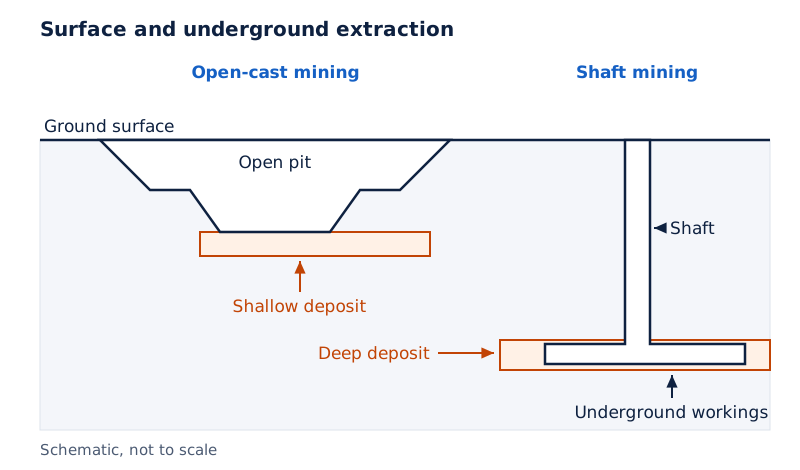
Draw a side view of the ground. Show a shallow deposit exposed in an open pit and a deeper deposit reached by a vertical shaft. Label the ground surface, shallow deposit, deep deposit and shaft.
Drawn by One Young India.
Extraction is followed by treatment where necessary. Metals must be obtained from their ores by appropriate processing, while crude petroleum needs refining. The method of reaching a deposit and the treatment of the extracted material are separate parts of obtaining a useful resource.
What does a case study of manganese show?
Manganese connects mineral distribution with steel manufacture. It is mainly used to make steel and ferro-manganese alloy, and also enters bleaching powder, insecticides and paints. An insecticide is a substance used to kill insects.
The following figures show the shares of India's manganese production in 2018-19. A percentage, written with the symbol %, expresses a number out of one hundred. A production share describes a state's part of the total produced during that period.
| State or group | Share of manganese production, 2018-19 |
|---|---|
| Madhya Pradesh | 33% |
| Maharashtra | 27% |
| Odisha | 16% |
| Karnataka | 12% |
| Andhra Pradesh | 10% |
| Others | 2% |
How should these figures be interpreted?
Madhya Pradesh has the largest share in this table, followed by Maharashtra. The heading's year is part of the information: these are production shares for 2018-19. They do not measure the total amount still underground or the area covered by deposits.
What the figure shows
Manganese production shares
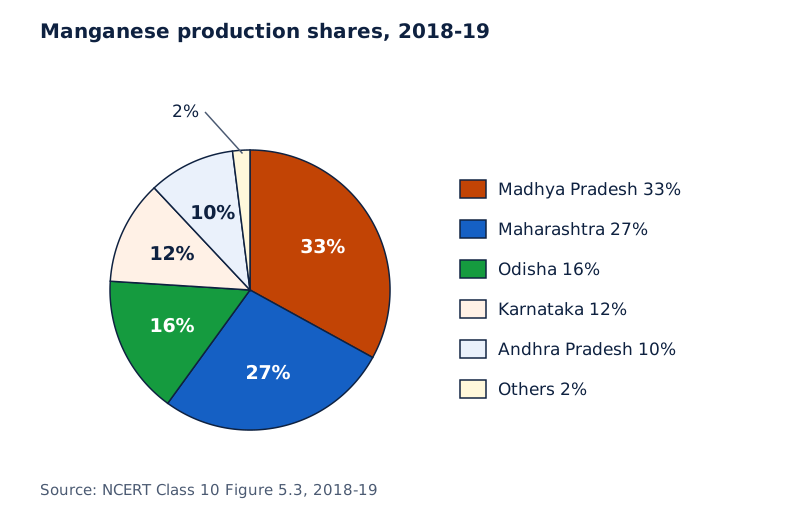
The pie chart divides production among six labelled categories. Madhya Pradesh has the largest slice, labelled 33%, and Others has the smallest, labelled 2%. Maharashtra's slice is labelled 27%.
Drawn by One Young India.
A pie chart is a circle divided into slices representing parts of a total. Reading it requires the labels as well as the sizes of the slices. The category Others groups the production outside the individually named states.
This case links three ideas: manganese's industrial use, its distribution across states and a dated comparison of production. A complete comparison names the resource, the places and the year. Keeping these together prevents confusion between mineral occurrence and measured output.
What does a case study of bauxite show?
Bauxite is a clay-like ore from which aluminium is obtained through processing. Its deposits form through the decomposition of rocks rich in aluminium-bearing substances. Decomposition here means the breaking down of rock material through natural processes.
India's bauxite deposits are mainly found in the Amarkantak plateau, Maikal hills and Bilaspur-Katni plateau region. These locations connect bauxite with elevated landforms. The Panchpatmali deposits in Odisha's Koraput district are important bauxite deposits.
| State or group | Share of bauxite production, 2018-19 |
|---|---|
| Odisha | 65% |
| Jharkhand | 10% |
| Gujarat | 9% |
| Chhattisgarh | 6% |
| Maharashtra | 6% |
| Madhya Pradesh | 3% |
| Others | 1% |
What connection can we make between ore and use?
Odisha was the largest bauxite-producing state in India in 2018-19. The table shows that its production share was much larger than any other listed state's share. Chhattisgarh and Maharashtra had equal shares in the displayed data.
What the figure shows
Bauxite production shares
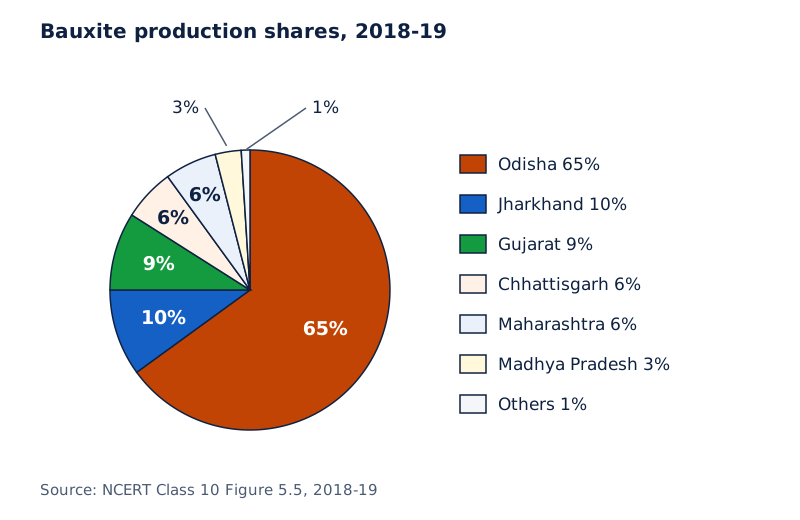
The pie chart has seven labelled categories. Odisha occupies the largest slice, labelled 65%. Chhattisgarh and Maharashtra are each labelled 6%, while Others is labelled 1%.
Drawn by One Young India.
The useful metal is aluminium, while the extracted ore is bauxite. This distinction matters when connecting a mine with the products made from its material. The metal's lightness, strength and ability to conduct electricity help explain why obtaining it is important.
Keep the two case studies separate. The manganese table compares manganese output; the bauxite table compares bauxite output. Their percentages each refer to their own resource's production. Equal percentages in different tables would not establish equal amounts of mineral material.
How can mining affect people and the environment?
Mining hazards are dangers associated with extracting minerals. Miners may breathe dust and harmful fumes. These can damage health and make miners vulnerable to lung diseases. Fumes are gases or airborne substances released during activities such as extraction and processing.
Underground work also involves the risk of collapsing roofs, flooding and fires in coalmines. Flooding means water entering and filling a place. These dangers explain why safety rules and their implementation are essential parts of mining.
How can damage spread beyond a mine?
Mining can contaminate nearby water sources. Contamination means the addition of harmful or unwanted substances. Waste dumped from mines can damage land and soil. Slurry, a mixture of fine solid material and water, can contribute to stream and river pollution.
| Mining problem | Possible effect |
|---|---|
| Dust and harmful fumes | Risks to miners' lungs and health |
| Roof collapse, flooding or fire | Danger to people working in mines |
| Dumped waste and slurry | Damage to land and soil |
| Contaminated water | Pollution of water sources, streams and rivers |
Environmental protection means preventing or limiting damage to the surroundings on which living things depend. Enforcing environmental laws and safety regulations helps address mining hazards. A regulation is a rule controlling how an activity is carried out.
The usefulness of minerals and the dangers of mining must both be understood. Minerals support daily life, but their extraction can harm the people doing the work and the surrounding land and water. Responsible use includes attention to both sets of effects.
A conservation poster can connect the message “avoid mineral waste” with the need to protect miners, land and water. Name the harm being addressed so that the message explains a reason for careful resource use.
Why must minerals be conserved, and how can we help?
Mineral resources are finite, meaning limited in amount, and non-renewable, meaning they cannot be replaced on the timescale of human use. Their formation takes millions of years. The rate at which useful deposits form is extremely small compared with present consumption.
How does continued extraction create pressure?
- Natural processes take very long periods to form and concentrate useful mineral deposits.
- People extract the deposits to obtain materials and energy for homes, transport, agriculture and industry.
- Continued extraction uses up accessible ores and can require working at greater depths with lower-quality material.
- Costs increase, strengthening the need to conserve resources and reduce unnecessary demand for newly extracted minerals.
Recycling means processing used material so it can be used again. Recycling metals and using scrap, discarded metal material, help conserve resources. Substitutes, materials used in place of others, can reduce demand for scarce minerals where suitable alternatives exist.
Better technology can help use low-grade ores, ores with a relatively small useful mineral content, at lower cost. Planned use also matters: a resource should be used carefully rather than wasted merely because it is available at present.
How does saving energy conserve mineral fuels?
Using public transport, switching off electricity when it is not needed and choosing power-saving devices can reduce unnecessary energy use. Developing solar and wind energy helps reduce dependence on exhaustible fuels. Solar energy comes from sunlight; wind energy comes from moving air.
Renewable resources are replenished through natural processes on useful human timescales. Recycling a metal does not turn the original mineral deposit into a renewable resource. It makes further use of material already extracted and helps keep mineral resources available for longer.
Note: Conservation combines careful use, recycling, suitable substitutes, improved technology and reduced energy waste. Its purpose is to protect useful resources for future needs.
Glossary
- Mineral — A naturally occurring substance with definite chemical composition and characteristic physical properties.
- Ore — A natural accumulation containing enough useful mineral to make its extraction economically worthwhile.
- Metallic mineral — A mineral resource that provides a metal after suitable extraction and processing.
- Non-metallic mineral — A mineral resource that does not provide metals in the way metallic ores do.
- Fossil fuel — A fuel formed from ancient living remains over very long periods of time.
- Open-cast mining — Extraction of near-surface deposits by removing material covering the useful mineral.
- Shaft mining — Extraction of deep deposits through vertical passages connected to underground workings.
- Quarrying — Removal of stone or other near-surface material from an open excavation.
- Drilling — Boring a narrow well into the Earth to reach resources such as petroleum.
- Production share — The part of total output supplied by a place during a stated period.
- Non-renewable resource — A resource that cannot be replaced on the timescale at which people use it.
- Conservation — Careful use and protection of resources to avoid waste and preserve future availability.
- Recycling — Processing used materials so that they can be used again instead of discarded.
Common errors and misconceptions
- Misconception: A rock and a mineral mean exactly the same thing. Correct: Rocks are made of mineral matter; most contain several minerals in varying proportions.
- Misconception: Every mineral occurrence can be mined profitably. Correct: Concentration, ease of extraction and access to markets influence whether working a deposit is economically worthwhile.
- Misconception: Non-metallic minerals have little use. Correct: Limestone supplies cement manufacture, mica serves electrical industries and mineral fuels provide energy.
- Misconception: Uranium is a fossil fuel because it supplies energy. Correct: Uranium is a metallic resource used for nuclear power; coal, petroleum and natural gas are fossil fuels.
- Misconception: Production share tells us the amount still underground. Correct: It measures a place's part of output during a specified period, rather than its reserves.
- Misconception: All minerals are extracted through deep shafts. Correct: Open-cast mining, quarrying and drilling are other methods, used according to the deposit and material.
- Misconception: Recycling makes mineral deposits renewable. Correct: Recycling reuses extracted material; the natural formation of new deposits remains extremely slow compared with consumption.
Exam-style questions with model answers
Q1. A mineral accumulation contains enough useful material to justify extraction costs. Bauxite is such a material and supplies aluminium. Identify the term for the accumulation and name the metal obtained from bauxite. [2 marks]
- The accumulation is an ore because its useful mineral content makes extraction economically worthwhile.
- The metal obtained by processing bauxite is aluminium.
Q2. Copper supplies a metal; mica does not supply a metal in this way. Classify each as metallic or non-metallic using the given information. [2 marks]
- Copper belongs to the metallic group because it provides a metal for useful products.
- Mica belongs to the non-metallic group because it does not provide a metal in this way.
Q3. In 2018-19, India's manganese production shares were Madhya Pradesh 33%, Maharashtra 27%, Odisha 16%, Karnataka 12%, Andhra Pradesh 10% and Others 2%, combining the remaining producers. Name the largest producer, the second-largest producer and the smallest category, giving each share. [3 marks]
- Madhya Pradesh was the largest producer in the supplied 2018-19 data, with a share of 33% of India's manganese production.
- Maharashtra was the second-largest producer in the supplied data. Its share of India's manganese production for that period was 27%.
- Others was the smallest category, representing 2% of production. This label combines producers outside the five states named individually in the question.
Q4. Open-cast mining removes covering material to reach shallow deposits; shaft mining reaches deep deposits through vertical passages; quarrying removes near-surface building stone; drilling bores wells for oil and gas. Match each method to its deposit and explain the match. [4 marks]
- A shallow mineral deposit suits open-cast mining because the material covering it can be removed to expose the resource from above.
- A deep deposit suits shaft mining because a vertical passage provides access to the mineral material far below the surface.
- Near-surface building stone suits quarrying because the stone can be removed directly from an open excavation near ground level.
- Petroleum and natural gas suit drilling because a bored well can reach these underground resources and provide access to them.
Q5. Bauxite supplies aluminium. Aluminium is light, strong and a good conductor. Bauxite production shares in 2018-19 included Odisha 65%, Jharkhand 10%, Chhattisgarh 6% and Maharashtra 6%. State the metal obtained, two properties, the leading listed state with its share, and the pair with equal shares. [5 marks]
- The metal obtained from bauxite is aluminium. Bauxite is the ore that is processed to obtain this useful metal for further use.
- Aluminium is light. This is one of the useful physical properties listed in the question for the metal obtained from the bauxite ore.
- Aluminium is strong. The question also identifies it as a good conductor, so its usefulness is connected with several physical properties together.
- Odisha is the leading state among those listed for 2018-19. Its share of bauxite production in the supplied figures is 65%.
- Chhattisgarh and Maharashtra form the pair with equal production shares. Each accounts for 6% of bauxite production in the supplied 2018-19 data.
Q6. Minerals form over millions of years and are used much faster. Deeper, lower-quality ores can increase extraction costs. Recycling, suitable substitutes and careful energy use reduce demand for fresh resources. Explain the need for conservation and three measures, in five points. [5 marks]
- Minerals need conservation because their formation takes millions of years, while people use them much faster. Supplies cannot be replaced on the timescale of human use.
- Conservation also addresses rising extraction costs. As work moves to deeper deposits with lower-quality ore, obtaining useful mineral material can become more costly.
- Recycling processes used materials for further use. This helps conserve minerals by reducing the demand for fresh material extracted from deposits in the Earth.
- Using suitable substitutes can reduce demand for a scarce mineral. The alternative must serve the required purpose so that useful resources are conserved.
- Careful energy use reduces unnecessary demand for mineral fuels. It therefore applies conservation to the resources supplying energy as well as those supplying materials.
Q7. Mining exposes workers to dust and harmful fumes that can damage lungs and cause lung diseases, as well as roof collapse, flooding and coal-mine fires. Dumped waste and slurry damage land and contaminate water. Explain three effects: one on health, one on worker safety and one on the environment. [3 marks]
- Dust and harmful fumes threaten miners' health because breathing them can damage the lungs and make workers vulnerable to lung diseases.
- Roof collapse, flooding and fires threaten worker safety. These are dangers within mining areas that can place people doing the extraction at risk.
- Dumped waste and slurry can damage land and soil and contaminate water sources. Pollution may therefore affect the surroundings as well as the mine.
Q8. The world-distribution pairs are Australia and Brazil for iron ore; Chile and Peru for copper; Kazakhstan and Canada for uranium. Reproduce the two countries for each resource as three separate pairs. [3 marks]
- The iron ore pair is Australia and Brazil. These are the two countries linked with iron ore in the world-distribution information provided.
- The copper pair is Chile and Peru. Both countries should be retained when reproducing the complete copper pair given in the question.
- The uranium pair is Kazakhstan and Canada. These complete the uranium entry; the information provides country-resource associations without giving annual production amounts.
Key takeaways
- Minerals occur naturally, while ores contain enough useful mineral to make extraction economically worthwhile under given conditions.
- Metallic resources include iron ore, bauxite, manganese, copper, gold, silver and uranium; limestone and mica are non-metallic resources.
- Coal, petroleum and natural gas supply energy and are fossil fuels formed over very long periods.
- Mineral distribution is uneven, so learning a resource together with its location helps explain geographical patterns.
- Open-cast mining, shaft mining, quarrying and drilling reach different deposits according to their position and the material involved.
- Production percentages need a resource name and a year; they describe output shares rather than underground reserves.
- Mining can threaten workers' health and safety and damage nearby land, soil and water sources.
- Conservation combines careful use, recycling, suitable substitutes and energy savings to protect limited resources for future needs.
Test yourself
What makes a mineral accumulation an ore?
It contains enough useful mineral for extraction to be economically worthwhile under the relevant conditions.
Which ore supplies aluminium, and what are two useful properties of the metal?
Bauxite supplies aluminium. Aluminium is light and strong; it also has good conductivity and malleability.
Why does copper suit the making of electrical wires?
Copper conducts electricity well and is ductile, meaning it can be drawn into wires.
How do mica and limestone help industries?
Mica's insulating properties serve electrical industries, while limestone is a basic raw material for cement.
Name three important coalfields associated with the Damodar valley region.
Jharia, Raniganj and Bokaro are important coalfields associated with the Damodar valley region.
How does shaft mining differ from open-cast mining?
Shaft mining reaches deep deposits through vertical passages; open-cast mining removes covering material to expose shallow deposits.
Why should a production chart include its year?
The figures describe output during a particular period. Production levels can change, so the date is essential to the comparison.
Does recycling make mineral deposits renewable?
No. Recycling reuses material already extracted, while natural formation of new mineral deposits remains very slow compared with consumption.
Write about it
Turn a question from this chapter into a paper.
The Writing Studio has a structure guide, a rubric and citation tools for 15 formats, from essays to research papers. Drafting is free with an account. Learnacy Essential adds feedback from an AI writing coach and submission to The OYI Review.
Publication depends on review and is not guaranteed.