
Peasants, Zamindars and the State | CBSE Class 12 History Notes
On this page

This note covers Mughal agrarian society, peasants and agricultural production, village communities, caste, panchayats, artisans, women, forest dwellers, zamindars, land revenue, silver flows, imperial chronology and the use of the Ain-i Akbari as historical evidence.
What was the setting of Mughal agrarian society?
During the sixteenth and seventeenth centuries, about 85 per cent of India's population lived in villages. Peasants and landed elites both claimed shares of agricultural produce. Their relationships combined cooperation, competition and conflict, forming the basis of rural society.
The Mughal state received the bulk of its income from agriculture. Revenue assessors, collectors and record keepers entered the countryside to ensure cultivation and secure taxes. Rural society therefore included relationships with imperial officials as well as relationships within villages.
How did village life connect with wider society?
Peasants tilled, sowed and harvested throughout the agricultural year. They also supplied labour for processing crops into products such as sugar and oil. Crops grown for sale brought trade, money and markets into villages and connected agricultural regions with towns.
The countryside was geographically varied. Fertile cultivated plains existed alongside dry lands, hills, forests and scrubland. Consequently, settled cultivation was one major form of livelihood, while pastoral, forest-based and mobile communities remained important.
Which reigns frame this agrarian world?
Akbar ruled from 1556 to 1605, Jahangir from 1605 to 1627, Shah Jahan from 1628 to 1658, and Aurangzeb from 1658 to 1707. These reigns provide the political setting for the institutions, administrative records and agrarian relationships discussed here.
The village was the basic agricultural unit, but it was neither socially uniform nor economically isolated. Individual rights over land coexisted with collective institutions, unequal caste relations, household labour and demands made by the state.
What does the timeline show about the Mughal Empire?
The timeline places agrarian administration within the longer history of Mughal rule. It distinguishes the foundation of the dynasty, interrupted succession, major reigns and later changes in political authority. The dates give context without implying that village institutions changed at every accession.
| Date or period | Political development |
|---|---|
| 1526 | Babur defeated Ibrahim Lodi at Panipat and became the first Mughal emperor. |
| 1530 to 1540 | First phase of Humayun's reign. |
| 1540 to 1555 | Defeated by Sher Shah, Humayun lived in exile at the Safavid court. |
| 1555 to 1556 | Humayun regained his lost territories. |
| 1556 to 1605 | Reign of Akbar. |
| 1605 to 1627 | Reign of Jahangir. |
| 1628 to 1658 | Reign of Shah Jahan. |
| 1658 to 1707 | Reign of Aurangzeb. |
| 1739 | Nadir Shah invaded India and sacked Delhi. |
| 1761 | Ahmad Shah Abdali defeated the Marathas in the third battle of Panipat. |
| 1765 | The diwani of Bengal passed to the East India Company. |
| 1857 | Bahadur Shah II, the last Mughal ruler, was deposed by the British and exiled to Rangoon. |
Agrarian evidence belongs to different points within and beyond this sequence. The Ain-i Akbari concerns Akbar's empire, while later revenue orders and regional records illuminate other periods. Keeping these settings distinct prevents evidence about one ruler or region from becoming an unsupported claim about every village.
Why did agriculture expand, and how did peasants cultivate land?
Abundant land, available labour and peasant mobility supported agricultural expansion. Indo-Persian writings used raiyat and muzarian for peasants; kisan and asami also occurred. Cultivation rested on individual ownership, and peasants could buy and sell land.
How did resident and non-resident cultivators differ?
| Category | Relationship to the village | Conditions of cultivation |
|---|---|---|
| Khud-kashta | Resided in the village where they held land. | Cultivated holdings in their own village. |
| Pahi-kashta | Belonged to another village. | Cultivated elsewhere under contracts, attracted by favourable revenue terms or driven by distress. |
Migration could be voluntary or forced by hardship after famine. An average north Indian peasant seldom owned more than a pair of bullocks and two ploughs; most owned even less. Landholding standards differed: about six acres signified affluence in Gujarat, while ten acres made a Bengal asami rich.
How did irrigation and tools support production?
Monsoons remained central. Rice generally grew where annual rainfall reached forty inches or more; wheat and millets corresponded to progressively lower rainfall. Additional water came through irrigation devices and canals. Under Shah Jahan, the state repaired the shahnahr in Punjab and supported canal works.
The light wooden plough, fitted with an iron tip, made shallow furrows that helped preserve moisture in hot months. Although an ox-drawn drill could plant seeds, broadcasting was more common. A narrow iron blade on a wooden handle served for hoeing and weeding.
What the figure shows
Persian wheel
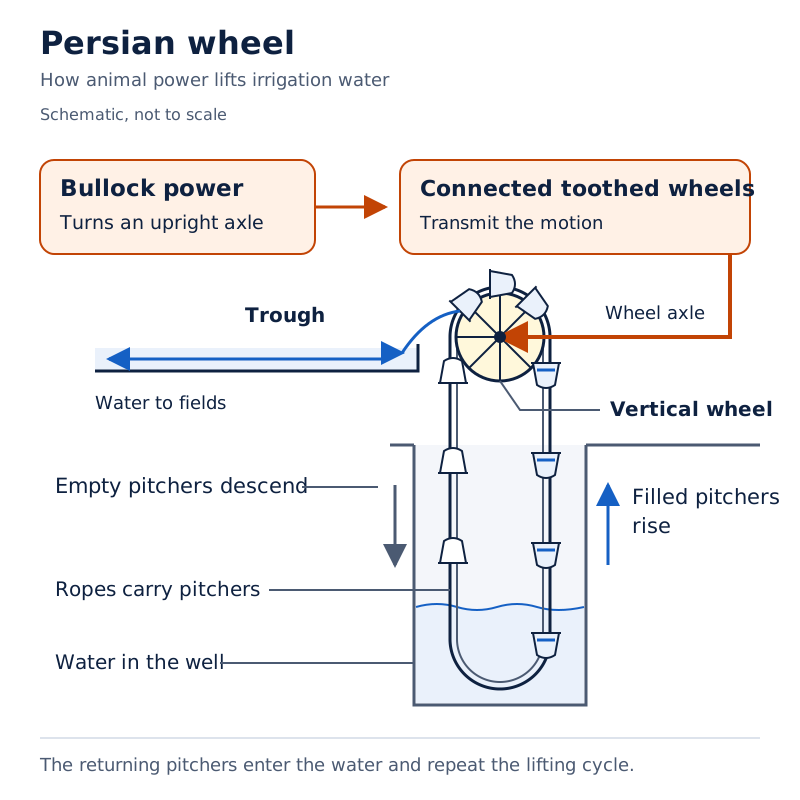
The reconstruction shows bullocks operating a wheel mechanism beside a well. A vertical wheel carries a line of containers down into the well and upwards. The drawing has no written component labels.
Drawn by One Young India. See Fig. 8.2 in your NCERT textbook
In the wheel system described by Babur, connected toothed wheels transmitted animal power to pitchers attached to ropes. Water emptied into a trough for distribution. His description of bucket irrigation instead required one person to drive the bullock and another to empty the bucket.
How did crop diversity connect subsistence with commerce?
Agriculture followed two principal seasonal cycles: kharif, associated with autumn, and rabi, associated with spring. Most regions produced at least two crops annually, except particularly arid or inhospitable areas. A dependable water supply allowed some regions to produce three.
What evidence shows varied production?
The Ain recorded 39 crop varieties in Agra and 43 in Delhi across the two seasons. Bengal produced 50 varieties of rice alone. Rice, wheat and millets supplied staple foods, but food production coexisted with crops intended for sale.
Jins-i kamil meant highly valued or “perfect” crops. Cotton and sugarcane were prominent examples, encouraged because they generated more revenue. Cotton spread across central India and the Deccan plateau; Bengal was known for sugar. Oilseeds, including mustard, and lentils also entered commercial production.
Thus, an average holding could combine subsistence and commercial cultivation. Describing the economy as purely subsistence-based misses the role of crops sold through markets and the state's interest in more profitable produce.
How did new crops and population affect this picture?
During the seventeenth century, maize reached India through Africa and Spain and became a major western Indian crop. Tomatoes, potatoes, chillies, pineapples and papayas came from the New World. These introductions widened the range of cultivated products.
Akbar and his nobles encountered tobacco in 1604. Jahangir's attempt to ban it proved ineffective: by the end of the seventeenth century, tobacco was widely consumed, cultivated and traded.
Varied and flexible agriculture supported slow population growth despite famines and epidemics. Economic historians estimate an increase of about 50 million between 1600 and 1800, approximately 33 per cent over two hundred years. Agricultural growth therefore coexisted with serious periodic disruptions.
How did different social groups participate in village life?
The village community comprised cultivators, the panchayat and the headman. Individual landownership existed within collective social arrangements. However, the community contained substantial inequalities, and its members differed in resources, occupation and social position.
Peasants and agricultural labourers
Caste and caste-like distinctions separated cultivators from many menial workers and agricultural labourers, or majur. Abundant cultivable land did not eliminate poverty because hereditary social restrictions limited access to resources. Muslim communities also contained subordinated groups, including scavengers housed outside village boundaries.
Social position was more flexible at intermediate levels. Rajputs and Jats both appeared as peasants in Marwar. Ahirs, Gujars and Malis could improve their status through profitable cattle rearing and horticulture. Sadgops and Kaivartas in eastern India acquired peasant status.
Artisans and cultivator households
Artisans supplied pottery, tools and other specialised services. The boundary between peasant and artisan could be fluid: cultivator households engaged in dyeing, textile printing or pottery during quieter stages of the farming year.
Artisans commonly received a harvest share or land, sometimes allocated by the panchayat. In Maharashtra, hereditary artisan holdings were called miras or watan. Other arrangements involved individually negotiated goods for services. Cash payments also occurred.
Headmen and village elites
Important elders and headmen exercised authority over accounts, social discipline and local justice. The poorest agricultural workers were unlikely to be represented in village councils. Collective organisation therefore coexisted with control by powerful people.
Note: Calling a village a “little republic” does not establish equality or economic isolation. Private property, caste and gender inequalities, elite authority, trade and cash payments all shaped rural life.
The expression jajmani system was later used for certain service and payment arrangements. It was not a term in vogue during the sixteenth and seventeenth centuries, so it should not be treated as their contemporary universal name.
How did panchayats and headmen regulate rural society?
A village panchayat was an assembly of elders, usually influential people with hereditary property rights. In mixed-caste villages it commonly represented several communities, but it remained an oligarchy. Its decisions bound members even though poorer workers were unlikely to participate.
Who managed accounts and common funds?
The muqaddam or mandal headed the panchayat. Some accounts describe selection by agreement among elders, followed by the zamindar's ratification. Elders could dismiss a headman who lost their confidence. The headman supervised village accounts with the patwari's assistance.
Individual contributions supplied a common fund. It paid for entertaining visiting revenue officials, meeting emergencies such as floods, and constructing bunds or canals beyond an individual peasant's resources. These functions made collective institutions materially important to cultivation.
Mandals often misused their positions. They were accused of colluding with patwaris to underassess their own land and transfer extra revenue burdens to smaller cultivators. Administrative responsibility therefore did not guarantee impartial conduct.
How did authority combine discipline and protection?
Panchayats upheld caste boundaries, imposed fines and sometimes expelled offenders temporarily. Expulsion could remove a person's right to practise an occupation. Separate jati panchayats dealt with matters such as disputed land claims, marriage norms and ritual precedence.
The state generally respected jati panchayat decisions except in criminal justice. Villagers also petitioned councils against excessive taxes and begar, or unpaid labour. Petitioners argued that custom protected the minimum necessary for subsistence.
In cases of excessive revenue demands, panchayats often suggested compromises with officials or zamindars. When reconciliation failed, peasants could abandon a village. Available uncultivated land and competition for labour made desertion an effective means of resistance, showing that cultivators were not entirely without bargaining power.
What roles and rights did women have in agrarian society?
Household labour supported cultivation, so women worked alongside men. Men generally tilled and ploughed, while women sowed, weeded, threshed and winnowed. A strict separation between women's work at home and men's work outside was impractical in this setting.
How did women's labour sustain production?
Spinning, preparing clay for pottery and embroidery depended on female labour. The more commercialised the product, the greater the demand on women's labour to produce it. Peasant and artisan women worked in fields and could also visit employers' houses or markets when their tasks required it.
Economic participation coexisted with restrictions. In western India, menstruating women were barred from touching the plough or potter's wheel. In Bengal, they were barred from entering betel-leaf groves. Productive importance did not remove gender prejudice.
How did family customs and property rights vary?
Malnutrition, repeated pregnancies and deaths in childbirth contributed to high female mortality and shortages of wives. Many peasant and artisan communities practised bride-price. Remarriage was accepted for divorced women and widows, distinguishing their customs from those of some elite groups.
Male-headed households nevertheless exercised strict control. Women could petition panchayats over husbands' infidelity or neglect of wives and children. The state and “superior” caste groups did intervene to ensure that the family was adequately provided for, although male infidelity was not always punished.
In most cases when women petitioned the panchayat, their names were excluded and they were identified as the mother, sister or wife of the male head of the household. This makes their actions visible while also revealing the patriarchal form of the surviving records.
Among landed groups, women could inherit property. Punjab evidence records women selling inherited land; Hindu and Muslim women could inherit zamindaris and sell or mortgage them. A woman headed the important Rajshahi zamindari in eighteenth-century Bengal.
How were forest dwellers connected with wider political and economic changes?
Forests and scrubland occupied extensive areas beyond settled cultivation. Estimates based on contemporary evidence suggest roughly 40 per cent forest cover, but this is an informed conjecture, not a measured all-India census figure.
The term jangli described people living through forest gathering, hunting and shifting cultivation. It did not imply an absence of civilisation. Bhil livelihoods followed seasonal rhythms: gathering in spring, fishing in summer, cultivation during the monsoon, and hunting in autumn and winter.
How did the state and markets enter forests?
Forests could shelter resistance to taxation. The Mughal state also demanded resources from forest communities: peshkash, or tribute, often included elephants needed by the army. Hunting expeditions represented imperial contact with subjects and attention to their grievances in court ideology.
Commercial demand connected forests with wider markets. Honey, beeswax and gum lac were valuable products; gum lac became an important overseas export. Elephants were captured and sold. Lohani traders linked India with Afghanistan and participated in Punjab's town-country trade.
Abu'l Fazl's account of Awadh around 1595 describes hill goods carried by people, ponies and goats. Mountain products exchanged for cloth, salt, ornaments and other plains goods reveal active connections between differing ecological regions.
How did social and cultural authority change?
Many tribal chiefs became zamindars, and some even became kings; they recruited armies through kinship groups. Ahom rulers obtained military service from paiks in exchange for land and reserved wild-elephant capture as a royal monopoly.
State formation and conflict altered tribal relationships. Some historians have suggested that sufi pirs played a major role in the gradual acceptance of Islam among agricultural communities in newly colonised areas. Forest history therefore includes trade, military power, settlement and cultural change.
How did zamindars acquire power and influence cultivation?
Zamindars were landed proprietors who drew income from agriculture without directly performing cultivation. Their high status rested partly on caste and partly on khidmat, or services to the state. They formed a powerful upper layer of rural society.
What supported zamindari authority?
Their personal lands, called milkiyat, were cultivated for their private benefit, often by hired or servile labour. Zamindars could sell, mortgage or bequeath these lands. Many also collected state revenue and received financial compensation for doing so.
Military resources strengthened their position. Fortresses and armed forces helped them maintain local power. Although a Brahmana-Rajput grouping was prominent, intermediate castes and Muslim zamindars were also represented. Zamindari status was not confined to a single religious or caste community.
Conquest and dispossession could create or enlarge estates, but slower processes mattered greatly: colonising new land, buying rights, receiving state orders and obtaining transferred rights. Such processes perhaps helped people from relatively lower castes enter the ranks of zamindars.
Why was their relationship with peasants complex?
Zamindars brought land under cultivation and attracted settlers by supplying means of cultivation, including cash loans. They sold produce from their milkiyat land and established haats where peasants could market crops. Buying and selling zamindaris also increased monetary dealings.
They were an exploitative class, yet their relationships with peasants included patronage, reciprocity and paternalism. Bhakti saints did not portray zamindars or moneylenders as exploiters or oppressors of the peasantry; usually, state revenue officials were the objects of their criticism. In a large number of seventeenth-century agrarian uprisings in north India, zamindars often received peasant support against the state.
These connections explain why exploitation and cooperation could coexist. A zamindar could claim resources from cultivators while also financing settlement, providing local leadership or sharing opposition to imperial revenue demands.
How did land revenue assessment and collection work?
Land revenue sustained the empire. The diwan supervised its fiscal system, while officials and record keepers sought information about cultivated area and production. Assessment preceded collection: jama was the assessed demand, whereas hasil was the amount actually collected.
How was land classified?
| Land category | Basis of classification |
|---|---|
| Polaj | Cultivated each year in succession and not left fallow. |
| Parauti | Temporarily left uncultivated to recover fertility. |
| Chachar | Left fallow for three or four years. |
| Banjar | Uncultivated for five years or more. |
Polaj and parauti were further graded as good, middling and bad. Their yields were combined to calculate an average; one-third of that average formed the royal dues described in this classification. This specific procedure should not become a claim about every payment everywhere.
How could revenue be paid?
Akbar instructed the amil-guzar to encourage cash payments while preserving payment in kind. Local conditions could prevent the state from realising its full claims. Measurement covered cultivated and cultivable land, but extensive forests remained unmeasured.
| Method | Procedure described |
|---|---|
| Kankut | Estimated grain; doubtful estimates could be checked using good, middling and inferior crops. |
| Batai or bhaoli | Reaped and stacked crops were divided by agreement in the parties' presence. |
| Khet-batai | Fields were divided after sowing. |
| Lang batai | Cut grain was heaped and divided, with each party taking its share. |
In 1665, Aurangzeb ordered detailed village-wise and peasant-wise scrutiny before assessment, considering state finances and peasant welfare. Such instructions show administrative aims; they do not prove that every official followed them successfully.
What the figure shows
Expansion of the Mughal Empire
The sketch uses separate patterns for Babur's reign in 1530, Akbar's in 1605 and Aurangzeb's in 1707. It labels places including Kabul, Lahore, Delhi, Agra and Patna, and is explicitly not to scale.
Reference: NCERT Class 12 Map 1
The mansabdari establishment combined civil and military responsibilities. Some mansabdars received cash salaries; most received revenue assignments called jagirs and were periodically transferred. A jagir was an assignment of revenue, distinct from the personal milkiyat lands of a zamindar.
What effects did silver flows have on trade and revenue?
The Mughal, Ming, Safavid and Ottoman empires helped sustain extensive Asian trade networks. Political stability supported overland exchange, while voyages and the opening of the New World expanded commerce between Asia and Europe.
How did bullion reach India?
Growing demand for Indian goods brought substantial quantities of silver bullion into Asia, much of which reached India. Overseas trade widened both geographically and in the goods exchanged. Imports of precious metal supported the monetary economy.
Giovanni Careri, who travelled through India around 1690, described the movement of money through trading networks. His account drew on Bernier and linked American silver, European commerce, West Asian markets and purchases of Indian products.
His account traces money moving through Europe and West Asia towards purchases of Indian commodities. It also describes maritime exchanges involving Indian, Dutch, English and Portuguese ships. These connections show how Indian markets participated in a much wider circulation of goods and precious metals.
Why did coin circulation matter in villages?
Stable metal supplies supported expanded minting and circulation of the silver rupya from the sixteenth to eighteenth centuries. This helped the Mughal state obtain revenue in cash and supported monetary transactions beyond major cities.
Export-oriented artisans could receive advances or wages in cash. Commercial crop producers also received cash payments. The traveller Jean-Baptiste Tavernier described village shroffs, who changed money and provided banking services for remittances.
These links join overseas commerce to agrarian administration. Coin circulation, crop sales, artisan payments and taxation formed connected parts of economic life, even though barter and payments in kind continued alongside monetary exchange.
How should historians use sources such as the Ain-i Akbari?
The Ain-i Akbari, compiled by Abu'l Fazl under Akbar's orders, was completed in 1598 after five revisions. It formed the third book of the Akbar Nama, whose first two books supplied the historical narrative.
What did its five daftars contain?
| Book | Principal contents |
|---|---|
| Manzil-abadi | The imperial household and its maintenance. |
| Sipah-abadi | Military and civil administration, servants and notices of officials, scholars, poets and artists. |
| Mulk-abadi | Fiscal administration, revenue rates and statistical accounts of twelve provinces. |
| Fourth and fifth daftars | Religious, literary and cultural traditions, together with Akbar's sayings. |
The mulk-abadi recorded measured areas, assessed revenue, charitable revenue grants, zamindars and their military resources. Its provincial and district-level information makes the work valuable for reconstructing agrarian organisation rather than merely recounting wars and dynastic events.
How was evidence collected and checked?
Abu'l Fazl consulted official records, imperial orders, ministers' reports, personal memoranda and oral testimony from experienced informants. Material was read before Akbar. Oral accounts were checked, and numerical information was written in words to reduce copying errors.
English translations later widened access: Henry Blochmann translated the first volume in 1873, and H.S. Jarrett translated the other volumes in 1891 and 1894. These publication dates belong to the work's later transmission, not to Mughal administration.
What are its limitations and how can they be addressed?
The Ain presents society from the imperial centre. Abu'l Fazl sought to portray harmony under a strong ruler, so it gives a view from above, not peasants' own account of their experiences.
Historians have found arithmetic and transcription errors, generally minor. Coverage is uneven: zamindar caste information is unavailable for Bengal and Orissa, while detailed prices and wages mainly concern Agra and nearby areas. Those figures cannot automatically represent the whole empire.
Regional revenue records from Gujarat, Maharashtra and Rajasthan, together with East India Company records concerning eastern India, supplement the Ain. They expose conflicts and expectations of fairness, helping historians compare administrative ideals with contested rural relationships.
Glossary
- Raiyat — A term commonly used in Indo-Persian sources for a peasant; its plural form was riaya.
- Khud-kashta — A resident cultivator who held agricultural land in the village where the cultivator lived.
- Pahi-kashta — A cultivator belonging to another village who cultivated land elsewhere on a contractual basis.
- Jins-i kamil — Highly valued crops, literally perfect crops, encouraged by the state because they yielded more revenue.
- Panchayat — A village assembly of elders whose authority included local administration, social discipline and dispute settlement.
- Muqaddam — A village headman, also called mandal, who supervised the preparation of accounts with the patwari.
- Begar — Unpaid labour demanded by powerful groups or state officials, against which villagers sometimes petitioned.
- Milkiyat — A zamindar's personal property in land, cultivated for private benefit and transferable through sale, inheritance or mortgage.
- Peshkash — A form of tribute collected by the Mughal state, sometimes including elephants supplied by forest communities.
- Jama — The revenue demand assessed by the administration, distinguished from the amount that was actually collected.
- Hasil — The revenue actually collected, which could differ from the demand previously assessed by officials.
- Amil-guzar — A revenue collector whose duties included obtaining payments while allowing collection in cash or kind.
- Jagir — An assignment of revenue through which most mansabdars received payment for their civil and military responsibilities.
- Shroff — A money-changer who could also act as a banker and assist with remittances of money.
Common errors and misconceptions
- Misconception: Mughal villages produced only enough for their own food. Correct: Staple cultivation coexisted with commercial crops, including cotton and sugarcane, and with links to markets and towns.
- Misconception: A panchayat represented every villager equally. Correct: Influential elders dominated these assemblies; menial agricultural workers were unlikely to be represented, despite being members of village society.
- Misconception: Women remained outside agricultural production. Correct: Women sowed, weeded, threshed and winnowed, supplied artisanal labour, and sometimes owned or inherited land.
- Misconception: Forest communities were isolated from the state and markets. Correct: Tribute, elephant capture, trade, military recruitment and agricultural settlement connected forests with wider society.
- Misconception: Zamindars were simply state officials with no personal property. Correct: They held milkiyat lands, enjoyed social privileges, controlled military resources and often also collected state revenue.
- Misconception: Jama and hasil meant the same amount, always paid in cash. Correct: Jama was assessed demand and hasil actual collection; payment in kind remained an accepted option.
- Misconception: The Ain gives an equally detailed, impartial description of every province. Correct: It reflects imperial priorities, contains some errors and offers uneven geographical coverage, requiring comparison with other records.
Exam-style questions with model answers
Q1. Khud-kashta cultivators lived in the village where they held land. Pahi-kashta cultivators belonged to another village and cultivated elsewhere under contracts, sometimes for better revenue terms and sometimes because of famine distress. Identify the central distinction and explain why pahi-kashta cultivation need not indicate free choice. [2 marks]
- The distinction concerns residence: khud-kashta held land in their home village, while pahi-kashta cultivated outside it under contracts.
- Pahi-kashta migration could follow favourable terms, but famine distress could also force it. The category therefore includes both choice and compulsion.
Q2. Jama denoted assessed revenue, while hasil denoted actual receipts. Officials sought to maximise claims, but local conditions could prevent full collection. Explain why jama cannot by itself establish how much the state received. [2 marks]
- Jama records what the administration demanded, rather than what it successfully collected.
- Local conditions could restrict collection, so evidence of hasil is needed to establish actual receipts. Assessed demand and realised revenue cannot simply be equated.
Q3. Rice, wheat and millets supplied staple foods. Cotton and sugarcane were valued for their higher revenue, and peasants sold produce in markets. Cash payments circulated alongside payments in kind. Using these facts, assess the claim that Mughal agriculture was purely subsistence-based. [4 marks]
- Staple crops show that feeding households was a central agricultural purpose, giving cultivation an important subsistence component.
- Cotton and sugarcane also served commercial purposes, while their higher revenue encouraged state interest in their production.
- Peasant sales connected cultivation to markets, so rural production extended beyond immediate household consumption.
- The coexistence of cash and payments in kind reveals overlapping economic arrangements. The evidence supports combined subsistence and commercial production, rather than a purely subsistence economy.
Q4. Panchayats collected common funds for flood relief and irrigation works, upheld caste boundaries, imposed fines or expulsion, and received petitions against excessive taxation and unpaid labour. Explain how these functions combined community support with social control. [4 marks]
- Common funds supported flood relief, helping the community respond to shared difficulties.
- Collective spending on irrigation made the panchayat important to productive activity as well as social organisation.
- Defending caste boundaries and imposing fines or expulsion gave it disciplinary power over villagers.
- Petitions against taxation and unpaid labour also made it a place where grievances could be raised. Community assistance and coercive authority therefore operated through the same institution.
Q5. Women sowed, weeded, threshed, winnowed and supplied craft labour. Male-headed households controlled their conduct, and in most cases petition records excluded their names and identified them through male relatives. Some landed women inherited and sold property. What do these facts reveal about women's position? [4 marks]
- Women's work contributed directly to both agricultural and artisanal production, so their role extended beyond household maintenance.
- Productive activity did not remove patriarchal control, since male-headed households regulated women's conduct.
- Recording petitioners through male relatives shows how documentary practices could subordinate women's individual identities.
- Inherited property and land sales demonstrate that some women possessed economic rights. Their position therefore combined labour, restrictions and rights that varied across social groups.
Q6. Zamindars held transferable milkiyat lands cultivated through hired or servile labour, often collected state revenue for compensation, and maintained forts and armed forces. They also supplied cultivators with loans, established markets and sometimes received peasant support in uprisings against the state. Explain why their power and their relationship with peasants require a complex interpretation. [6 marks]
- Milkiyat provided a personal landed base, while the labour of others supported the zamindars' private agricultural income.
- Compensated revenue collection connected them to state administration and added a further source of economic advantage.
- Forts and armed forces supplied military backing. Their authority therefore combined landed wealth, administrative functions and coercive resources.
- Loans could provide cultivators with means of cultivation, while markets created places where agricultural produce could be sold.
- Peasant support in some uprisings shows that zamindars could become allies against the state, despite unequal relationships within the countryside.
- The evidence therefore joins extraction and dominance with patronage and cooperation. Treating every peasant-zamindar relationship as either harmony or uninterrupted hostility would overlook part of the evidence.
Q7. The Ain-i Akbari was an imperial project intended to portray order under Akbar. Abu'l Fazl checked oral testimony and revised his work five times. Historians find minor arithmetic errors, missing zamindar caste data for Bengal and Orissa, and prices and wages mainly from Agra's vicinity. Regional revenue records and East India Company records reveal agrarian conflicts. Explain how historians can use the Ain critically. [6 marks]
- Its official purpose helps explain its perspective: the account favours imperial order and must be read as a view shaped by the ruling establishment.
- Repeated revision and checking of testimony show care in compilation. Official sponsorship therefore does not make the entire work worthless.
- Minor arithmetic errors require scrutiny of individual figures rather than unquestioning acceptance of every total.
- Missing caste data and the concentration of price and wage evidence around Agra restrict geographical generalisation. Historians should identify where the evidence is strong and where it is incomplete.
- Regional revenue and Company records allow comparison, especially where agrarian conflicts complicate the image of imperial harmony. Critical use combines the Ain's detailed evidence with awareness of its purposes, mistakes and uneven coverage.
Q8. Forest communities gathered produce, hunted and practised shifting cultivation. The state demanded elephants as tribute; honey, beeswax and gum lac entered trade. Many tribal chiefs became zamindars, and some even became kings. Ahom paiks supplied military service in return for land. Explain how these facts challenge the idea that forest dwellers were isolated from political and economic change. [6 marks]
- Gathering, hunting and shifting cultivation supplied a distinctive livelihood base, but these activities did not prevent connections with wider society.
- Elephant tribute linked forest communities directly to state demands. Forest resources therefore had political and military importance beyond local use.
- Trade in honey, beeswax and gum lac connected forest products with buyers outside the communities that collected them.
- Chiefs becoming zamindars or kings demonstrate changes in political rank and authority within forest society itself.
- Military service by Ahom paiks in return for land connected obligations to rulers with access to resources.
- Together, these examples show overlapping commercial, tributary and military relationships. Forest livelihoods remained distinctive while communities participated in wider processes of exchange and state formation.
Key takeaways
- Rural society combined individual landownership with collective institutions, unequal social relationships and competing claims over agricultural produce.
- Peasant mobility, labour and available land encouraged cultivation; irrigation and varied crops connected subsistence production with commerce.
- Panchayats supported shared needs and heard grievances while also defending caste boundaries and enforcing social discipline.
- Women's agricultural and artisanal work was essential, although patriarchal controls persisted and property rights varied across social groups.
- Forest communities participated in trade, tribute and military service, while many chiefs became zamindars and some even became kings.
- Zamindars combined landed property, revenue functions and military resources with roles in settlement, lending and market formation.
- Jama measured assessed demand and hasil actual collection; Mughal revenue arrangements allowed both cash and payments in kind.
- The Ain-i Akbari offers rich evidence, but its imperial perspective and uneven coverage require comparison with regional records.
Test yourself
What were the three principal constituents of the village community?
The cultivators, the village panchayat and the headman, known as muqaddam or mandal, formed its three principal constituents.
How could village desertion become an effective form of resistance?
Uncultivated land was relatively accessible, and settlements competed for labour. Cultivators' departure could therefore put pressure on those making excessive demands.
What distinguishes chachar from banjar?
Chachar had remained fallow for three or four years; banjar had been uncultivated for five years or more.
Why should jangli not be read as meaning uncivilised?
The term described forest-based livelihoods such as gathering, hunting and shifting cultivation, rather than an absence of civilisation.
Which part of the Ain is particularly important for fiscal information?
The mulk-abadi, its third daftar, contains revenue rates and detailed statistical accounts of the empire's twelve provinces.
How is the Ain related to the Akbar Nama?
The Ain forms the third book of the Akbar Nama; its own contents are arranged in five daftars.
How did silver imports assist the Mughal state?
Silver supplies supported coin minting and circulation, making it easier for the state to collect taxes and revenue in cash.
What is one reason to compare the Ain with regional records?
Regional records reveal conflicts and expectations of fairness that supplement the Ain's imperial perspective and help correct its uneven coverage.