
India's External Relations | CBSE Class 12 Political Science Notes
On this page
Watch & explore
Start with a few high-quality watches, then dive into the notes below.
Try an idea before you read. Test your understanding of India's foreign policy during the Cold War era. Explore →
India's external relations cover the international setting at independence, constitutional principles, Nehru's foreign policy, non-alignment, Afro-Asian unity, relations with China and Pakistan, the Bangladesh war, defence and development, nuclear policy, and the relationship between foreign affairs and domestic politics.
What international and domestic conditions shaped India's foreign policy?
A new nation in a divided world
India became independent in a world recovering from the Second World War. Reconstruction, the creation of an international organisation, the collapse of colonial empires, and the emergence of new countries shaped the international setting. Most newly independent nations were trying to come to terms with the linked challenges of democracy and welfare.
The establishment of the United Nations (UN), the development of nuclear weapons and the emergence of Communist China added further challenges. Indian leaders had to protect national interests within this changing environment. Their freedom to act depended partly on conditions beyond India's borders.
The Cold War divided much of the world between two blocs. One was led by the United States (US) and its Western allies; the other was led by the Soviet Union, or Union of Soviet Socialist Republics (USSR). Their confrontation involved political, economic and military power.
Domestic needs and external pressures
India also inherited international disputes from British rule. Partition created additional pressures, while poverty alleviation demanded resources and attention. These domestic needs helped explain why peace and economic development became central foreign policy concerns.
Developing countries generally lacked the resources available to powerful states. Their economic and security dependence on more powerful states occasionally influenced their foreign policies. Many supported the preferences of the powers assisting them, contributing to the division into rival camps.
India sought security through peace and respect for the sovereignty of other nations. Its foreign policy therefore grew from an interaction between domestic priorities and the international environment. Neither internal needs nor global pressures alone explain its choices.
How does Article 51 express India's approach to international relations?
Constitutional direction
Article 51 belongs to the Directive Principles of State Policy. It concerns the promotion of international peace and security. Its four elements connect peaceful international relations with fair dealings, respect for international obligations and methods of settling disputes.
| Provision | Constitutional direction | Main concern |
|---|---|---|
| Article 51(a) | Promote international peace and security. | Peaceful conditions between nations. |
| Article 51(b) | Maintain just and honourable relations between nations. | Fairness in international dealings. |
| Article 51(c) | Encourage respect for international law and treaty obligations in dealings between organised peoples. | Respect for accepted international obligations. |
| Article 51(d) | Encourage the settlement of international disputes through arbitration. | Peaceful resolution of disputes. |
These principles express an approach in which security is pursued through peaceful relations. They also provide a basis for examining the choices made after independence: whether diplomacy, international cooperation and the handling of disputes reflected these aims.
Independence and decision-making
In a Constituent Assembly debate in March 1949, Jawaharlal Nehru treated control over foreign relations as a crucial test of independence. If another power controlled a country's external relations, that country's independence would be reduced, even if it retained internal autonomy.
This view helps explain the importance attached to an independent foreign policy. India wanted to decide how it related to other countries. Peaceful relations and independent judgement were connected goals, rather than separate concerns.
Note: Constitutional commitments to peace identify objectives. The wars of 1962, 1965 and 1971 must also be examined through their immediate causes and international circumstances.
How did Nehru use non-alignment to pursue India's national interests?
Leadership and objectives
Jawaharlal Nehru combined the responsibilities of Prime Minister and Foreign Minister. He strongly influenced the formulation and implementation of foreign policy from 1946 to 1964. His main objectives were preserving sovereignty, protecting territorial integrity and promoting rapid economic development.
These objectives were to be pursued through non-alignment. The freedom struggle had opposed colonialism and imperialism, and its ideals influenced foreign policy. Contacts with other anti-colonial movements also linked India's national struggle to developments overseas.
Definition: Non-alignment meant avoiding attachment to rival military blocs, judging international issues independently and seeking friendly relations with different countries.
India stayed outside the US-led North Atlantic Treaty Organisation (NATO) and the Soviet-led Warsaw Pact. It tried to reduce Cold War tensions and contributed personnel to UN peacekeeping operations. Keeping away from military alliances did not mean withdrawing from international affairs.
Opportunities, tensions and criticism
Non-alignment enabled India to receive assistance from members of both blocs. Yet maintaining an independent position was difficult. In 1956 India led protests against Britain's attack on Egypt over the Suez Canal, but did not publicly condemn the Soviet invasion of Hungary that year.
These contrasting responses show why the balance did not always appear even. Broadly, however, India retained the ability to take independent positions. Non-alignment should therefore be assessed through actual decisions, rather than assumed to mean identical responses to every superpower action.
Not everyone agreed with Nehru. Dr Ambedkar favoured greater friendship with the US-led bloc, which claimed to support democracy. Anti-communist parties, including the Bharatiya Jan Sangh and later the Swatantra Party, also preferred a more pro-US policy.
Pakistan's participation in US-led military alliances complicated India's position. The US disliked India's independent initiatives and its growing Soviet partnership, producing unease in Indo-US relations during the 1950s.
India's development strategy also shaped external relations. Import-substitution and the effort to build a domestic resource base limited export-oriented growth and economic interaction with the outside world. Foreign policy thus reflected economic choices as well as diplomatic principles.
Why did India promote Afro-Asian unity?
From anti-colonial links to international cooperation
The Indian national movement formed part of a wider struggle against colonialism and imperialism. Indian nationalist leaders maintained links with leaders of other colonies. The Indian National Army, associated with Netaji Subhash Chandra Bose, demonstrated links between the freedom struggle and Indians overseas.
Nehru believed India's size, location and potential gave it an important role in world affairs, particularly in Asia. He promoted contact with newly independent Asian and African countries and supported their efforts to free themselves from colonial rule.
| Event | Date | Significance |
|---|---|---|
| Asian Relations Conference | March 1947 | India convened a gathering promoting Asian contacts before independence. |
| International conference supporting Indonesia | 1949 | India supported Indonesia's struggle against Dutch colonial rule. |
| Bandung Conference in Indonesia | 1955 | Afro-Asian cooperation reached an important high point. |
| First Non-Aligned Movement summit in Belgrade | September 1961 | The movement developed a summit platform for non-aligned countries. |
Decolonisation and opposition to racism
India supported decolonisation and opposed racism, particularly apartheid in South Africa. Afro-Asian unity therefore involved more than relations among governments: it expressed solidarity with people resisting colonial domination and racial discrimination.
The Bandung Conference helped prepare the way for the Non-Aligned Movement (NAM). Nehru became one of its co-founders. Cooperation among newly independent states offered a way to participate actively in world politics while resisting automatic attachment to either Cold War bloc.
The distinction between Bandung and Belgrade matters. Bandung was an Afro-Asian conference in 1955; Belgrade hosted the first NAM summit in September 1961. They were connected stages, not two names for the same meeting.
How did early friendship with China give way to tension over Tibet?
Recognition and Panchsheel
Independent India initially enjoyed friendly relations with China. Following the Chinese revolution in 1949, India was among the first countries to recognise the communist government. Nehru supported the new government in international forums and saw China as emerging from Western domination.
Some colleagues, including Vallabhbhai Patel, feared possible future aggression. Nehru considered an attack exceedingly unlikely. For a long period, paramilitary forces rather than the army guarded the Chinese border, reflecting the government's assessment of the relationship.
On 29 April 1954, Nehru and Chinese Premier Zhou Enlai jointly announced Panchsheel, the Five Principles of Peaceful Coexistence. Visits by leaders were welcomed by large crowds. These developments encouraged hopes of a stronger relationship.
Tibet as a source of conflict
China took control of Tibet in 1950, removing a historical buffer between India and China. Large sections of Tibet's population opposed the takeover. India initially avoided open opposition but became uneasy as information about the suppression of Tibetan culture emerged.
Through the 1954 Panchsheel agreement's recognition of territorial integrity and sovereignty, India accepted China's claim over Tibet. During a 1956 visit to India with Zhou Enlai, the Tibetan spiritual leader, the Dalai Lama, told Nehru about deteriorating conditions there.
An armed uprising in Tibet in 1958 was suppressed by Chinese forces. In 1959 the Dalai Lama crossed into India, sought asylum and received it. China strongly protested, alleging that anti-China activities were being allowed from Indian territory.
Many Tibetans subsequently sought refuge abroad, including in India. Dharmashala in Himachal Pradesh became the Dalai Lama's home. Indian political groups, including the Socialist Party and Jan Sangh, supported Tibetan independence during the 1950s and 1960s.
Tibet therefore connected territorial claims, cultural concerns, refugees and diplomatic relations. India's decision to grant asylum became a major point of disagreement even though the two governments had earlier endorsed peaceful coexistence.
What caused the 1962 war with China, and how did it unfold?
The disputed border
Alongside Tibet, the boundary dispute strained relations. India regarded the boundary as settled during colonial rule. China rejected the binding force of colonial decisions. The main disagreements concerned the western and eastern ends of the border.
China claimed Aksai Chin in Ladakh and much of the area now called Arunachal Pradesh. The eastern region was then known as the North Eastern Frontier Agency (NEFA). Between 1957 and 1959, Chinese forces occupied Aksai Chin and built a strategic road.
Correspondence and discussions between leaders failed to resolve the dispute. Small border clashes followed. The conflict cannot be explained by Tibet alone: territorial disagreement was a distinct and immediate source of tension.
What the figure shows
India-China border
The illustration labels Aksai Chin near Ladakh in the west and places such as Tawang in the east. It marks the India-China border in red. It is not to scale or an authoritative depiction of India's external boundaries.
Reference: NCERT Class 12, page 60
Two waves of attack
- In October 1962, while world attention focused on the Cuban Missile Crisis, China launched a major invasion in both disputed regions.
- The first attack lasted a week, and Chinese forces captured important areas in the eastern sector.
- A second wave followed in November. Indian forces checked advances in western Ladakh, but Chinese forces advanced towards the Assam plains in the east.
- China eventually announced a unilateral ceasefire and withdrew its troops to positions held before the invasion.
The war exposed weaknesses in India's military preparedness. India sought military assistance from the US and Britain, while the Soviet Union remained neutral. An independent foreign policy did not remove the need for outside assistance during an immediate security crisis.
How did the 1962 war affect Indian politics?
Government, leadership and public opinion
The war damaged India's image at home and abroad. It produced a sense of national humiliation but also strengthened nationalism. Nehru faced criticism for his assessment of Chinese intentions and for insufficient military preparedness.
Some senior army commanders resigned or retired. V.K. Krishna Menon, the Defence Minister and a close associate of Nehru, left the cabinet. A no-confidence motion against Nehru's government was moved and debated in the Lok Sabha for the first time.
The Congress then lost some important Lok Sabha by-elections. These developments showed that a foreign policy crisis could alter public confidence and the political mood within India. Nehru's authority in foreign affairs did not shield him from criticism after military defeat.
Opposition parties and the Northeast
The conflict also affected the Communist Party of India (CPI). The war and the growing disagreement between China and the Soviet Union deepened divisions within the party. A pro-Soviet faction remained in the CPI and moved towards closer ties with the Congress.
The other faction was temporarily closer to China and opposed links with the Congress. In 1964, the split produced the Communist Party of India (Marxist), or CPI(M). Many leaders of the group that became CPI(M) were arrested after the war for being pro-China.
The war also highlighted the Northeast's isolation, underdevelopment and challenges of political integration. Reorganisation followed: Nagaland received statehood, while Manipur and Tripura, then Union Territories, gained the right to elect their own legislative assemblies.
Diagram
Domestic consequences of the 1962 war
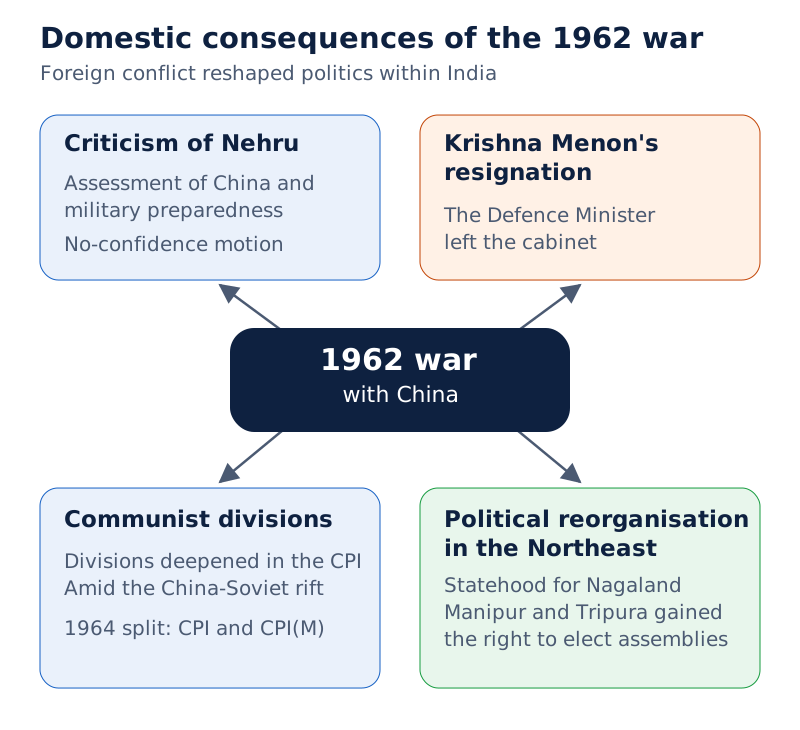
Put the war at the centre and draw branches to criticism of Nehru, Krishna Menon's resignation, communist divisions, and political reorganisation in the Northeast.
Drawn by One Young India.
How did India and Pakistan combine conflict and cooperation up to 1966?
Kashmir and areas of cooperation
Conflict over Jammu and Kashmir began soon after Partition. Fighting involving the two armies broke out in 1947, and the issue was referred to the UN. Pakistan subsequently became important in India's relations with both the US and China.
Hostility did not prevent all cooperation. The governments worked to return women abducted during Partition to their original families. They also negotiated over shared river waters, showing that specific practical problems could be addressed despite wider disagreement.
World Bank mediation helped resolve a long-running water dispute. Nehru and General Ayub Khan signed the Indus Waters Treaty in 1960. This provides a historical example of negotiated cooperation within an otherwise troubled relationship.
The 1965 war and Tashkent
In April 1965, Pakistan launched armed attacks in the Rann of Kutch in Gujarat. A larger offensive in Jammu and Kashmir followed in August and September. Pakistani rulers expected support from the local population, but that expectation was not fulfilled.
Prime Minister Lal Bahadur Shastri ordered a counter-offensive across the Punjab border to reduce pressure on the Kashmir front. Indian forces reached close to Lahore. UN intervention brought the fighting to an end.
| Agreement | Participants and date | Context |
|---|---|---|
| Indus Waters Treaty | Nehru and Ayub Khan, 1960 | World Bank mediation over river-water sharing. |
| Tashkent Agreement | Shastri and Ayub Khan, January 1966 | Soviet mediation after the 1965 war. |
Although India inflicted considerable military losses on Pakistan, the war worsened an already difficult economic situation. Its outcome must therefore be understood in both military and economic terms. Defence demands placed additional pressure on resources needed for development.
The sequence also distinguishes the roles of international institutions and powers: the World Bank mediated the water dispute, the UN helped end the 1965 hostilities, and the Soviet Union brokered the Tashkent Agreement.
How did the Bangladesh crisis lead to war in 1971?
Democratic conflict and refugees
Pakistan's 1970 general election exposed a deep division. Zulfikar Ali Bhutto's party won in West Pakistan, while Sheikh Mujib-ur Rahman's Awami League swept East Pakistan. Bengali voters protested against years of treatment as second-class citizens.
The rulers based in West Pakistan refused to accept the democratic verdict or the Awami League's demand for a federation. In early 1971 the army arrested Sheikh Mujib and began severe repression in East Pakistan. A struggle for Bangladesh's liberation followed.
About 80 lakh refugees fled East Pakistan and took shelter in neighbouring Indian areas during 1971. India gave moral and material support to the liberation movement. Pakistan accused India of seeking to break up the country.
The international alignment
The US and China supported Pakistan. Their improving relations affected the regional balance. Henry Kissinger, adviser to US President Richard Nixon, travelled secretly to China through Pakistan in July 1971.
To counter the US-Pakistan-China alignment, India signed a 20-year Treaty of Peace and Friendship with the Soviet Union in August 1971. It assured Soviet support if India faced an attack. The treaty also raised debate about India's distance from the rival blocs.
War, surrender and peace
- After months of tension and military preparations, full-scale war began in December 1971.
- Pakistani aircraft attacked Punjab and Rajasthan, while its army advanced on the Jammu and Kashmir front.
- India responded with coordinated air force, navy and army operations on the western and eastern fronts.
- With local support, Indian forces advanced rapidly in East Pakistan and surrounded Dhaka from three sides within ten days.
- About 90,000 Pakistani military personnel surrendered. Bangladesh became independent, and India announced a unilateral ceasefire.
The Shimla Agreement, signed by Indira Gandhi and Zulfikar Ali Bhutto on 3 July 1972, formalised the return of peace. The 1971 friendship treaty and the 1972 peace agreement had different partners, purposes and contexts.
Victory produced national celebration and strengthened confidence in India's military capacity. Indira Gandhi had already won the 1971 Lok Sabha election; the war increased her popularity further. Subsequent assembly elections brought large Congress majorities in many states.
Diagram
The Bangladesh crisis and its consequences
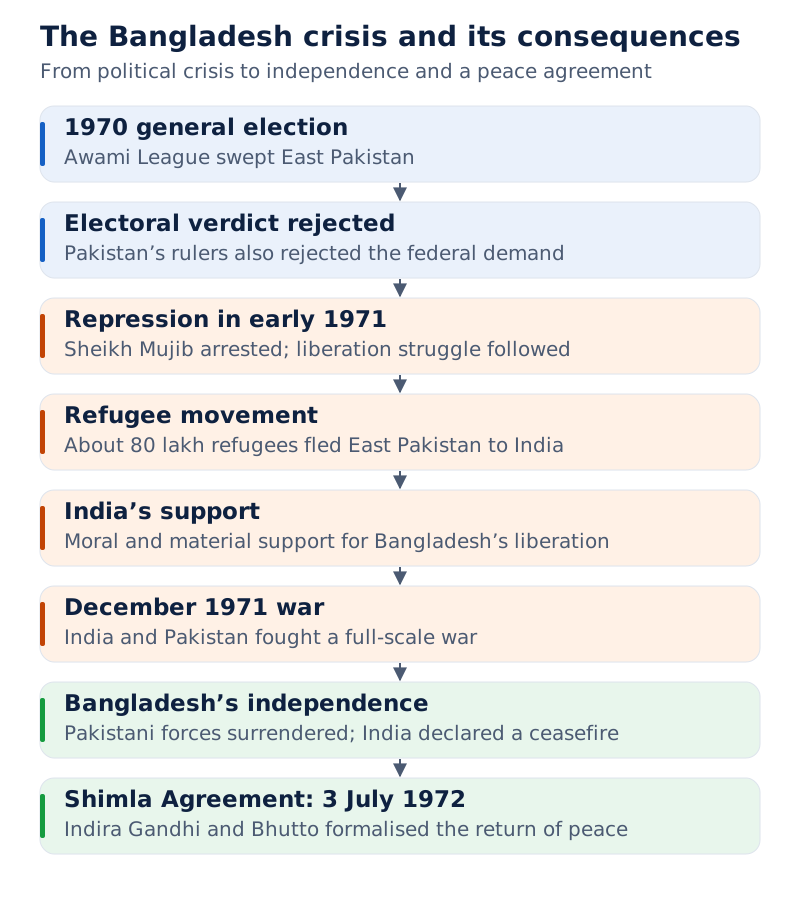
Link the 1970 election, rejection of its verdict, repression, refugee movement, India's support, the December 1971 war and Bangladesh's independence. Add the Shimla Agreement as the later step towards peace.
Drawn by One Young India.
How did wars change the balance between defence and development?
Pressure on limited resources
India had begun development planning with limited resources. Wars with neighbouring countries disrupted those priorities. After 1962, military modernisation required resources that might otherwise have supported development, and defence expenditure increased considerably.
The Department of Defence Production was established in November 1962. The Department of Defence Supplies followed in November 1965. These institutional changes reflected the effort to improve defence capacity after the experience of war.
| Development | Date or period | Connection with policy |
|---|---|---|
| Third Five-Year Plan | 1961 to 1966 | Conflicts disrupted planned development. |
| Three Annual Plans | After the Third Plan | Annual planning followed the disrupted five-year programme. |
| Fourth Five-Year Plan | Began in 1969 | The next five-year plan could begin only after the intervening Annual Plans. |
Different political consequences
The wars did not have identical domestic effects. The 1962 defeat weakened confidence in Nehru's judgement. The 1965 war imposed further economic strain, while the 1971 victory strengthened Indira Gandhi's popularity and produced widespread celebration.
These contrasting outcomes illustrate the two-way relationship between domestic and external politics. Domestic resources and political leadership shaped foreign policy, while war affected leadership, public confidence, institutions and economic planning.
Peace and security were therefore connected to development. A government pursuing economic progress needed a peaceful setting, but threats from neighbours could force greater defence expenditure. The tension arose from India's limited resources and its need to protect national interests.
How did India's nuclear policy develop?
Peaceful energy and opposition to discrimination
India's nuclear programme began in the late 1940s under Homi J. Bhabha's guidance. Nehru regarded science and technology as essential to building a modern country. He supported atomic energy for peaceful purposes and urged comprehensive nuclear disarmament.
China tested nuclear weapons in October 1964. The Nuclear Non-Proliferation Treaty (NPT) of 1968 subsequently became a major issue. India considered the treaty discriminatory because the international non-proliferation framework preserved the position of established nuclear powers while restricting others.
India conducted its first nuclear explosion in May 1974, describing it as peaceful. It maintained that nuclear energy should serve peaceful purposes. This position must be distinguished from the later tests demonstrating a military nuclear capability.
The 1974 test occurred during domestic economic difficulty. After the Arab-Israel War of 1973, sharp increases in oil prices produced an international Oil Shock. India experienced high inflation and political agitation, including a nationwide railway strike.
Later tests and nuclear doctrine
India opposed the indefinite extension of the NPT in 1995 and refused to sign the Comprehensive Test Ban Treaty (CTBT). Its objection concerned selective restrictions on non-nuclear states and the preservation of the existing powers' nuclear monopoly.
In May 1998, India conducted a series of nuclear tests demonstrating military capability. Pakistan soon followed. International criticism and sanctions affected both countries, although the sanctions were subsequently waived. The tests increased the region's vulnerability to a nuclear exchange.
| Aspect | Position |
|---|---|
| Early nuclear programme | Develop atomic energy for peaceful uses and national modernisation. |
| Objection to non-proliferation treaties | Oppose discriminatory rules protecting an established nuclear monopoly. |
| Nuclear deterrence | Maintain credible minimum nuclear deterrence. |
| First use | Profess a policy of no first use. |
| Disarmament objective | Support global, verifiable and non-discriminatory nuclear disarmament. |
No first use means not initiating the use of nuclear weapons. The stated doctrine combines minimum credible deterrence with commitment to a nuclear-weapon-free world. Deterrence and disarmament are therefore both necessary parts of an account of India's nuclear policy.
What continuity and change appeared in India's later external relations?
Changing relations with major powers
Full diplomatic relations with China were restored in 1976. Atal Behari Vajpayee visited China as External Affairs Minister in 1979. Rajiv Gandhi later became the first Prime Minister after Nehru to visit China, and greater attention was given to trade relations.
The Janata Party government of 1977 promised genuine non-alignment, indicating an intention to correct the perceived pro-Soviet tilt. Congress and non-Congress governments subsequently pursued better relations with China and closer ties with the US.
After 1990, Russia remained an important friend but no longer enjoyed its earlier global pre-eminence. India's policy moved towards closer US relations. The international situation was more influenced by economic interests than by military interests, which also affected India's foreign policy choices.
Kargil and the limits of peace efforts
In early 1999, forces claiming to be Mujahideens occupied points on India's side of the Line of Control (LoC) in the Mashkoh, Dras, Kaksar and Batalik areas. Indian forces responded, suspecting Pakistan Army involvement.
The Kargil conflict continued through May and June. By 26 July 1999, India had recovered many lost positions. The fighting remained confined to Kargil, but attracted worldwide attention because both countries had demonstrated nuclear capability the previous year.
In Pakistan, allegations that the Prime Minister had been kept uninformed by the Army Chief produced controversy. Soon afterwards, the army under General Parvez Musharraf took over the government.
Broad agreement amid disagreement
Indian parties have differed over the handling of external relations, particularly relations with Pakistan and the US. Nevertheless, a broad foreign policy consensus has generally existed on national integration, the protection of international boundaries and national interests.
Foreign policy has consequently played a relatively limited role in party competition. Changes of government have brought shifts of emphasis, but the continuing pursuit of national interests links policies across different periods.
Glossary
- Foreign policy — A country's approach to external relations, shaped by domestic needs, international conditions and national interests.
- Sovereignty — A country's independence in making its own decisions, including decisions about its external relations.
- Territorial integrity — Protection of a country's territory and boundaries against threats to its unity.
- Non-alignment — Avoiding attachment to rival military blocs while making independent judgements and maintaining international relations.
- Cold War — Global political, economic and military confrontation between the blocs led by the US and Soviet Union.
- Decolonisation — The process through which countries gained freedom from colonial rule and became independent states.
- Panchsheel — Five Principles of Peaceful Coexistence jointly announced by Nehru and Zhou Enlai in April 1954.
- Political asylum — Protection in another country, sought and received by the Dalai Lama in India in 1959.
- Unilateral ceasefire — A decision by one side to stop fighting, as illustrated by China's announcement in 1962.
- Nuclear non-proliferation — Efforts to prevent the spread of nuclear weapons to additional countries through international restrictions.
- No first use — A nuclear policy professing that a country will not initiate the use of nuclear weapons.
- Nuclear disarmament — Removal of nuclear weapons, with India supporting a global, verifiable and non-discriminatory approach.
- Foreign policy consensus — Broad agreement among political parties on national integration, international boundaries and questions of national interest.
Common errors and misconceptions
- Misconception: Non-alignment meant avoiding international affairs. Correct: India participated in UN peacekeeping, promoted Afro-Asian cooperation and took positions on international disputes.
- Misconception: Non-alignment prevented assistance from either bloc. Correct: India obtained assistance from members of both blocs while seeking independent judgement.
- Misconception: India and China were hostile from the beginning. Correct: Early friendship included recognition of Communist China and the joint announcement of Panchsheel.
- Misconception: Bandung hosted the first NAM summit. Correct: Bandung hosted the Afro-Asian conference in 1955; the first NAM summit took place in Belgrade in September 1961.
- Misconception: The Tashkent and Shimla agreements followed the same war. Correct: Tashkent followed the 1965 war; Shimla followed the 1971 war.
- Misconception: India's first nuclear test occurred in 1998. Correct: The first explosion was in May 1974; the May 1998 tests demonstrated military nuclear capability.
- Misconception: The Bangladesh crisis began solely as an India-Pakistan territorial dispute. Correct: It arose from Pakistan's political crisis, rejection of the electoral verdict and repression in East Pakistan.
- Misconception: Foreign policy consensus means all parties agree on every decision. Correct: Broad agreement on national interests coexists with disagreement over particular policies and relationships.
Exam-style questions with model answers
Q1. India avoided rival military alliances, received assistance from both blocs and contributed to UN peacekeeping. Using these facts, explain why non-alignment did not mean isolation. [2 marks]
- India's avoidance of military alliances preserved independent decision-making rather than ending its external relations.
- Assistance from both blocs and participation in UN peacekeeping demonstrate active international cooperation without membership of either rival alliance.
Q2. Article 51 encourages international peace, just relations between nations, respect for international law and treaties, and arbitration of disputes. Identify two ways these provisions support peaceful external relations. [2 marks]
- Respect for international law and treaty obligations encourages countries to honour accepted commitments in their dealings.
- Arbitration offers a peaceful means of settling international disputes, supporting the wider objective of international peace and security.
Q3. India recognised Communist China after 1949, jointly announced Panchsheel, the Five Principles of Peaceful Coexistence, in 1954, granted the Dalai Lama asylum in 1959 and disputed Chinese claims over Aksai Chin and the eastern border. Explain the change in relations using these facts. [4 marks]
- India's recognition of the new Chinese government after 1949 showed that relations began on a friendly basis.
- The joint announcement of Panchsheel in 1954 strengthened hopes of peaceful coexistence between India and China.
- India's grant of asylum to the Dalai Lama in 1959 drew strong Chinese protests, making Tibet a source of tension.
- Unresolved competing claims over Aksai Chin and the eastern border created a separate territorial dispute that further strained relations.
Q4. After the 1962 war, Nehru faced criticism over his assessment of China and military preparedness, Defence Minister Krishna Menon resigned, communist divisions deepened and the Northeast underwent political reorganisation. Explain four domestic consequences using these developments. [4 marks]
- Criticism of Nehru weakened confidence in his assessment of China and showed that foreign policy outcomes could affect a leader's standing within India.
- Krishna Menon's resignation connected military failure with ministerial responsibility and changes in the government.
- Deepening communist divisions showed that an external conflict could intensify ideological disagreements within opposition politics.
- Reorganisation in the Northeast showed the connection between border security, national integration and the political arrangements governing a sensitive region.
Q5. The Awami League swept East Pakistan in 1970, but Pakistan's rulers rejected the verdict and federal demand. Repression followed in early 1971; about 80 lakh refugees entered India. India supported Bangladesh's liberation, while the US and China supported Pakistan. India signed a friendship treaty with the Soviet Union in August 1971; interstate war began in December. Explain the domestic, regional and international dimensions of this crisis. [6 marks]
- The domestic crisis in Pakistan concerned democratic representation. Rejecting the Awami League's electoral victory and federal demand prevented a political response to East Pakistan's grievances.
- Repression transformed the dispute into a struggle for liberation. The crisis therefore developed from internal political conflict before becoming an interstate war.
- The movement of about 80 lakh refugees into India gave the crisis a direct regional and humanitarian dimension. Developments inside Pakistan imposed burdens on a neighbouring country.
- India's support for Bangladesh connected its response to the refugee crisis with support for the liberation struggle.
- US and Chinese support for Pakistan added a wider international dimension by bringing major powers into the regional crisis.
- India's August 1971 treaty with the Soviet Union countered the US-Pakistan-China alignment and assured Soviet support if India faced an attack.
Q6. India sought peace and rapid development. After the 1962 war it diverted scarce resources towards military modernisation. Defence departments were established in November 1962 and November 1965. The Third Plan, 1961 to 1966, was disrupted; three Annual Plans followed before the Fourth Plan began in 1969. Explain how these facts illustrate interaction between external security and domestic policy. [6 marks]
- India's wish for rapid development made peace an important external objective. Avoiding conflict would help preserve scarce resources for economic progress.
- The security crisis after the 1962 war changed spending priorities. Military modernisation required resources despite the continuing need for development.
- The Department of Defence Production was established in November 1962, showing that the security crisis prompted institutional changes to strengthen defence production.
- The Department of Defence Supplies was established in November 1965, showing that strengthening defence also required attention to military supplies.
- Disruption of the Third Plan demonstrates that wars affected economic planning as well as military policy. Domestic programmes could not proceed independently of the security environment.
- The three Annual Plans and the Fourth Plan's start in 1969 illustrate the effect on the planning sequence. Together, these developments show that domestic aims influenced foreign policy, while external conflict reshaped domestic choices.
Q7. India's programme began with peaceful atomic energy for scientific modernisation under Homi J. Bhabha. It described its May 1974 explosion as peaceful, opposed discriminatory non-proliferation rules, and demonstrated military capability in May 1998. Its doctrine combines credible minimum deterrence, no first use and global, verifiable, non-discriminatory disarmament. Explain the main elements and evolution of this policy. [6 marks]
- The early programme linked atomic energy with peaceful development and scientific modernisation under Homi J. Bhabha's guidance.
- The description of the May 1974 explosion as peaceful reflected the emphasis placed on peaceful nuclear uses at that stage.
- Opposition to discriminatory non-proliferation rules concerned unequal treatment between established nuclear powers and countries denied similar capabilities.
- The May 1998 tests demonstrated military nuclear capability, marking a distinction from the earlier public emphasis on a peaceful explosion.
- Credible minimum deterrence describes the security element of the doctrine, while no first use states that India would not initiate nuclear use.
- The commitment to global, verifiable and non-discriminatory disarmament retains the objective of a nuclear-weapon-free world. The policy therefore combines security concerns with opposition to discriminatory arrangements and support for disarmament.
Q8. Nehru and Ayub Khan signed the Indus Waters Treaty in 1960 after World Bank mediation. Shastri and Ayub Khan signed the Soviet-brokered Tashkent Agreement in January 1966 after the 1965 war. Indira Gandhi and Bhutto signed the Shimla Agreement on 3 July 1972 after the 1971 war. Distinguish these agreements and explain what they reveal about diplomacy. [4 marks]
- The Indus Waters Treaty addressed river-water sharing and illustrates cooperation on a practical problem through World Bank mediation.
- The Tashkent Agreement concerned peace after the 1965 war, with the Soviet Union acting as broker between Shastri and Ayub Khan.
- The Shimla Agreement formalised peace after the 1971 war and involved Indira Gandhi and Bhutto.
- Together, they show that serious conflict did not remove the possibility of negotiation. Their different purposes, participants and dates should not be confused.
Key takeaways
- India's foreign policy reflected the interaction of domestic development needs, independence, Cold War pressures and national interests.
- Nehru pursued sovereignty, territorial integrity and rapid economic development through a policy of non-alignment.
- Afro-Asian cooperation connected India's anti-colonial commitments with the Bandung Conference and the emergence of NAM.
- Early friendship with China deteriorated over Tibet and disputed boundaries, culminating in the 1962 war.
- Relations with Pakistan included wars and negotiations, as shown by the Indus Waters Treaty, Tashkent and Shimla.
- The Bangladesh crisis linked Pakistan's internal democratic conflict, refugees, India's response and alignments among major powers.
- Wars affected leadership and domestic politics while diverting scarce resources from development towards defence and military modernisation.
- India's nuclear policy combined peaceful uses, opposition to discrimination, deterrence, no first use and support for disarmament.
Test yourself
What were Nehru's three main foreign policy objectives?
They were preserving sovereignty, protecting territorial integrity and promoting rapid economic development.
What distinguishes the Bandung Conference from the first NAM summit?
Bandung hosted the Afro-Asian conference in 1955. The first NAM summit took place in Belgrade in September 1961.
Who announced Panchsheel, and on what date?
Nehru and Chinese Premier Zhou Enlai jointly announced Panchsheel on 29 April 1954.
Which two broad areas were central to the India-China boundary dispute?
The dispute concerned Aksai Chin in the western sector and much of the area then called NEFA in the east.
Who signed the Tashkent Agreement, and when?
Lal Bahadur Shastri and General Ayub Khan signed the Soviet-brokered agreement in January 1966.
Why did India sign a friendship treaty with the Soviet Union in August 1971?
India sought to counter the US-Pakistan-China alignment and secure Soviet support if it faced an attack.
How did the stated significance of the 1974 and 1998 nuclear tests differ?
India described the May 1974 explosion as peaceful; the May 1998 tests demonstrated military nuclear capability.
Why did Kargil attract particular international attention?
The 1999 conflict occurred only a year after India and Pakistan had demonstrated nuclear capability, increasing international concern.
Try it
India's External Relations | Class 12 Political Science
Test your understanding of India's foreign policy during the Cold War era.
1According to the text, what were Nehru's three major goals for India's foreign policy?
Correct. The text states Nehru's goals were 'to preserve hard-earned sovereignty, to protect territorial integrity, and to promote rapid economic development.' He hoped to achieve these through non-alignment.
Incorrect. The text does not mention military dominance or allying with the Soviet Union. Nehru sought to avoid military alliances entirely.
Incorrect. While India did support anti-colonial movements, the text explicitly states some wanted India to join the US bloc, but Nehru chose non-alignment instead. Poverty reduction was an internal concern, not a foreign policy goal.
2Which event demonstrates that India's non-alignment allowed it to take an independent stand, rather than automatically supporting either Cold War power?
Correct. The text explicitly states: 'When Britain attacked Egypt over the Suez Canal in 1956, India was among the first to condemn the invasion. Yet the following year, when the Soviet Union invaded Hungary, India did not join the international condemnation.' This shows India took independent positions based on its own judgment, not bloc loyalty.
Incorrect. The text states India 'received aid and assistance from members of both blocs,' showing it did accept support while maintaining independence.
Incorrect. The text mentions India 'contributing personnel to UN peacekeeping missions,' but does not say it supported them 'without question.' The text emphasizes India took 'an independent stand on international issues.'