
Industries | ICSE Class 7 Geography Notes
On this page

This note covers the need for industries, industry types, factory locations, stages of production, iron and steel, cotton textiles, information technology, sugar, shipbuilding, fishing, automobiles, important industrial centres, and the prevention of industrial pollution.
What is an industry, and why do we need industries?
Definition: An industry is an economic activity concerned with producing goods, extracting minerals or providing services. Minerals are naturally occurring substances found in the Earth. Economic activities are activities through which people earn a living.
Raw materials are the materials used to make a product. Manufacturing changes raw materials into finished goods that have greater value and usefulness. Cotton becomes cloth, wood becomes paper, and sugarcane provides the raw material for sugar.
How do industries meet daily needs?
Industries supply clothing, paper, sugar, utensils and many other everyday goods. They also make the machines and tools used to produce further goods. The steel used in machinery therefore contributes to production beyond the steel industry itself.
Industry is a wider term than manufacturing. Iron and steel production makes goods, coal mining extracts a mineral, and tourism provides a service. A service is useful work provided to people, rather than a manufactured object.
How do industries support other activities?
Agriculture means growing crops and rearing animals. Agriculture and industry depend on one another. Farms supply raw materials to industries, while industries supply agricultural tools, machines, irrigation pumps and fertilisers. Irrigation means supplying water to crops; fertilisers are substances added to provide plant nutrients.
Manufacturing provides employment outside agriculture. It also supports trade, the buying and selling of goods. Exports, which are goods sold to other countries, bring in foreign exchange, meaning earnings in foreign currencies.
The journey from wood to a notebook shows value addition: processing makes a material more useful and valuable. Paper is a product of one manufacturing activity and a material used in the next. Industries are therefore connected through the goods they make and use.
How do cottage, small-scale and large-scale industries differ?
The size of an industry is judged by its capital, workforce and volume of production. Capital means the money invested in the activity. The workforce consists of the people employed, while volume of production means the quantity of goods produced.
What distinguishes the three sizes?
| Type | Production and organisation | Examples |
|---|---|---|
| Cottage or household industry | Artisans, or skilled craft workers, make goods by hand using simple tools; work can involve family members at home. | Basket weaving and pottery |
| Small-scale industry | Uses less capital and technology than large-scale industry; production can take place in a workshop. | Silk weaving and food processing |
| Large-scale industry | Uses large capital investment, advanced technology and specialised workers to produce large quantities. | Automobiles (road vehicles) and heavy machinery |
In household production, artisans use local materials and simple tools to make everyday articles. Products may be used by the household, sold in local markets, where buyers and sellers exchange goods, or exchanged through barter, the exchange of goods without money.
Cottage industries are a type of small-scale industry. Small-scale manufacturing outside the home can use simple power-driven machines and workers with some training. It provides employment and increases local purchasing power, meaning people's ability to buy goods.
Large-scale manufacturing requires a large market, considerable energy and advanced production methods. Mass production means making goods in large quantities. In an assembly line, a product passes through a sequence of tasks as workers or machines add or fit its parts.
Note: Size describes investment, employment and production. It does not describe the source of the raw material. A cloth-making industry can be classified by its raw material as well as by its scale.
Compare industries using the same basis. If the question concerns size, discuss capital, workers, tools and goods produced. If it concerns raw materials, identify what the industry uses. These are different ways of examining the same productive activity.
How are industries classified by their raw materials?
Classification means grouping things by a shared feature. Industries can be grouped according to the source of their raw materials. Agro-based industries use plant and animal products, mineral-based industries use mineral ores, materials from which metals can be extracted, marine-based industries use sea products, and forest-based industries use forest produce.
Which materials supply which industries?
| Group | Raw-material source | Examples of industries |
|---|---|---|
| Agro-based | Products from plants and animals | Cotton textiles (cloth), sugar, vegetable oil and dairy products |
| Mineral-based | Mineral ores, from which metals can be extracted | Iron and steel |
| Marine-based | Products obtained from seas and oceans | Seafood processing and fish oil |
| Forest-based | Materials obtained from forests | Pulp (prepared wood material for paper), paper and furniture |
Cotton textiles and sugar show the connection between farming and industry. Cotton supplies fibre for making yarn and cloth. Sugarcane supplies the raw material for sugar. A textile is fabric or cloth, and yarn is a continuous thread used to make it.
Agro-based does not mean that the industry grows its own crops. The classification identifies the origin of its materials. The factory processes farm produce into another form, while farming supplies the material that enters the factory.
The product of a mineral-based industry can become another industry's raw material. Iron obtained from iron ore is used to make heavy machinery, building materials and railway coaches. This helps explain why industrial activities are linked rather than isolated.
Keep the source and the finished product distinct. Wood is the starting material for paper manufacture, while paper is the finished product of that activity. Paper can then enter notebook production. The label depends on which industrial activity is being examined.
Which factors influence the location of an industry?
Industrial location means the place where an industry is established. Localisation means the concentration of an industry in particular places.
Why must a location combine several advantages?
Labour is the human work used in production. Power supplies energy for industrial operations. A market consists of buyers who need the goods and have the ability to purchase them. Together with raw materials, land, water, capital and transport, these factors affect the choice of site. Different industries combine these requirements in different ways.
| Factor | Reason it matters |
|---|---|
| Raw materials | Factories need supplies; moving bulky materials can involve high transport costs. |
| Land and water | Land provides a site, while water is required by industrial processes. |
| Labour and capital | Production requires workers and investment in the industrial activity. |
| Power | Energy is needed to operate machinery and carry out production. |
| Transport and communication | Transport moves materials and goods; communication allows the exchange of information. |
| Market | Finished products need buyers, and access to them influences location. |
Industries are situated where some or all of these factors are easily available. A nearby raw material is an advantage, but it is not the entire explanation. A factory also needs ways to obtain other supplies and distribute its finished goods.
Materials that are bulky or quickly lose their usefulness favour processing close to their source. Sugarcane is bulky, and its sugar content decreases during transport. Steel production also involves heavy materials and finished products, making transport an important consideration.
How do government support and nearby industries help?
Sometimes governments provide incentives, meaning support intended to encourage investment. These can include cheaper power, lower transport costs and infrastructure, the supporting facilities such as transport and power supply that an industry needs.
An industrial region develops when industries locate close together and share the benefits of that closeness. Industrialisation, the development of industries, often leads to the growth of towns and cities. It should not be treated as an identical process in every location.
How does an industrial system turn materials into products?
An industrial system connects inputs, processes and outputs. Inputs are the resources and costs involved in production. Processes are the activities that transform materials. Outputs are the resulting goods and the income earned from them.
What happens in cotton textile production?
Cotton textile inputs may include cotton, human labour, factory costs and transport costs. Ginning separates cotton fibres from seeds. Spinning turns fibres into yarn, and weaving interlaces yarns to make cloth. Dyeing colours material, while printing adds patterns.
- Ginning: separate the cotton fibres from the seeds so the fibres can be prepared for further processing.
- Spinning: turn the fibres into yarn, the thread used in the next stage of cloth production.
- Weaving: interlace yarns to produce fabric, changing thread into a material suitable for clothing.
- Dyeing and printing: colour and decorate the fabric before it is made into finished clothing.
Tailoring and sewing turn cloth into garments such as a shirt. The shirt is the final product in this example. The complete journey connects agricultural production, factory processing and the preparation of clothing for use.
How does the notebook example show linked processes?
Wood is processed into pulp, the prepared wood material used to make paper. Chemicals and machines help turn pulp into paper. Lines are printed on the paper; pages are then bound into notebooks, packed and sent to markets.
Do not put workers or transport costs in the output category. They are inputs needed to make the product. Similarly, weaving is a process, while cloth is its product. Keeping these categories separate makes a production chain easier to explain.
Why is iron and steel important, and how has its location changed?
Iron and steel is a feeder industry, meaning that its products provide materials for other industries. Steel supplies machinery, building materials and transport equipment. It is often called the backbone of modern industry because so many activities depend on it.
What enters and leaves a steel plant?
Inputs include iron ore, coal, limestone, labour, capital, a site and supporting facilities. A blast furnace is a furnace in which iron ore is processed at high temperature with a blast of air. Smelting extracts metals from their ores by heating beyond the melting point.
The materials pass through smelting and further refining, or treatment to improve the metal, before steel is obtained. Steel may then become another industry's raw material. Ships, trains, trucks and cars are made largely of steel; farm machines are mostly steel.
How did transport change suitable locations?
| Period | Favourable location | Connection with production |
|---|---|---|
| Before 1800 | Near raw materials, power supplies and running water | Access to the main requirements of production |
| 1800 to 1950 | Near coalfields, canals and railways | Access to fuel and routes for moving materials |
| Since 1950 | Large areas of flat land near seaports | Space for very large steel works and access to imported iron ore |
These changes show why the best location can change as transport and production change. They do not mean every plant moved at the same time. After 1950, the industry began locating near seaports as steel works became very large and ore was imported overseas.
What the figure shows
Changing steel-industry locations
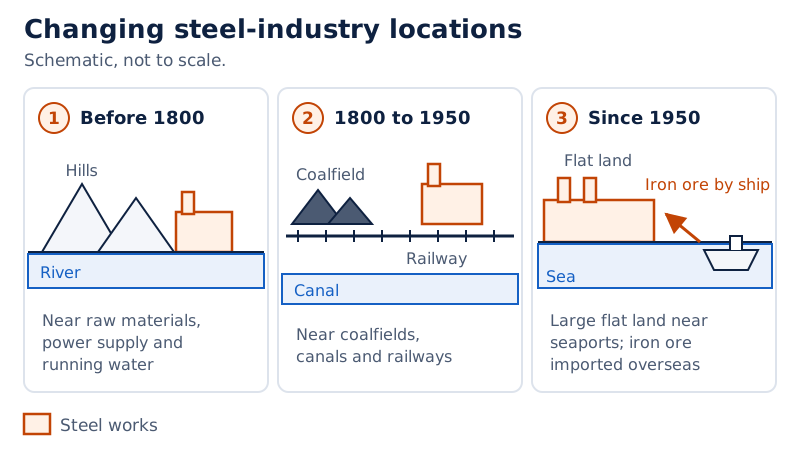
The drawing places the earliest location near hills and a river, a later works beside a railway, and a coastal works beside a ship. Its labels distinguish before 1800, 1800 to 1950, and since 1950.
Drawn by One Young India.
What do the Jamshedpur and Pittsburgh case studies show?
These steel centres show how several locational advantages work together. They also show that access to a raw material does not necessarily mean that every raw material is available beside the factory. Effective transport can connect a plant with distant supplies.
Case study: Why did Jamshedpur develop as a steel centre?
The Tata Iron and Steel Company Limited, abbreviated here as TISCO, was established in 1907 at Sakchi in Jharkhand. Sakchi was later renamed Jamshedpur. The site is near the meeting of the Kharkai and Subarnarekha rivers, which supplied water.
Sakchi was close to deposits of iron ore, coal and manganese, a metal used in steelmaking. Kolkata provided a large market. Coal came from Jharia, while Odisha and Chhattisgarh supplied iron ore and other mineral materials. Railway access helped connect these requirements.
Case study: Why did Pittsburgh develop as a steel centre?
Pittsburgh is an important steel centre in the United States of America. Some raw materials, such as coal, are available locally. Iron ore comes from Minnesota, with the Great Lakes waterway and railways forming a route for bringing it to the Pittsburgh area.
The Ohio, Monongahela and Allegheny rivers provide water. Very few of the large steel mills are in Pittsburgh itself; mills are located in nearby river valleys. Finished steel reaches markets by land and water, and other factories use steel to make machinery and railway equipment.
In the comparison below, km means kilometre, a unit of distance equal to 1,000 metres. The distances describe different links in each centre's supply network.
| Locational feature | Jamshedpur | Pittsburgh |
|---|---|---|
| Distance example | Sakchi was only 32 km from Kalimati railway station. | Minnesota iron mines are about 1500 km from Pittsburgh. |
| Transport connection | Bengal-Nagpur railway line | Great Lakes waterway followed by rail transport |
| Water supply | Kharkai and Subarnarekha rivers | Ohio, Monongahela and Allegheny rivers |
What the figure shows
Jamshedpur's steel works and transport links
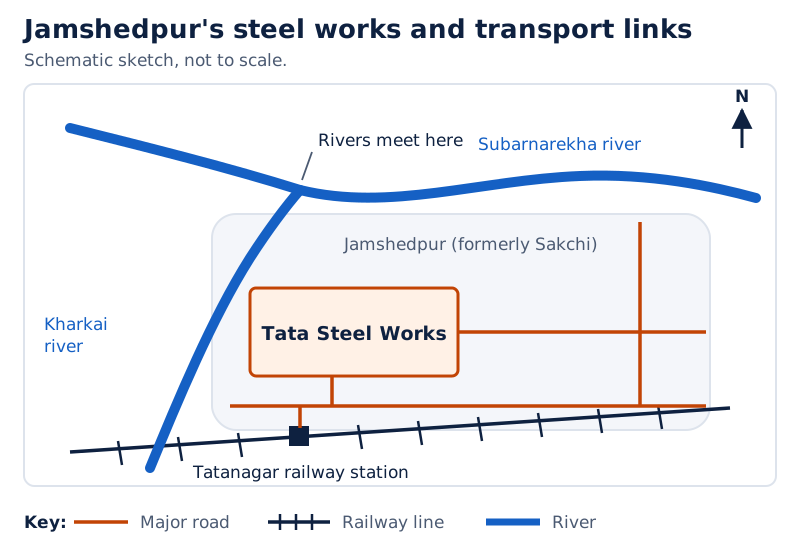
The sketch shows Tata Steel Works near the rivers, with roads and Tatanagar railway station nearby. The key distinguishes major roads from the railway, and an arrow shows north.
Drawn by One Young India.
The comparison links resources with movement. Jamshedpur combines nearby mineral supplies, water and railway access. Pittsburgh combines local coal with a route for distant ore. Both cases support an explanation based on several factors acting together.
How do cotton textiles and sugar depend on agriculture?
Cotton textiles and sugar are agro-based industries because they process agricultural materials. Cotton supplies fibre for cloth, while sugarcane supplies sugar. Their industrial locations therefore need to be understood in relation to farming as well as labour, transport and markets.
Why did cotton textiles develop in western India?
In its early years, India's cotton textile industry was concentrated in the cotton-growing belt of Maharashtra and Gujarat. Raw cotton, markets, transport, accessible ports, labour and a moist climate contributed to this concentration. Mumbai is an important cotton textile centre.
The industry supports work in cotton growing and picking, ginning, spinning, weaving, dyeing, designing, packaging, tailoring and sewing. It also creates demand for chemicals, dyes, packaging materials and engineering products. Its connections therefore extend beyond the production of cloth itself.
Weaving takes place on handlooms, powerlooms and in mills. A loom is a device for weaving cloth; a handloom is operated by hand, while a powerloom uses mechanical power. Khadi, handwoven cloth made from handspun yarn, provides employment to weavers in their homes.
Why does sugar manufacture favour access to sugarcane?
Sugarcane is bulky, and its sucrose, or sugar, content decreases during transport. The sugar industry is seasonal, meaning its production is linked to a particular season. These features make the supply of cane a central concern in choosing a location.
Sugar mills are found in Uttar Pradesh, Bihar, Maharashtra, Karnataka, Tamil Nadu, Andhra Pradesh, Gujarat, Punjab, Haryana and Madhya Pradesh. These are producing areas to recognise on a map of India; they should not be confused with individual factory sites.
The comparison is useful: both industries rely on crops, but their locational explanations are not identical. Cotton textiles show the combined influence of cotton supplies, labour, climate, ports and markets. Sugar manufacture has a particularly close connection with bulky cane that loses sugar content during transport.
What does the information technology industry provide?
Information technology, abbreviated as IT, uses computers and related systems to store, process and communicate information. Its activities include producing computer software and providing services based on information. Software means the programs or instructions used by computers.
How is IT linked with electronics?
Hardware is the physical equipment used in a computer system. Electronics manufacturing supplies products such as computers and telephones. IT and electronics are connected, but a computer as a physical product is different from the software running on it.
The IT industry provides a useful contrast with industries that process bulky raw materials. Its work involves information and computer systems. It demonstrates why the word industry includes services as well as the manufacture of objects such as cloth, sugar or steel.
Which centres are important?
Important IT hubs include Silicon Valley in central California in the United States of America and the Bengaluru region of India, also known as Bangalore. A hub is a major centre where related activities are concentrated.
Important Indian centres for electronics include Bengaluru, Mumbai, Delhi, Hyderabad, Pune, Chennai, Kolkata, Lucknow and Coimbatore. The development of hardware and software supports the IT industry, and these activities have contributed to employment generation.
When identifying a centre, connect the place with the activity. Bengaluru can be associated with information technology and electronics. Silicon Valley is an IT centre in California. A location answer becomes clearer when it includes the region or country rather than an isolated place name.
How do shipbuilding, fishing and automobile industries differ?
These activities meet different needs. Shipbuilding constructs ships; fishing catches fish from water bodies; and automobile manufacture produces road vehicles. Their products and working conditions help explain why their locations cannot be understood through one identical rule.
What does shipbuilding require?
A shipyard is a place where ships are built or repaired. Shipbuilding needs access to water so completed ships can be launched. It also requires materials such as steel, machinery, skilled workers and space for construction. Kobe in Japan is an important shipbuilding centre.
Shipbuilding connects with other industries because ships are made largely of steel. It shows the relationship between a feeder industry and an industry using its output. A shipyard constructs the vessel, while the steel industry supplies an important material used in construction.
How is catching fish connected with processing?
Catching fish obtains a natural resource. Processing seafood or manufacturing fish oil turns marine products into industrial products. The distinction matters: catching the resource and processing the catch are connected activities, but they are different stages.
Fishing depends on access to fishing waters. Boats, landing facilities and arrangements for preserving and transporting the catch support the activity. Bergen in Norway is a recognised fishing and fish-trade centre. On a world map, locate Norway in northern Europe.
What does automobile manufacturing produce?
Automobile production makes trucks, buses, cars, motorcycles, scooters and other road vehicles. It is an example of large-scale manufacturing. The industry uses the products of other industries and combines parts to make a finished vehicle.
Indian automobile centres include Delhi, Gurugram, Mumbai, Pune, Chennai, Kolkata, Lucknow, Indore, Hyderabad, Jamshedpur and Bengaluru. Chennai and Pune are useful centres to identify when connecting an industry with a place on a map.
The comparison separates an activity from its setting: a shipyard needs access to water for launching ships; fishing needs access to the resource being caught; automobile manufacturing brings together industrial materials and parts for vehicle production.
Where are important industrial regions and centres located?
An industrial centre is a place where industrial activity is concentrated. An industrial region is a wider area containing related concentrations of industry. Distinguish a particular city, such as Pittsburgh, from a broad region, such as eastern North America.
What broad pattern appears on a world map?
Major industrial regions include eastern North America, western and central Europe, eastern Europe and eastern Asia. Major industrial regions tend to occur in temperate areas, near seaports and especially near coalfields. Temperate areas lie between tropical and polar regions.
What the figure shows
World's industrial regions
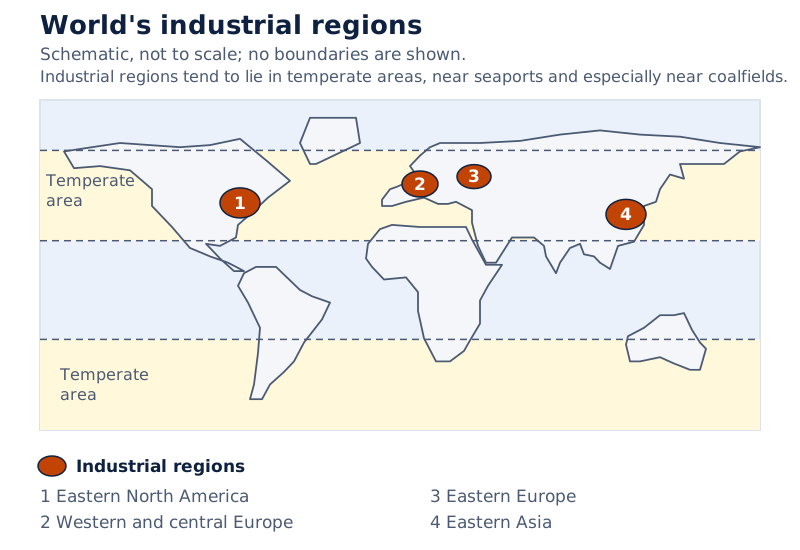
The map uses pale shading for the world industrial belt and dark shading for industrial regions. Dark areas appear across parts of North America, Europe and eastern Asia, with smaller marked regions elsewhere.
Drawn by One Young India.
Which places should be connected with the industries?
| Industry | Centre or producing area | World-map location |
|---|---|---|
| Iron and steel | Jamshedpur; Pittsburgh | India in Asia; United States of America in North America |
| Cotton textiles | Mumbai | Western India in Asia |
| Information technology | Bengaluru; Silicon Valley | Southern India; California in the western United States of America |
| Sugar | Uttar Pradesh; Maharashtra | Northern and western India respectively |
| Shipbuilding | Kobe | Japan in eastern Asia |
| Fishing and fish trade | Bergen | Norway in northern Europe |
| Automobiles | Chennai; Pune | Southern and western India respectively |
For map practice, first locate the country, then the relevant city or producing region. Use an atlas to place the labels accurately. Write the industry beside each place so the map records both its location and its industrial importance.
Some places support several industries. Jamshedpur, for example, is associated with steel and also appears among automobile centres. A map label for one activity should not imply that it is the only activity in that place.
How do industries cause pollution, and how can it be reduced?
Pollution is the contamination or harmful alteration of the environment. Industries can pollute air, water and land and create unwanted noise. Industrial development therefore needs measures that reduce pollution alongside measures that increase production.
How do pollutants reach the environment?
| Type of pollution | Industrial source or pathway | Control measure |
|---|---|---|
| Air | Smoke, dust and undesirable gases from factories | Fit pollution-control equipment to factory chimneys to reduce particles. |
| Water | Industrial wastes and hot water discharged into water bodies | Treat waste liquids and cool hot water before discharge. |
| Land | Dumped industrial wastes, chemicals and packaging | Reduce waste generation and improve waste management. |
| Noise | Machinery, generators and other industrial equipment | Use noise-reducing devices, quieter equipment and noise-absorbing materials. |
Effluents are liquid wastes discharged from an industrial activity. They can carry dyes, acids, salts and other harmful substances into rivers. Land and water pollution are connected because rainwater can carry pollutants from dumped waste into soil and groundwater.
Thermal pollution occurs when factories or power plants discharge hot water into rivers and ponds before it has cooled. Particulate matter means small solid or liquid particles carried in the air, such as dust and droplets.
Which preventive measures are useful?
Factories can reuse and recycle process water, harvest rainwater, and treat effluents before release. Rainwater harvesting means collecting rainwater for use. Filters and other control equipment reduce particles released through chimneys. Using oil or gas instead of coal can reduce smoke.
Generators should have silencers, devices that reduce noise. Almost all machinery can be redesigned to improve energy efficiency and reduce noise. Noise-absorbing material may be used, while workers can use ear protection. Reducing waste at its source also helps limit the burden of disposal.
How can industrial accidents be made less likely or less harmful?
Hazardous substances are materials that can cause harm. Densely populated residential areas should be separated from industrial areas. Nearby residents should know about stored hazardous substances and their possible effects. Fire-warning and firefighting systems should be improved, and storage of toxic, or poisonous, substances should be limited.
Sustainable development brings economic development together with environmental concerns. The aim is to meet needs while reducing environmental damage. Providing useful goods and employment does not remove the responsibility to protect the air, water and land on which people depend.
Glossary
- Industry — An economic activity involving the production of goods, extraction of minerals or provision of services.
- Manufacturing — The transformation of raw materials into finished goods with greater value and usefulness.
- Raw materials — Materials used as the starting inputs for making an industrial product.
- Capital — Money invested in an industry to establish and support its productive activities.
- Cottage industry — Small-scale production in which artisans make goods by hand using simple tools.
- Agro-based industry — An industry that uses plant or animal products as its raw materials.
- Mineral-based industry — An industry using mineral ores as raw materials to produce useful industrial goods.
- Industrial localisation — The concentration of an industry in particular places because of locational advantages.
- Infrastructure — Supporting facilities, including transport and power supply, needed for an industry to operate.
- Industrial system — The connected inputs, processes and outputs through which an industrial activity operates.
- Feeder industry — An industry whose products are used as raw materials by other industries.
- Information technology — The use of computers and related systems to store, process and communicate information.
- Effluents — Liquid wastes discharged by industrial activities that can carry harmful substances into water bodies.
- Thermal pollution — Pollution caused when hot water enters water bodies from factories or power plants before cooling.
- Sustainable development — Development that brings economic progress together with concern for the environment.
Common errors and misconceptions
- Misconception: Industry means only a large factory. Correct: Industry includes producing goods, extracting minerals and providing services; cottage production is also industrial activity.
- Misconception: Cottage and large-scale industries use the same amount of capital and technology. Correct: Cottage industries use simple tools and hand production; large-scale industries use much greater investment and advanced technology.
- Misconception: Agro-based and small-scale mean the same thing. Correct: Agro-based identifies the source of raw materials, while small-scale describes the scale of an industry's operations.
- Misconception: Every raw material must be next to a factory. Correct: Transport can bring distant supplies. Pittsburgh receives iron ore from Minnesota through water and rail connections.
- Misconception: A cotton factory's workers and weaving are outputs. Correct: Workers provide an input, weaving is a process, and cloth is a product of that process.
- Misconception: Steel is only useful for making large machines. Correct: Its uses include safety pins and needles as well as machinery, transport equipment and building frameworks.
- Misconception: Industrial pollution means only visible smoke. Correct: Industries can also pollute water and land, create harmful noise and cause thermal pollution through hot-water discharge.
- Misconception: Catching fish and manufacturing fish oil are the same stage. Correct: Catching obtains the resource; fish-oil manufacture processes a marine raw material into another product.
Exam-style questions with model answers
Q1. Industry is an economic activity that includes producing goods, extracting minerals and providing services. Manufacturing transforms raw materials into more useful and valuable goods. Using this information, state the meaning of industry and explain manufacturing. [2 marks]
- An industry is an economic activity concerned with producing goods, extracting minerals or providing services.
- Manufacturing changes raw materials into finished goods that have greater usefulness and value.
Q2. Cottage producers are artisans who make pottery by hand with simple tools. Small-scale producers use less capital and technology than large-scale producers. Large-scale automobile plants use advanced technology to produce large quantities. Give one distinguishing description of each scale from this information. [3 marks]
- Cottage production involves artisans making goods by hand with simple tools. Pottery is the example given of this kind of production.
- Small-scale production uses comparatively less capital and technology. Its scale must therefore be understood in relation to the larger industrial activity.
- Large-scale production uses advanced technology and makes goods in large quantities. The automobile plant illustrates this scale of industrial production.
Q3. Cotton textile production uses cotton, workers, factory costs and transport costs. Ginning separates fibres from seeds; spinning makes yarn; weaving makes cloth; dyeing and printing colour and decorate it. Tailoring produces a shirt, and its sale earns income. Identify the inputs, the first two processes, the later processes and the outputs. [4 marks]
- The inputs are cotton, human labour, factory costs and transport costs. They provide the resources and expenditure required for production.
- The first processes are ginning, which separates cotton fibres from seeds, and spinning, which turns those fibres into yarn.
- Weaving makes cloth from yarn; dyeing and printing colour and decorate it; tailoring then turns the cloth into a shirt.
- The outputs are the finished shirt and the income earned from its sale. These are the results of the productive activity.
Q4. The steel works at Sakchi had nearby mineral deposits, was only 32 km from Kalimati station on the Bengal-Nagpur railway, had a large market at Kolkata, received water from the Kharkai and Subarnarekha rivers, and later received capital through government initiatives. Here km means kilometre. Explain five locational advantages using these facts. [5 marks]
- Nearby mineral deposits gave the steel works access to raw materials. This was an advantage because materials are essential inputs for production.
- Kalimati station was only 32 km away on the Bengal-Nagpur railway, giving the industrial location access to a railway transport connection.
- Kolkata provided a large market for the industry. Buyers for finished products are an important part of an industry's locational requirements.
- The Kharkai and Subarnarekha rivers supplied water. Their presence therefore helped meet another of the requirements of industrial activity at the site.
- Government initiatives provided capital for later development. This supported the investment needed for the industry to develop beyond its initial establishment.
Q5. Pittsburgh has local coal, receives iron ore from Minnesota about 1500 km away, uses the Great Lakes waterway followed by trains to bring ore, receives water from the Ohio, Monongahela and Allegheny rivers, and sends finished steel to markets by land and water. Here km means kilometre. Explain five features of its location. [5 marks]
- Local coal provides access to one raw material used by the steel industry. The location therefore has a nearby source of this input.
- The iron ore comes from Minnesota, about 1500 km away. This shows that an industrial centre can depend on a distant raw-material source.
- The Great Lakes waterway and trains connect those ore supplies with Pittsburgh. Together they provide the transport link needed to bring in ore.
- The Ohio, Monongahela and Allegheny rivers supply water. These rivers help meet the water requirements of the steel industry in the area.
- Land and water routes carry finished steel to markets. Transport therefore serves the outward movement of products as well as the inward movement of materials.
Q6. Cotton textiles use cotton. Sugar manufacture uses bulky sugarcane whose sucrose, or sugar, content decreases during transport. Both materials come from agriculture. Identify the common industry group, name the raw material for each industry and explain why sugar manufacture benefits from access to cane supplies. [3 marks]
- Both belong to the agro-based group because they use raw materials supplied by agriculture. The classification concerns the origin of their materials.
- Cotton is the raw material for cotton textiles, while sugarcane is the raw material for sugar manufacture. They process different agricultural products.
- Sugar manufacture benefits from access to cane supplies because cane is bulky and loses sucrose during transport. Raw-material location therefore matters to the industry.
Q7. Use these location pairs: Silicon Valley, California, United States of America, information technology (IT); Kobe, Japan, shipbuilding; Bergen, Norway, fishing and fish trade; Chennai, India, automobiles. Write four complete centre-country-industry associations for a world-map key. [4 marks]
- Silicon Valley is an information technology centre in California, in the United States of America. Connect that region with IT in the map key.
- Kobe is a shipbuilding centre in Japan. Its map label should connect the named city and country with the construction of ships.
- Bergen is a fishing and fish-trade centre in Norway. Identify both the place and its associated activity in the map key.
- Chennai is an automobile centre in India. Its label should connect the city with the manufacture of road vehicles.
Q8. A pollution-control checklist contains six measures: reuse and recycle process water; harvest rainwater; treat effluents; cool hot water before discharge; fit particle-control equipment to chimneys; and fit generators with silencers. Effluents are liquid industrial wastes. Explain the action required by each measure without adding further measures. [6 marks]
- Reuse and recycle water already used in processing. The action is to use that water again in industrial operations instead of discarding it after one use.
- Harvest rainwater by collecting it for use. This provides water that can help meet the requirements of industrial activities.
- Treat industrial effluents before releasing them. The factory must process its liquid wastes rather than discharge those wastes untreated.
- Cool hot water before allowing it into a river or pond. The required action addresses the temperature of the industrial discharge.
- Fit particle-control equipment to factory chimneys. This equipment reduces particles released into the air through the industrial smoke outlet.
- Fit silencers to generators. This action addresses the noise produced by the equipment and helps reduce industrial noise pollution.
Key takeaways
- Industry includes producing goods, extracting minerals and providing services; manufacturing transforms materials into more useful products.
- Cottage, small-scale and large-scale industries differ in investment, workers, technology and the quantity of goods produced.
- Agro-based industries use plant or animal materials; cotton textiles and sugar connect agriculture with manufacturing.
- Industrial locations reflect combinations of raw materials, land, water, labour, power, capital, transport and markets.
- An industrial system links inputs, processes and outputs; cotton passes through several processes before becoming a shirt.
- Iron and steel supplies materials for other industries, while the Jamshedpur and Pittsburgh cases show different combinations of locational advantages.
- Match each important centre with its industry and country, and distinguish individual cities from wider producing regions.
- Industries can pollute air, water and land and create noise; prevention includes treatment, recycling and improved equipment.
Test yourself
Why is a notebook an example of value addition?
Wood becomes pulp, pulp becomes paper, and paper becomes a notebook. Processing increases the usefulness and value of the material.
What three features are used to judge an industry's size?
The amount of capital invested, the number of people employed and the volume of production are used to judge its size.
Why is agro-based different from small-scale?
Agro-based describes where raw materials come from; small-scale describes investment, employment and production in comparison with larger industrial activity.
What are inputs, processes and outputs in an industrial system?
Inputs are resources and costs, processes transform the materials, and outputs are the resulting products and income.
Why can a steel centre obtain ore from far away?
Transport can connect distant ore supplies with the plant, as the Great Lakes waterway and railways do for Pittsburgh.
Which two IT hubs are highlighted in this note?
Silicon Valley in central California in the United States of America and Bengaluru, also called Bangalore, in India are important IT hubs.
How does hot-water discharge differ from chemical waste discharge?
Hot-water discharge causes thermal pollution through heat, while chemical wastes introduce harmful substances. Both require control before release into water bodies.
Why is smoke control alone insufficient?
Industries can also cause water, land and noise pollution. Their prevention therefore needs several measures addressing different wastes and industrial activities.
Write about it
Turn a question from this chapter into a paper.
The Writing Studio has a structure guide, a rubric and citation tools for 15 formats, from essays to research papers. Drafting is free with an account. Learnacy Essential adds feedback from an AI writing coach and submission to The OYI Review.
Learnacy Essential is ₹1,499 for the year. Publication depends on review and is not guaranteed.