
Our Environment | CBSE Class 10 Science Notes
On this page
Watch & explore
Start with a few high-quality watches, then dive into the notes below.
This note covers ecosystem components, producers, consumers and decomposers, food chains and food webs, trophic levels, energy flow, biological magnification, ozone formation and depletion, biodegradable and non-biodegradable waste, waste investigations and everyday environmental choices.
What makes an ecosystem, and how do its components interact?
Definition: An ecosystem consists of the interacting organisms in an area together with the non-living constituents of their environment.
An ecosystem includes relationships as well as components. Plants, animals, microorganisms and human beings interact with one another and with their physical surroundings. These interactions help maintain a balance in nature.
How do biotic and abiotic components differ?
Biotic components are the living organisms. Abiotic components are the non-living physical factors, including temperature, rainfall, wind, soil and minerals. An account of an ecosystem must include both groups because organisms' activities are affected by their surroundings.
| Point of comparison | Biotic components | Abiotic components |
|---|---|---|
| Nature | Living organisms | Non-living constituents of the environment |
| Plant examples | Grasses, trees, rose, jasmine and sunflower | Soil and minerals associated with their surroundings |
| Animal examples and surroundings | Frogs, insects and birds | Temperature, rainfall and wind |
| Activities and influences | Organisms grow, reproduce and carry out other activities | Physical factors affect those activities |
| Place in the ecosystem | Interacting living part of the system | Physical surroundings with which organisms interact |
A garden illustrates these relationships. Its grasses, trees and flowering plants occur alongside frogs, insects and birds. Their growth and reproduction are influenced by abiotic conditions. The garden is therefore an ecosystem, rather than merely a collection of plants.
Which ecosystems are natural or artificial?
Forests, ponds and lakes are natural ecosystems. Gardens and crop-fields are human-made, or artificial, ecosystems. The distinction concerns how the ecosystem is established; it does not remove the interactions between organisms and physical surroundings.
When identifying an ecosystem, ask which organisms are present, which physical factors affect them and how the components depend on one another. Listing animals alone leaves out the plants, microorganisms and non-living constituents that also belong to the system.
What can an aquarium teach us about an ecosystem?
An aquarium is a human-made ecosystem that makes environmental relationships easier to examine. Fish need space for swimming, water, oxygen and food. A large jar can provide swimming space, an aerator can supply oxygen and fish food can be supplied separately.
How can an aquarium be planned?
- Provide a suitable container with free space in which the fish can swim.
- Provide water and arrange a supply of oxygen, using an oxygen pump or aerator where needed.
- Provide fish food and consider adding aquatic plants and animals to the system.
- Consider feeding relationships before choosing animals, including whether an animal would eat the others.
- Observe the system over time, including its need for cleaning and what happens to dead plants or fish.
Adding aquatic plants and animals can help create a self-sustaining system. This invites consideration of how different organisms support one another. It does not justify assuming that any aquarium, once assembled, can be left without observation or care.
Food relationships matter when selecting organisms. If an aquatic animal eats others placed with it, the organisms in the aquarium will not remain as they were at the start. The choice of animals therefore affects the relationships within the system.
What questions should observations answer?
Useful questions include why an aquarium needs cleaning from time to time, what happens when fish or plants die, and how its conditions compare with those in ponds and lakes. These questions connect the visible organisms with less visible processes such as decomposition.
The roles of producers, consumers and decomposers can be studied together through this example. A functioning ecosystem depends on their relationships. Supplying food alone does not explain what happens to waste, while studying decomposition alone does not explain how food energy enters the system.
How do producers, consumers and decomposers obtain their sustenance?
Organisms can be grouped according to how they obtain sustenance from their environment. The main groups are producers, consumers and decomposers. Each describes a different role in the movement of food materials through an ecosystem.
How do producers and consumers differ?
Green plants and certain bacteria make food by photosynthesis. Using sunlight in the presence of chlorophyll, they form organic compounds such as sugar and starch from inorganic substances. They are producers because they make food available to other organisms.
Consumers obtain the food produced by other organisms. Some feed directly on producers; others feed on consumers and therefore depend on producers indirectly. Consumers can be classified as herbivores, carnivores, omnivores and parasites.
This direct or indirect dependence is important. An organism need not eat a green plant itself to depend on the food made by plants. Its food may have obtained sustenance from a producer earlier in the chain.
How do decomposers replenish the soil?
Microorganisms such as bacteria and fungi break down dead remains and the waste products of organisms. They convert complex organic substances into simpler inorganic substances. These substances enter the soil and can be used again by plants.
- Dead organisms and waste products provide complex organic material.
- Bacteria and fungi act on this material as decomposers.
- Complex organic substances are broken down into simple inorganic substances.
- The simple substances enter the soil and become available for use by plants again.
Decomposition therefore links the disposal of dead matter with the replenishment of soil. Without this activity, dead remains and waste would accumulate, and the return of these substances to plants would be disrupted.
Note: The reuse of substances after decomposition must be distinguished from energy flow. Substances can become available to plants again, while usable energy diminishes as it passes through trophic levels.
What are food chains and trophic levels?
Definition: A food chain is a series of organisms feeding on one another. Each step or level in that chain is called a trophic level.
A food chain follows a feeding sequence. It connects the organism supplying food with the organism consuming it. Merely placing several organisms in a list does not establish a chain; their feeding relationships must connect them.
How are trophic levels arranged?
| Trophic level | Organisms or feeding group | Role in the sequence |
|---|---|---|
| First | Autotrophs or producers | Capture solar energy and make it available as food |
| Second | Herbivores or primary consumers | Feed on producers |
| Third | Small carnivores or secondary consumers | Feed on primary consumers |
| Fourth | Larger carnivores or tertiary consumers | Feed on secondary consumers |
Autotrophs occupy the first trophic level because they fix solar energy into food. The energy then becomes available to heterotrophs, or consumers. The terms primary, secondary and tertiary describe successive consumer positions in the feeding sequence.
What the figure shows
Food chains in different habitats
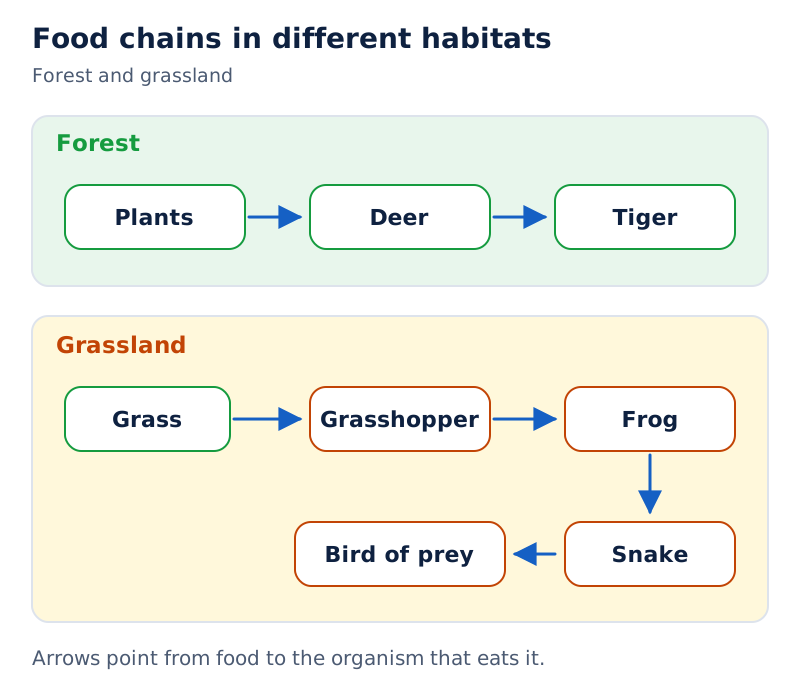
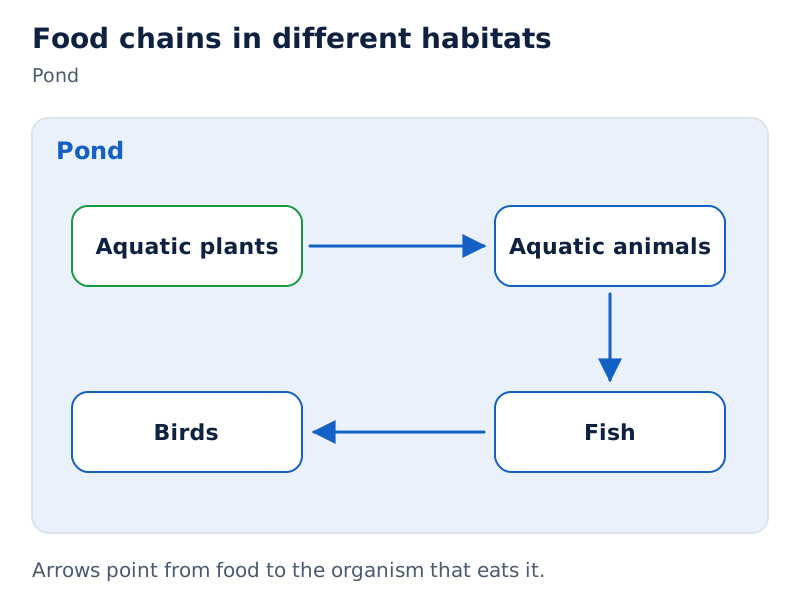
Three illustrated chains are marked as forest, grassland and pond. The forest chain shows plants, a deer and a tiger. The grassland chain includes grass, a grasshopper, a frog, a snake and a bird of prey. Arrows connect successive organisms.
Drawn by One Young India. See Fig. 13.1 in your NCERT textbook
What the figure shows
Trophic levels
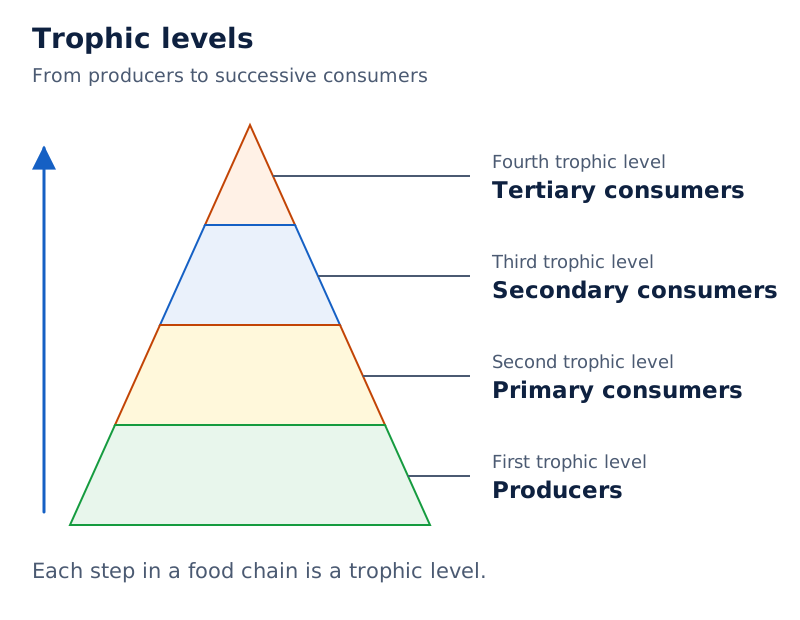
A triangle is divided into four horizontal regions. From the broad base upwards, the labels read Producers, Primary consumers, Secondary consumers and Tertiary consumers.
Drawn by One Young India. See Fig. 13.2 in your NCERT textbook
How should a food-chain example be read?
Consider grass eaten by a goat, followed by the goat being eaten by a human. Grass is the producer at the first level, the goat is the primary consumer at the second, and the human occupies the next consumer position in this particular chain.
The trophic position follows the specified food relationship. Identify the producer first, then follow each feeding step. Do not assign a position simply by the size of an organism or by whether it appears familiar.
Why do food webs represent feeding relationships more fully?
Food chains differ in length and complexity. An organism is generally eaten by two or more kinds of organisms, which may themselves be eaten by several others. Consequently, feeding relationships usually branch instead of forming a single isolated line.
How does a food web differ from a food chain?
A food web represents these branching relationships and consists of many food chains. A food chain follows one sequence of feeding, whereas a food web shows how different feeding sequences connect within an ecosystem.
What the figure shows
Interconnected food chains
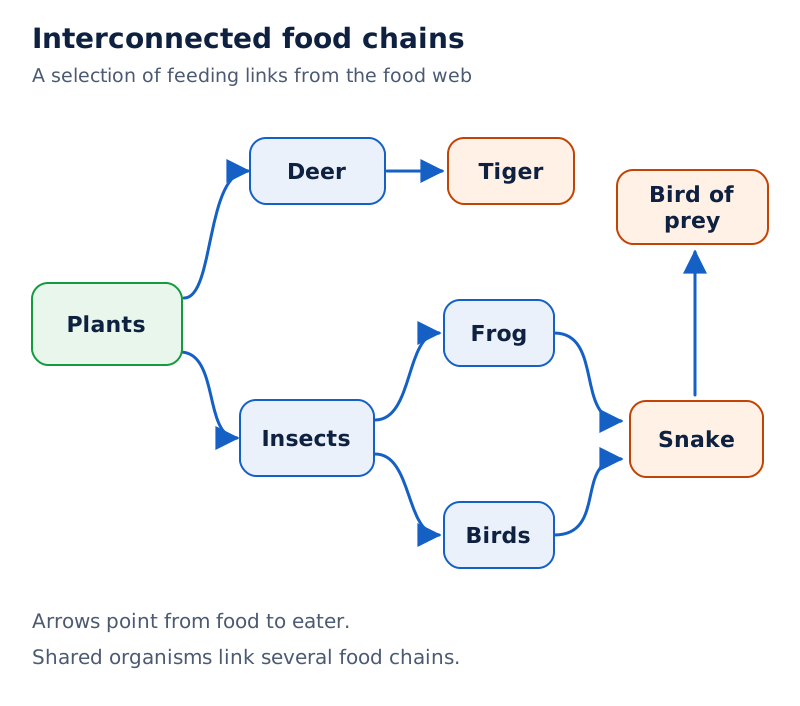
Plants appear towards the bottom of the drawing, with insects, birds and other animals above them. Many arrows branch between organisms, including a tiger near the top. The caption identifies the network as a food web consisting of many food chains.
Drawn by One Young India. See Fig. 13.3 in your NCERT textbook
To interpret such a diagram, trace one connected feeding route and then look for branches. A branch shows why describing the whole ecosystem by one straight food chain would leave out some of its relationships.
Why does removing a trophic level matter?
Because ecosystem components are interdependent, removing organisms at one level affects organisms connected with them. Removing producers interrupts the entry of food energy into the chain. Removing consumers disrupts the feeding links in which those consumers participate.
The exact effects depend on the level removed and the feeding relationships present. The same description cannot be applied mechanically to every removal. What remains common is the loss of connections within the ecosystem.
Food webs help explain why an environmental change can affect more than one food chain. If a shared organism is affected, several connected feeding routes may be affected too. This follows from the web's structure, rather than from treating each chain as an independent system.
No trophic level should therefore be regarded as dispensable merely because another level seems more noticeable. Producers supply food energy, consumers transfer it through feeding, and decomposers act on dead remains and waste.
How does energy flow through an ecosystem?
The Sun supplies the energy captured by autotrophs. They convert light energy into chemical energy stored in food. Through feeding relationships, this energy reaches heterotrophs and decomposers and supports the activities of living organisms.
What do the energy percentages describe?
Green plants in a terrestrial ecosystem capture about 1% of the sunlight energy falling on their leaves and convert it into food energy. The symbol % means per cent, or per hundred. Here, the percentage compares food energy captured with the sunlight energy received by the leaves.
When a primary consumer eats a plant, much energy is lost as heat. Energy is also used in digestion and work, while some contributes to growth and reproduction. On average, about 10% becomes available to the next consumer level.
The 10% value describes transfer between successive feeding levels. It is an average, not a claim that every organism transfers exactly the same fraction. It must also be distinguished from the approximately 1% capture of sunlight by terrestrial green plants.
- Sunlight reaches green plants, which capture a small part of it as food energy.
- Primary consumers obtain energy when they eat the plants.
- Energy is used in life activities and lost as heat, leaving less available for the next level.
- Further consumers obtain energy by feeding, with usable energy diminishing at each successive transfer.
What the figure shows
Flow of energy
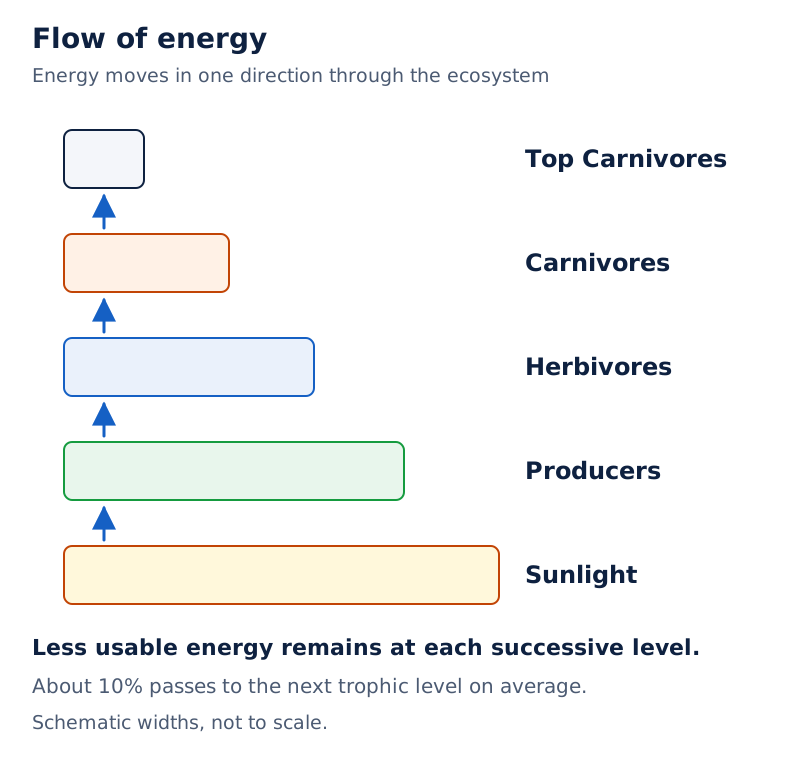
Upward arrows connect coloured bars labelled Sunlight, Producers, Herbivores, Carnivores and Top Carnivores. The bars become narrower towards the top, showing progressively less energy at successive levels.
Drawn by One Young India. See Fig. 13.4 in your NCERT textbook
Why is energy flow unidirectional?
Unidirectional means that energy moves in one direction through these transfers. Energy captured by autotrophs does not return to the solar input. Energy passed to herbivores does not become available again to the autotrophs from which it came.
The large energy loss at each step limits food-chain length. Chains generally contain only three or four steps, with very little usable energy remaining after four trophic levels. This is a general pattern, not an absolute limit applying to every illustrated chain.
Lower trophic levels generally contain more individuals, with producers usually the most numerous. Both this pattern and the decreasing energy supply help explain why the broad base of a trophic-level diagram represents producers.
How do harmful chemicals become concentrated in food chains?
Food chains can transfer harmful chemicals as well as food energy. Pesticides and other chemicals used to protect crops from pests and diseases may enter soil and water. From there, they can enter living organisms and pass along feeding relationships.
What is the route into food?
- Chemicals used on crops are washed into the soil or into water bodies.
- Plants absorb chemicals from the soil along with water and minerals; aquatic plants and animals take them up from water.
- These organisms become part of food chains through which the chemicals are transferred.
- Non-degradable chemicals accumulate progressively at successive trophic levels.
- Organisms at the top of the affected food chain receive the greatest concentration.
Definition: Biological magnification is the progressive increase in the concentration of non-degradable harmful chemicals at successive trophic levels of a food chain.
Where humans occupy the top of such a chain, a high concentration can accumulate in their bodies. The concern is therefore not limited to contact with a chemical at the place where it was first used.
Food grains such as wheat and rice, vegetables, fruits and meat can contain varying amounts of pesticide residues. These residues cannot always be removed by washing or other methods. Washing must not be treated as a guarantee that all residues have disappeared.
How does this differ from energy transfer?
Usable energy decreases at successive trophic levels because much is used or lost during transfers. The concentration of the non-degradable chemicals involved in biological magnification increases. These are different changes, even though both can be traced through a food chain.
Reports about pesticide levels in ready-made foods have been accompanied by bans on some products in some states. Such reports invite investigation of the pesticides’ source. A useful explanation follows the route through soil or water, organisms and food products. It should not assume that chemicals reach people only through one particular type of food.
How does ozone form, protect life and become depleted?
Ozone, written O₃, is a molecule containing three oxygen atoms. O₂ represents ordinary molecular oxygen, containing two oxygen atoms, while O represents a single oxygen atom. Ordinary oxygen is essential for aerobic life; ozone itself is poisonous.
Why is ozone in the upper atmosphere important?
At higher levels of the atmosphere, ozone shields Earth's surface from ultraviolet radiation, abbreviated UV, from the Sun. UV radiation can damage organisms and is known to cause skin cancer in humans. The protective value of atmospheric ozone concerns this shielding function.
High-energy UV radiation acts on oxygen molecules and splits some of them into free oxygen atoms. These atoms then combine with oxygen molecules to form ozone. In the reactions below, the arrow means “forms”, and the plus sign separates the reacting or resulting particles.
O₂ → O + O, under the action of UV radiation.
O + O₂ → O₃, forming ozone.
The first reaction supplies individual oxygen atoms. The second joins an oxygen atom to an oxygen molecule. Keeping the two steps distinct explains both where the free atoms come from and how a three-atom ozone molecule is produced.
What caused concern, and what action followed?
Atmospheric ozone began to decline sharply in the 1980s. The decrease was linked to synthetic chemicals such as chlorofluorocarbons, abbreviated CFCs, used as refrigerants and in fire extinguishers.
In 1987, the United Nations Environment Programme, abbreviated UNEP, secured an agreement to freeze CFC production at 1986 levels. A freeze at that level means limiting production to the stated reference level; it does not mean that ozone formation stopped.
The requirement for manufacturers to make CFC-free refrigerators addresses the use of chemicals linked with ozone depletion. The environmental purpose is to limit damage to the layer that protects life from harmful solar radiation.
Note: “Ozone is poisonous” and “ozone protects life” describe different aspects of the same substance. Its protective role is the screening of UV radiation at higher atmospheric levels.
Why are some wastes biodegradable and others non-biodegradable?
Daily activities generate discarded materials, including spoilt food, vegetable peels, used tea leaves, milk packets, cartons, paper, medicine packaging, old clothes and broken footwear. Their fate depends partly on whether biological processes can break them down.
How does biological breakdown differ?
Biodegradable substances are broken down by biological processes. Non-biodegradable substances are not broken down in this manner. The distinction concerns biological breakdown, rather than simply whether a discarded item looks natural or artificial.
| Point of comparison | Biodegradable substances | Non-biodegradable substances |
|---|---|---|
| Meaning | Can be broken down by biological processes | Are not broken down by these processes |
| Biological action | Suitable biological processes act on the material | Available biological processes do not break down the material |
| Examples | Grass, flowers and fruit peels | Many human-made plastics |
| Pattern during observation | Form and structure change as decomposition proceeds | May remain unchanged over long periods |
| Environmental significance | Breakdown connects waste with the return of substances to the environment | May persist without reacting or may harm ecosystem members |
Enzymes are specific in their action: a particular substance requires suitable enzymes for its breakdown. This explains why biological activity does not break down every material indiscriminately. Many plastics resist the action of bacteria and other saprophytes.
Physical processes such as heat and pressure may act on such materials, yet they persist for long periods under ordinary environmental conditions. Non-biodegradable therefore does not mean that a substance can never undergo any kind of change.
How can waste changes be investigated?
One investigation collects household waste, buries it in a garden pit or places it in an old bucket or flowerpot, and covers it with at least 15 cm of soil. The symbol cm means centimetres. The material is kept moist and observed at 15-day intervals.
Record which items remain unchanged, which change form or structure and which change fastest. The observation interval is not a promised decomposition time. Conclusions about particular materials should follow observations instead of assigning an invented number of days to every item.
New plastics described as biodegradable also need investigation. The description alone does not answer every question about environmental harm. The material's behaviour and its effects must be considered together.
How can everyday waste choices and local investigations protect the environment?
Changes in lifestyle have increased waste generation. More articles are treated as disposable, and changes in packaging have increased the non-biodegradable part of waste. Managing garbage therefore involves considering what is used, what is discarded and what happens afterwards.
What does the disposable-cup example show?
Tea on trains was once served in plastic glasses that were returned to the vendor. Disposable cups were welcomed for hygiene, but their widespread disposal created an environmental concern. A change that appears convenient can have consequences beyond its immediate use.
Kulhads, disposable clay cups, were proposed as an alternative. Producing them on a large scale would remove fertile topsoil. Paper cups provide another disposable alternative to plastic cups.
The central lesson is to consider the material used and the consequences of producing and discarding it. Calling an item disposable does not settle whether its overall environmental effects are acceptable. The topsoil concern remains relevant even though clay differs from plastic.
What should a local waste investigation examine?
- Find out whether household waste is collected and which local body manages it, such as a panchayat, municipal corporation or resident welfare association.
- Measure the waste generated at home and in the classroom in a day, and identify the biodegradable portion.
- Investigate whether biodegradable and non-biodegradable wastes are treated separately.
- Find out how local sewage is treated and whether untreated sewage reaches nearby water bodies.
- Investigate industrial waste treatment and whether soil and water are protected from pollution.
Electronic-item disposal and plastic recycling raise further questions. Investigations should identify hazardous materials and examine the environmental effects of recycling. An inquiry needs evidence; it should not begin by assuming that every disposal or recycling process is harmless.
Which everyday practices are environment-friendly?
Carrying cloth bags for purchases, switching off unnecessary lights and fans, and walking to school instead of using a scooter are environment-friendly practices. These choices address everyday resource use alongside the larger problem of waste disposal.
Biodegradability also does not justify unlimited waste generation. It describes how a material can be broken down, not permission to discard any quantity carelessly. Waste generation and disposal still need attention even when the discarded material can undergo biological breakdown.
Glossary
- Ecosystem — Interacting organisms in an area together with the non-living constituents of their environment.
- Biotic components — Living parts of an ecosystem, including plants, animals, microorganisms and human beings.
- Abiotic components — Non-living environmental constituents, including physical factors such as temperature, rainfall, wind, soil and minerals.
- Producers — Organisms, including green plants and certain bacteria, that make food through photosynthesis.
- Consumers — Organisms obtaining food directly from producers or indirectly by feeding on other consumers.
- Decomposers — Microorganisms such as bacteria and fungi that break down dead remains and waste into simpler substances.
- Food chain — A feeding sequence in which organisms obtain food from other organisms at successive steps.
- Trophic level — A particular step or feeding level occupied by organisms in a food chain.
- Food web — A network of branching feeding relationships consisting of many interconnected food chains.
- Unidirectional energy flow — Movement of energy through successive levels without becoming available again to the previous feeding level.
- Biological magnification — Progressive increase in the concentration of non-degradable harmful chemicals at successive trophic levels.
- Ozone — A substance whose molecules contain three oxygen atoms and which screens ultraviolet radiation high in the atmosphere.
- Chlorofluorocarbons — Synthetic chemicals used as refrigerants and in fire extinguishers, linked with depletion of atmospheric ozone.
- Biodegradable substances — Substances capable of being broken down through biological processes in the environment.
- Non-biodegradable substances — Substances not broken down through biological processes, which may persist or harm ecosystem members.
Common errors and misconceptions
- Misconception: An ecosystem includes only living organisms. Correct: It includes interacting organisms and non-living constituents such as soil, minerals, temperature, rainfall and wind.
- Misconception: Consumers depend on plants only if they eat plants directly. Correct: Consumers feeding on other consumers depend indirectly on producers through the food chain.
- Misconception: Plants capture 10% of sunlight, and 1% passes between feeding levels. Correct: Terrestrial green plants capture about 1% of the sunlight falling on their leaves; average transfer to the next consumer level is about 10%.
- Misconception: Energy cycles back to producers in the same way as decomposed materials. Correct: Energy flow is unidirectional and usable energy diminishes, while decomposition returns simple substances for plant use.
- Misconception: Washing always removes pesticide residues from food. Correct: Residues cannot always be removed by washing or other methods, and non-degradable chemicals can accumulate through food chains.
- Misconception: Ozone is either entirely beneficial or entirely harmful. Correct: Ozone is poisonous, yet at higher atmospheric levels it protects life by screening harmful ultraviolet radiation.
- Misconception: Non-biodegradable materials cannot change under any circumstances. Correct: The term concerns biological breakdown; physical processes can still act on materials that persist under ordinary environmental conditions.
- Misconception: An item being biodegradable makes all waste-disposal concerns disappear. Correct: Biodegradability describes breakdown, while the amount of waste generated and its disposal remain environmental concerns.
Exam-style questions with model answers
Q1. Define an ecosystem and distinguish its biotic and abiotic components. [2 marks]
- An ecosystem consists of interacting organisms in an area together with the non-living constituents of their environment.
- Biotic components are living organisms, such as plants and animals. Abiotic components are non-living factors, such as temperature, rainfall, soil and minerals.
Q2. In a feeding sequence, grass is eaten by a goat, and the goat is eaten by a human. Define a trophic level and identify the trophic position of each organism in this sequence. [3 marks]
- A trophic level is a step or feeding level in a food chain.
- Grass is the producer at the first trophic level. It makes food using solar energy, making that energy available to consumers.
- The goat feeds on grass, so it is the primary consumer at the second trophic level. The human feeds on the goat in this specified sequence, so the human occupies the third trophic level as a secondary consumer.
Q3. Terrestrial green plants capture about 1% of the sunlight energy falling on their leaves. On average, about 10% of food energy becomes available to the next consumer level. Food chains generally contain three or four steps. Explain what each percentage compares, why chains are generally this short, and why energy flow is called unidirectional. [4 marks]
- The 1% value compares food energy captured by terrestrial green plants with sunlight energy falling on their leaves.
- The 10% value concerns transfer of food energy between successive feeding levels.
- Much energy is lost as heat or used in activities such as digestion and work. Only a small part remains available for the next consumer level, so very little usable energy remains after several transfers.
- Food chains therefore generally have three or four steps. Energy flow is unidirectional because energy passed to a later feeding level does not become available again to the previous level or return to the solar input.
Q4. Non-degradable pesticides used on crops are washed into soil and water. Plants absorb them from soil, and aquatic organisms take them up from water. Explain biological magnification as affected organisms are eaten, including the consequence for humans at the top of an affected food chain and the limitation of washing food. [5 marks]
- The supplied situation shows how pesticides enter organisms from contaminated soil and water. Once affected organisms are eaten, the chemicals enter the feeding relationships of the ecosystem.
- Because the chemicals are non-degradable, they accumulate progressively through successive trophic levels. The increase in their concentration at higher levels is called biological magnification.
- Humans at the top of an affected food chain can accumulate the greatest concentration in that chain. Their exposure therefore need not involve direct contact with the original pesticide application.
- Pesticide residues may occur in plant foods and animal foods.
- Washing and other methods cannot always remove them, so washing alone cannot guarantee the absence of these residues.
Q5. Explain the role of decomposers in an ecosystem and predict what would happen to dead remains and soil replenishment if decomposers were absent. [3 marks]
- Decomposers include microorganisms such as bacteria and fungi that act on dead remains and the waste products of organisms.
- They break complex organic substances into simple inorganic substances. These enter the soil and can be used again by plants, helping replenish the soil.
- Without decomposers, dead remains and waste would accumulate. The return of these simple substances to the soil and their availability to plants would be disrupted.
Q6. High-energy ultraviolet radiation splits oxygen molecules into oxygen atoms, which can combine with oxygen molecules. Explain ozone formation and its protective role. Atmospheric ozone declined sharply in the 1980s; an agreement secured in 1987 froze chlorofluorocarbon production at 1986 levels. Explain the environmental purpose of that response. [5 marks]
- High-energy ultraviolet (UV) radiation splits an oxygen molecule, O₂, into two oxygen atoms, O: O₂ → O + O. The arrow means “forms”, and the plus sign separates particles.
- A free oxygen atom combines with an oxygen molecule to form ozone, O₃: O + O₂ → O₃. Each ozone molecule contains three oxygen atoms.
- At higher atmospheric levels, ozone shields Earth from harmful UV radiation, despite ozone itself being poisonous.
- Depletion weakens this protection against UV radiation, which damages organisms and can cause skin cancer in humans.
- Chlorofluorocarbons are linked with ozone depletion. The 1987 agreement to freeze their production at 1986 levels aimed to limit damage to the protective ozone layer; making CFC-free refrigerators also addresses their use.
Q7. Household waste is covered with at least 15 centimetres of soil, kept moist and examined at 15-day intervals. Explain how observations can distinguish biodegradable from non-biodegradable materials, why biological breakdown differs between substances, and why the interval does not give a decomposition time for every item. [4 marks]
- Record which materials change form or structure and which remain unchanged over long periods.
- Materials broken down by biological processes are biodegradable; materials not broken down in this way are non-biodegradable.
- Enzymes are specific in their action. Suitable enzymes are needed to break down a particular substance, so bacteria and other organisms do not break down every material equally.
- Fifteen days is the interval between observations, not a stated time for complete decomposition. Different changes must be established from the recorded observations rather than assumed from the schedule.
Q8. Disposable clay cups called kulhads were suggested as an alternative to disposable cups used for tea in trains. Their large-scale manufacture would remove fertile topsoil. Using this information, explain why replacing a disposable material requires environmental evaluation. [2 marks]
- An alternative material must be assessed for the consequences of producing and discarding it, not simply for its convenience.
- Large-scale kulhad production would remove fertile topsoil, showing that changing the cup material can create another environmental problem.
Key takeaways
- Ecosystems include living organisms, non-living surroundings and the interactions connecting these components into an interdependent system.
- Producers make food using sunlight, consumers obtain food through feeding, and decomposers return simple substances for reuse by plants.
- Food chains show feeding sequences, while food webs connect many chains through branching relationships between organisms.
- Energy flow is unidirectional, with decreasing usable energy at successive levels and an average transfer of about 10%.
- Non-degradable harmful chemicals can increase in concentration at successive trophic levels through biological magnification.
- Ozone in the upper atmosphere screens harmful ultraviolet radiation; chlorofluorocarbons are linked to its depletion.
- Biodegradable and non-biodegradable wastes differ in biological breakdown, so waste investigations must examine what actually happens to discarded materials.
- Disposal choices require attention to materials, waste generation and environmental consequences, including the loss of topsoil from large-scale kulhad production.
Test yourself
Why does a garden count as an ecosystem?
Its plants, animals and other organisms interact with one another and with non-living factors such as soil, temperature and rainfall.
How does a consumer depend indirectly on producers?
It may eat another consumer that obtained food from producers, connecting it indirectly to the food made by plants.
What happens to substances produced by decomposition?
Simple inorganic substances enter the soil and become available for plants to use again.
Why is a food web drawn with branching lines?
Organisms generally participate in several feeding relationships, so many food chains connect instead of remaining isolated straight sequences.
What is the difference between the 1% and 10% energy values?
About 1% concerns sunlight captured by terrestrial green plants. About 10% concerns average transfer of food energy to the next consumer level.
Why can a non-degradable pesticide become more concentrated at higher trophic levels?
It is not broken down and accumulates progressively as affected organisms are eaten along the food chain.
Which year supplied the CFC production reference level for the agreement secured in 1987?
The agreement sought to freeze chlorofluorocarbon production at the level reached in 1986.
Why does “non-biodegradable” not mean “incapable of any change”?
It describes resistance to biological breakdown; physical processes such as heat and pressure may still act on the material.