
Manufacturing Industries | ICSE Class 10 Geography Notes
On this page

This note covers the importance and classification of manufacturing industries, industrial location, cotton and silk textiles, sugar manufacture, iron and steel, Tata Steel, Rourkela and Visakhapatnam, petrochemicals, electronics, industrial linkages and environmental responsibility.
What is manufacturing, and why does it matter?
Definition: Manufacturing is the production of goods in large quantities by processing raw materials into more valuable products. Raw materials are the materials used to make a product.
Secondary activities transform materials into finished goods. Making sugar from sugarcane and producing iron and steel from iron ore are examples. Manufacturing belongs to the secondary sector, the part of the economy concerned with this transformation.
The word industry has a wider meaning. It includes producing goods, extracting minerals and providing services. Thus, manufacturing is an industrial activity, but mining coal and providing tourism services are also industrial activities without being manufacturing.
How does processing add value?
Value addition means increasing the usefulness and value of materials through processing. Wood becomes pulp, pulp becomes paper, and paper becomes a notebook. Similarly, cotton fibre, a fine thread-like material, becomes yarn, a continuous strand. Yarn becomes fabric, or cloth, before it is made into garments.
A finished product therefore represents more than the original raw material. It also embodies processing, labour and other inputs. The cotton textile chain links farming with spinning, which makes yarn; weaving, which interlaces yarns into cloth; dyeing, which adds colour; packaging; and the manufacture of clothing.
Why is manufacturing important to development?
- Agricultural modernisation: Industries supply irrigation pumps, fertilisers, machines and tools to farmers, helping improve production and the efficiency of agricultural work.
- Employment: Industrial development provides work outside farming and reduces heavy dependence on agricultural income. It also supports tertiary activities, meaning services such as transport and trade.
- Regional development: Establishing industries in tribal and backward areas has been used to reduce regional disparities, meaning differences in development between regions.
- Foreign exchange: Exports, or goods sold abroad, bring earnings in foreign currencies and expand trade and commerce.
Agriculture and industry are interdependent. Agro-industries obtain raw materials from farming, while farmers use manufactured inputs. Greater industrial efficiency can therefore benefit agriculture as well as factories. Producing a wider range of valuable finished goods strengthens this relationship.
Competitiveness means the ability to compete in a market. Self-sufficiency alone is not enough: manufactured goods must match the quality of goods in international markets if they are to compete successfully.
How are industries classified by materials, size and ownership?
Industries can be grouped using different criteria, meaning bases of comparison. Raw materials identify what an industry uses; size concerns its scale of operation; ownership identifies who owns and operates it. These classifications answer different questions about the same enterprise.
What is the difference between agro-based and mineral-based industries?
| Category | Basis | Examples |
|---|---|---|
| Agro-based | Uses plant or animal products as raw materials | Sugar, cotton textiles and silk textiles |
| Mineral-based | Uses minerals and metals as raw materials | Iron and steel and petrochemicals, meaning chemicals derived from petroleum |
Agro-based does not mean plant-based alone. Silk comes from an animal source, but silk textiles belong to this group. Cotton textiles and sugar use crop materials. Their connection with agriculture is therefore clear, although their manufacturing processes differ.
Mineral-based industries transform mineral resources into useful goods. Iron and steel also supply materials for other industries. A basic or key industry supplies products used as raw materials to manufacture other goods; iron and steel is an important example.
How does scale differ from ownership?
Capital is the money invested in an industrial enterprise. Industrial size reflects capital investment, the number of workers and the volume of production. Small-scale industries use less capital and technology than large-scale industries, which produce large volumes of goods.
Cottage industries are small-scale household activities in which artisans make products by hand. Silk weaving is an example of small-scale activity; producing heavy machinery is an example of large-scale industry. A large factory and a household workshop differ in scale, not necessarily in raw-material category.
| Ownership category | Who owns and operates it? | Distinguishing feature |
|---|---|---|
| Public sector | Government agencies | Government ownership and operation |
| Private sector | Individuals or groups of individuals | Private ownership and operation |
| Joint sector | The state and private individuals together | Shared government and private participation |
| Cooperative sector | Producers, raw-material suppliers, workers or both suppliers and workers | Members pool resources and share profits or losses proportionately |
Consumer industries produce goods for direct use by consumers, such as sugar. The distinction between basic and consumer industries concerns the use of the output. It should not be confused with the distinction between public and private ownership.
Which factors explain the location of a manufacturing industry?
Industrial location means the place where an industry operates. Raw materials, land, water, labour, power, capital, transport and markets influence this choice. Industries are situated where some or all of these factors are easily available, rather than according to one universal rule.
How do inputs, processes and outputs connect?
An industrial system consists of inputs, processes and outputs. Inputs include raw materials, workers and expenditure on land, power and transport. Processes are the activities that transform materials. Outputs include finished products and the income earned from them.
| Part of the system | Textile example | Geographical connection |
|---|---|---|
| Inputs | Cotton, labour, factory and transport costs | Access to materials, workers and transport |
| Processes | Spinning, weaving, dyeing and printing, which applies patterns to fabric | Manufacturing activities performed at production centres |
| Outputs | Finished shirts and income from their sale | Access to consumers and markets |
A market is where goods are sold. Access to a market matters alongside access to raw materials. Finished steel needs an efficient transport network for distribution, just as the heavy materials entering a steel plant need transport to reach it.
Why does the strongest locational factor vary?
Sugarcane is bulky and loses sucrose during haulage, meaning transport. Sucrose is the sugar contained in the cane. Iron and steel also face high transport costs because both their raw materials and finished products are heavy and bulky.
Cotton textiles illustrate a wider combination: raw cotton, labour, markets, transport, port facilities and moist climate helped concentrate the industry in Maharashtra and Gujarat. The geographical explanation therefore depends on the particular industry and its production requirements.
Government can encourage industrial location in backward areas through subsidised power, lower transport costs and infrastructure. Infrastructure means supporting facilities such as transport and power supply. Industrialisation often leads to the growth of towns and cities.
Industrial regions develop when industries locate close together and share the benefits of proximity. Their growth reflects connections between activities, resources and markets. A factory should consequently be understood as part of a wider industrial system.
How does the cotton textile industry link agriculture with manufacturing?
The textile industry, which produces yarn, fabric and related products, contributes significantly to industrial production, employment and foreign exchange earnings. Its value chain extends from raw materials to highly processed products. A value chain is the connected sequence of activities that adds value to a product.
What happens between fibre and clothing?
Fibre is a fine, thread-like material used to make textiles. Spinning converts fibres into yarn, a continuous strand used in making fabric. Weaving interlaces yarns to form cloth. Dyeing adds colour, while garment manufacture turns fabric into clothing.
What the figure shows
Value addition in the textile industry
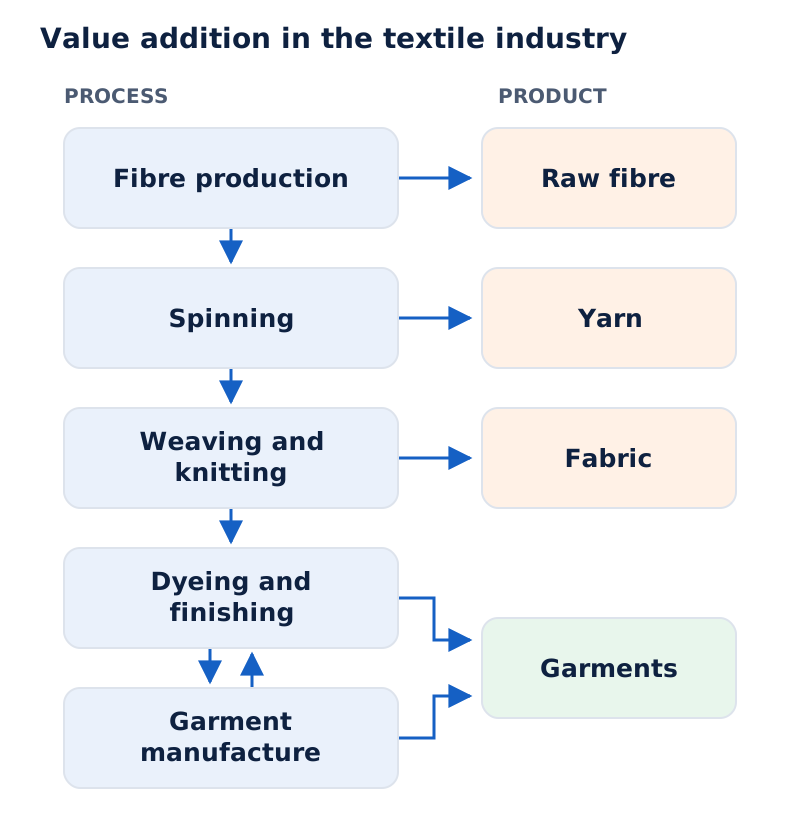
The flow chart labels fibre production, spinning, weaving and knitting, dyeing and finishing, and garment manufacture. The product boxes below identify raw fibre, yarn, fabric and garments.
Drawn by One Young India.
Knitting forms fabric through loops of yarn, while finishing prepares fabric for use. Keeping the stages distinct explains why raw cotton, yarn, cloth and garments represent different products within the same industry rather than interchangeable names.
Case study: Why did Maharashtra and Gujarat attract cotton textiles?
In the early years, cotton textiles were concentrated in the cotton-growing belt of Maharashtra and Gujarat. Available raw cotton, labour, markets, transport including accessible ports, and a moist climate contributed to this concentration.
The industry supports farmers and cotton boll pluckers, as well as workers in ginning, the separation of cotton fibres from seeds. Spinning, weaving, dyeing, designing, packaging, tailoring and sewing extend this employment chain beyond the farm.
Demand from textile production also supports chemicals and dyes, packaging materials and engineering works. This is an example of industrial linkage: production in one industry creates demand for the products and activities of others.
How do spinning and weaving differ geographically?
Spinning continues to be centralised in Maharashtra, Gujarat and Tamil Nadu. Weaving is highly decentralised, meaning spread across many production units, allowing traditional skills and designs to be incorporated. Weaving takes place on handlooms, powerlooms and in mills.
A handloom is operated by hand; a powerloom uses power to weave. Handspun khadi, cloth made from handspun yarn, provides large-scale employment to weavers in their homes as a cottage industry. Modern production and household weaving therefore coexist.
| Period or date | Development | Significance |
|---|---|---|
| After the 18th century | Powerlooms came into use | Production developed beyond hand spinning and handloom weaving |
| 1854 | The first successful textile mill was established in Mumbai | A historical landmark in mill-based textile production |
Traditional cotton industries suffered during colonial rule because they could not compete with mill-made cloth from England. This historical difficulty is different from the geographical factors explaining the later concentration of mills.
How is silk produced, and why is it an agro-based textile?
Silk is an animal fibre obtained from the cocoons of silk moths. A cocoon is the protective covering spun by a silkworm before its next stage of development. Silkworms are caterpillars, the larval stage of silk moths.
Sericulture is the rearing of silkworms to obtain silk. It is distinct from weaving: rearing produces the source of the fibre, while weaving converts yarn into fabric. Silk belongs among agro-based industries because this group includes animal as well as plant products.
What is the sequence from silkworm to silk fibre?
- Female silk moths lay eggs. These are warmed to a suitable temperature so that the larvae, or young caterpillars, hatch.
- The caterpillars are kept in clean trays with freshly chopped mulberry leaves to feed on.
- After 25 to 30 days, the caterpillars stop eating and begin spinning cocoons around themselves.
- The cocoons are kept under the sun or boiled in water before fibres are taken out.
- The removal of silk threads from cocoons is called reeling. It obtains the threads used in subsequent textile production.
Silkworms secrete fibre made of protein, a substance forming many animal tissues. Mulberry, tassar and mooga are types of silk. The words sericulture, cocoon and reeling identify different parts of production and should be used precisely.
What does the distribution of textile centres show?
What the figure shows
Cotton, woollen and silk industries
The map uses separate symbols for cotton, woollen and silk textiles. Silk symbols occur at Srinagar, Varanasi, Bengaluru and Mysuru. Cotton symbols occur at Mumbai, Ahmedabad and Coimbatore. Read the legend before identifying each industry.
A map legend explains the symbols used on a map. Different textile industries can occur within the same broad region, so a place name alone does not identify its industry. Silk weaving also illustrates how textile manufacture can operate on a small scale.
The textile value chain brings together fibre production and manufacturing skills. Cotton and silk differ in the origin of their fibres, but both depend on processing before becoming fabric and garments. This shared sequence explains their place within the wider textile industry.
Why is sugar manufacturing closely linked to the location of sugarcane?
The sugar industry processes sugarcane, making it an agro-based industry. Its geography is closely connected with the nature of its raw material. Cane is bulky, and its sucrose content reduces during haulage. Transport is therefore part of the production problem, not merely a delivery arrangement.
Why do seasonal production and ownership matter?
The industry is seasonal, meaning that its operation is linked to a particular production season. It is ideally suited to the cooperative sector. Cooperative industries are owned and operated by raw-material producers or suppliers, workers, or both.
Members pool resources and share profits or losses proportionately. This ownership arrangement connects the supply of agricultural material with industrial processing. It differs from public-sector ownership by government and private ownership by individuals or groups of individuals.
Sugar mills occur in Uttar Pradesh, Bihar, Maharashtra, Karnataka, Tamil Nadu, Andhra Pradesh, Gujarat, Punjab, Haryana and Madhya Pradesh. The industry is therefore distributed across both northern and peninsular states rather than confined to one region.
Why is there a tendency towards southern and western states?
There is a tendency for mills to shift and concentrate in southern and western states, especially Maharashtra. Cane produced here has a higher sucrose content. The cooler climate also ensures a longer crushing season, meaning a longer period for processing cane.
Cooperatives are more successful in these states. These explanations combine the quality of the raw material, the duration of operation and the organisation of the industry. They do not imply that sugar production has disappeared from the north.
| Factor | Feature of sugar manufacturing | Geographical importance |
|---|---|---|
| Nature of cane | Bulky raw material | Movement of raw material is an important locational consideration |
| Sucrose content | Reduces during haulage | Transport affects the material reaching the mill |
| Crushing season | Longer in the southern and western shift described | Influences the period available for processing |
| Cooperative organisation | More successful in these states | Helps explain the regional tendency |
Note: A tendency to shift is a regional trend, not a claim that all mills have moved. Retain the connection between higher sucrose content, a longer crushing season and cooperative success when explaining it.
Why is iron and steel a basic industry, and how is steel made?
Iron and steel is a basic industry because other industries depend on it for machinery and materials. Steel is used in engineering goods, construction, defence, medical and scientific equipment, and consumer goods. Its production and consumption are often regarded as an index of a country's development.
It is also a heavy industry: its raw materials and finished goods are heavy and bulky, leading to high transport costs. This classification concerns weight and bulk, whereas calling it a basic industry describes its role in supporting other production.
Which raw materials are needed?
Iron ore, coking coal and limestone are required in the ratio of approximately 4 : 2 : 1. Coking coal is coal used to make coke, a fuel used in the furnace. Limestone serves as a flux, a material added to help remove unwanted matter.
| Raw material | Approximate relative quantity | Role in the process |
|---|---|---|
| Iron ore | 4 parts | Source of iron |
| Coking coal | 2 parts | Provides coke used for heating the ore |
| Limestone | 1 part | Fluxing material associated with removal of impurities |
The colon in the ratio separates relative quantities. The figures describe inputs, not a guaranteed amount of finished steel. Some manganese, another mineral input, is required to harden the steel. The word approximately is essential when using these proportions.
What sequence does steel production follow?
What the figure shows
Processes of manufacture of steel
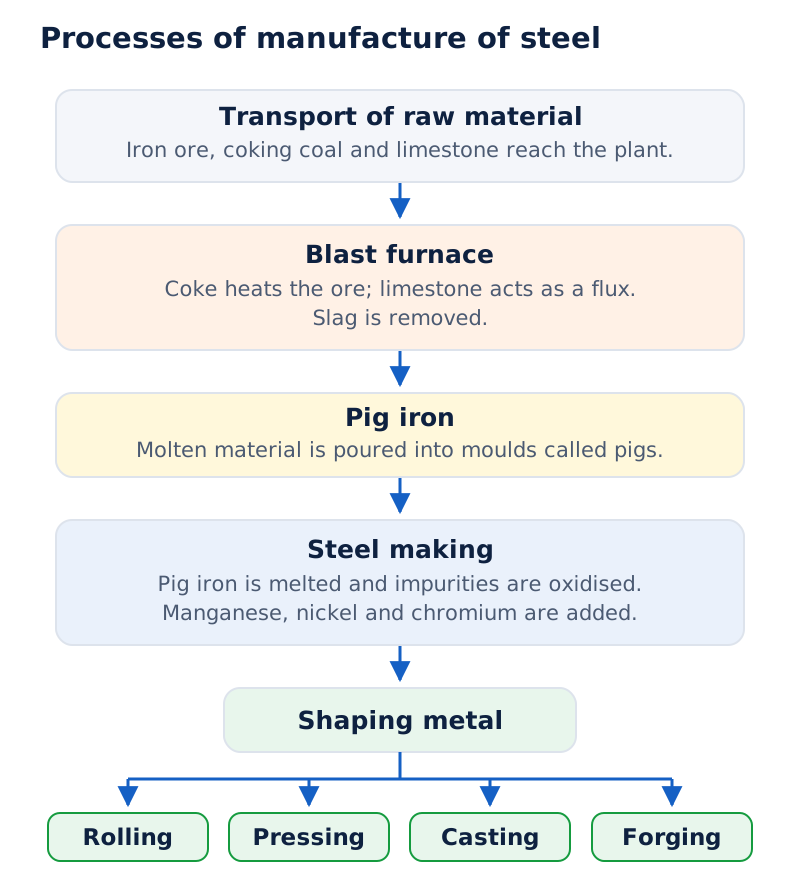
The flow chart connects transport of raw material, the blast furnace, pig iron, steel making and shaping metal. It identifies rolling, pressing, casting and forging as shaping operations.
Drawn by One Young India.
- Transport: Raw materials are brought to the plant for processing.
- Blast furnace: In this furnace, iron ore is melted, limestone is added as a flux and slag is removed. Coke is burnt to heat the ore. Slag is the unwanted material separated during processing.
- Pig iron: Molten material is poured into moulds called pigs. Pig iron is the intermediate iron product shown before further purification.
- Steel making: Pig iron is further purified by melting and oxidising impurities, meaning reacting them with oxygen. Manganese, nickel and chromium are added.
- Shaping: Metal is rolled, pressed, cast or forged. These operations shape it using rollers, pressure, moulds or working under force respectively.
An integrated steel plant carries out all the processes of steel making in one manufacturing unit. This helps distinguish the full production chain from a unit carrying out only one stage, such as shaping metal.
What do Tata Steel, Rourkela and Visakhapatnam show about industrial location?
India's steel industry has developed using advantages of raw materials, labour, transport and markets. The Chhotanagpur plateau region has the maximum concentration of iron and steel industries, largely because of low-cost iron ore, nearby high-grade raw materials, cheap labour and growth potential in the home market.
Case study: Why was Jamshedpur suitable for Tata Steel?
The Tata Iron and Steel Company Limited, abbreviated TISCO and associated with Tata Steel, began in 1907 at Sakchi in Jharkhand. Sakchi was later renamed Jamshedpur. The site lies near the confluence, or meeting point, of the Subarnarekha and Kharkai rivers.
Sakchi was only 32 kilometres from Kalimati station on the Bengal-Nagpur railway. It was near iron ore, coal and manganese deposits and close to Kolkata, which provided a large market. These advantages combined access to materials with transport and demand.
The plant obtained coal from the Jharia coalfields and iron ore, limestone, dolomite and manganese from Odisha and Chhattisgarh. Dolomite is another mineral used in iron and steel production. The Kharkai and Subarnarekha rivers ensured sufficient water, while government initiatives supplied capital for later development.
Other industries subsequently developed in Jamshedpur, producing chemicals, locomotive parts, agricultural equipment, machinery, tinplate, cable and wire. This illustrates the relationship between a basic industry and further industrial growth around it.
Where are Rourkela and Visakhapatnam located?
Rourkela, in Odisha, belongs to the important eastern steel-producing belt. Visakhapatnam, in Andhra Pradesh, is another important steel centre, shown close to the eastern coast. These plants demonstrate that India's steel industry includes both inland and coastal locations.
What the figure shows
Iron and steel plants in India
The map marks Jamshedpur, Rourkela and Vishakhapatnam, along with other steel centres. Jamshedpur and Rourkela are inland; Vishakhapatnam is beside the eastern coast. The map also names Bokaro, Bhilai, Durgapur and Salem.
Which specific resources support Rourkela?
Rourkela obtains iron ore from Mayurbhanj and Keonjhar in Odisha. Raniganj and Jharia provide nearby coal sources. Limestone and dolomite come from Birmitrapur in Odisha. These named sources explain its raw-material advantages more precisely than simply describing it as near minerals.
Water comes from the Sankh and Koel rivers. The Hirakud project in Odisha supplies hydroelectric power, meaning electricity generated using moving water. Together, these resources connect mineral supply, water and energy with the plant's location.
Visakhapatnam Steel Plant is a public-sector industry. Its government ownership is a different characteristic from its coastal position or its classification as an integrated steel plant. Ownership, location and the organisation of production should be identified separately.
Visakhapatnam is also spelt Vishakhapatnam. Locating a plant and explaining its location are separate tasks. A dot establishes position; an explanation needs evidence about resources, water, transport, labour and markets. Jamshedpur provides a detailed example of these combined influences.
What are petrochemicals, and why are they important in the modern world?
Petrochemicals are chemicals derived from petroleum, or mineral oil. They are part of the mineral-based industrial group and belong to the organic chemical sector. Organic chemicals are carbon-based compounds; the term here identifies a chemical category, not a farming method.
Which products depend on petrochemicals?
Petrochemicals are used in manufacturing synthetic fibres, synthetic rubber, plastics, dyes, drugs and pharmaceuticals. Synthetic means made through chemical manufacture. Pharmaceuticals are medicinal products. These applications connect petrochemical production with clothing, materials, colouring substances and medicines.
A useful way to understand the industry is to connect an upstream material with downstream products. Upstream refers to earlier production stages; downstream refers to later processing. Petrochemical materials can undergo further manufacturing before reaching consumers as finished products.
| Product group | Connection with petrochemicals | Industrial link |
|---|---|---|
| Synthetic fibres | Manufactured using petrochemicals | Links chemicals with textiles |
| Synthetic rubber and plastics | Products of petrochemical processing | Provides manufactured materials for further use |
| Dyes | Included among petrochemical applications | Links chemical manufacture with colouring products |
| Drugs and pharmaceuticals | Included among petrochemical applications | Connects chemical production with medicinal products |
Why is refinery proximity important?
An oil refinery processes crude petroleum, meaning unrefined mineral oil, into usable products. Organic chemical plants are located near oil refineries or petrochemical plants. This links their geographical location with the materials needed for production and with related processing activities.
The chemical industry is its own largest consumer: basic chemicals undergo further processing to make other chemicals. Products may then be used in industry, agriculture or directly by consumers. The importance of petrochemicals therefore extends beyond a single finished commodity.
This relationship also clarifies a classification issue. Petrochemicals supply materials used by other manufacturers, while cotton and silk obtain their original fibres from agricultural or animal sources. A textile product's industrial connections depend partly on which fibre it uses.
How do electronics support modern life, and why must manufacturing be environmentally responsible?
The electronics industry makes products ranging from transistor sets and televisions to telephones, computers and equipment for telecommunications. Telecommunications means communication over a distance using electronic systems. This industry supports the equipment through which people exchange information.
Where are the important electronics centres?
Bengaluru has emerged as India's electronic capital. Other important centres include Mumbai, Delhi, Hyderabad, Pune, Chennai, Kolkata, Lucknow and Coimbatore. Major concentrations occur at Bengaluru, Noida, Mumbai, Chennai, Hyderabad and Pune.
Information technology, abbreviated IT, concerns the handling of information through computing systems. Hardware means physical equipment; software means the programs used with it. Continued growth in hardware and software is key to the success of India's IT industry.
Employment generation is a major impact of this industry. Its relevance includes both the products it supplies and the work associated with their development and manufacture. Computers and communications equipment connect industrial production with the wider service economy.
How can industries reduce environmental damage?
Manufacturing contributes to economic development, but industrial pollution can affect air, water, land and the sound environment. Effluents are liquid wastes discharged from industrial activity. Textile dyeing, chemical production and petroleum refineries are among activities associated with water pollution.
Industries can reduce freshwater use by reusing and recycling water in successive stages and harvesting rainwater. Treating hot water and effluents before releasing them reduces water pollution. Thermal pollution occurs when hot water from factories or thermal plants enters rivers or ponds before cooling.
- Water treatment: Mechanical treatment is followed by biological treatment and then further biological, chemical and physical treatment.
- Cleaner air: Filters and other pollution-control equipment can reduce particles discharged from factory smoke stacks.
- Less noise: Silencers on generators, noise-absorbing materials and redesigned machinery can reduce industrial noise.
Sustainable development requires economic development to be integrated with environmental concerns. Industrial success therefore involves using materials and energy efficiently while reducing waste and pollution, alongside producing useful goods and creating employment.
Glossary
- Manufacturing — Production of goods in large quantities by processing raw materials into products of greater value.
- Value addition — Increase in a material's usefulness and value as it passes through stages of manufacturing.
- Agro-based industry — Industry using plant or animal products as its raw materials, including cotton, silk and sugar manufacture.
- Mineral-based industry — Industry using minerals or metals as raw materials to manufacture useful products.
- Basic industry — Industry supplying products that other industries use as raw materials for further manufacture.
- Public sector — Industrial enterprises owned and operated by government agencies rather than private individuals.
- Private sector — Industrial enterprises owned and operated by individuals or groups of private individuals.
- Cooperative sector — Enterprises whose producers, suppliers or workers pool resources and share profits or losses proportionately.
- Industrial system — The connected inputs, processing activities and outputs that together constitute an industrial operation.
- Sericulture — Rearing silkworms to obtain silk, distinct from the later weaving of silk fabric.
- Reeling — The process of taking silk threads from cocoons for use in further textile production.
- Integrated steel plant — A manufacturing unit in which all the processes of steel making take place.
- Petrochemicals — Chemicals derived from petroleum and used to make products such as synthetic fibres, plastics and medicines.
- Effluents — Liquid industrial wastes that require treatment before discharge into rivers and other water bodies.
Common errors and misconceptions
- Misconception: Every industrial activity is manufacturing. Correct: Industry also includes mineral extraction and services; manufacturing specifically transforms materials into more valuable goods.
- Misconception: Agro-based industries use only plants. Correct: Their raw materials include animal products, so silk textiles also belong to this group.
- Misconception: Public sector means large-scale industry. Correct: Public sector describes ownership, while large-scale describes the size of industrial activity.
- Misconception: Spinning and weaving are the same process. Correct: Spinning produces yarn from fibres, while weaving forms fabric by interlacing yarns.
- Misconception: Sericulture means weaving silk. Correct: Sericulture means rearing silkworms; reeling removes threads from cocoons, and weaving is a later textile process.
- Misconception: All sugar mills have moved to Maharashtra. Correct: There is a tendency towards southern and western states, especially Maharashtra; mills also occur in northern states.
- Misconception: The steel-input ratio is exactly 4 : 2 : 1 and states the steel output. Correct: It is an approximate ratio of iron ore, coking coal and limestone, not a statement of finished output.
- Misconception: All important steel plants lie in the Chhotanagpur region. Correct: That region has the maximum concentration, but other centres include coastal Visakhapatnam in Andhra Pradesh.
Exam-style questions with model answers
Q1. A sugar mill uses sugarcane, while a steel plant uses iron ore. Classify each industry by its raw material, giving a reason. [2 marks]
- The sugar mill is agro-based because sugarcane is an agricultural crop used as its raw material.
- The steel plant is mineral-based because iron ore is a mineral raw material used in manufacturing steel.
Q2. An enterprise is owned and operated by government, while another is owned and operated by private individuals. Identify their ownership categories. [2 marks]
- The government-owned and government-operated enterprise belongs to the public sector, which is defined by government ownership and operation.
- The enterprise owned and operated by private individuals belongs to the private sector, irrespective of its raw material.
Q3. Cotton mills in Maharashtra and Gujarat had access to raw cotton, workers, markets, transport and ports. Explain any three locational advantages from this information. [3 marks]
- Access to raw cotton linked the mills with their principal agricultural input, connecting the location of manufacturing with the cotton-growing belt.
- Available workers supplied labour for textile production, helping the mills carry out the activities involved in processing cotton into textile products.
- Transport and accessible ports supported the movement of goods, while available markets provided buyers for the products manufactured by the mills.
Q4. Southern and western sugar-producing states, especially Maharashtra, have cane with higher sucrose content, a longer crushing season associated with cooler climate, and more successful cooperatives. Explain the tendency for mills to concentrate there using three points. [3 marks]
- The higher sucrose content of cane is an advantage of the raw material used by sugar mills in these states.
- The cooler climate ensures a longer crushing season, extending the period during which the mills can carry out cane processing.
- More successful cooperatives support the organisation of production in these states, helping explain the tendency towards concentration, especially in Maharashtra.
Q5. A steel plant uses iron ore, coking coal and limestone in the approximate ratio 4 : 2 : 1. Ore supplies iron, coal provides coke for heat, and limestone acts as a flux to remove unwanted matter. Transporting these heavy inputs is costly. Explain the proportions and their locational implication in four points. [4 marks]
- Iron ore represents approximately four relative parts of the stated input mixture and supplies the iron needed for manufacture.
- Coking coal represents approximately two relative parts, with coke used to provide heat during the processing of iron ore.
- Limestone represents approximately one relative part and serves as a flux associated with removing unwanted material during furnace processing.
- Heavy and bulky inputs involve high transport costs, making transport and access to raw materials important considerations in locating a steel plant.
Q6. Sakchi was 32 kilometres from Kalimati station, near mineral deposits and Kolkata's market, and supplied with water by the Kharkai and Subarnarekha rivers. Government initiatives provided capital for later development. Explain five advantages for the Tata steel plant. [5 marks]
- The nearby railway station gave the location a transport connection. This helped link the steel plant with the movement of materials and goods.
- Proximity to mineral deposits provided a raw-material advantage for a manufacturing industry that processes heavy inputs into iron and steel.
- Kolkata provided a large market. Access to demand mattered alongside raw-material access because the plant needed buyers for its finished products.
- The Kharkai and Subarnarekha rivers ensured sufficient water supply, providing an important industrial input at the location chosen for the plant.
- Government initiatives supplied adequate capital for later development, supporting the plant's growth in addition to the site's geographical advantages.
Q7. Arrange and explain these five stages in order: shaping by rolling, pressing, casting or forging; transport of raw materials; purifying pig iron by melting and oxidising impurities, with manganese, nickel and chromium added; blast-furnace processing using coke for heat and limestone as flux, with slag removed; pouring molten material into moulds called pigs. [5 marks]
- Transport raw materials to the plant first, so that the materials required for the production sequence are available for processing.
- Process the ore in the blast furnace. Coke is burnt for heat, limestone acts as a flux, and slag is removed.
- Pour the molten material into moulds called pigs. This produces the pig iron shown as an intermediate stage in the sequence.
- Further purify pig iron by melting and oxidising impurities, and add manganese, nickel and chromium during the steel-making stage of production.
- Shape the metal by rolling, pressing, casting or forging. These operations follow steel making and give the metal its required forms.
Q8. Petrochemicals are used to manufacture synthetic fibres, synthetic rubber, plastics, dyes and pharmaceuticals. Explain three industrial connections using these supplied examples. [3 marks]
- Synthetic fibres connect petrochemicals with textiles because chemically manufactured fibres provide materials used in the production of textile goods.
- Synthetic rubber connects petrochemicals with tyre manufacture, while plastics supply packaging materials, linking petrochemical production with tyre and packaging industries.
- Pharmaceuticals connect petrochemical production with medicinal products, demonstrating the relevance of chemical manufacture beyond the production of fibres and plastics.
Key takeaways
- Manufacturing adds value to raw materials, creates employment, supports agriculture and helps expand trade through the production of finished goods.
- Raw materials, industrial size and ownership are separate bases of classification and must not be treated as interchangeable categories.
- Industrial location reflects a combination of resources, labour, water, power, transport, capital and access to markets.
- Cotton textiles connect agriculture with spinning, weaving and garment production, while silk depends on sericulture and the reeling of cocoons.
- Sugarcane's bulk, loss of sucrose during haulage, seasonality and regional advantages help explain the geography of sugar mills.
- Iron and steel is both basic and heavy; its main raw-material ratio is approximately four parts ore, two coal and one limestone.
- Tata Steel at Jamshedpur, Rourkela and coastal Visakhapatnam illustrate the distribution of important integrated iron and steel plants.
- Petrochemicals and electronics support modern manufacturing and communication, while sustainable development requires attention to industrial waste and pollution.
Test yourself
How does manufacturing differ from the wider term industry?
Manufacturing transforms materials into more valuable goods; industry also includes mineral extraction and the provision of services.
Why is silk classified as agro-based despite its animal origin?
Agro-based industries use plant or animal products, and silk fibre is obtained from the cocoons of silk moths.
How does reeling differ from sericulture?
Sericulture is the rearing of silkworms, while reeling is the removal of silk threads from their cocoons.
Why does transporting sugarcane raise a production concern?
Sugarcane is bulky, and its sucrose content reduces during haulage, connecting transport with the quality of the raw material.
What does the approximate ratio 4 : 2 : 1 represent?
It represents the relative quantities of iron ore, coking coal and limestone used in iron and steel production.
Which rivers supplied water to the Tata plant at Jamshedpur?
The Kharkai and Subarnarekha rivers ensured sufficient water supply for the plant at the selected location.
Why do organic chemical plants occur near oil refineries or petrochemical plants?
Their manufacture is connected with petroleum-derived chemicals and related processing activities, linking location with industrial inputs.
Why should industrial development include environmental concerns?
Industries contribute to economic development but can pollute air, water and land and create noise; sustainable development integrates these concerns.
Write about it
Turn a question from this chapter into a paper.
The Writing Studio has a structure guide, a rubric and citation tools for 15 formats, from essays to research papers. Drafting is free with an account. Learnacy Essential adds feedback from an AI writing coach and submission to The OYI Review.
Publication depends on review and is not guaranteed.