
Tertiary and Quaternary Activities | CBSE Class 12 Geography Notes
On this page

This note covers paid services, buying and selling goods, transport networks, communication, professional and personal work, recreational travel, travel for medical treatment, knowledge-based work, decision-making, contracting work to outside agencies and unequal access to digital technology.
What are tertiary activities, and why do they matter?
Definition: Tertiary activities belong to the service sector. They involve the commercial provision of services rather than the production of tangible goods, meaning goods with a physical form.
A doctor's treatment, a teacher's teaching and a lawyer's legal advice are services provided in exchange for payment. Health, education, law, governance and recreation require professional skills. These depend on theoretical knowledge as well as practical training.
Manpower, the people performing the work, is an important component of this sector. Most tertiary activities are performed by skilled labour, professionally trained experts and consultants. Other examples include plumbers, electricians, technicians, launderers, barbers, shopkeepers, drivers, cashiers and publishers.
How do production and exchange work in services?
Tertiary activities include both production and exchange. Production means providing services that people consume. Service output is indirectly measured through wages and salaries. Exchange involves trade, transport and communication facilities that overcome distance.
Tertiary workers are not directly involved in processing physical raw materials. Their contribution depends more heavily on specialised skills, experience and knowledge than on production techniques, machinery and factory processes. This distinguishes service work from secondary activities concerned with processing and manufacturing.
How does employment change with development?
In the initial stages of economic development, a larger proportion of people worked in the primary sector, which includes activities such as farming and hunting. In a developed economy, the majority of workers find employment in tertiary activities, while a moderate proportion works in the secondary sector.
Services exist in all societies. More developed countries have a higher percentage of service workers than less developed countries. Employment in services has been increasing, while employment in primary and secondary activities has remained unchanged or has been decreasing.
What the figure shows
Service Sector classification
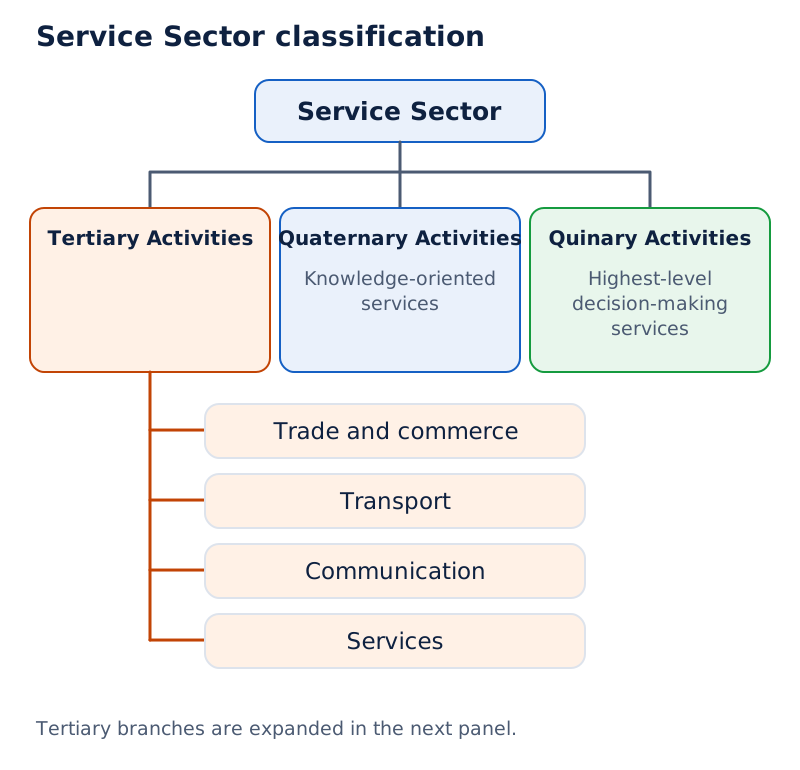
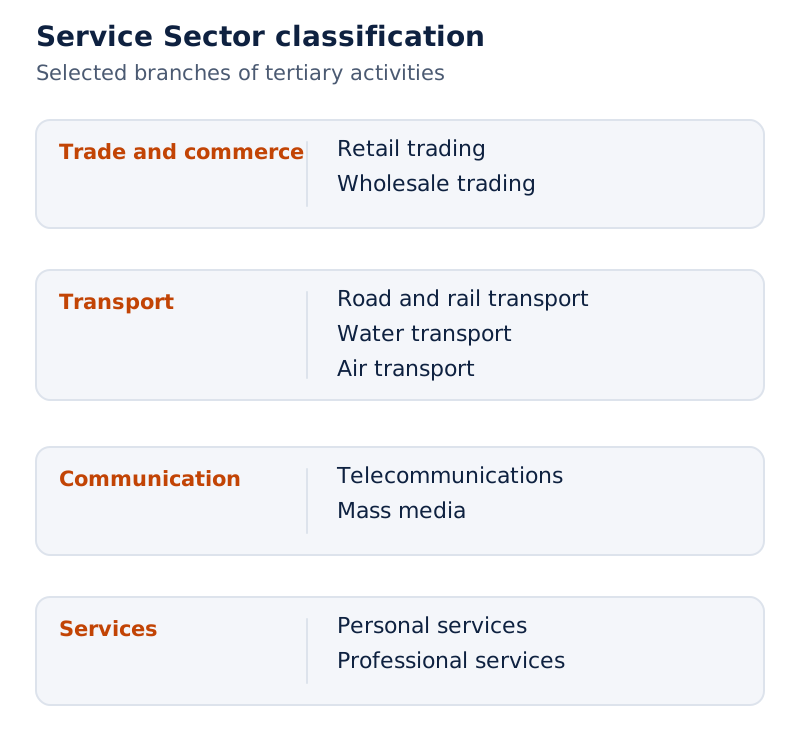
The chart branches from Service Sector into Tertiary Activities, Quaternary Activities (knowledge-oriented services) and Quinary Activities (highest-level decision-making services). Under tertiary activities, it shows trade and commerce, transport, communication and services, followed by more detailed branches.
Drawn by One Young India. See Fig. 6.1 in your NCERT textbook
How do rural and urban trading centres differ?
Trade is the buying and selling of items produced elsewhere. Retail trading, or selling directly to consumers, and wholesale trading, or bulk business through intermediary merchants and supply houses, are specifically intended for profit. Towns and cities where these activities take place are called trading centres.
Trade developed from barter, the exchange of goods without money, at the local level to money exchange on an international scale. This growth produced trading centres and institutions that act as collection and distribution points.
What functions do rural marketing centres perform?
Rural marketing centres serve nearby settlements. They are quasi-urban, meaning that they have some urban functions without being urban centres in themselves. They provide the most rudimentary trading facilities, and personal and professional services are not well-developed.
These centres collect and distribute goods locally. Most contain mandis, or wholesale markets, along with retailing areas. Their importance lies in making frequently demanded goods and services available to rural people.
Periodic markets operate at intervals in rural areas without regular markets. These may be weekly markets. They meet demand that has accumulated between market days. Markets take place on specified dates and move between places, keeping shopkeepers busy while serving a large area.
What makes urban marketing centres more specialised?
Urban marketing centres provide ordinary goods and services as well as a wider range of specialised ones. They offer manufactured goods and specialised markets for labour, housing, and semi-finished or finished products.
| Basis | Rural marketing centres | Urban marketing centres |
|---|---|---|
| Area and demand served | Nearby settlements and frequently demanded rural goods and services | Ordinary needs alongside more specialised urban requirements |
| Trading functions | Local collection and distribution, with mandis in most centres | Manufactured goods and specialised markets for labour, housing and products |
| Professional services | Not well-developed | Educational institutions, teachers, lawyers, consultants, physicians, dentists and veterinary doctors |
What the figure shows
Photograph of a wholesale vegetable market
The photograph shows a crowded outdoor market with people, produce and vehicles. It presents a physical trading place rather than a diagram of the stages of trade.
See Fig. 6.2 in your NCERT textbook
How are retail and wholesale trading organised?
Retail trading is the sale of goods directly to consumers. Most retail trade occurs in fixed establishments or stores devoted to selling. However, a permanent shop is not necessary for an activity to be retail trade.
Non-store retailing means retail sales outside such fixed selling establishments. Examples include street peddling, handcarts, trucks, door-to-door selling, mail-order, telephone sales, automatic vending machines and the internet. The defining feature remains direct sale to the consumer.
How do large retail organisations operate?
Consumer cooperatives, retail organisations formed by consumers, were the first large-scale innovations in retailing. In departmental stores, departmental heads receive authority and responsibility for purchasing commodities and supervising sales in their respective sections.
Chain stores are linked stores that can purchase merchandise most economically. They often go so far as to have goods manufactured to their specifications. Highly skilled specialists handle many executive tasks, and an experiment in one store can be applied across many stores.
What role do wholesalers play?
Wholesale trading is bulk business conducted through intermediary merchants and supply houses rather than through retail stores. An intermediary stands between the manufacturer and the retailer in the supply arrangement. Most retail stores obtain their supplies through such an intermediary source.
Some large stores, including chain stores, buy directly from manufacturers. Wholesalers often extend credit, allowing retailers to obtain supplies before payment, to such an extent that a retailer operates very largely on the wholesaler's capital.
| Basis | Retail trading | Wholesale trading |
|---|---|---|
| Main transaction | Direct sale to consumers | Bulk business through intermediary merchants and supply houses |
| Organisation | Fixed stores and non-store forms | Intermediary sources supplying retail stores |
| Supply relationship | Most stores buy from intermediaries; some large stores buy directly | Wholesalers often supply goods and extend credit to retailers |
What the figure shows
Photograph of a packed food market in the United States of America
The photograph shows a shopper beside shelves of packaged goods inside a store. The stocked shelves and indoor shopping space contrast with the crowded outdoor vegetable market.
See Fig. 6.3 in your NCERT textbook
How do transport distance, networks and routes affect movement?
Definition: Transport is a service or facility that physically carries people, materials and manufactured goods from one location to another. It is an organised industry meeting the basic need for mobility.
Modern society needs speedy and efficient transport to support the production, distribution and consumption of goods. Transportation significantly enhances the value of material at every stage of this system. It connects the movement of goods with the places where they are needed.
What are the different measures of distance?
| Measure | Meaning | What it describes |
|---|---|---|
| Kilometre distance | The actual length of a route, measured in kilometres | Physical route length |
| Time distance | The time taken to travel along a particular route | Duration of the journey |
| Cost distance | The expense of travelling along a route | Journey cost |
When choosing a transport mode, distance in terms of time or cost is the determining factor. Isochrone lines on a map join places that are equal in the time taken to reach them. Their basis is travel time rather than route length.
How do nodes and links form a network?
A transport network forms when transport systems link different places. A node may be where two or more routes meet, an origin, a destination, or any sizeable town along a route. A link is every road joining two nodes.
A developed network has many links, so its places are well-connected. The size of the population influences demand for transport: a larger population creates greater demand. Demand and the choice of routes are related aspects of transport, but they have different determinants.
Routes depend on the locations of cities, towns, villages, industrial centres and raw materials; trade patterns between them; the landscape between them; climate; and funds available to overcome obstacles along the route. These factors help explain why a transport network takes a particular form.
Diagram
Transport network
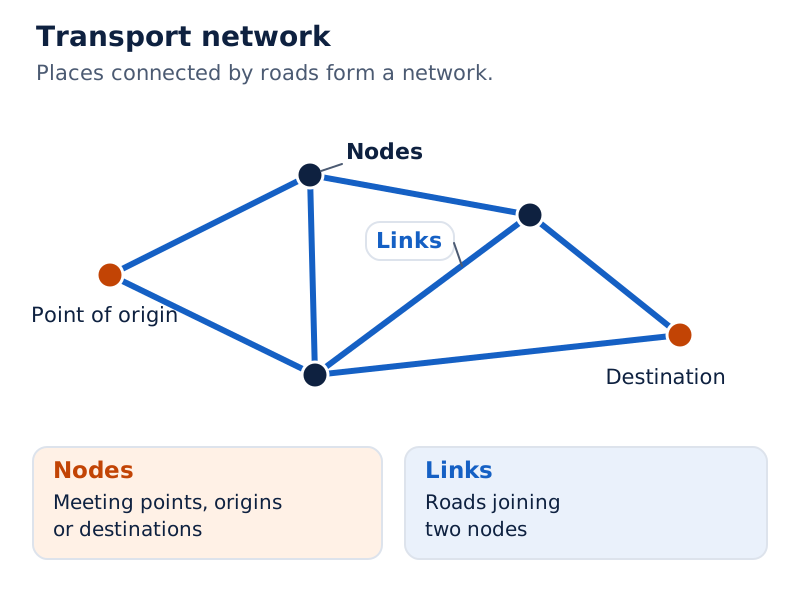
Draw meeting points and connect them with roads. Label the meeting points “nodes” and the connecting roads “links”. Also label a point of origin and a destination to show the different roles a node can perform.
Drawn by One Young India.
How has communication become less dependent on transport?
Communication involves transmitting words, messages, facts and ideas. Writing made it possible to preserve messages, but their physical movement depended on transport. Written messages were carried by hand, animals, boats, roads, railways and air.
For this reason, forms of transport are also called lines of communication. An efficient transport network helps messages spread easily. Mobile telephony and satellites have made communication independent of transport, but all forms are not fully disassociated because older systems are cheap.
Post offices therefore continue to handle very large volumes of mail worldwide. The existence of rapid electronic communication does not remove the continuing role of physically transported messages.
What do telecommunications and mass media provide?
Telecommunications transmit messages using communication technology. Their development has reduced the time needed to send messages from weeks to minutes. Mobile telephony makes communication direct and instantaneous at any time and from anywhere. The telegraph sends messages electrically; Morse code represents information through short and long signals; and telex sends printed text through a telecommunications network. These have almost become things of the past.
Mass media reach large audiences. Radio and television relay news, pictures and telephone calls to vast audiences around the world. They are vital for advertising and entertainment. Newspapers can cover events in all corners of the world.
Satellite communication relays information about the Earth and from space. The internet has revolutionised the global communication system. Together, these developments show how communication services can overcome distance through rapid information transmission as well as through transport networks.
How do services vary in skill, organisation and location?
Some services are directed towards industry, some towards people, and others towards both. Transport systems serve both industry and people. Services are provided to individual consumers who can afford to pay for them, and the kind of labour involved varies.
What distinguishes low-order and high-order services?
Low-order services are common, widespread services such as grocery shops and laundries. High-order services are more specialised services, such as those provided by accountants, consultants and physicians. Low-order services are more common and widespread than high-order ones.
Gardeners, launderers and barbers perform primarily physical labour. Teachers, lawyers, physicians and musicians perform mental labour. Professional services are primarily health care, engineering, law and management. Service work therefore includes both everyday assistance and activities requiring specialised professional knowledge.
Who regulates services, and where do they locate?
Many services are regulated. Building and maintaining highways and bridges, maintaining fire-fighting departments, and supplying or supervising education and customer care are among the services most often supervised or performed by governments or companies.
State and union legislation has established corporations to supervise and control the marketing of transport, telecommunication, energy and water supply services. This organised provision exists alongside services supplied directly to individual customers.
The location of recreation and entertainment depends on the market. Multiplexes and restaurants might locate within or near the Central Business District (CBD), the central business area of a city. A golf course would choose land costing less than land in the CBD.
Case study: How does Mumbai's dabbawala service illustrate personal services?
Personal services help people carry out daily work. Unskilled workers migrate from rural areas in search of employment and work as housekeepers, cooks and gardeners. This segment is generally unorganised.
Mumbai's dabbawala service is a tiffin delivery service provided to about 1,75,000 customers across the city. It is an example of personal services. The word “about” matters because the customer count is approximate.
What the figure shows
Photograph of Mumbai's dabbawala service
A man is shown moving a handcart loaded with tiffin containers along a street. The photograph presents the physical delivery work involved in this personal service.
See Fig. 6.4 in your NCERT textbook
How does tourism support services and employment?
Definition: Tourism is travel undertaken for recreation rather than business. It involves services for visitors and supports employment among people living in tourist regions.
Tourism has become the world's single largest tertiary activity in total registered jobs and total revenue. Gross Domestic Product (GDP) means the value of final goods and services produced within an economy over a given period.
| Tourism indicator | Figure | What the figure refers to |
|---|---|---|
| Total registered jobs | 250 million | Registered employment in tourism |
| Total revenue | 40 per cent of total GDP | Tourism revenue expressed in relation to total GDP |
Many local people also provide accommodation, meals, transport, entertainment and special shops for tourists. Tourism encourages infrastructure industries, retail trade and craft industries producing souvenirs, or objects bought as reminders of a visit.
Where and when does tourism develop?
Some regions have seasonal tourism, with visits concentrated in a particular season because vacations depend on favourable weather. Many other regions attract visitors throughout the year. Seasonality therefore varies between tourist regions.
The warmer places around the Mediterranean Coast and the West Coast of India are some of the world's popular destinations. Winter sports regions are found mainly in mountainous areas. Scenic landscapes and national parks are scattered tourist attractions.
Historic towns attract visitors through monuments, heritage sites and cultural activities. Different tourist regions thus offer different combinations of recreation, landscape and cultural interest, while supporting services needed during a visit.
What the figure shows
Photograph of skiing in Switzerland
The photograph shows a group of tourists with skiing equipment on a snow-covered slope. It illustrates winter recreation in a mountain setting.
See Fig. 6.5 in your NCERT textbook
Diagram
Tourist locations
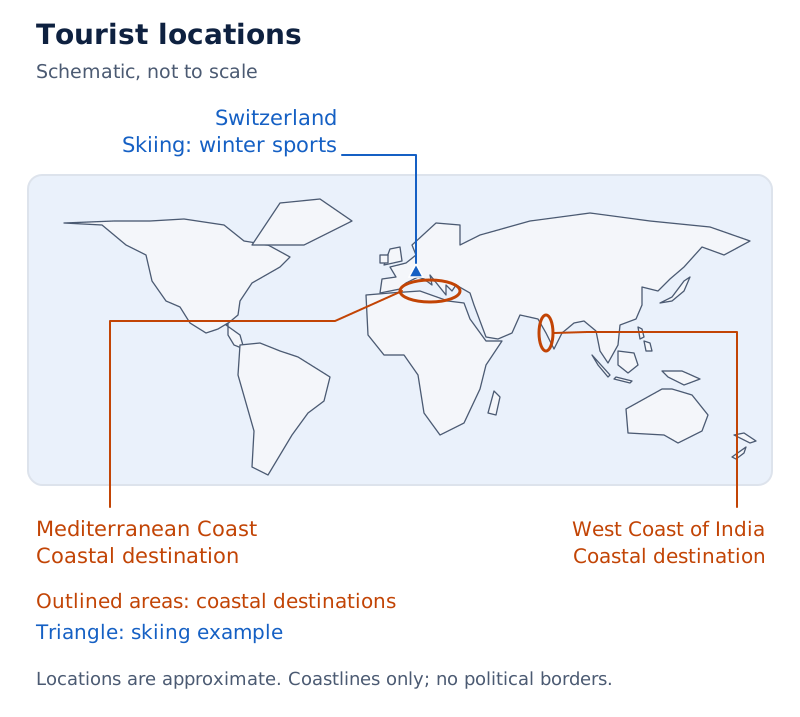
On an outline world map, label the Mediterranean Coast and the West Coast of India as popular tourist destinations. Identify Switzerland and label its skiing example. Use written labels to distinguish coastal destinations from the winter sports example.
Drawn by One Young India.
What makes a place attractive to tourists?
Tourist attractions include climate, landscape, history and art, and culture and economy. These factors explain why visitors choose different destinations. A warm beach holiday and a skiing holiday, for example, require different climatic conditions.
How do climate and landscape attract visitors?
Climate is important because most people from colder regions expect warm, sunny weather for beach holidays. This is one of the main reasons tourism is important in Southern Europe and the Mediterranean lands.
The Mediterranean climate offers almost consistently higher temperatures than other parts of Europe, long sunshine hours and low rainfall throughout the peak holiday season. People taking winter holidays seek either temperatures higher than those at home or snow cover suitable for skiing.
Landscape attracts many visitors seeking an appealing environment. This often means mountains, lakes, spectacular sea coasts and landscapes not completely altered by people. The attraction is the character of the environment in which the holiday is spent.
How do history, culture and cost influence tourism?
History and art have potential attractiveness. Visitors explore ancient or picturesque towns, archaeological sites, castles, palaces and churches. These attractions draw attention to the historical and artistic character of a place.
Culture and economy attract tourists interested in ethnic and local customs. A region that meets tourists' needs at a cheap cost is likely to become very popular. This is a likelihood, rather than a guarantee that low prices will make every destination successful.
Home-stay, accommodation for visitors in homes, has emerged as a profitable business. Examples include heritage homes in Goa, Madikere and Coorg in Karnataka. Such accommodation belongs within the discussion of culture, local experience and the economic provision of tourist services.
How does medical tourism connect health care with international services?
Definition: Medical tourism combines medical treatment with international tourism activity. It connects the provision of health care with travel across countries.
Case study: What does India show about medical services for overseas patients?
About 55,000 patients from the United States of America (U.S.A.) visited India for treatment in 2005. This was a small number compared with the millions of surgeries performed each year in the United States healthcare system.
| Feature of the patient example | Detail |
|---|---|
| Country from which patients travelled | United States of America |
| Country visited for treatment | India |
| Year | 2005 |
| Number of visiting patients | About 55,000 |
India has emerged as the leading country of medical tourism in the world. World-class hospitals in metropolitan cities, meaning major urban centres, cater to patients from across the world. Medical tourism brings abundant benefits to developing countries like India, Thailand, Singapore and Malaysia.
How can medical work itself be contracted out?
Outsourcing, or contracting out, means giving work to an outside agency to improve efficiency and reduce costs. Beyond medical tourism, medical tests and the interpretation of data are also outsourced.
Hospitals in India, Switzerland and Australia perform certain medical services, from reading radiology images to interpreting Magnetic Resonance Images (MRIs) and ultrasound tests. These are examples of interpreting medical images or test results.
Outsourcing holds tremendous advantages for patients if it focuses on improving quality or providing specialised care. The condition matters: the advantage is tied to the purpose and quality of the service, rather than being asserted without qualification.
How do quaternary and quinary activities differ?
Quaternary activities are knowledge-oriented services involving the collection, production and dissemination of information. Dissemination means spreading information. These activities centre on research and development and may be seen as advanced services involving specialised knowledge and technical skills.
The quaternary and tertiary sectors have replaced most primary and secondary employment as the basis of economic growth. Over half of workers in developed economies belong to the knowledge sector, the information-based part of service work.
What kinds of work belong to the quaternary sector?
Demand for information-based services has grown very rapidly. Examples include mutual fund managers, who manage pooled investments; tax consultants, who advise on taxes; software developers, who develop computer programs; and statisticians, who analyse numerical information. The range includes work in offices, elementary schools, university classrooms, hospitals, doctors' offices, theatres, and accounting and brokerage firms, which respectively handle financial accounts and arrange transactions.
The shared emphasis of these information-based services is knowledge and information rather than direct processing of physical raw materials. They include work carried out in educational, medical, financial and other service settings.
Like some tertiary functions, quaternary work can be outsourced. It is not tied to resources, affected by the environment, or necessarily localised by the market. Specialised knowledge can therefore be provided through arrangements that extend beyond a local market.
What makes quinary work distinctive?
Quinary activities are performed by the highest level of decision makers or policy makers. They focus on creating, rearranging and interpreting new and existing ideas, interpreting data, and using and evaluating new technologies.
They are often called gold collar professions. They represent specialised, highly paid skills of senior business executives, government officials, research scientists, and financial and legal consultants. Their importance in advanced economies far outweighs their numbers.
| Basis | Quaternary activities | Quinary activities |
|---|---|---|
| Central emphasis | Information, research, development and specialised knowledge | Highest-level decisions, policy, ideas and evaluation of technology |
| Illustrative work | Software development, statistics and university teaching | Senior business leadership, government policy and research science |
| Economic importance | Very high growth in demand for information-based services | Influence on advanced economies far outweighing the number of workers |
Why is work outsourced, and what effects can follow?
Outsourcing seeks greater efficiency and lower costs by placing work with an outside agency. Off-shoring is outsourcing that transfers work to overseas locations. Although the terms are used together, overseas transfer is the specific feature of off-shoring.
Outsourced activities include information technology (IT), the use of technology for information-related work; human resources, which concerns personnel; customer support; and call centre services. At times, manufacturing and engineering are also outsourced.
How do lower costs encourage overseas contracting?
- Companies give work to outside agencies to improve efficiency and reduce costs.
- Data processing can be carried out in Asian, East European and African countries, where IT-skilled staff with good English are available at lower wages than in developed countries.
- Overhead costs, the general costs of running a business, are also much lower in these locations.
- Lower wages and overhead costs make overseas job-work profitable, including in India, China and a less populous country such as Botswana.
Outsourcing has opened many call centres in India, China, Eastern Europe, Israel, the Philippines and Costa Rica. It has created jobs where cheap and skilled workers are available. These are also countries from which workers migrate out.
Diagram
Locations of outsourced call centres
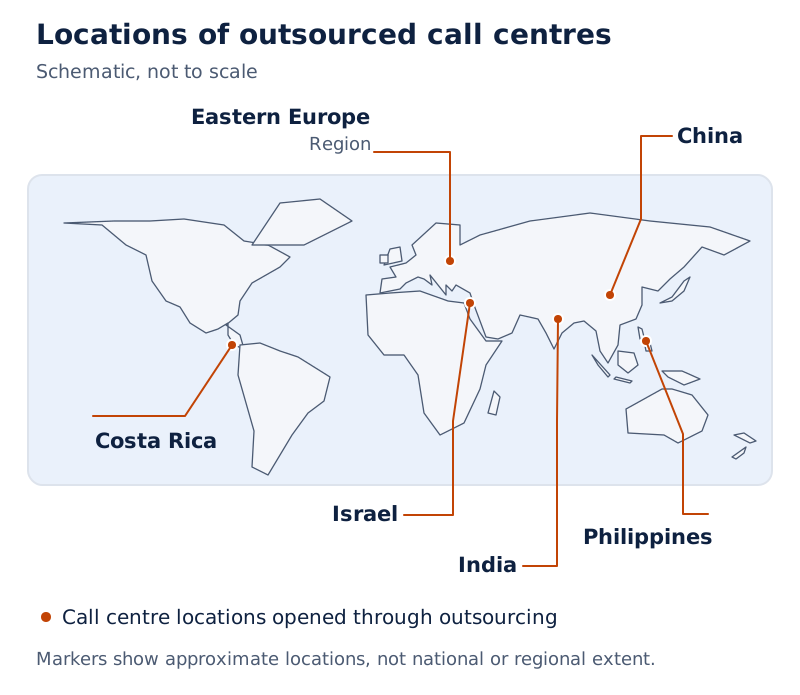
On an outline world map, identify India, China, Israel, the Philippines and Costa Rica, and label Eastern Europe as a region. Give the map a key identifying these places as locations where outsourcing has opened call centres.
Drawn by One Young India.
With outsourced work available, migration from these countries may come down. Countries sending work abroad face resistance from job-seeking youths. The comparative advantage, meaning the relative cost advantage supporting these arrangements, is the main reason outsourcing continues.
What distinguishes knowledge processing outsourcing?
Knowledge Processing Outsourcing (KPO) is information-driven knowledge outsourcing involving highly skilled workers. It is distinct from Business Process Outsourcing (BPO), the contracting out of business processes. KPO enables companies to create additional business opportunities.
Examples of KPO include research and development, e-learning or electronically delivered learning, business research, intellectual property research, the legal profession and banking. Intellectual property concerns creations of the mind. The emphasis in these services is the use of specialised knowledge.
Another trend is home shoring, using home-based workers linked through communication technology. It is an alternative to outsourcing.
Note: Outsourcing is broader than off-shoring. Nor does it make reduced migration certain: jobs created through outsourcing may reduce the need for workers to migrate.
What is the digital divide, and where does it occur?
Definition: The digital divide is the gap in access to and benefits from Information and Communication Technology (ICT). ICT brings together technologies used to handle information and communicate it.
Opportunities created by ICT-based development are unevenly distributed across the globe. Countries differ widely in economic, political and social conditions. The deciding factor is how quickly they can provide their citizens with access to ICT and its benefits.
How does the divide operate at different scales?
Developed countries in general have surged forward, while developing countries have lagged behind. This difference is the international digital divide. The phrase “in general” describes a broad pattern rather than an identical situation in every country.
Digital divides also occur within countries. In large countries such as India or Russia, it is inevitable that certain areas, such as metropolitan centres, possess better connectivity and access to the digital world than peripheral rural areas, meaning rural areas away from the main centres.
The divide therefore concerns both differences between countries and differences between areas within a country. Recognising both scales helps explain why the benefits of information-based development are distributed unevenly.
What the figure shows
“Where Will it All Lead to?” cartoon
A person stands near the top of a ladder labelled Primary, Secondary, Tertiary, Quaternary and Quinary. The cartoon asks “Is this the beginning or the end?” and “What Next?”
Reference: NCERT Class 12, page 52
Glossary
- Tertiary activities — Economic activities providing commercial services rather than directly processing physical raw materials into tangible goods.
- Trading centre — A town or city where buying, selling and related trading services take place.
- Periodic market — A market held on specified dates at intervals to meet locally accumulated demand.
- Retail trading — The business of selling goods directly to consumers through stores or non-store arrangements.
- Wholesale trading — Bulk business conducted through intermediary merchants and supply houses rather than through retail stores.
- Time distance — The time taken to travel from place to place along a particular route.
- Isochrone line — A line on a map joining places equal in the time taken to reach them.
- Node — A route meeting point, origin, destination or sizeable town located along a transport route.
- Link — A road that joins two nodes within a transport network connecting different places.
- Tourism — Travel undertaken for recreation rather than business, supported by services meeting visitors' needs.
- Medical tourism — The combination of medical treatment with international tourism activity involving travel across countries.
- Quaternary activities — Knowledge-oriented services involving information, research and development, specialised knowledge and technical skills.
- Quinary activities — Highest-level decision-making and policy services involving ideas, data interpretation and evaluation of technologies.
- Outsourcing — Giving work to an outside agency to improve efficiency and reduce the costs involved.
- Digital divide — Unequal access to ICT and its benefits between countries or between areas within countries.
Common errors and misconceptions
- Misconception: Services produce no economic output because they do not manufacture physical goods. Correct: Tertiary activities produce services that are consumed, and their output is indirectly measured through wages and salaries.
- Misconception: Retail trade requires a permanent shop. Correct: Most retailing uses fixed establishments, but handcarts, door-to-door selling, vending machines and internet selling are also retail activities.
- Misconception: Every large retailer must buy through a wholesaler. Correct: Most retail stores obtain supplies through intermediaries, but some large stores, including chain stores, buy directly from manufacturers.
- Misconception: An isochrone joins places at equal physical distances. Correct: It joins places equal in travel time. Actual route length, travel time and travel expense are different measures.
- Misconception: New technology has completely separated all communication from transport. Correct: All forms are not fully disassociated, because older systems are cheap and post offices continue to handle very large mail volumes.
- Misconception: Tourism is seasonal in every region. Correct: It is seasonal in some regions because of weather-dependent vacations, but many regions attract visitors throughout the year.
- Misconception: Outsourcing necessarily sends work overseas and certainly reduces migration. Correct: Overseas transfer specifically means off-shoring. Outsourced employment may reduce migration; the outcome is not certain.
- Misconception: The digital divide exists solely between developed and developing countries. Correct: It also exists within countries, including between metropolitan centres and peripheral rural areas in India or Russia.
Exam-style questions with model answers
Q1. Goods are sold directly to consumers through fixed shops, handcarts and the internet. Identify the trading activity and explain why all these arrangements belong to it. [2 marks]
- This is retail trading, defined by the sale of goods directly to consumers.
- Both fixed shops and non-store methods such as handcarts and internet selling qualify because each sells directly to the consumer.
Q2. A route can be described by its actual length, the time taken to travel along it, and the expense of the journey. Name and explain the three measures of transport distance represented by these descriptions. [3 marks]
- Kilometre distance measures the actual route length. It describes the physical length of the route along which a journey takes place.
- Time distance measures how long travel along the particular route takes. Its focus is the journey's duration rather than its physical length.
- Cost distance measures the expense of travelling along the route. It expresses distance in terms of the financial cost of the journey.
Q3. Rural marketing centres serve nearby settlements, collect and distribute goods locally, contain mandis in most cases, and have poorly developed professional services. Urban centres offer ordinary and specialised goods, manufactured products, labour and housing markets, and educational and professional services. Compare the centres on four bases using this information. [4 marks]
- Needs served: Rural centres meet the needs of nearby settlements, while urban centres supply ordinary goods as well as more specialised requirements.
- Goods handled: Rural centres collect and distribute goods locally; urban centres offer manufactured goods among their wider range of products.
- Markets: Most rural centres contain mandis, or wholesale markets; urban centres include specialised markets for labour and housing.
- Professional provision: Rural centres have poorly developed professional services, while urban centres provide educational institutions and professional services.
Q4. Tourists seek warm sunny beaches or snow for skiing, attractive mountains and lakes, ancient towns and castles, and experiences of local customs. Regions meeting tourists' needs cheaply are likely to become popular. Explain four categories of attraction using these details. [4 marks]
- Climate: Different holidays require different conditions, including warm sunshine for beach visits and suitable snow cover for skiing.
- Landscape: Attractive mountains and lakes encourage tourists to spend holidays in an appealing natural environment.
- History and art: Ancient towns and castles provide historical and artistic interest that attracts visitors to explore them.
- Culture and economy: Local customs appeal to visitors seeking cultural experience, while meeting their needs cheaply makes popularity more likely.
Q5. Transport physically moves people, materials and manufactured goods; supports production, distribution and consumption; and significantly enhances material value at each stage. Efficient transport also spreads physically carried messages. Mobile telephony and satellites allow rapid communication independent of transport, although older systems continue because they are cheap. Explain five contributions of transport and communication using this information. [5 marks]
- Mobility: Transport meets the need for movement by physically carrying people, materials and manufactured goods between locations where they are required.
- Economic support: Transport assists production, distribution and consumption, connecting the movement of goods with these different parts of economic activity.
- Value enhancement: Transportation significantly enhances the value of material at each stage of the system through its movement between locations.
- Message circulation: Efficient transport networks help physically carried messages spread. Older communication systems continue to operate because they are cheap.
- Rapid communication: Mobile telephony and satellites enable communication independent of physical transport, allowing messages to move rapidly across distance.
Q6. About 55,000 patients from the United States of America visited India for treatment in 2005. Medical tourism combines treatment with international tourism. Hospitals also outsource tests and data interpretation, with advantages for patients if quality improves or specialised care is provided. Explain medical tourism, the patient example and the condition attached to outsourcing benefits. [3 marks]
- Medical tourism combines medical treatment with international tourism activity, linking health services to travel from one country to another.
- Patient example: About 55,000 patients from the United States of America visited India for treatment in 2005; the count is approximate.
- Condition: Outsourced tests and data interpretation offer advantages for patients if they focus on improving quality or providing specialised care.
Q7. One service activity collects and disseminates information using specialised knowledge. Another involves the highest-level policy decisions and evaluation of new technologies. Identify and distinguish the two activity types. [2 marks]
- The first is quaternary activity, centred on information and specialised knowledge.
- The second is quinary activity, distinguished by the highest-level decision-making, policy and evaluation of technology.
Q8. Outsourcing gives work to outside agencies to improve efficiency and reduce costs. Overseas transfer is off-shoring. Receiving countries offer skilled workers at lower wages and have lower overhead costs. New jobs may reduce migration, while job-seeking youths in countries sending work abroad resist it. Explain five features or effects using these facts. [5 marks]
- Purpose: Outsourcing places work with an outside agency to improve the efficiency of the activity and reduce the costs involved in performing it.
- Overseas transfer: Off-shoring specifically describes outsourcing to overseas locations, so the international movement of work is what distinguishes this arrangement.
- Cost advantage: Skilled labour at lower wages, combined with lower overhead costs, makes receiving countries attractive places for outsourced work.
- Employment and migration: Outsourcing creates employment in receiving countries. With work available there, migration from these countries may come down.
- Resistance: Job-seeking youths in the countries sending work abroad resist outsourcing, showing that the movement of work can provoke opposition.
Q9. ICT opportunities are unevenly distributed. Developed countries in general have advanced faster than developing countries. Within India and Russia, metropolitan centres have better connectivity than peripheral rural areas. How quickly countries provide ICT access and benefits is the deciding factor. Explain the digital divide at two scales and identify that deciding factor. [3 marks]
- International scale: Developed countries in general have moved ahead while developing countries have lagged behind in access to ICT-based opportunities.
- Within-country scale: In India and Russia, metropolitan centres have better connectivity and access to the digital world than peripheral rural areas.
- Deciding factor: The speed at which countries provide their citizens with ICT access and benefits determines their progress in accessing these opportunities.
Key takeaways
- Tertiary activities provide commercial services, with specialised skills, experience and knowledge playing a larger role than manufacturing techniques.
- Retail trade sells directly to consumers, while wholesale trade involves bulk business through intermediary merchants and supply houses.
- Rural marketing centres meet nearby needs, whereas urban centres provide ordinary goods alongside more specialised markets and professional services.
- Transport distance includes route length, travel time and travel cost; isochrone lines join places equal in travel time.
- Tourism supports accommodation, meals, transport, entertainment, retailing and crafts; its seasonality varies between regions and their weather conditions.
- Quaternary work centres on knowledge and information, while quinary work involves the highest levels of decisions and policy.
- Outsourcing aims to improve efficiency and reduce costs; off-shoring specifically transfers work overseas, and resulting employment may reduce migration.
- The digital divide concerns uneven ICT access between countries and within countries, including differences between metropolitan and peripheral rural areas.
Test yourself
Why can a teacher's work count as production within the tertiary sector?
Production includes providing services that are consumed. Teaching provides a service, and service output is indirectly measured through wages and salaries.
Why do periodic markets move between different places?
They operate on specified dates at different places, meeting accumulated local demand while keeping shopkeepers busy and serving a large area.
How can a wholesaler's credit affect a retail store?
Wholesalers often extend credit so extensively that a retailer operates very largely on the wholesaler's capital.
What is a node, and what is a link?
A node is a route meeting point, origin, destination or sizeable town along a route. A link is a road joining two nodes.
Why might a golf course locate away from the Central Business District?
A golf course would choose a site where land costs are lower than in the Central Business District.
What different conditions might people seek for winter holidays?
They may seek temperatures higher than those at home or snow cover suitable for skiing.
What distinguishes KPO from BPO?
Knowledge Processing Outsourcing involves highly skilled workers and information-driven knowledge work. It is distinct from Business Process Outsourcing and enables additional business opportunities.
Why does better national connectivity not eliminate every digital divide?
Digital divides also exist within countries. Metropolitan centres in India or Russia possess better connectivity and digital access than peripheral rural areas.
Write about it
Turn a question from this chapter into a paper.
The Writing Studio has a structure guide, a rubric and citation tools for 15 formats, from essays to research papers. Drafting is free with an account. Learnacy Essential adds feedback from an AI writing coach and submission to The OYI Review.
Learnacy Essential is ₹1,499 for the year. Publication depends on review and is not guaranteed.