
Environment and Sustainable Development | CBSE Class 12 Economics Notes
On this page
Watch & explore
Start with a few high-quality watches, then dive into the notes below.
Try an idea before you read. Test your understanding of environmental challenges and sustainable development concepts. Explore →
This note covers the meaning and functions of the environment, resource limits, environmental crisis, global warming, ozone depletion, India's environmental challenges, forest conservation, pollution control, sustainable development, intergenerational equity and strategies for conserving resources while meeting human needs.
What is the environment, and how does it support economic life?
The environment comprises our entire planetary inheritance and all its resources. It includes living and non-living components that influence one another. Understanding it therefore requires studying relationships between its parts, rather than treating land, water, plants and animals as isolated resources.
How do biotic and abiotic components differ?
Biotic components are living elements, including birds, animals, plants, forests and fisheries. Abiotic components are non-living elements, including air, water, land, rocks and sunlight. Economic activity depends on both groups and on the connections between them.
A product's connection with nature may be hidden by industrial processing. Books require paper, which comes from trees. Cotton cloth begins with a plant. Machinery uses iron obtained from mineral deposits. Production transforms natural resources; it does not remove our dependence on them.
What are the four environmental functions?
| Function | Meaning | Illustration |
|---|---|---|
| Supplying resources | Providing inputs for production and consumption | Forest trees, ocean fish and fossil fuels |
| Assimilating waste | Absorbing the waste produced by human activity | Absorption of wastes within environmental capacity |
| Sustaining life | Maintaining genetic diversity and biodiversity | Living species and the conditions supporting them |
| Providing aesthetic services | Offering natural beauty that people enjoy | Scenery and landscapes |
Renewable resources can maintain a continuing supply through regeneration. Trees in forests and fish in oceans are examples. Non-renewable resources become exhausted through extraction and use; fossil fuels illustrate this category.
Note: Renewable does not mean safe from overuse. A continuing supply depends on respecting regeneration. Taking resources faster than they can regenerate undermines the environmental conditions that make continued use possible.
The four functions belong together. An economy needs materials, but it also needs waste absorption and life-supporting conditions. Increasing the supply of goods while damaging these other functions can weaken the environmental foundation on which production and human well-being depend.
Why do carrying capacity and supply-demand reversal matter?
Definition: Carrying capacity is the limit within which the environment can continue its functions: resource extraction must remain within regeneration, and waste generation must remain within waste-assimilating capacity.
Absorptive capacity means the environment's ability to absorb degradation. It concerns the waste side of the problem. Carrying capacity also brings in the resource side, so the two expressions should not be treated as completely interchangeable.
How does an environmental crisis develop?
- Population growth and high levels of production and consumption increase the demand for environmental resources and services.
- Extraction can become faster than the regeneration of renewable resources, while continued use exhausts non-renewable resources.
- Waste generation can exceed the environment's capacity to absorb it, causing environmental quality to deteriorate.
- The environment then fails to perform its vital life-sustaining function, bringing resource depletion and pollution together in an environmental crisis.
Rising population in developing countries and affluent consumption and production in developed countries both create pressure. The problem cannot be explained through population alone. The amount and character of resource use also matter.
What changed in the supply-demand relationship?
In the early stages of civilisation, demand for environmental resources and services was relatively small compared with their availability. Resource extraction remained below regeneration, and pollution remained within absorptive capacity. Environmental services therefore did not face the present degree of scarcity.
Population expansion and industrialisation increased demands for production and consumption. Overuse and misuse limited the available supply of environmental resources and services. This supply-demand reversal explains why waste disposal, pollution and resource scarcity became pressing economic concerns.
Pollution and the drying of rivers and aquifers also make water an economic good. Access to usable water can no longer be taken for granted when environmental damage reduces its availability.
Why are the opportunity costs high?
Resource exhaustion requires spending on research and technology to find alternatives. Deteriorating air and water quality raises health expenditure through respiratory and water-borne diseases. Global warming and ozone depletion create further financial commitments for governments.
These commitments carry an opportunity cost: resources devoted to correcting environmental damage cannot simultaneously serve other uses. Environmental degradation therefore imposes costs beyond the immediate loss of clean air, water or natural resources.
Photograph: Himalayan stream (NCERT Class 11 Figure 7.1). The photograph shows water flowing among rocks, with wooded slopes and snow-covered mountains behind it. Its caption identifies small, snow-fed Himalayan streams as among the few remaining unpolluted fresh-water sources.
How does global warming arise, and what can it cause?
Global warming is a gradual rise in the average temperature of the earth's lower atmosphere associated with increased greenhouse gases since the Industrial Revolution. Much of the recent observed and projected warming is human-induced.
What produces the warming effect?
Carbon dioxide and methane are gases that can absorb heat. Adding more of these gases to the atmosphere, with no other changes, warms the earth's surface. Burning fossil fuels and deforestation contribute to increased greenhouse-gas concentrations.
Among the activities that may contribute are burning coal and petroleum products, releasing methane from animal waste, and increased cattle production. Cattle production contributes through methane production, deforestation and the use of fossil fuels.
Historical comparisons with pre-industrial levels since 1750 include increases of 31 per cent in atmospheric carbon dioxide and 149 per cent in methane. These figures describe increases in concentrations relative to a baseline, rather than each gas's percentage share of the atmosphere.
Diagram
Increases in greenhouse-gas concentrations
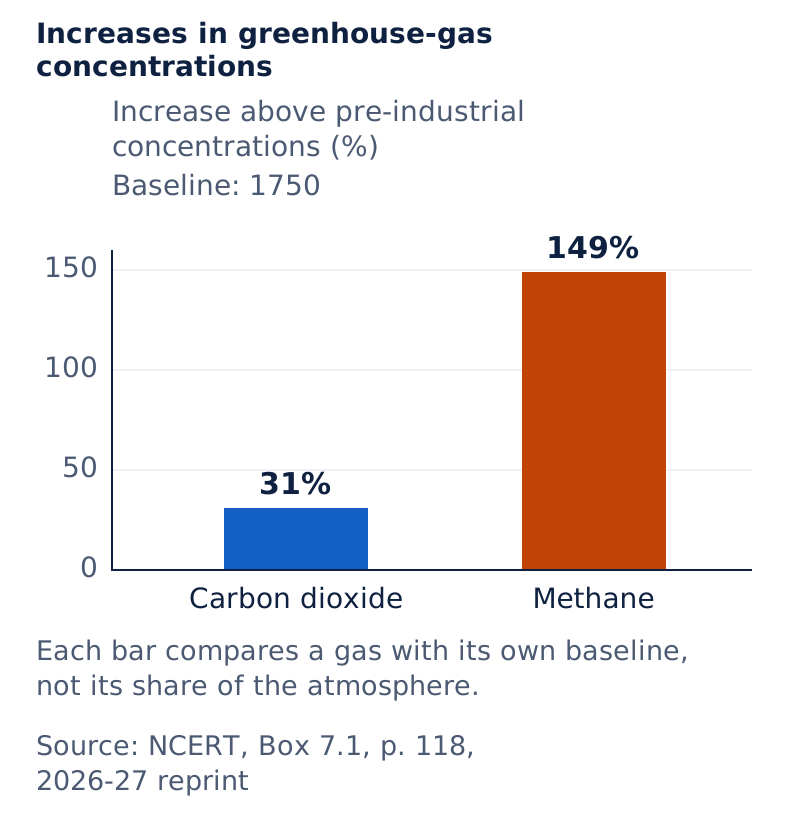
Draw a bar graph with carbon dioxide and methane on the horizontal axis and percentage increase above pre-industrial concentrations since 1750 on the vertical axis. Start the vertical scale at zero and label the bars 31 per cent and 149 per cent respectively.
Methane shows the larger percentage increase relative to its own baseline. The bars compare proportional increases in concentrations, not the gases’ shares of the atmosphere or their contributions to warming.
Drawn by One Young India.
What are the longer-term consequences?
- Melting polar ice can raise sea levels and contribute to coastal flooding.
- Changes in snow melt can disrupt drinking-water supplies that depend on it.
- Species can become extinct as the ecological conditions supporting them disappear.
- Tropical storms can become more frequent.
- The incidence of tropical diseases can increase.
These consequences link environmental change with human welfare. Drinking-water supplies, settlements, biodiversity and health are affected, so global warming also places demands on economic resources and public action.
A United Nations climate-change conference in Kyoto, Japan, in 1997 produced an international agreement to combat global warming. It called for industrialised nations to reduce greenhouse-gas emissions, connecting international environmental cooperation with changes in emissions.
How is ozone depletion different from global warming?
Ozone depletion means a reduction in the amount of ozone in the stratosphere. The ozone layer prevents most harmful wavelengths of ultraviolet radiation from passing through the atmosphere. A reduction in this protection allows more harmful radiation to reach the earth.
Which substances damage the ozone layer?
High levels of chlorine and bromine compounds in the stratosphere cause the problem. Chlorofluorocarbons, abbreviated as CFCs, have been used in air-conditioners, refrigerators and aerosol propellants. Bromofluorocarbons, called halons, have been used in fire extinguishers.
Ultraviolet radiation, abbreviated as UV radiation, seems responsible for skin cancer in humans. It also reduces phytoplankton production, affecting other aquatic organisms, and can influence the growth of terrestrial plants. These are different effects from the warming caused by heat-absorbing gases.
| Basis | Global warming | Ozone depletion |
|---|---|---|
| Main change | Rising average temperature of the lower atmosphere | Reduced ozone in the stratosphere |
| Central mechanism | Increased concentrations of heat-absorbing gases | Damage associated with chlorine and bromine compounds |
| Consequences | Sea-level rise, coastal flooding and ecological disruption | Greater UV exposure and harm to living organisms |
| International response | The 1997 Kyoto agreement sought emission reductions | The Montreal Protocol addressed ozone-depleting substances |
An ozone-layer reduction of approximately 5 per cent from 1979 to 1990 generated concern. The Montreal Protocol banned CFC compounds and other ozone-depleting chemicals, including carbon tetrachloride, trichloroethane, also called methyl chloroform, and halons.
What natural wealth and environmental challenges does India have?
India possesses rich soils, rivers and tributaries, forests, mineral deposits, mountains and a vast oceanic stretch. These resources support agriculture, industry and human life. Their abundance, however, does not mean that their supply is unlimited or immune to degradation.
How do natural resources support production?
| Resource or region | Economic or environmental significance |
|---|---|
| Black soil of the Deccan Plateau | Particularly suitable for cotton cultivation, supporting a concentration of textile industries |
| Indo-Gangetic plains | Among the world's fertile, intensively cultivated and densely populated regions |
| Forests | Provide green cover and natural cover for wildlife, although unevenly distributed |
| Iron ore, coal and natural gas | Large deposits provide resources for economic activity |
| Other mineral deposits | Include bauxite, copper, chromate, diamonds, gold, lead, lignite, manganese, zinc and uranium |
Developmental pressure occurs when economic activities place growing demands on finite resources. It affects environmental quality as well as human health and well-being. Resource wealth and environmental crisis can therefore exist together.
Why is India's environmental problem a dichotomy?
The dichotomy consists of two simultaneous threats: degradation associated with poverty, and pollution associated with affluence and rapid industrial growth. Protecting the environment requires recognising both, rather than placing responsibility entirely on one group.
Pressing concerns include air pollution, contaminated water, soil erosion, deforestation and wildlife extinction. The priority areas are land degradation, biodiversity loss, urban air pollution with particular attention to vehicles, fresh-water management and solid-waste management.
These priorities concern different environmental functions. Resource management protects the materials and water required for life and production. Controlling pollution protects waste-assimilating and life-supporting capacity. Conserving forests and wildlife protects biodiversity as well as natural cover.
Photograph: Deforestation (NCERT Class 11 Figure 7.3). The photograph shows cut tree stumps, fallen wood and some standing trees. The caption links deforestation with land degradation, biodiversity loss and air pollution.
Why is land degradation a serious problem in India?
Land degradation involves deterioration associated with unstable resource use and inappropriate management. India's land must support agriculture, forests, grazing, settlements and industry. Competing demands place pressure on a finite geographical area.
Which practices contribute to degradation?
- Deforestation removes vegetation, while unsustainable extraction of fuelwood and fodder increases pressure on remaining cover.
- Shifting cultivation and encroachment into forestland contribute to degradation.
- Forest fires and overgrazing damage vegetation and land.
- Failure to adopt adequate soil-conservation measures and improper crop rotation weaken land management.
- Indiscriminate use of fertilisers and pesticides creates further environmental damage.
- Poor planning and management of irrigation systems contribute to the problem.
- Groundwater extraction beyond recharge capacity places excessive pressure on water resources.
- Open-access resources and poverty among people dependent on agriculture are also contributing factors.
These causes combine physical damage with economic pressures. Removing vegetation is a direct change to the land. Poverty and competing uses affect how intensely resources are used. An adequate explanation therefore includes management practices and the pressures shaping them.
How do resource pressures show up in the background estimates?
| Indicator | Background estimate | Meaning |
|---|---|---|
| Share of world human population supported | Approximately 17 per cent | A large demand for land and resources |
| Share of world livestock population supported | Approximately 20 per cent | Additional pressure from animals and their requirements |
| Share of world geographical area | 2.5 per cent | A comparatively limited physical area |
| Per-person forestland availability | 0.06 hectare | Less than the stated 0.47 hectare requirement for basic needs |
| Forest extraction beyond the permissible limit | About 15 million cubic metres | Pressure associated with excess felling |
Diagram
Forestland availability and basic-needs requirement in India
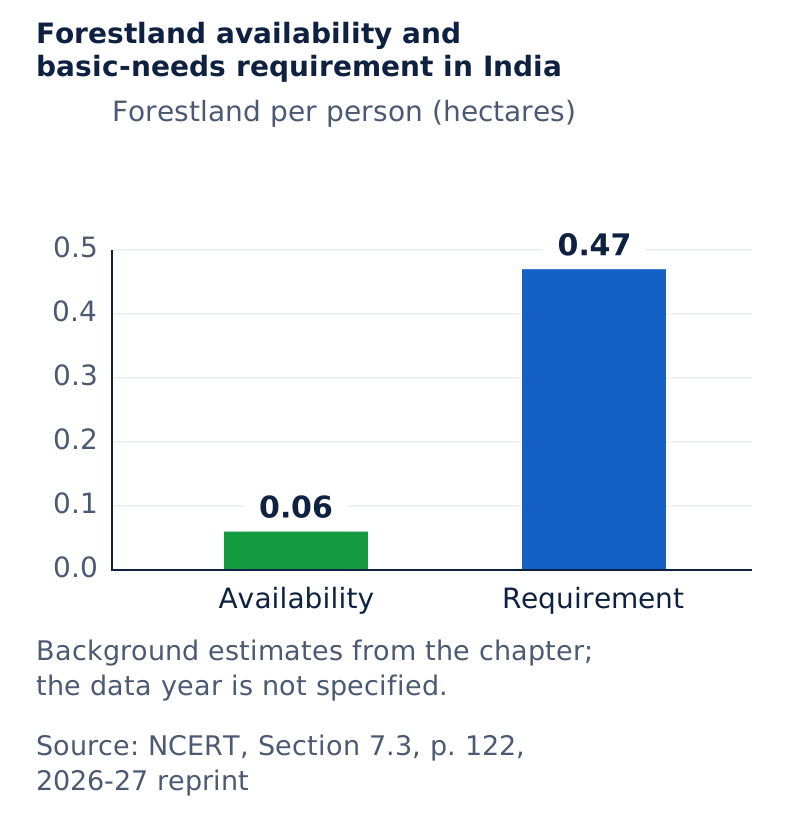
Draw two bars labelled Availability and Requirement on the horizontal axis. Label the vertical axis Forestland per person (hectares), beginning at zero. Use the same scale for both bars and mark their heights as 0.06 and 0.47 hectare respectively.
These background estimates show that forestland available per person is below the amount required to meet basic needs. The comparison illustrates pressure on forest resources; it is not a time series showing changes in forest cover.
Drawn by One Young India.
These background estimates illustrate the imbalance between resource demands and available land. They should not be mistaken for measurements of the present year's population or forest resources.
Soil erosion also removes valuable nutrients, including nitrogen, phosphorus and potassium. The damage therefore extends beyond the visible loss of soil: the productive resource base is weakened as material needed for agriculture is carried away.
Note: Overuse and misuse are related but different. Groundwater extraction beyond recharge illustrates excessive use. Indiscriminate agro-chemical use and poorly managed irrigation illustrate damaging ways of using resources.
What does the Appiko movement show about forest conservation?
The Chipko movement sought to protect Himalayan forests. A similar movement in Karnataka became known as Appiko, meaning to hug. Its methods linked local participation with the protection of forests used by surrounding communities.
What happened in Salkani forest?
On 8 September 1983, tree felling began in Salkani forest in Sirsi district. A group of 160 men, women and children hugged trees and forced the woodcutters to leave. They maintained a vigil for the next six weeks.
The volunteers left after forest officials assured them that felling would follow scientific practices and the district's working plan. Stopping felling in this incident saved 12,000 trees. Within months, the movement spread to adjoining districts.
Which environmental concerns motivated the movement?
Commercial felling damaged natural forests. In the Uttar Kanara area, bamboo had disappeared twelve years after a paper mill was established. Removal of broad-leaved trees exposed soil to rain, leaving bare laterite soil after erosion.
Farmers complained of streams and rivers drying sooner, increasingly erratic rainfall, and previously unfamiliar diseases and insects attacking crops. These complaints connected forest damage with agriculture and everyday livelihoods.
Appiko volunteers wanted local consultation when trees were marked for cutting. They also sought restrictions against felling within 100 metres of a water source or on slopes of 30 degrees or above. These were the volunteers' demands, not a general statutory rule.
Worked example 1. Consider a paper mill employing 10,000 workers and a plywood factory employing 800 people, while their use of forest resources deprives a million people of daily necessities. Is employment alone enough to justify this use of forests?
Answer: No. Employment benefits must be considered alongside the loss of daily necessities for a million people. Sustainable development requires attention to basic needs, resource conservation and livelihoods. The employment figures alone do not establish that the development choice is acceptable.
This is a distributional question as well as a conservation question. Forest use must be assessed through its consequences for the people who depend on the resource, not merely through the employment generated by industries using it.
How do pollution and pollution control affect India's development?
Urban air pollution is strongly associated with vehicles. Industrial concentrations and thermal power plants also contribute to pollution in particular areas. Vehicular emissions are especially concerning because they occur at ground level and directly affect the general population.
The number of motor vehicles rose from about 3 lakh in 1951 to 35 crore in 2022. In 2022, two-wheelers and cars accounted for about 85 per cent of registered vehicles. These dated figures illustrate the scale of the transport-related challenge.
Photograph: Damodar Valley (NCERT Class 11 Figure 7.2). The photograph shows industrial buildings and tall chimneys. The caption connects heavy industries along the Damodar river with damaging pollution in the valley.
What do pollution control boards do?
The government established the Central Pollution Control Board, abbreviated as CPCB, in 1974. States subsequently established their own boards. Their responsibilities combine information, technical assistance, standards, research, monitoring and public awareness.
- Investigate pollution and collect and disseminate information about water, air and land pollution.
- Set standards for sewage, trade effluents and emissions, and provide technical assistance for preventing and controlling pollution.
- Conduct or support research and prepare manuals, codes and guidelines for treating and disposing of sewage and industrial effluents.
- Organise public-awareness programmes through mass media and supply technical and statistical information.
- Inspect industries through state-board district officials to assess treatment of effluents and gaseous emissions, while supplying background air-quality data for planning.
The water-monitoring network described by the background figures covers 125 rivers, including tributaries, as well as wells, lakes, creeks, ponds, tanks, drains and canals. CPCB also identified seventeen categories of large and medium industries as significantly polluting.
Worked example 2. A truck driver pays a challan of 10,000 rupees because the truck emits black soot. Explain the environmental reason for the penalty.
Answer: The 10,000 rupees penalty responds to the truck's polluting emissions. Vehicles are ground-level sources of urban air pollution, affecting people nearby. Penalising the emission addresses pollution control; the amount is part of this example, not a stated universal fine for every vehicle.
Worked example 3. Suppose 70 lakh cars are added each year to metropolitan roads. Which kind of resource faces depletion?
Answer: Non-renewable fossil-fuel resources face additional pressure as vehicles require fuel. The 70 lakh figure is a hypothetical annual addition, not an observed annual total. The amount of fuel depleted depends on fuel use per car.
Industrial development can bring unplanned urbanisation, pollution and accident risks. Pollution-control measures are therefore necessary, but lasting improvement also requires a broader development path that respects environmental limits.
What does sustainable development mean for present and future needs?
Definition: Sustainable development meets present needs while preserving future generations' ability to meet theirs. It connects improvements in human well-being with protection of the environmental resources that make those improvements possible.
The economy and environment are interdependent. Development that damages the environment can destroy the conditions sustaining life and production. Sustainable development seeks to give future generations the potential for an average quality of life at least as high as that enjoyed today.
Why are needs and distribution central?
The United Nations Conference on Environment and Development emphasised the concept. Our Common Future connected it with meeting everyone's basic needs and extending opportunities for a better life. Meeting these needs involves resource distribution and is therefore also a moral issue.
Edward Barbier stressed improved material living standards for poor people at the grass-roots level. Relevant improvements include income and real income, education, healthcare, sanitation and water supply. The aim is lasting, secure livelihoods with less resource depletion and environmental damage.
Sustainability consequently includes employment, food, energy, water and housing, particularly for the poor majority. It calls for growth in agriculture, manufacturing, power and services that meets these needs while limiting cultural disruption and social instability.
What is intergenerational equity?
Intergenerational equity concerns fairness between present and future generations. The Brundtland Commission emphasised protecting future generations. The present generation has an obligation to pass on environmental and quality-of-life assets at least as good as those it inherited.
Three connected responsibilities follow: conserve natural assets, preserve the regenerative capacity of ecological systems, and avoid imposing extra environmental costs or risks on future generations. Improving current living standards must be compatible with these responsibilities.
Protecting future welfare does not remove the urgency of present poverty. The definition brings both concerns together. Depriving today's poor of basic needs and exhausting tomorrow's resources are both inconsistent with development that can last.
In 2015, the United Nations formulated 17 Sustainable Development Goals, abbreviated as SDGs, intended for achievement by 2030. Sustainability thus forms part of a wider programme of development objectives.
What conditions does Herman Daly propose for sustainability?
Herman Daly, an environmental economist, identifies conditions that keep economic activity within environmental limits. They address population, technology, renewable resources, non-renewable resources and pollution. Together they explain how a commitment to future generations can influence present choices.
How does the plimsoll-line analogy work?
A ship's plimsoll line marks its loading limit. Carrying capacity plays a comparable role for the environment. Without an effective limit, the human scale of economic activity can exceed what the earth can sustain.
- Limit population pressure: keep the human population at a level within environmental carrying capacity.
- Improve input efficiency: technological progress should save inputs rather than continually increase their consumption.
- Respect regeneration: extraction of renewable resources should not exceed the rate at which they regenerate.
- Develop substitutes: depletion of non-renewable resources should not outpace the creation of renewable alternatives.
- Correct pollution inefficiencies: address the inefficiencies arising from pollution rather than allowing them to continue.
Why are the two resource rules different?
For renewable resources, the relevant comparison is extraction against regeneration. Continued use can be sustained only if the resource can replenish itself sufficiently. For non-renewable resources, the focus shifts to creating renewable substitutes as the original stock is depleted.
The non-renewable rule does not claim that fossil fuels regenerate at the rate they are used. It requires attention to alternatives. Likewise, input-efficient technology concerns the resources used to obtain development benefits, rather than technological change for its own sake.
These conditions complement social objectives. Resource conservation supports lasting livelihoods and helps avoid passing extra costs to future generations. Sustainability therefore requires both an improvement in human well-being and a pattern of resource use that can support it.
How can energy choices make development more sustainable?
Energy strategies must consider both the supply of power and its environmental effects. India's reliance on thermal and hydroelectric power creates specific problems. Thermal plants release carbon dioxide and produce fly ash, which can pollute water and land if improperly used.
Large hydroelectric projects inundate forests and disturb natural water flows in catchments and river basins. Wind and solar energy provide alternatives, while smaller projects and cleaner fuels can address particular local needs.
How do cleaner fuels help households and transport?
| Strategy | How it works | Environmental benefit |
|---|---|---|
| Liquefied petroleum gas, or LPG | Replaces wood, dung cakes and other biomass used in rural households; subsidies support access | Substantially reduces household pollution and minimises energy wastage |
| Gobar gas | Uses cattle dung to produce cooking fuel; loans and subsidies support plants | Provides fuel while retaining useful organic material as slurry |
| Compressed natural gas, or CNG | Used in Delhi's public transport and subsequently in other Indian cities | Its use has significantly reduced air pollution in Delhi |
The gobar-gas process connects energy and agriculture. Cattle dung enters the plant, gas is produced for fuel, and the remaining slurry serves as an organic fertiliser and soil conditioner. Dung therefore supplies energy while leaving a useful agricultural product.
Photograph: Gobar-gas plant (NCERT Class 11 Figure 7.4). The photograph shows a circular plant structure beside a rectangular opening, with vegetation around it. The caption identifies a plant using cattle dung to produce energy.
What are the roles of wind, solar power and mini-hydel plants?
Wind power uses moving air to turn turbines and generate electricity. It is suited to places where wind speeds are usually high. Initial costs are high, but the resulting benefits can absorb those costs.
Photovoltaic cells use special materials to capture solar energy and convert it into electricity. They are particularly useful in remote areas where grid connections are impossible or very costly. India is also leading the international body called the International Solar Alliance.
Mini-hydel plants use mountain streams to turn small turbines. A large percentage of these streams are perennial. Such plants supply local electricity, avoid changes to the local land-use pattern, and are more or less environment-friendly.
Meeting demand locally can remove the need for large transmission towers and cables and avoid transmission loss. This distinguishes mini-hydel projects from the forest inundation and water-flow disruption associated with large hydroelectric projects.
Delhi's sustainability measures also include solar street lighting and an odd/even vehicle scheme used during specified periods. The scheme restricts use according to whether registration numbers end in odd or even digits on alternating days.
How can traditional practices, composting and biopest control help?
Traditional knowledge offers approaches to agriculture, healthcare, housing and transport rooted in close relationships with the environment. Sustainable development includes considering these practices alongside changes in energy use and industrial technology.
What role does traditional knowledge play?
India has about 15,000 plant species with medicinal properties, with about 8,000 used regularly across treatment systems, including folk traditions. Ayurveda, Unani, Tibetan and folk systems illustrate this knowledge base.
The environmental relevance lies partly in approaches that do not require large-scale industrial and chemical processing. Traditional knowledge also represents rural heritage. Recognising its value broadens the choice of practices considered in development.
How does biocomposting address agricultural problems?
A strong shift towards chemical fertilisers damaged productive land, contaminated water, including groundwater, and increased irrigation demand. Biocomposting uses organic wastes to produce compost, bringing material back into agricultural use.
Cattle dung is an important fertiliser and soil conditioner. Earthworms convert organic material into compost faster than normal composting. This practice also benefits civic authorities by reducing the quantity of waste they must dispose of.
The connection is between waste management and soil care. Organic material that would otherwise require disposal becomes useful compost. The strategy therefore addresses both a pressure on public waste services and a need within agriculture.
How can pests be controlled with fewer chemical inputs?
Heavy chemical-pesticide use contaminated food, soil and water; milk, meat and fish were also affected. Biopest control includes plant-based pest-control products and protection of organisms that prey on pests. Neem supplies substances useful for controlling pests.
Mixed cropping and growing different crops in consecutive years on the same land have also helped farmers. These agricultural practices form part of the search for better pest-management methods.
| Organism | Contribution to pest control |
|---|---|
| Snakes | Prey on rats, mice and other pests |
| Owls and peacocks | Prey on vermin and pests around agricultural areas |
| Lizards | Also play a useful role in controlling pests |
Allowing useful animals and birds to live around agricultural areas supports their pest-control role. Resource conservation, waste reuse and protection of living organisms thus become practical parts of sustaining agricultural production and human welfare.
Glossary
- Environment — The total planetary inheritance, including resources and interacting living and non-living components.
- Biotic components — Living elements of the environment, including plants, birds, animals, forests and fisheries.
- Abiotic components — Non-living environmental elements, including air, water, land, rocks and sunlight.
- Renewable resources — Resources capable of maintaining a continuing supply through regeneration when extraction remains sustainable.
- Non-renewable resources — Resources that become exhausted through extraction and use, including fossil fuels.
- Carrying capacity — The limit within which resource extraction and waste generation remain environmentally sustainable.
- Absorptive capacity — The environment's ability to absorb degradation arising from waste and other pressures.
- Global warming — A gradual increase in average lower-atmosphere temperature associated with increased greenhouse-gas concentrations.
- Ozone depletion — A reduction of stratospheric ozone that allows more ultraviolet radiation to reach Earth.
- Sustainable development — Development meeting present needs while protecting future generations' ability to meet their needs.
- Intergenerational equity — Fairness between generations through protection of environmental resources and future quality of life.
- Biocomposting — Conversion of organic waste into compost useful for agriculture and soil care.
- Photovoltaic cells — Devices using special materials to capture solar energy and convert it into electricity.
- Biopest control — Pest-control approaches using plant products and organisms that naturally prey on pests.
Common errors and misconceptions
- Misconception: The environment supplies raw materials and nothing else. Correct: It also assimilates waste, sustains life through genetic diversity and biodiversity, and provides aesthetic services.
- Misconception: Renewable resources cannot be depleted. Correct: Their continued availability requires extraction to remain within regeneration; excessive use undermines that condition.
- Misconception: Population growth alone explains environmental crisis. Correct: Affluent consumption and production also increase pressure on resource supplies and waste absorption.
- Misconception: Global warming and ozone depletion are the same process. Correct: Warming concerns increased temperatures; ozone depletion concerns reduced stratospheric protection from ultraviolet radiation.
- Misconception: Sustainable development concerns future people alone. Correct: It also requires meeting present basic needs, particularly those of poor people, through lasting livelihoods.
- Misconception: Daly's non-renewable-resource rule requires fossil fuels to regenerate. Correct: Their depletion should not exceed the rate at which renewable substitutes are created.
- Misconception: The Appiko restrictions are universal legal rules. Correct: Consultation and restrictions near water sources and steep slopes were demands made by Appiko volunteers.
- Misconception: The truck example establishes a universal pollution fine. Correct: 10,000 rupees is the supplied challan amount in that particular discussion example.
Exam-style questions with model answers
Q1. State the four functions performed by the environment. [2 marks]
- It supplies renewable and non-renewable resources and assimilates wastes produced by human activities.
- It sustains life through genetic diversity and biodiversity, and provides aesthetic services such as natural scenery.
Q2. Explain how the supply-demand reversal of environmental resources creates an environmental crisis. [4 marks]
- Initially, demand for environmental resources and services was smaller than their availability. Extraction and waste generation remained within regeneration and absorption limits.
- Population growth, industrialisation and affluent consumption increased demand for production inputs and environmental services.
- Overuse and misuse limited resource availability, while growing waste placed pressure on absorptive capacity.
- Demand therefore came to exceed sustainable supply. Resource depletion and pollution weakened the environment's life-supporting function, producing an environmental crisis.
Q3. Explain sustainable development with reference to present basic needs, intergenerational equity and resource conservation. [6 marks]
- Sustainable development meets present needs while protecting future generations' ability to meet their own.
- Environmental protection and economic well-being are connected because the economy depends on environmental resources and services.
- Present needs include employment, food, energy, water and housing.
- Particular attention goes to the poor majority and to secure livelihoods that reduce absolute poverty.
- Intergenerational equity requires passing on quality-of-life assets at least as good as those inherited. Current improvements should not impose additional environmental costs or risks on future people.
- Conserving natural assets and protecting ecological regeneration help sustain those assets. Growth in agriculture, manufacturing, power and services must therefore meet human needs within environmental limits.
Q4. In Salkani forest, 160 people hugged trees on 8 September 1983 and kept vigil for six weeks. Felling stopped and 12,000 trees were saved. Volunteers sought local consultation and no felling within 100 metres of water sources or on slopes of 30 degrees or above. Identify the movement and explain its conservation approach. [4 marks]
- This was Appiko in Karnataka, a movement similar to the Himalayan Chipko movement. Appiko means to hug.
- Hugging trees and maintaining a vigil prevented immediate felling, saving the 12,000 trees identified in the question.
- Consultation would involve local people in decisions affecting forests on which their livelihoods depended.
- The proposed restrictions near water and on steep slopes sought to limit damaging felling. They were conservation demands made by volunteers, rather than universal legal provisions.
Q5. Distinguish global warming from ozone depletion by explaining their meanings, causes and effects. [4 marks]
- Global warming is a gradual increase in average lower-atmosphere temperature. Increased heat-absorbing gases, associated with fossil-fuel burning and deforestation, contribute to it.
- Its possible consequences include polar-ice melting, sea-level rise, coastal flooding and disruption of water supplies and ecological conditions.
- Ozone depletion is a reduction in stratospheric ozone associated with chlorine and bromine compounds, including those originating in CFCs and halons.
- It allows more ultraviolet radiation to reach Earth, harming living organisms, lowering phytoplankton production and potentially affecting terrestrial plant growth.
Q6. Explain the five conditions for sustainable development proposed by Herman Daly. [5 marks]
- Human population should remain within environmental carrying capacity. The economy must respect this limit, just as a ship must respect its loading limit.
- Technological progress should be input-efficient. It should reduce the pressure of input consumption rather than continually intensify it.
- Renewable-resource extraction should not exceed regeneration. Continued use must leave sufficient capacity for the resource to replenish itself.
- Non-renewable-resource depletion should not exceed the creation of renewable substitutes. The focus here is replacement through alternatives, rather than regeneration of the depleted stock.
- Inefficiencies arising from pollution should be corrected. Addressing pollution complements resource conservation and helps maintain the environmental conditions required for lasting development.
Q7. Explain three energy strategies for sustainable development: gobar gas, photovoltaic electricity and mini-hydel plants. State how each works and its environmental or practical benefit. [6 marks]
- Gobar-gas plants use cattle dung to produce gas for fuel.
- The slurry left behind serves as an organic fertiliser and soil conditioner, combining energy provision with a useful agricultural output.
- Photovoltaic cells use special materials to capture solar energy and turn it into electricity.
- Photovoltaic electricity is particularly useful in remote places where power lines are unavailable or a grid connection would be very costly.
- Mini-hydel plants use mountain streams to drive small turbines and supply local electricity.
- Mini-hydel plants are more or less environment-friendly because local land-use patterns are not changed; local supply can also avoid large transmission towers, cables and transmission losses.
Q8. Explain how biocomposting and biopest control can reduce environmental damage in agriculture. [3 marks]
- Biocomposting converts organic waste into useful compost; cattle dung serves as a fertiliser and soil conditioner.
- Earthworms accelerate conversion compared with normal composting, reducing the quantity of waste requiring civic disposal.
- Biopest control uses plant-based products such as neem and protects pest predators, including snakes, birds and lizards. These approaches help address problems associated with chemical-pesticide contamination of food, soil and water.
Key takeaways
- The environment supplies resources, absorbs waste, sustains life and provides aesthetic services; economic activity depends on all four functions.
- Carrying capacity requires extraction within regeneration and wastes within assimilation limits; renewable resources can still suffer from overuse.
- Population growth, industrialisation and affluent consumption reversed the earlier relationship between resource demand and available environmental supply.
- Global warming and ozone depletion are distinct problems involving different atmospheric changes, causes and consequences for living organisms.
- India faces both poverty-related degradation and pollution associated with affluence and industrial growth, despite substantial natural-resource wealth.
- Appiko illustrates community forest protection, while pollution control boards combine standards, monitoring, research and public awareness.
- Sustainable development connects present basic needs with intergenerational equity, conservation of natural assets and protection of ecological regeneration.
- Cleaner energy, traditional knowledge, biocomposting and biopest control provide practical strategies for reducing environmental damage while supporting livelihoods.
Test yourself
What distinguishes biotic from abiotic components?
Biotic components are living elements such as plants and animals; abiotic components include non-living elements such as air, water and rocks.
Why can renewable resources still become depleted?
If extraction exceeds regeneration, use becomes unsustainable and the resource cannot maintain its continuing supply.
What is absorptive capacity?
It is the environment's ability to absorb degradation; waste beyond this capacity contributes to environmental crisis.
What did the 1997 Kyoto agreement seek?
It sought action against global warming through reductions in greenhouse-gas emissions by industrialised nations.
When was CPCB established, and what were its two major initial concerns?
CPCB was established in 1974 to address water pollution and air pollution in India.
What does Daly's rule for non-renewable resources require?
The rate of depletion should not exceed the rate at which renewable substitutes are created.
What two useful outputs come from a gobar-gas plant?
It produces gas used as fuel and slurry used as an organic fertiliser and soil conditioner.
How do earthworms assist biocomposting?
Earthworms convert organic material into compost faster than the normal composting process, reducing waste requiring disposal.
Try it
Environment and Sustainable Development Notes | Class 12 Indian Economic Development
Test your understanding of environmental challenges and sustainable development concepts.
1A rapidly industrializing nation is deciding between two development paths. Path A follows the traditional model: maximize production using fossil fuels and intensive resource extraction. Path B invests in renewable energy and strict environmental regulations. Based on the text, which statement best describes why Path A is problematic for long-term development?
This contradicts the text's warning that development 'often come at a very heavy price, paid in the form of a decline in environmental quality.' The text explicitly states we must 'consciously choose a path of sustainable development' rather than repeat the old path.
The text explains that the environmental crisis arises because 'many resources are close to extinction, and the wastes we generate are now beyond the absorptive capacity of the environment.' Additionally, 'the health costs of a degraded environment' include more respiratory and water-borne diseases like asthma and cholera.
The text does not make this distinction. Instead, it emphasizes that 'the intensive extraction of both renewable and non-renewable resources has exhausted some vital resources,' affecting all sectors.
2A city planner must address two environmental concerns: rising temperatures and increased UV radiation exposure. The text identifies these as separate problems with distinct causes. Which option correctly matches the environmental issue with its primary cause according to the passage?
This reverses the causes. The text clearly states that global warming is caused by 'man-made increases in carbon dioxide and other greenhouse gases through the burning of fossil fuels and through deforestation,' while ozone depletion is caused by 'high levels of chlorine and bromine compounds' from CFCs and halons.
The text specifies that global warming results from 'increases in carbon dioxide and other greenhouse gases' causing the atmosphere to retain more heat. Ozone depletion is caused by 'chlorine and bromine compounds' from CFCs, which allows 'more ultraviolet (UV) radiation [to] reach the Earth and damages living organisms.'
The text does not attribute global warming or ozone depletion to water pollution. Global warming is caused by atmospheric greenhouse gases; ozone depletion is caused by stratospheric chlorine and bromine compounds.